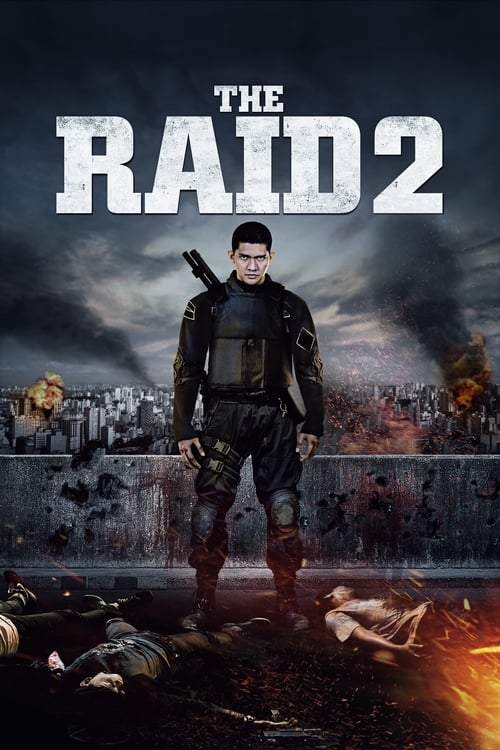
The Raid 2
2014 · Gareth Evans
For when you want action at full intensity — the kind of night where you want to be pinned to the couch saying 'how did they film that.' Absolutely not a casual background watch, and not for the squeamish; the violence is graphic and relentless.
What it's about
Rookie cop Rama survived one impossible building; now he's ordered to disappear into a far longer war. Sent undercover into an Indonesian crime syndicate — starting with years in prison to earn the trust of a boss's ambitious son — he has to protect his family and expose the corrupt police feeding the underworld, while the city's fragile truce between crime families starts to crack.
The experience
Punishing, propulsive, and jaw-dropping — long stretches of slow-burn gangster intrigue detonate into some of the most ferocious fight scenes ever filmed. It's two and a half hours that leave you wrung out, wincing, and occasionally laughing in disbelief at what you just watched.
Performances
Iko Uwais anchors it as Rama, doing his own astonishing silat fight work while carrying the strain of a man losing himself undercover; the film's memorable assassins have become icons of the genre in their own right.
The craft
Gareth Evans choreographs, shoots, and edits the action with total clarity — long, legible takes where you always know where every body is, from a mud-soaked prison-yard riot to a kitchen duel of brutal elegance. A car chase shot from inside and around moving vehicles remains a how-did-they-do-that landmark. Demands the biggest screen and loudest sound you can give it.
Why it matters
It escalated the modern action renaissance that its predecessor started, proving martial-arts filmmaking could carry an operatic crime epic — and its fight choreography has been studied and imitated by Hollywood ever since.
Snapshot
The Raid 2 — released in Indonesia under the title The Raid 2: Berandal ("Thug") — is Welsh director Gareth Evans's sprawling sequel to his 2011 breakout The Raid: Redemption. Where the first film compressed its action into a single tower block over roughly ninety propulsive minutes, the sequel expands into a two-and-a-half-hour crime saga, pushing Iko Uwais's rookie officer Rama out of the building and into a years-long undercover operation inside an Indonesian syndicate. The film is at once a continuation of the pencak silat–driven action that made Redemption a global cult object and a deliberate genre escalation: an attempt to graft the operatic sweep of the crime epic onto some of the most intricately choreographed close-quarters violence in contemporary cinema. It premiered at the 2014 Sundance Film Festival and cemented Evans, Uwais, and their collaborators as reference points for a generation of action filmmakers.
Industry & production
The Raid 2 is a product of a distinctive transnational production model: an English-language-fluent Welsh director working inside the Indonesian film industry, financed and marketed with international partners. Evans had relocated to Indonesia in the mid-2000s, initially to make a documentary about pencak silat, and built his features through PT Merantau Films, the production company associated with producer Ario Sagantoro. The American genre outfit XYZ Films — instrumental in bringing Redemption to Western audiences — was again attached to the sequel, and Sony Pictures Classics handled the U.S. release, with the film premiering at Sundance in January 2014.
The commercial afterlife of the first film made the sequel possible on a larger canvas. Redemption had been produced very cheaply and became a worldwide cult success, and The Raid 2 was mounted with a visibly greater scope: many more locations, a substantially larger cast, elaborate set-piece environments (a prison yard, a nightclub, a subway car, a restaurant kitchen), and a car chase staged on public roads. Precise budget figures for both films circulate in the trade press but I would not want to assert specific numbers with confidence here. What is clear is the leap in ambition — the sequel behaves like a studio crime picture built by an action-genre workshop, rather than the lean siege thriller that preceded it.
Notably, the Berandal concept predated Redemption: Evans had developed a gangster story before the tower-block film, and elements of that earlier project were folded into the sequel, which helps account for the film's expansive, almost novelistic structure.
Technology
The Raid 2 was shot digitally, and its technical program is oriented entirely toward legibility of movement. The defining challenge of the film — as with all of Evans's action work — is capturing extended, full-body martial-arts choreography without resorting to the fragmented, quick-cut coverage that dominates much Western action. That places heavy demands on camera stabilization and rigging: the shooting had to keep pace with fighters moving continuously through tight, complex spaces while holding the frame steady enough to read every strike.
Two environments crystallize this. The prison-yard mud brawl, staged in rain and slick earth, required a camera capable of moving with the melee while remaining coherent; and the celebrated car-chase sequence integrates in-vehicle fighting with moving-vehicle photography, a coordination problem of choreography, rigging, and stunt driving. I would flag that the granular technical specifications — exact camera bodies, lens packages, rig builds — are the kind of production detail I cannot reliably recover from memory, and I will not fabricate them. What can be stated firmly is the aesthetic goal the technology served: sustained, spatially intelligible long-take-inflected action.
Technique
Cinematography
The cinematography is credited to Matt Flannery, Evans's regular collaborator, working with Dimas Imam Subhono. The visual signature is a camera that is highly mobile yet disciplined — it travels with the fighters, whips and reframes to follow reversals of momentum, and frequently resolves complex exchanges in unbroken or near-unbroken takes rather than cutting around them. This is a crucial inheritance from Hong Kong action tradition and a rebuke to the "chaos cinema" of shaky, over-cut Hollywood fights: the audience is kept oriented in space so that cause and effect, blow and counter, remain readable.
The sequel is also markedly more painterly than its predecessor. Where Redemption was largely a study in grimy, claustrophobic interiors, The Raid 2 deploys a wider palette: the desaturated gray of the prison in rain, the neon of nightclub interiors, snow, and the warmer tones of domestic and restaurant spaces. Evans and Flannery use these environments not merely as backdrops but as instruments — the mud slows and levels the combatants; the confined subway car forces a specific geometry of violence.
Editing
Evans edited the film himself, as he did the first, and the editing is central to its authorship. The paradox of his cutting is that it is at once invisible and virtuosic: within fights, cuts are motivated and rhythmically precise, often designed to be barely perceptible so that discrete takes read as continuous action. This is the opposite of concealment-through-confusion; it is concealment in service of clarity. Across the film's macro-structure, the editing must also sustain a long crime narrative between the action peaks, intercutting the syndicate's political machinations with Rama's mounting danger — a considerably harder rhythmic task than the near-continuous forward drive of Redemption.
Mise-en-scène / staging
The staging is the film's true medium. Each major set piece is built around a distinct spatial premise and, often, a distinct antagonist with a signature weapon: the mud-and-rain prison riot as a mass brawl; the subway sequence introducing Hammer Girl (Julie Estelle), who fights with a pair of claw hammers, and her partner Baseball Bat Man; the escalating one-on-one duels; and the extended kitchen finale against The Assassin (Cecep Arif Rahman). These are choreographed by Uwais and Yayan Ruhian, and the staging fuses pencak silat's flowing, close-range grappling and joint manipulation with weapon work and environmental hazard. The recurring principle is that space and object dictate the choreography — a hammer, a wet floor, a moving car, a kitchen full of knives each generate their own vocabulary of violence.
Sound
The sound design foregrounds the visceral, percussive impact of the fighting — the crack of bone, the wet slap of bodies in mud, the ring of blades — with a heightened, almost hyperreal physicality that is essential to the film's brutality. The musical score for the international release is credited to Joseph Trapanese working with Aria Prayogi and Fajar Yuskemal, the Indonesian composers who scored the first film; the result blends driving electronic and orchestral textures with more traditional elements, propelling the action while lending the crime-saga passages a darker gravity. (I would treat fine details of how scoring duties were divided between the international and Indonesian releases with some caution.)
Performance
Iko Uwais anchors the film as Rama, and his performance is defined less by dialogue than by physical expressivity and endurance — the exhaustion, resolve, and moral fatigue of a man kept undercover far too long. Arifin Putra gives one of the film's most dramatically ambitious performances as Uco, the volatile, ambitious son of crime boss Bangun (Tio Pakusadewo), whose thwarted hunger for power drives the plot's tragic engine. Yayan Ruhian — unforgettable as the antagonist Mad Dog in Redemption — returns in an entirely different role as the melancholy assassin Prakoso, a striking act of casting recursion. Alex Abbad's oily up-and-comer Bejo, Oka Antara's conflicted Eka, and the near-silent specialist killers (Hammer Girl, Baseball Bat Man, The Assassin) round out a gallery of vivid genre figures whose "performance" is often expressed primarily through movement.
Narrative & dramatic mode
The dramatic mode is the undercover-cop crime epic, and the shift from the first film is fundamental. Redemption was essentially a survival thriller with a near-unity of time and place; The Raid 2 is a sprawling, elliptical saga spanning years, built on the classic architecture of the infiltration narrative — the good man submerged so long in a criminal world that his identity, loyalties, and family ties are placed under unbearable strain. Rama enters prison to get close to Uco, then follows him into the syndicate, while a war brews between an established Indonesian crime family and an ambitious Japanese faction, with Bejo maneuvering to exploit the chaos.
The film consciously borrows the tragic dynastic structure of the crime epic — the ambitious heir, the aging patriarch, betrayal within the "family," a fragile truce detonating into war. The result is a hybrid: long dialogue-driven passages of political maneuvering punctuated by extreme action, so that the picture oscillates between the operatic patience of the gangster saga and the kinetic ferocity of the martial-arts film. Whether that hybrid fully coheres is a genuine critical question, and reasonable viewers have differed on whether the crime plot earns its length.
Genre & cycle
The Raid 2 sits at the intersection of the martial-arts film and the crime epic. Its action lineage runs through Hong Kong cinema — the golden-age choreography of the 1980s and 90s, and the "heroic bloodshed" tradition — while its narrative frame draws openly on the yakuza film and the Hollywood/Hong Kong undercover thriller (the Infernal Affairs lineage is an obvious touchstone). It also participates in the 2010s revival of clarity-first, craft-forward action cinema, a movement that prized long takes, real stunt work, and legible geography as a corrective to digitally smeared, over-edited blockbuster fights. Within Evans's own filmography it forms the middle panel of a loose triptych — Merantau (2009), The Raid (2011), The Raid 2 (2014) — that showcases pencak silat for international audiences.
Authorship & method
The film is unusually singular in authorship: Gareth Evans wrote, directed, and edited it, giving him control over conception, staging, and rhythm. His method is collaborative at the level that matters most — the choreography — where Iko Uwais and Yayan Ruhian function as co-authors of the action, devising and drilling the fights that Evans then shoots and cuts. This partnership, forged on Merantau and Redemption, is the creative core of the enterprise. Key collaborators include cinematographer Matt Flannery (with Dimas Imam Subhono), and composers Joseph Trapanese, Aria Prayogi, and Fajar Yuskemal. Evans's working process — planning action around the specific capacities of his performers and the geometry of chosen locations, then protecting the legibility of that action through editing — is the through-line of his authorship. He originated the Berandal gangster story before Redemption, which underscores that the crime-saga ambition was not an afterthought but a long-held design.
Movement / national cinema
The film belongs to a modern wave of Indonesian genre cinema that reached global audiences largely through the vehicle of pencak silat, the Indonesian martial art at the center of Evans's work. Its cultural position is complex and worth stating plainly: it is an Indonesian production, made with Indonesian performers, crew, and a martial tradition, yet authored by a British director and shaped for international distribution. That hybridity is characteristic of contemporary transnational genre filmmaking rather than a flaw, but it means the film functions simultaneously as a showcase of Indonesian martial arts and as a work aimed at the global action marketplace. Its success helped raise the international profile of Indonesian action cinema and of pencak silat specifically as a screen fighting style.
Era / period
The Raid 2 is emphatically a film of the early-to-mid 2010s. It arrived at a moment when audiences and critics were actively rebelling against incoherent action editing, and it became a rallying point for the counter-argument that action could be balletic, sustained, and clear. It is contemporary with the emergence of the John Wick strain of stunt-driven, choreography-forward American action, and part of a broader cross-pollination in which practitioners from Asian martial-arts traditions and the Western stunt community reshaped mainstream action aesthetics. The film's digital production, festival-launch strategy (Sundance), and cult-to-crossover distribution pattern are all of their moment.
Themes
Beneath the spectacle, the film is preoccupied with loyalty and its costs. Rama's undercover ordeal dramatizes the erosion of the self under prolonged deception — the danger that the mask becomes the face, that duty to family and force curdles into something closer to imprisonment. The syndicate plot is a study in ambition and generational succession: Uco's tragedy is the impatient heir's, undone by the gap between his sense of entitlement and his father's caution. Corruption is pervasive and structural — the film assumes a world in which police, politics, and organized crime are deeply interpenetrated, so that Rama's "clean" mission is compromised from the outside as much as from within. And, more abstractly, the film meditates on violence itself: its craft, its escalation, and its exhaustion. The recurring image of characters pushed past physical limit gives the brutality a moral weight beyond sensation.
Reception, canon & influence
The Raid 2 was widely praised on release, particularly for the scale, invention, and clarity of its action sequences, which many critics regarded as among the finest of their era; the car chase and the kitchen finale in particular became instant reference points. Critical reservation, where it appeared, tended to concern the film's length and the density of its crime plot — the sense that the connective narrative tissue between set pieces strained a formula that had thrived on lean economy. The consensus, broadly, was admiration for an audacious escalation, even from those who preferred the tighter first film. (I'm characterizing the critical reception in general terms; I would not want to cite specific scores or quotations from memory.)
Its influences flow backward to Hong Kong action cinema, the yakuza and heroic-bloodshed traditions, and the undercover-cop crime thriller; and forward into the 2010s renaissance of stunt-forward, legibility-first action. Evans and his collaborators — above all Iko Uwais and Yayan Ruhian — became sought-after figures, and their approach to choreography, long-take shooting, and real physical stunt work is frequently invoked as a benchmark by which subsequent action films are measured. Together with Redemption, the film is now a fixture of any serious discussion of modern martial-arts cinema, and a case study in how a regional martial tradition, filtered through a transnational production, can reshape a global genre.
Reception
It premiered at Sundance 2014 to rapturous genre-fan buzz — and reports of walkouts over the violence — while some critics dinged its sprawl next to the first film's lean purity. A decade on, the bloat complaints have largely evaporated and it's routinely ranked among the century's greatest action films.
How The Raid 2 was received, from release to now →
How to watch The Raid 2: what to notice on a first viewing
- Watch fight scenes resolve in long, unbroken takes. Flannery's camera travels with the fighters, whipping and reframing to follow momentum rather than cutting around the choreography. You can always tell who is winning and how, because the space never breaks apart.
- Notice each fight built around one specific object or space. A hammer, a wet subway floor, a kitchen full of knives: each set piece generates its own vocabulary of violence from what is actually in the room. The location itself decides how a fight moves, not just who is in it.
- Listen for the exact, wet, percussive impact of every blow. Sound design foregrounds the crack of bone and the slap of bodies in mud with a heightened, hyperreal physicality. The brutality lands in your ears as much as in what you see.
- Notice the mud and rain, then the neon, then the snow. The film moves through a wider palette than its predecessor: desaturated gray prison rain, nightclub neon, and later warmer domestic tones. Each environment gets its own color world instead of one grimy look throughout.
- Watch how much Rama's exhaustion is carried in his body. Uwais conveys years of undercover strain through physical bearing and endurance rather than through dialogue. His fatigue reads as moral cost, not just as physical tiredness.
The whole guide to watching The Raid 2, with the keys for a rewatch →
Influences: the films it descends from and the films it influenced
- The Raid: Redemption (2011) — Established the Evans–Uwais–Ruhian working method — silat choreographed to the geometry of a single building, then cut for total spatial legibility — that The Raid 2 explodes to city scale.
- Merantau (2009) — First fused Iko Uwais's pencak silat to Evans's mobile, full-body framing, birthing the performer-as-co-choreographer partnership the sequel deepens.
- Police Story (1985) — Codified stunt-forward action where a credited stunt team authors real, un-augmented impacts shot wide and full-figure — the escalating-destruction ethos behind the kitchen and hallway finales.
- Legend of Drunken Master (1994) — Perfected the sustained long-take fight held wide enough to read every exchange, the clarity-first shooting grammar Evans adopts and protects in the edit.
- Hard Boiled (1992) — Its hospital sequence models the single-location shootout choreographed as one continuously escalating movement — the heroic-bloodshed lineage the film cites explicitly.
- Oldboy (2003) — The lateral corridor hammer brawl set the template for the one-against-many long take staged in a confined plane, a device Evans extends in the subway and prison-yard mud fights.
- Ong-Bak (2003) — Revived Southeast Asian martial cinema on the promise of authentic wire-free, CGI-free bodily impact, the same 'no cheats' contract underwriting Uwais and Ruhian's stunts.
- Infernal Affairs (2002) — Supplies the dual-loyalty undercover architecture — the mole whose identity corrodes under prolonged infiltration — that Evans grafts onto an action frame ('infernal-affairs-lineage').
- Battles Without Honor and Humanity (1973) — Its restless handheld camera and sprawling betrayal-driven yakuza saga model the mobile crime-epic canvas and generational-succession plotting of Berandal.
- The Godfather Part II (1974) — The operatic crime-dynasty scale and theme of a son's succession consuming him is the epic ambition Evans overlays on genre-film action economy.
- The Raid (2012) — Evans stress-tests the enclosed-space choreographic system by exporting it to new environments — the car-fight transfers architectural constraint to a moving vehicle interior, the kitchen sequence to an industrial galley — demonstrating that the grammar is spatial logic rather than a single location gimmick.
- Drunken Master III (1994) — Derives entire fights from props and architecture (kitchen, car interior) while holding the frame wide enough to keep both combatants whole — the full-figure, geography-first principle Lau defended in 1994 and lost.
- Headshot (2016) — Direct extension of silat cinema built around Iko Uwais, inheriting Evans's environment-dictates-choreography staging and hyperreal impact sound.
- The Night Comes for Us (2018) — Reunites Uwais and Joe Taslim to push the film's real-body brutality and hyperreal wet-impact foley to a gorier extreme within the same choreographic school.
- Gangs of London (2020) — Evans transplants his own method — long-take silat drilled to location geometry, cut for clarity — into a British crime-succession saga, a serialized outgrowth of Berandal's ambitions.
- Extraction (2020) — Its faux-oner car-and-foot chase openly extends The Raid 2's celebrated in-vehicle set piece, prioritizing continuous camera choreography over cut-driven impact.
- Kill (2023) — A confined train-corridor siege that inherits the space-dictates-choreography design and escalating close-quarters brutality of Evans's cramped-location fights.
- Atomic Blonde (2017) — Models the stairwell/enclosed-corridor brawl as a set-piece form, with brutal-but-readable choreography that prioritizes the impact and depletion of each blow over editorial acceleration.
- The Furious (2026) — Extends the debt to legible long-take fight coverage and the weaponized environment (kitchen, car interior) as a choreographic arena.
- Dredd (2012) — A contemporaneous single-tower siege built on legibility-first spatial action, sharing The Raid's confined-vertical-space design lineage.
- John Wick (2014) — Stunt-team directors applying the same wide-framed, uncut 'gun-fu' legibility doctrine, making it a twin pillar of the mid-2010s clarity-first action revival.
- John Wick: Chapter 4 (2023) — Evans's kitchen and car-chase set pieces prove the choreography-first thesis — action pre-designed as the film's true script and shot to let silat read cleanly in wide frame — that JW4 shares as parallel gospel.
- The Villainess (2017) — Supplies the choreographic standard: wide-lens, geographically legible silat brutality shot in long articulated units, plus the car-chase interior camera that fights alongside the bodies rather than cutting around them.
Similar films
- The Night Comes For Us (2018) — influence & lineage · same viewing thread
- Hard Boiled (1992) — influence & lineage · same viewing thread
- John Wick (2014) — influence & lineage
- The Raid (2012) — same viewing thread
- The Furious (2026) — same viewing thread
- Kill (2024) — same viewing thread
- New World (2013) — same viewing thread
- Dhurandhar (2025) — same viewing thread
All the films related to The Raid 2 →
Watch it with: curated runs of related films
- Elegant Savagery — A run of sleek, merciless thrillers where vengeance arrives in tailored suits and is paid in broken bone — watch these when you want beauty and brutality in the same frame.