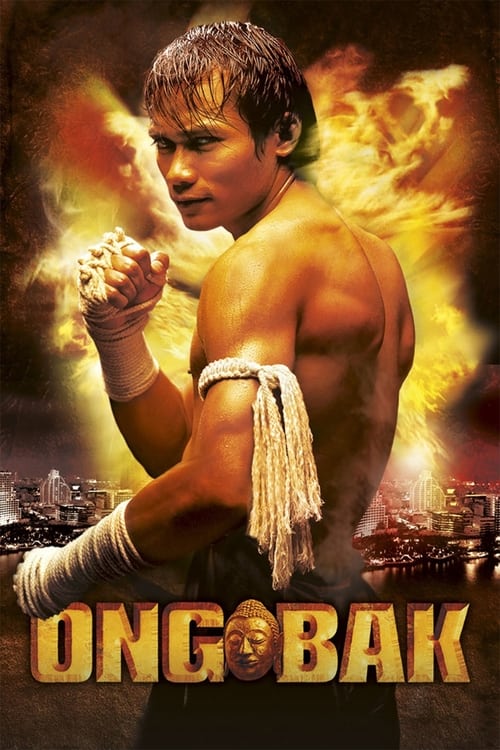
Ong-Bak
2003 · Prachya Pinkaew
For when you want to whoop at your screen — a crowd-pleaser to put on with friends, or the antidote when slick digital action has left you numb and you're craving something that actually happened.
What it's about
When thieves steal the head of a village's sacred Buddha statue, a young Muay Thai prodigy is sent to Bangkok to bring it back. His search drags him into the city's underworld — fight clubs, gangsters, and back-alley chases — where his fists and knees are the only currency he has.
The experience
Pure adrenaline with a grin on its face. The plot is simple on purpose; what you're really watching is a human body do impossible things for real — no wires, no doubles, no CGI — and the film keeps replaying its best stunts because it knows you'll want to see them again.
Performances
Tony Jaa isn't acting so much as demonstrating: leaping through hoops of barbed wire, vaulting cars, fighting with knees and elbows at full contact. It's a physical performance in the lineage of the great screen martial artists, and it made him an international star overnight.
The craft
Prachya Pinkaew shoots the action in wide, legible frames precisely because there's nothing to hide — the whole aesthetic is built on proving every stunt is real. The film arrived when martial-arts cinema was saturated with wire work and digital flight, and its raw, seam-free physicality was the entire argument. It rewards a big screen, where the impacts read at full scale.
Why it matters
It put Thai action cinema on the world map, launched Tony Jaa globally, and pushed the genre back toward practical, verifiable stuntwork.
Snapshot
Ong-Bak is the film that put Thai action cinema on the world map, and it did so by making a technical constraint into an argument. Its marketing line — no wires, no stunt doubles, no digital augmentation — was not incidental packaging but the film's entire aesthetic thesis, staged at the exact moment when the international martial-arts image was at its most digitally mediated. Arriving three years after Crouching Tiger, Hidden Dragon and a year after Zhang Yimou's Hero, in a marketplace saturated with wire-assisted flight and Matrix-descended bullet-time, Ong-Bak offered instead a body that could actually do the thing on camera, filmed in wide framings that refused to hide the seam because there was no seam to hide.
The story is deliberately, almost archaically simple. The head of Ong-Bak, a Buddha image sacred to the northeastern village of Nong Pra Du, is sawn off and trafficked to Bangkok. Ting (Tony Jaa), trained in the old fighting art of Muay Boran by a monk who has made him swear never to use it on another person, is sent to bring it home. The plot exists to generate pretexts — a fight pit, a foot chase, a tuk-tuk pursuit, a cave-temple finale — and the film is unembarrassed about that. What is genuinely new is the instrument: Jaa's elbows, knees, and airborne strikes, an idiom of martial performance that had never before carried an internationally exported feature.
Industry & production
Ong-Bak was produced by Sahamongkol Film International, the dominant commercial studio of the post-crisis Thai industry, under the studio head Somsak Techaratanaprasert. That context matters. The 1997 Asian financial crisis had gutted Thai film production, and the recovery that followed — often called the Thai New Wave — was driven by directors who had come out of advertising and music video, working with new capital and a new confidence that Thai films could compete domestically against Hollywood imports. Prachya Pinkaew belonged squarely to that commercial wing, having worked as a director and producer across horror and popular genre fare through the late 1990s and early 2000s, rather than to the festival-facing art cinema of Apichatpong Weerasethakul or Pen-ek Ratanaruang.
The origin story, as it circulates in interviews and press materials, is that Pinkaew was shown a demonstration reel of Tony Jaa's stunt work assembled by Panna Rittikrai — Jaa's teacher, a veteran of the low-budget Thai action underground — and that this reel was instrumental in securing backing. The film is widely reported to have taken years of preparation and shooting, with Jaa training and rehearsing sequences over an extended period before and during production. The precise budget, shooting schedule, and the working division of labor between Pinkaew and Panna on set are not well documented in English-language scholarship; much of what is repeated derives from promotional interviews given during the international rollout, and should be held loosely.
The export history is unusually consequential. The film reached Western audiences largely through Luc Besson's EuropaCorp, which handled the French release and prepared an international version that was re-edited and re-scored; the U.S. release followed through Magnolia Pictures in 2005. Non-Thai audiences therefore mostly encountered a somewhat different film from the domestic one — tightened, with comedy trimmed and music replaced. This became a pattern for the cycle: Pinkaew and Jaa's follow-up, Tom-Yum-Goong (2005), was released in the U.S. by the Weinstein Company in a substantially shortened cut presented under Quentin Tarantino's name. The Thai action film of this period entered the West through Western auteur-curators, and arrived altered.
Technology
The technological claim of Ong-Bak is negative: it advertises what it does not use. Shot on 35mm at a moment when digital intermediate grading and CGI enhancement were becoming routine even in modest action production, the film positions unassisted human performance as its special effect. This is a marketing position as much as a production fact — every action film manipulates through camera speed, cutting, and staging, and Ong-Bak certainly undercranks, overcranks, and ramps — but the load-bearing stunts are real, and the film's formal choices exist to prove it.
The most conspicuous device is the instant replay: a major stunt is executed once, then immediately repeated from a second and sometimes third angle, often with a speed change. The technique is borrowed from sports broadcasting and has antecedents in Hong Kong cinema and in Jackie Chan's habit of showing failed takes over end credits. Its function here is evidentiary. The replay says: look again, from another position, because there is nothing to conceal. It converts the spectator into a judge of authenticity, which is exactly the terrain on which the film wants to be evaluated.
Technique
Cinematography
The camera work, credited to Nattawut Kittikhun, is organized around legibility of the body. Fights are held in medium and wide framings that keep Jaa's full figure in frame, so that a jump knee reads as a single continuous action rather than as an assembly of fragments. Where the Matrix-era action film tends toward close coverage and orbiting camera, Ong-Bak tends toward the fixed or lightly mobile frame at a distance that respects the proportions of the human figure — a stance closer to Buster Keaton or to 1970s Hong Kong than to its 2003 contemporaries. Handheld energy is reserved for pursuit: the Bangkok chase is shot with a camera that runs alongside and behind Jaa, converting the city's alleys, market stalls, and rooftops into an obstacle course.
Editing
The cutting is fast but not concealing, which is a harder problem than it sounds. Impacts are frequently cut on rather than around, and the film resists the accelerated-montage habit of using cuts to manufacture speed the performer does not have. Shot duration is calibrated to let a technique complete. Against this, the replay structure introduces a deliberate stutter in the action's forward motion — a temporal luxury that stops the narrative to admire the feat. Below-the-line credits for the film are inconsistently recorded in English-language sources, and the editing credit in particular is not securely documented; the working method, however, is legible on screen.
Mise-en-scène / staging
Staging is the film's real authorship, and it is Panna Rittikrai's. The set pieces are built around environmental antagonism: Ting vaults through a coil of barbed wire, dives through a hoop of blades, slides beneath a moving car, sprints across the shoulders of a crowd, leaps between the roofs of moving tuk-tuks. The Bangkok chase in particular is a catalog of ways a body can negotiate an unforgiving city — a sensibility that runs parallel to the French parkour cinema emerging at the same moment in District 13 (2004), though the two developed independently.
The fight-pit sequence organizes opponents as a tournament of national and stylistic types — a heavyset Western brawler, fighters coded to other traditions — so that Muay Boran can be demonstrated as the superior instrument. This is an old structure in martial-arts cinema, inherited directly from the Hong Kong kung fu film, and it carries the same nationalist charge here that it did there.
Sound
The foley is maximalist: strikes land with exaggerated cracks and bone-snaps, a sonic overstatement that compensates for the visual restraint of unaugmented staging. The music, credited domestically to Atomix Clubbing Studio, blends electronic and breakbeat textures with Thai traditional instrumentation — the reed-and-percussion sound associated with the sarama, the music that accompanies actual Muay Thai bouts. That fusion is the whole cultural program of the film in miniature: an ancient practice amplified through contemporary popular form. Because the international version was re-scored, the sonic experience of Ong-Bak differs materially between territories.
Performance
Jaa's screen presence is defined by what it withholds. He is nearly silent, unsmiling, and physically ascetic — closer to the martial monk than to Bruce Lee's charisma or Jackie Chan's clowning. The comedy is fully displaced onto Petchtai Wongkamlao (Mum Jokmok), a major Thai comic star whose presence as the hustling cousin Humlae was essential to the film's domestic appeal and whose material was among the first casualties of international re-editing. Pumwaree Yodkamol supplies the third point of the trio; Suchao Pongwilai's crime boss Komtuan, wheelchair-bound and speaking through an electrolarynx, is a grotesque of physical incapacity set against Jaa's plenitude — a crude but effective moral schema.
Narrative & dramatic mode
The dramaturgy is folkloric: a sacred object is violated, an innocent leaves the village, the city corrupts and tests him, the object is recovered, order is restored. The distinguishing move is the vow. Ting's teacher forbids him to use Muay Boran against another person, which converts the first act into a study in withholding — the film's hero spends its opening stretch refusing to fight. Every subsequent eruption is thereby licensed as compelled rather than chosen, which is both a moral alibi and a structural device for delaying gratification.
Tonally the film mixes registers in a way that is entirely conventional in Thai popular cinema and jarring to viewers trained on Hollywood consistency: broad comedy sits beside melodramatic bereavement and near-devotional imagery. The ending is unusually unhedged in its piety — the head returned, retribution delivered by a falling Buddha image rather than by the hero's hand, and Ting withdrawing into monastic ordination. The hero's reward is renunciation.
Genre & cycle
Ong-Bak belongs to the martial-arts film's recurrent authenticity cycle — the periodic insistence, against whatever the prevailing technology of illusion happens to be, that the fighting must be real. Its immediate genre parent is the Hong Kong stunt film of the 1980s, Jackie Chan and Sammo Hung above all, from which it takes the environmental gag, the replay, and the injury as proof of sincerity. Its immediate genre antagonist is the wire-and-CGI wuxia revival of 2000–2002.
Domestically it launched a Muay Thai cycle: Panna Rittikrai's Born to Fight (2004), Pinkaew and Jaa's Tom-Yum-Goong (2005), Pinkaew's Chocolate (2008) with JeeJa Yanin, Jaa's own directorial prequels Ong Bak 2 (2008) and Ong Bak 3 (2010), and Panna's Bangkok Knockout (2010). More broadly it demonstrated that a national martial art could function as an exportable brand outside the Chinese sphere — the commercial precondition for the Indonesian silat films that followed, Gareth Evans's Merantau (2009) and The Raid (2011).
Authorship & method
Authorship here is genuinely divided, and the division is the interesting part. Pinkaew is the film's producer-director in the studio sense: he supplies structure, tone management, comic casting, and the commercial packaging that made the film legible to a mass audience. Panna Rittikrai, as action director, supplies the film's reason for existing — the choreography, the stunt design, and the training regime that produced Jaa. Panna's own career in the Thai direct-to-video action underground of the 1980s and 90s is the buried prehistory of Ong-Bak: he had been making unassisted, often dangerous action films for years with no international audience whatsoever, and Ong-Bak is best understood as that tradition finally receiving studio finance and export distribution.
The screenplay is credited to Suphachai Sittiaumponpan from Pinkaew's story, with Panna involved in shaping the action beats; cinematography to Nattawut Kittikhun; music, in the Thai version, to Atomix Clubbing Studio. English-language documentation of the below-the-line crew is thin and occasionally contradictory across sources, and the credits differ between the Thai and international versions.
Movement / national cinema
The film sits inside the post-1997 revival of Thai cinema without belonging to its critically celebrated wing. That revival ran on two tracks: an internationally festival-legible art cinema — Apichatpong's Blissfully Yours (2002) and Tropical Malady (2004), Pen-ek's work, Wisit Sasanatieng's Tears of the Black Tiger (2000) — and a commercially revitalized popular cinema exemplified by Nonzee Nimibutr's Nang Nak (1999) and by Sahamongkol's genre output. Ong-Bak is the popular track's greatest export success, and it succeeded internationally by different means than the art films: not through critical prestige but through the genre-festival and midnight circuit, video, and word of mouth among action enthusiasts.
Its cultural politics are conservative and explicit. The film aligns rural Isan with authenticity, Buddhism, and communal solidarity, and Bangkok with theft, gambling, drugs, and the antiquities trade that sells the nation's sacred objects abroad. This maps neatly onto state-sponsored discourses of Thainess current in the period, and onto real anxieties about the trafficking of Buddhist artifacts. That the villain's final ambition is to decapitate a monumental Buddha for foreign sale makes the allegory unmissable.
Era / period
2003 is a precise historical position: after The Matrix had made digitally impossible movement the default of studio action, after Crouching Tiger had made wire-assisted grace the prestige idiom of Asian action, and before the practical-stunt revival that would later be associated with The Raid, the John Wick films, and the Mission: Impossible cycle's promotion of unassisted work. Ong-Bak stands at the hinge. It also arrives at the moment when DVD and the international genre circuit made it possible for a Thai action film to build a Western following without a Hollywood remake or a Hollywood star — the same infrastructure that had recently carried Japanese horror and Korean thrillers westward.
Themes
Three run through the film. The first is desecration and restitution: a body part is severed from a sacred image, and the narrative is the labor of reattachment — a structure that rhymes uncomfortably and effectively with the bodily damage Ting absorbs along the way. The second is discipline as ethics. Muay Boran is presented not as a fighting technique but as an inheritance held in trust, and the vow that governs its use makes restraint, rather than victory, the measure of the hero. The third is the country-city antithesis, an old melodramatic engine given local specificity: the migrant from the northeast arriving in a capital that has already absorbed and degraded his kin.
Reception, canon & influence
Critical reception separated the athleticism from everything else, and did so almost unanimously. Reviewers described the plot as thin and derivative and the character work as minimal, while treating the action as a genuine event — the arrival of a performer whose capabilities had no current equivalent in world cinema. The film played the genre-festival circuit, including Toronto's Midnight Madness, and built its Western reputation from there rather than from mainstream critical channels. It was a substantial domestic hit and became the most widely exported Thai film of its era; specific gross figures vary across sources and are not reproduced here.
Backward, the film's debts are clear. Its stunt-comedy structure and its replay device descend from Jackie Chan and the Hong Kong stunt cinema of the 1980s. Its tournament-of-styles dramaturgy and its framing of a national art as morally superior come from the Bruce Lee-era kung fu film. Its rural-innocent-in-the-corrupt-city plot is a staple of Thai popular melodrama long predating it. Panna Rittikrai's own low-budget Thai action films are the direct, and least visible, ancestor.
Forward, its effects are larger than its own quality. It made Tony Jaa an international figure and eventually a Hollywood one, in Furious 7 (2015), xXx: Return of Xander Cage (2017), and Monster Hunter (2020) — a career that, characteristically for the period, absorbed him into ensembles rather than building around him. It established a durable commercial template in which a specific national martial art is packaged for export, most consequentially enabling the Indonesian silat cycle. And it reintroduced the "no wires, no CGI" claim as a legitimate marketing and critical category, one that has since become a standard promotional grammar for practical-stunt action and a standard critical yardstick in writing about the form. Its limitations — the perfunctory storytelling, the crude villainy, the tonal whiplash — are real and were noticed immediately. They have not much mattered. Ong-Bak is canonical for a narrow reason that turned out to be a wide one: it proved that the unaugmented human body, filmed honestly, was still the most compelling special effect available.
Reception
Landed in 2003 like a defibrillator to action cinema — after years of post-Matrix wire-fu and CGI, critics and fans hailed its all-practical stunts as a back-to-basics revelation. It's never needed a reappraisal: it's still the consensus moment Muay Thai arrived in world action cinema and Tony Jaa was anointed the next Jackie Chan.
How Ong-Bak was received, from release to now →
How to watch Ong-Bak: what to notice on a first viewing
- Watch fights held in wide shots that show Jaa's full body. Kittikhun keeps the frame wide and medium rather than close, so a jump knee reads as one continuous action instead of an assembly of cuts. You can verify with your own eyes that no one is faking this.
- Notice the wildest stunts replayed instantly from another angle. A major stunt plays once, then immediately again from a second or third angle, a device borrowed from sports broadcasting to prove what you just saw was real. The replay exists purely to let a real feat sink in twice.
- Listen for exaggerated cracks and bone-snaps on every strike. The foley is deliberately maximalist, overstating each impact's sound to compensate for staging that never relies on wires or digital tricks. The sound tells your ear what the unaugmented image is already showing you.
- Watch Ting use barbed wire, blades, and moving cars as obstacles. Each set piece turns the environment itself into an opponent, vaulting through wire, diving through a hoop of blades, sliding beneath a car in motion. The city and its junk become as dangerous as any human fighter in the film.
The whole guide to watching Ong-Bak, with the keys for a rewatch →
Influences: the films it descends from and the films it influenced
- Police Story (1985) — The instant-replay device is lifted almost intact — a stunt shown once at speed, then repeated from two or three alternate angles and often in slow motion, plus the end-credit injury reel, both used to certify that no cut concealed an assist.
- Project A (1983) — Establishes the environmental obstacle course as choreography: the set (bicycles, ladders, a clock tower) is designed as a sequence of solvable physical problems, exactly the logic of Ong-Bak's alley chase through hoops of barbed wire, panes of glass and coils of rope.
- Fist of Fury (1972) — Supplies the tournament-of-styles dramaturgy in which a hero fights a sequence of differently-schooled opponents, and the framing of one national art as morally purer than the foreign styles it defeats — the structural spine of Ong-Bak's underground fight-club escalation.
- The 36th Chamber of Shaolin (1978) — Codifies the sustained wide full-body take held long enough for a genuinely trained performer's form to be legible, and the ascetic temple-training regime as the film's real narrative — the grammar Panna Rittikrai reused to make Jaa's muay boran readable as authentic technique rather than editing.
- Drunken Master II (1994) — Perfects cut-on-impact assembly — the blow lands on the splice, with a few frames of the action overlapped across the cut so the hit reads twice — which Ong-Bak adopts wholesale for its knee and elbow strikes.
- Born to Fight (1986) — The buried direct ancestor: Panna's Thai direct-to-video action underground, where an unsalaried stunt team performed uninsured car hits and high falls with no wire rigs and no coverage safety net — Ong-Bak is that method finally given studio finance.
- Kickboxer (1989) — Fixed the export iconography of muay thai for Western audiences — the wai khru ram muay, rope-bound fists, the shin-conditioning montage — which Ong-Bak deliberately repatriates, staging the same ritual signs with a Thai body and Thai sarama percussion instead of a Belgian import.
- Bang Rajan (2000) — Proved a Thai commercial feature could sell heritage as spectacle through practical, unglamorised weapon combat and mud-and-blood handheld coverage, establishing the domestic production and marketing conditions Ong-Bak stepped into three years later.
- The Matrix (1999) — The negative debt: its wire-assisted, ramped, digitally composited fight grammar is the baseline against which 'no wires, no CGI, no stunt doubles' became a legible marketing and critical claim — Ong-Bak's aesthetic is defined by systematically withholding every tool The Matrix normalized.
- Police Story 3: Super Cop (1992) — Adopts the full Chan authentication package — no wires, no doubles, impacts covered from multiple angles and replayed, and a closing reel of failed takes and injuries — as its explicit marketing and formal argument.
- Drunken Master III (1994) — Sells itself on unassisted technique and replays single impacts from two or three angles across the cut — the same frame-level impact repetition DM3 uses to certify that a blow actually landed on a body.
- Tom-Yum-Goong (2005) — The same Pinkaew/Panna/Jaa unit escalating the identical premises: the four-minute unbroken ascending-staircase Steadicam take is the wide-full-body, no-cut authenticity claim pushed to the point where the take itself becomes the stunt.
- Chocolate (2008) — Transplants the exact production method — Panna's multi-year training pipeline building an unknown performer's body into the special effect, plus the closing reel of real injuries — onto a female lead, JeeJa Yanin.
- Born to Fight (2004) — Panna's own remake of his 1986 film, made on Ong-Bak's success, which foregrounds the stunt team as ensemble protagonist and pushes vehicle-impact and high-fall work past what any insured production would sanction.
- Merantau (2009) — The closest structural descendant: a rural innocent carrying a village discipline (Minangkabau silat harimau) into a corrupt capital, built around a trained non-star performer in sustained wide framing — the Ong-Bak template ported to Indonesia almost beat for beat.
- The Raid: Redemption (2011) — Takes Ong-Bak's national-art-as-export packaging and its environmental obstacle-course staging vertical — one building as a stack of escalating physical problems — with cut-on-impact editing and foley pushed even harder over the strikes.
- The Night Comes for Us (2018) — Second-generation Indonesian silat cycle that Ong-Bak's commercial proof-of-concept made fundable, retaining the practical no-double contract while pushing maximalist wet foley on every impact into outright body-horror texture.
- John Wick (2014) — Inherits Ong-Bak's promotional and formal grammar for Hollywood — wide, held, minimally cut framing whose entire purpose is to prove the star is really performing the gun-handling and judo, sold on precisely the 'that's actually him' claim Ong-Bak revived.
- The Raid (2012) — Established the contemporary Southeast Asian action cinema premise that a martial art's genuine technical vocabulary — here Muay Boran, no wirework, no CGI — is itself sufficient spectacle; Evans extends the same argument to Pencak Silat, with the audience's unfamiliarity with the art form serving as a discovery engine identical to Jaa's debut.
- The Furious (2026) — No-wire, no-undercrank, no-CGI Muay Thai aesthetic prizing visible body-on-body impact — the 'acoustic guitar' austerity Tanigaki explicitly aimed for.
- The Raid 2 (2014) — Revived Southeast Asian martial cinema on the promise of authentic wire-free, CGI-free bodily impact, the same 'no cheats' contract underwriting Uwais and Ruhian's stunts.
- Tears of the Black Tiger (2000) — The other half of the Thai New Wave export strategy — reviving a native popular genre (the rural melodrama-western) with heightened craft for the festival circuit, the same play Ong-Bak runs on muay boran and Thai stunt cinema.
- SPL: Kill Zone (2005) — Hong Kong's parallel correction, with Donnie Yen replacing wire-fu with MMA-derived grappling and shot-in-full contact staging — the same post-2003 authenticity turn arrived at independently, confirming Ong-Bak was reading the moment rather than causing it alone.
- Who Killed Captain Alex? (2010) — Stakes its action on real bodies performing real stunts without wires or CGI, prizing physical authenticity over budget — the stunt-first, non-professional-athleticism value Wakaliwood shares.
Similar films
- The 36th Chamber of Shaolin (1978) — influence & lineage
- The Night Comes For Us (2018) — influence & lineage
- Police Story (1985) — influence & lineage
- The Furious (2026) — shared sensibility
- The Raid (2012) — shared sensibility
- Duel to the Death (1983) — shared sensibility
- Oldboy (2003) — shared sensibility
- The Blade (1995) — shared sensibility