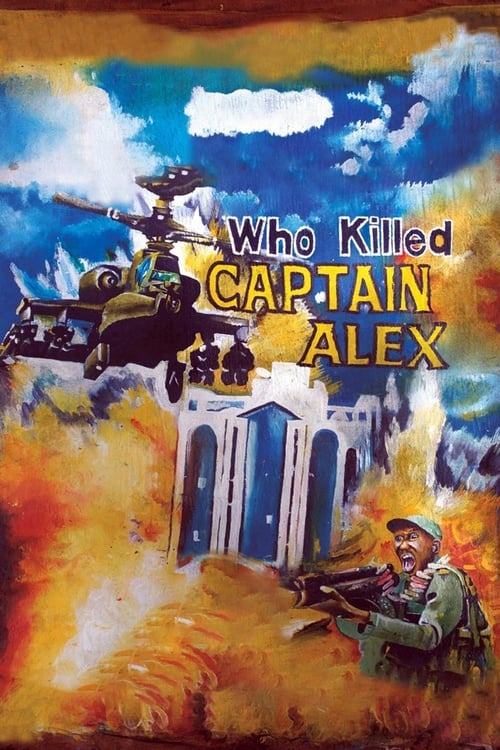
Who Killed Captain Alex?
2010 · Nabwana IGG
For a raucous movie night when you want to laugh, cheer, and be reminded why anyone makes movies at all — zero pretension, maximum fun. The definition of a crowd film.
What it's about
Uganda's first action movie: after a police raid on the Tiger Mafia drug cartel in Kampala, a captain turns up dead, and commandos and gangsters go to war over it. Shot for about two hundred dollars in the Wakaliga slum with prop guns machined from scrap, neighbors as cast, and condoms filled with fake blood — and narrated live, over the top of everything, by VJ Emmie, a 'video joker' whose delighted commentary ('Expect the unexpectable!') is inseparable from the film.
The experience
Pure joy. It's chaotic, hilarious, and completely sincere — you're laughing with it, because the film's own delight in its explosions and kung fu is infectious. Sixty-odd minutes that fly by, ideally with friends shouting along.
Performances
VJ Emmie's live narration is the show: a nonstop, gleeful running commentary in the Ugandan video-joker tradition that turns the whole film into a party.
The craft
Director Nabwana IGG taught himself editing from scavenged manuals, built his computers from salvaged parts, and does his own homemade digital effects — helicopters, muzzle flash, all of it. The original footage was lost when he deleted files to free hard-drive space, so what survives is a re-edit, which somehow only adds to the legend. This is filmmaking will in its purest form.
Why it matters
When the trailer went viral, Wakaliwood became a global phenomenon and a rallying point for no-budget filmmakers everywhere — proof that resourcefulness and joy can matter more than money.
Shot for roughly two hundred dollars in the Wakaliga slum of Kampala, Uganda's first action movie became one of the century's great parables of pure filmmaking will. Nabwana IGG — a self-taught director who learned editing from scavenged manuals and built his own computers from salvaged parts — staged a war between police commandos and the Tiger Mafia using prop guns machined from scrap, condoms filled with fake blood, and his neighbors as cast. The original footage was lost (Nabwana routinely deleted films to free hard-drive space), so the surviving version is a re-edit, narrated live by VJ Emmie, a 'video joker' in the Ugandan tradition of exhibition commentary, whose delighted shouting — 'Expect the unexpectable!' — is inseparable from the film itself. When the trailer went viral, Wakaliwood became a global phenomenon, drawing pilgrims and collaborators to Nabwana's compound. It is easy to laugh with the film — it insists you do — but the deeper astonishment is how much genuine craft is visible through the artifacts: real choreography, real editing rhythm, a real action director working with nothing but conviction.
A Deleuzian reading
A man stands in a dirt yard in Wakaliga holding a machine gun his neighbor milled out of scrap.
The full Deleuzian reading of Who Killed Captain Alex? →
Reception
A no-budget action film from the Wakaliga slum of Kampala that went viral off its trailer in 2010, then exploded worldwide when the full film hit YouTube for free in 2015 — what began as a local curiosity is now the beloved flagship of 'Wakaliwood' and a global cult phenomenon.
How Who Killed Captain Alex? was received, from release to now →
Influences: the films it descends from and the films it influenced
- Police Story (1985) — Turns whatever is on set into a weapon and undercranks the camera to sharpen impact — the improvised-prop, DIY-stunt fight rhythm Wakaliwood's Waka Starz drill by hand.
- Enter the Dragon (1973) — Codified the escalating one-against-many combat grammar — clear lines of attack, a beat per blow — that structures Captain Alex's commando-vs-Tiger Mafia set-pieces.
- El Mariachi (1992) — Guerrilla single-operator action made for pocket change, proving in-camera economy and one-man-crew resourcefulness can carry a full genre picture — the founding no-budget model IGG scales in a Kampala slum.
- Bad Taste (1987) — Shot on weekends with a cast of non-professional friends and homemade practical gore, treating handmade splatter props as the whole production design — Wakaliwood's condom-and-scrap-metal effects run the same playbook.
- Plan 9 from Outer Space (1959) — Sincere filmmaking-will that plows past budget with visible seams, making earnest artifice itself the film's charm — the emotional ancestor of 'da best of da best' bravado.
- Living in Bondage (1992) — Launched the Nollywood straight-to-video engine — shoot fast in a local language, sell on VHS/VCD from market stalls — the African no-budget distribution model Ramon Film Productions inherits.
- The Toxic Avenger (1984) — Troma's amateur-cast splatter comedy where the cheapness IS the joke, cueing the audience to laugh with the artifice — the comedy-through-artifice register Captain Alex adopts wholesale.
- A Page of Madness (1926) — Exhibited with a live benshi narrator performing over the images in real time — the direct forerunner of the Video Joker (VJ) live narration layered over Wakaliwood screenings.
- Bad Black (2016) — Same Ramon studio and green-screen muzzle-flash pipeline, refining the VJ-narrated, comic-action template while foregrounding VJ Emmie's live commentary as co-author.
- Crazy World (2019) — Extends the child-commando 'Waka Starz' fight choreography into a full feature, showing the improvised-prop kung-fu drilling matured into a repeatable house style.
- Kung Fury (2015) — Crowdfunded pastiche that deliberately weaponizes lo-fi digital artifice and VHS degradation for laughs — the same 'artifice as comedy' contract, arrived at from the opposite hemisphere.
- Turbo Kid (2015) — Foregrounds gleeful handmade practical gore and homemade props as an aesthetic choice, sharing Wakaliwood's staging/improvised-props ethos of visible, joyful fabrication.
- House (1977) — Builds comedy from overtly artificial, hand-crafted in-camera effects that flaunt their own fakeness — the same 'comedy through artifice' logic driving Captain Alex's crude composites.
- Story of Ricky (1991) — Cartoon-cheap practical splatter timed to a punchy action rhythm, where over-the-top low-budget gore becomes the entertainment — a Hong Kong cousin to Wakaliwood's exploding-body edits.
- The Raid (2011) — Structures the entire film as escalating, continuous fight-choreography set-pieces — the pure action-rhythm-as-architecture that Captain Alex chases with far less money but the same intent.
- Ong-Bak (2003) — Stakes its action on real bodies performing real stunts without wires or CGI, prizing physical authenticity over budget — the stunt-first, non-professional-athleticism value Wakaliwood shares.
Similar films
- Bad Black (2016) — influence & lineage · often watched together
- Ong-Bak (2003) — influence & lineage
- The Furious (2026) — often watched together
- The Night Comes For Us (2018) — shared sensibility
- The Raid (2012) — shared sensibility
- The Raid 2 (2014) — shared sensibility
- Ambulance (2022) — shared sensibility
- The Villainess (2017) — shared sensibility
All the films related to Who Killed Captain Alex? →