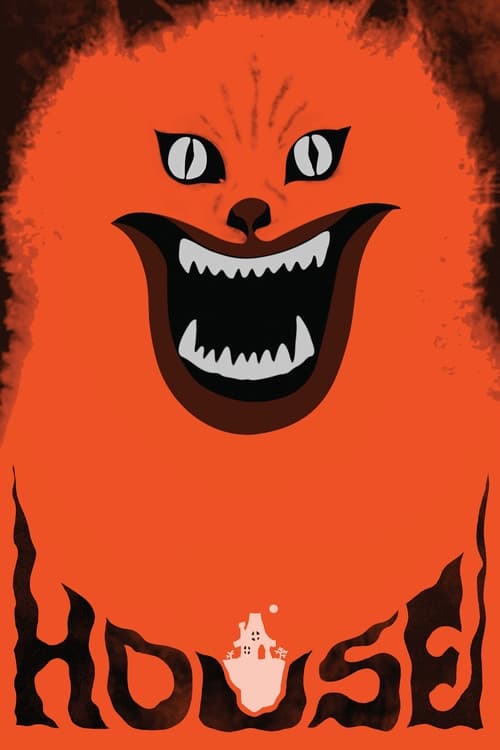
House
1977 · Nobuhiko Obayashi
For a midnight-movie mood: when you want something wild to watch with friends, laugh at, gasp at, and talk about after — a cult experience more than a scare-delivery machine.
What it's about
A schoolgirl nicknamed Gorgeous, missing her late mother, takes six friends — with attribute names like Kung Fu and Melody — to visit her aunt's remote country mansion for the summer. The house, it turns out, has opinions of its own. What follows is a haunted-house movie staged like a fever dream inside a candy box: part horror, part slapstick, part pop-art collage.
The experience
Utterly unhinged and grinning about it — painted skies, cartoon logic, a lullaby piano score that curdles mid-phrase — funny and unsettling in the same breath, with a strange melancholy humming underneath the candy colors. It moves fast and never stops surprising you.
The craft
Nobuhiko Obayashi came from experimental film and TV advertising, and he empties his entire toolkit onto the screen — iris wipes, crude animation, collaged mattes, deliberately fake backdrops — with the artificiality as the point, a pop surface over a genuine undertow of wartime grief from a director raised in Hiroshima. He built it partly from his young daughter's ideas about what's frightening, which explains its dream-of-childhood logic. Gorgeous with a crowd and a good sound system.
Why it matters
Shrugged off by Japanese critics in 1977 while young audiences flocked, it grew into one of world cinema's great cult objects and a foundational text for horror-comedy and maximalist genre filmmaking.
Toho asked Nobuhiko Obayashi for a Japanese Jaws; he consulted his young daughter Chigumi about what frightened her, and delivered a haunted-house film like a fever dream staged inside a candy box. Seven schoolgirls with attribute names — Gorgeous, Kung Fu, Melody, and company — visit a remote aunt's mansion, which begins, in ways no synopsis should preview, to express opinions of its own. Obayashi came from experimental film and television advertising, and he throws every trick in his kit at the screen: painted skies, iris wipes, crude animation, collaged mattes, a piano score that curdles mid-lullaby. The deliberate artificiality is the point — a pop surface over a genuine undertow of wartime loss, from a director raised in Hiroshima whose entire career circled that wound. Japanese critics shrugged in 1977 while young audiences flocked; three decades later a Janus Films tour and Criterion release turned it into a beloved cult object abroad. Its shrieking, kaleidoscopic maximalism has never really been imitated, because it couldn't be.
A Deleuzian reading
The sky is painted.
The full Deleuzian reading of House →
Reception
A domestic hit with young audiences in Japan in 1977 but sniffed at by critics as commercial nonsense, it was barely known in the West until Janus Films toured it in 2009 and Criterion canonized it in 2010 — turning it almost overnight into the definitive 'you have to see this' cult object.
How House was received, from release to now →
Influences: the films it descends from and the films it influenced
- A Trip to the Moon (1902) — Establishes the in-camera trick-film grammar Obayashi revives — stop-substitution splices, matte overlays and hand-painted flats where skies are frankly drawn rather than photographed.
- The Blood of a Poet (1930) — Model for dream-logic narrative built from reverse-motion, superimposition and mirror-passage effects done in-camera rather than through psychological realism.
- Juliet of the Spirits (1965) — Precedent for the candy-box color palette — surreal domestic space rendered in saturated storybook hues as an externalized interior life.
- Kill, Baby... Kill! (1966) — Source of the expressionist colored-gel lighting and painterly artificial gothic interiors where a haunted house is lit like a fever dream, not a real room.
- Tokyo Drifter (1966) — Japanese precedent for pop-art theatrical sets and abrupt anti-realist color swaps that treat the frame as a graphic-design surface.
- Inauguration of the Pleasure Dome (1954) — Underground-film model for dense superimposition collage — layering bodies, mattes and painted grounds into a single hallucinatory image.
- Kwaidan (1965) — Pushes Kwaidan's overt painted-set artifice and anti-realist color to surreal extremes, treating the haunted-tale as frankly theatrical, hand-crafted spectacle where design supersedes naturalism.
- Kuroneko (1968) — Carries forward the vengeful cat-spirit devouring intruders, but detonates Kuroneko's studio-bound anti-realism into gleeful in-camera trick effects, painted backdrops, and openly artificial spectral space.
- The Evil Dead (1981) — Extends the 'house attacks its occupants' kineticism — POV possession-cam, comic bodily dismemberment and gleeful in-camera prop gags.
- Careful (1992) — Revives the same silent-era toolkit — iris wipes, tinted stock, painted backdrops and collage — as knowing pastiche of early cinema's artifice.
- Braindead (Dead Alive) (1992) — Carries forward the splatstick register where escalating, absurd practical gore is played for cartoon comedy rather than dread.
- The Science of Sleep (2006) — Inherits the handmade-analog effects ethos — cardboard, stop-motion and visible-seam craft chosen over seamless illusion for childlike texture.
- Tag (2015) — Direct heir to attribute-named schoolgirls caught in escalating dream-logic carnage, staged with pop-surreal excess and jarring tonal whiplash.
- Mandy (2018) — Continues the hallucinatory saturated grade and matte-layered skies, treating color and superimposition as the primary emotional engine.
- The Grand Budapest Hotel (2014) — Shares the artificial candy-box staging — frontal dollhouse framing and confectionery palette that flaunt the set as a fabricated miniature world.
- The Taste of Tea (2004) — Splashes hand-drawn and optical animation directly into a live-action Japanese domestic space, the playful analog-collage surrealism Ishii revives for his interpolated animated interludes.
- Survive Style 5+ (2004) — The foundational Japanese pop-surrealism: a commercial director importing anything-goes CM/collage optical trickery and toy-like artifice into a horror-comedy, licensing later films to treat cinema as playful advertising spectacle.
- Kamikaze Girls (2004) — Obayashi, like Nakashima, migrated from TV-commercial directing and brought the same pop-art collage of naive optical effects and hyper-girlish surrealism into Japanese feature filmmaking, the native precedent for this advertising-bred maximalism.
- Helter Skelter (2012) — Obayashi's candy-colored surreal collage, in which artifice literally devours pretty young women, prefigures Ninagawa's excess-as-menace and her painterly, unreal set design.
- Pastoral: To Die in the Country (1974) — Contemporary Japanese avant-garde cousin fusing collage montage, artificial tableaux and wartime-memory nostalgia into anti-realist autobiography.
- The Color of Pomegranates (1969) — Parallel commitment to frontal, storybook tableau staging where meaning arrives through emblematic composition rather than dramatic continuity.
- Suspiria (1977) — Same-year twin using fairy-tale gel color (primary-red and blue washes) and a wall-of-sound prog score to turn a girls'-school horror into a lurid design object.
- Memories of Matsuko (2006) — Japanese ad-director collage maximalism — matte-painted skies, gleeful in-camera and optical trickery, tonal whiplash between whimsy and horror — the native lineage for Nakashima's toy-box digital surrealism.
- Who Killed Captain Alex? (2010) — Builds comedy from overtly artificial, hand-crafted in-camera effects that flaunt their own fakeness — the same 'comedy through artifice' logic driving Captain Alex's crude composites.
- Belladonna of Sadness (1973) — Obayashi cuts optical printing, matte-blocked color fields and hand-drawn animation directly into live action so that the medium itself ruptures at moments of female desire and death — the same use of technique-change as the event.
- The Man Who Stole the Sun (1979) — The other Toho-distributed experiment in commercial velocity — pop-idol casting, advertising-trained cutting rhythms, and tonal whiplash that flips comedy to horror between shots rather than across acts.
Similar films
- Suspiria (1977) — influence & lineage · often watched together
- Pastoral: To Die in the Country (1974) — influence & lineage
- Cure (1997) — same viewing thread · often watched together
- Angel's Egg (1985) — same viewing thread · often watched together
- The Color of Pomegranates (1969) — influence & lineage · often watched together
- Pulse (2001) — often watched together
- Spirited Away (2001) — shared sensibility
- A Tale of Two Sisters (2003) — shared sensibility
All the films related to House →
Watch it with: curated runs of related films
- Doubles, Dreams, and Dissolving Selves — Watch these when you want the floor to give way — dream machines, hypnotists, doppelgängers, and haunted houses where perception and identity quietly come undone.