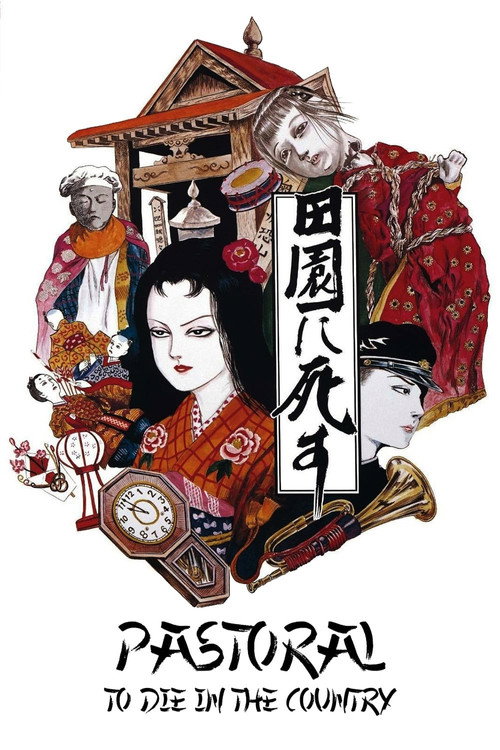
Pastoral: To Die in the Country
1974 · Shūji Terayama
When you want to be transported somewhere genuinely strange and are happy to surrender the need for things to make literal sense — a film to chew on for days. Firmly a challenge, and a gorgeous one.
What it's about
A filmmaker stalled on his latest project tries to dramatize his own adolescence in a remote mountain village in northern Japan — a boyhood of séance mediums, a traveling circus, a beautiful married neighbor, and a suffocating mother he dreamed of escaping. But the memories won't hold still: the adult author ends up stepping into his own recreation to argue with it, revise it, and confront the boy he was.
The experience
A hallucination of a film — carnival colors, painted faces, clocks and ghosts in the rice fields — that moves by dream logic rather than plot. It's disorienting, morbidly funny, and strangely moving; you come out feeling like you've been inside someone else's memory.
The craft
Terayama, a poet and avant-garde theater legend, adapted the film from his own book of tanka verse, and it shows: images land with the compression of poetry, scenes are staged like traveling-theater tableaux, and the color design runs from funeral black to circus scarlet. It's one of the most visually extravagant films of the Japanese avant-garde and rewards the biggest screen you can find.
Why it matters
A landmark of 1970s Japanese experimental cinema and Terayama's fullest statement on film — a touchstone for later filmmakers exploring memory as something you invent rather than retrieve.
Snapshot
Pastoral: To Die in the Country (Japanese: Den'en ni shisu, 田園に死す) is Shūji Terayama's second solo feature and the fullest cinematic distillation of his lifelong project: the reconstruction, and deliberate sabotage, of his own memory. Nominally the film follows a filmmaker suffering creative block as he attempts to dramatize his adolescence in a mountain village in rural Aomori; in practice it fractures into two intertwined movements — the boy's fevered coming-of-age among itako mediums, circus performers, and a smothering mother, and the adult author's return "into" that footage to argue with, revise, and finally fail to correct it. Terayama adapted the film from his own 1965 tanka collection of the same title, and the picture retains the compression, the shock-cuts of imagery, and the funereal wit of the poems. It is at once an autobiography, a critique of autobiography, and a piece of anti-nostalgia that concludes there is no home to return to because "home" was always a fiction the author authored. Among Terayama's small filmography it is the most personal, the most formally controlled, and the work through which he is most often introduced to viewers outside Japan.
Industry & production
Terayama came to feature filmmaking sideways, as a celebrated poet, tanka innovator, radio and stage dramatist, essayist, and — decisively — as founder in 1967 of the experimental theater troupe Tenjō Sajiki ("The Peanut Gallery" / "upper gallery"). By 1974 he was one of the most visible avant-garde figures in Japan, and Pastoral was made from within that theatrical apparatus rather than the mainstream studio system, which by the mid-1970s was contracting sharply. The film belongs to the ecosystem of independent and art-house Japanese cinema that had grown up around the Art Theatre Guild (ATG) — the low-budget production-and-exhibition network that had already backed Terayama's Throw Away Your Books, Let's Go into the Streets (1971) and sustained much of the era's New Wave. The precise contractual arrangement of Pastoral's financing is one point where the accessible English-language record is thin; what is secure is that it was produced outside the majors, on modest means, with Terayama's own collaborators supplying much of the labor.
That production model is inseparable from the film's aesthetics. The circus troupe, the mediums, the theatrical tableaux and the willingness to break the fourth wall all derive from Terayama's stage practice, where non-professional and semi-professional performers, hand-built spectacle, and confrontation of the audience were house style. Pastoral imports Tenjō Sajiki's methods into the frame. The film was completed in 1974 and subsequently circulated internationally on the festival and art-house circuit; it is frequently cited as having screened at Cannes in the mid-1970s, though anyone stating a specific prize or section should verify it against a primary source, as the details are inconsistently reported.
Technology
Pastoral is a 35mm color film, and color is not incidental to it — it is arguably the film's central technology. Terayama and his cinematographer treat the color image as something to be manipulated, saturated, and adulterated rather than faithfully recorded. Sequences are drenched in monochromatic washes — reds above all — achieved through colored gels, filtered lighting, and processing choices, so that the "remembered" village registers as a hand-tinted, artificial construct rather than a photographed reality. This anti-naturalism is a deliberate rhetorical move: memory in the film is explicitly not documentary. The picture belongs to the moment when color stock had become the default even for low-budget art cinema, and Terayama exploits that ubiquity by refusing the transparent, "natural" color that mainstream production sought. There is no evidence of exotic camera technology; the film's innovation lies in optical and photochemical treatment of an otherwise conventional apparatus, plus in-camera and staging tricks — mirrors, painted backdrops, theatrical scenery wheeled into landscape — that owe more to the magic-lantern and misemono (sideshow) tradition than to any modern gadget.
Technique
Cinematography
The photography — credited to Tatsuo Suzuki — is among the film's glories, alternating between painterly stillness and eruptive stylization. Compositions frequently arrange figures frontally, as on a stage, against skies and mountainsides that read as backdrops. The camera favors bold, emblematic framings: a face isolated in a field of red, a procession crossing a barren slope, a domestic interior opened out like a doll's house. Color, as noted, is wielded as a compositional element in its own right. The imagery repeatedly foregrounds its own artifice — painted flats, visible theatrical machinery, tableaux held past the point of realism — so that even the "landscape" of the pastoral title feels curated and false, a set dressed to look like the past.
Editing
The cutting is associative and poetic rather than continuous, mirroring the tanka's method of juxtaposing charged images without connective tissue. Terayama builds by collision — a folk ritual against a moment of adolescent shame, an image of the mother against an image of escape. The film's most celebrated structural device is temporal editing: the narrative folds back on itself so that the adult filmmaker can enter his own reconstructed childhood, sit across from his younger self, and attempt to intervene in the past. The editing thereby dramatizes the film's thesis — that autobiography is a cut-and-paste act, and that the editor of memory can always revise but never redeem.
Mise-en-scène / staging
This is the register in which Terayama's theatrical genius is most visible. The village is a stage: neighbors, a bride glimpsed as an object of the boy's longing, a domineering mother, a traveling circus, and blind itako mediums associated with the region's cult of the dead (the film's imagery draws on the folk world of Aomori and its mountain of the dead, Osorezan). Terayama stages spectacle within the frame — sideshow acts, ritual, painted scenery pushed into natural exteriors — collapsing the boundary between landscape and set, between remembered life and performed fiction. The famous final movement, in which the walls of an interior drop away to reveal the family home standing incongruously in the middle of a modern city intersection, is the culminating mise-en-scène gesture: the past literally has no ground to stand on except the present that reconstructs it.
Sound
The score is by J. A. Seazer (Julius Arnest Seazer), Terayama's principal musical collaborator and the composer for Tenjō Sajiki. Seazer's music — incantatory, rock-inflected, folk-haunted, often chant-like — is one of the defining textures of Terayama's cinema, and in Pastoral it binds the ritual and circus material to the film's dream logic. Sound is used expressively rather than realistically, layering song, folk motif, and voice against images to heighten the sense of a summoned, not recorded, world.
Performance
Performance is stylized and frontal, closer to theatrical presentation than screen naturalism, consistent with the film's origins in Terayama's troupe. Figures are often emblematic — the Mother, the Bride, the mediums, the circus performers — functioning as archetypes in the author's psychic landscape more than as rounded psychological characters. The two central figures, the boy and the adult filmmaker who returns to confront him, carry the film's argument about the divided autobiographical self.
Narrative & dramatic mode
The dramatic mode is reflexive, essayistic, and self-cancelling. On the surface it is a Künstlerroman-in-reverse: an artist blocked on a film about his own youth. But Terayama refuses the therapeutic arc such a premise usually promises. The first movement immerses us in the boy's world with apparent sincerity; the second breaks that immersion, exposing it as the filmmaker's construction and letting the adult author walk into the frame to negotiate with his past. The film's governing gesture — the wish to kill or escape the mother, revisited and thwarted — resolves not in catharsis but in the recognition that revising the past changes nothing, and that the "self" is a montage. This places Pastoral in the lineage of modernist reflexive cinema (the film-about-its-own-making), but Terayama pushes it toward a specifically poetic, funerary register signaled by the title's insistence on dying in the country.
Genre & cycle
Labeled "Fantasy, Drama," the film is more precisely avant-garde autobiography — an art-cinema hybrid of memory-film, folk-horror atmosphere, musical (through Seazer's numbers and the circus material), and metafictional essay. It sits within the cycle of radical Japanese cinema of the late 1960s–70s that broke with studio realism, and within Terayama's own compact run of features — from Emperor Tomato Ketchup (1971) and Throw Away Your Books, Let's Go into the Streets (1971) through Pastoral (1974) to Grass Labyrinth (1979) and The Fruits of Passion (1981). Across that cycle recur the sideshow, the tyrannical mother, adolescent revolt, and the theatricalized image; Pastoral is the cycle's most disciplined and elegiac entry.
Authorship & method
Pastoral is an auteur film in the strong sense: Terayama wrote it (adapting his own poetry), directed it, and generated its imagery out of his own biography and his troupe's practice. His method was cross-medial — poem, play, and film feed one another, and the picture reads as a poet's cinema in which the tanka's compression and imagistic shock are translated into montage and tableau. He worked with a stable of collaborators drawn from Tenjō Sajiki, and the two most consequential here are cinematographer Tatsuo Suzuki, who realized the film's saturated, staged visual world, and composer J. A. Seazer, whose music is inseparable from Terayama's sound. The screenplay is Terayama's own, extended from the Den'en ni shisu collection. Beyond these principals the detailed crew credits (art direction, editing supervision) are less consistently documented in English-language sources, and I flag that rather than guess; what is not in doubt is that the film is Terayama's authored vision, executed by artists formed in his theater.
Movement / national cinema
The film belongs to Japanese cinema's post-studio avant-garde — the constellation of independent, experimental, and politically charged filmmaking that flourished as the major studios declined and the ATG model rose. Terayama is usually discussed alongside the broader Japanese New Wave and its underground offshoots, though his footing was as much in poetry and experimental theater as in film culture proper, which gives his work its distinctive theatrical-poetic accent. Nationally, Pastoral is deeply rooted in a specific Japan: the folk world of northern Tōhoku, the Aomori of Terayama's childhood, the itako mediums and the mountain-of-the-dead cosmology, set against the modern metropolis that erupts in the finale. The film thus stages a confrontation between rural, ritual, "eternal" Japan and the urban present — a tension central to much Japanese art of the period.
Era / period
Made in 1974, the film sits in the aftermath of the political and countercultural upheavals of the late 1960s, whose energies Terayama had channeled through Tenjō Sajiki. By the mid-1970s the overt revolutionary fervor had cooled, and Pastoral turns inward — from the streets of Throw Away Your Books to the interior country of memory. It is a film of the "morning after," exchanging collective provocation for a private reckoning with origin, mother, and mortality, while retaining the era's appetite for formal rupture and its distrust of official realities.
Themes
The film's obsessions are memory and its unreliability; the impossibility of return; the tyranny and inescapability of the mother; adolescent sexual awakening and the longing to flee (embodied in the boy's fixation on the neighboring bride); death as the country's true horizon, announced in the title; and the constructedness of the self and of art. Above all it dramatizes the fiction of autobiography: the recognition that to remember is to compose, that the past is a set one builds, and that even the fantasy of murdering one's origins to become free is itself a story the author tells and cannot make true. Terayama sets these themes within a distinctly Japanese iconography of ritual, mediums, and the dead, but their reach is universal.
Reception, canon & influence
Critically, Pastoral: To Die in the Country has become the keystone of Terayama's reputation as a filmmaker and is widely regarded as his cinematic masterpiece — the work in which his poetic, theatrical, and cinematic identities cohere. It circulated internationally on the art-house and festival circuit and, through later restoration and home-video releases, reached a global cinephile audience that has consolidated its standing. (Specific festival awards and any box-office figures are not reliably established in the accessible record, and I decline to assign numbers or prizes I cannot verify.)
Looking backward, the film's influences are heterodox: the compression and juxtaposition of the Japanese tanka tradition (Terayama's own); the folk and ritual culture of Aomori and Osorezan; the popular spectacle of the misemono sideshow and traveling circus; the reflexive, film-within-a-film modernism of European art cinema; and the confrontational aesthetics of Terayama's own experimental theater. Looking forward, its legacy runs strongest through the appreciation of Terayama himself — a touchstone for later avant-garde, poetic, and reflexive filmmakers, and a recurring reference for artists interested in memory, autobiography-as-fiction, and the fusion of theater and film. Its most famous image — the domestic past marooned in the modern city as its walls fall away — has become an emblem of the anti-nostalgic memory film. Within Japanese cinema and the broader canon of the poetic avant-garde, Pastoral endures as the definitive statement of an artist who trusted no memory, least of all his own, and made that distrust into a form.
Reception
For decades it was a hard-to-see artifact of Japan's ATG avant-garde scene, known mostly to Terayama devotees; the streaming/Letterboxd era turned it into a rediscovered jewel, now routinely ranked among the most visually stunning films ever made.
How Pastoral: To Die in the Country was received, from release to now →
How to watch Pastoral: To Die in the Country: what to notice on a first viewing
- Watch entire scenes wash into a single color, often red. Terayama floods whole sequences in a single monochromatic tint through gels and filtered light, so memory registers as hand-tinted artifice rather than as neutral record. The color itself tells you this is a composed memory, not a documentary of what happened.
- Notice figures arranged frontally, as if posed on a stage. Suzuki composes people facing the camera directly against mountainsides and skies that read as painted backdrops, treating the whole landscape as a theatrical set. The 'pastoral' countryside of the title never once looks like a real, remembered place.
- Notice images collide without any connective explanation between them. A folk ritual is cut directly against a moment of adolescent shame, an image of the mother against an image of escape, with no transition offered. The cutting works the way a poem does, by collision, not by a story's usual cause and effect.
- Listen for chant-like music entering the ritual scenes. J. A. Seazer's incantatory, rock-inflected score layers song, folk motif, and voice against the images, so a world feels summoned rather than simply recorded. The music makes the whole village feel conjured for the occasion, not just captured on film.
- Notice painted flats and visible theatrical machinery in outdoor scenes. Real exteriors are repeatedly pushed up against obviously artificial scenery and sideshow apparatus, so natural landscape and stage set start to look interchangeable. The film keeps admitting its own artifice instead of hiding it from you.
The whole guide to watching Pastoral: To Die in the Country, with the keys for a rewatch →
Influences: the films it descends from and the films it influenced
- Wild Strawberries (1957) — The template for Terayama's temporal-fold: an older protagonist physically walks back into his own childhood memory-tableaux and shares the frame with his younger self, memory staged as trespassable space rather than dissolve.
- 8½ (1963) — Established the reflexive film-about-its-own-authorship in which the director's autobiography is threaded through circus/parade spectacle — the misemono-as-self-portrait structure Terayama inherits and turns on his own past.
- Kwaidan (1964) — Total studio-built world with hand-painted skies and photochemically saturated, non-naturalistic color washes — the precedent for Suzuki's frontal, artificially-tinted tableau surfaces in Pastoral.
- Meshes of the Afternoon (1943) — Ritualized associative montage built on self-doubling and looping repetition, cutting by dream-logic association rather than continuity — the grammar Terayama uses to fold identity back on itself.
- L'Age d'Or (1930) — Surrealist shock-juxtaposition editing, cutting unlike images together for imagistic detonation — the montage-as-tanka-compression logic and sideshow-grotesque imagery Terayama pushes further.
- Persona (1966) — Rupturing the fiction by exposing the celluloid/projector itself, making the medium visibly break — the reflexive tearing-open of the film's own surface that Pastoral echoes in its collapsing sets.
- Throw Away Your Books, Rally in the Streets (1971) — Terayama's own prior feature that first fused Tenjō Sajiki troupe performance, direct-address reflexive autobiography, and photochemical color abuse — the workshop Pastoral perfects.
- The Ballad of Narayama (1958) — Terayama's avant-garde folk-memory piece breaks the frame, exposes its own theatricality and mixes carnival/folk-song staging, radicalizing Narayama's anti-illusionist rupture and folk-ballad mode.
- Santa Sangre (1989) — Builds an entire film from circus/misemono spectacle around a tyrannical mother who literally controls her son's body — the mother-tyranny-through-sideshow braid Terayama planted, extended into full narrative.
- My Winnipeg (2007) — Anti-nostalgic 'docu-fantasia' that restages the director's own childhood home with hired actors and open distrust of memory — the fiction-of-autobiography method Pastoral defined.
- Dogville (2003) — Brechtian theatrical staging with walls reduced to chalk outlines so the whole house is nakedly exposed — the wall-drop reveal turned into an entire film's set logic.
- Songs from the Second Floor (2000) — Static, frontal, deep-stage tableaux composed like painted dioramas with figures held in theatrical arrangement — the frontal-tableau/theatrical-tableau discipline carried forward.
- The Grand Budapest Hotel (2014) — Planimetric frontal framing plus dollhouse cross-section sets whose facing wall is removed to show every room at once — a decorative descendant of Pastoral's frontal tableau and wall-drop reveal.
- Suicide Club (2001) — Sono, who emerged from the same poet-to-filmmaker lineage, stages reflexive autobiographical performance and Tenjō-Sajiki-style street-theater ensembles as confrontational spectacle directed at the audience.
- The Color of Pomegranates (1969) — Parallel poet's-cinema that translates verse into static, frontal living-picture tableaux populated by emblematic archetypes rather than psychological characters — the same conversion of poetry into flattened emblem-staging.
- Funeral Parade of Roses (1969) — Contemporary Japanese post-studio avant-garde that interleaves documentary self-reflexivity, jump-cut associative montage, and staged artifice — the sibling experiment in exposing the film's own making.
- The Holy Mountain (1973) — Carnivalesque emblematic tableaux staged as sideshow spectacle, capped by the famous reflexive zoom-out revealing the camera crew — the same misemono-plus-fourth-wall-collapse move as Pastoral's falling walls.
- House (1977) — Contemporary Japanese avant-garde cousin fusing collage montage, artificial tableaux and wartime-memory nostalgia into anti-realist autobiography.
Similar films
- Throw Away Your Books, Rally in the Streets (1971) — influence & lineage
- Funeral Parade of Roses (1969) — influence & lineage
- The Ballad of Narayama (1958) — shared sensibility
- Dreams (1990) — shared sensibility
- Mirror (1975) — shared sensibility
- Woman in the Dunes (1964) — shared sensibility
- Only Yesterday (1991) — shared sensibility
- The Boy and the Heron (2023) — shared sensibility