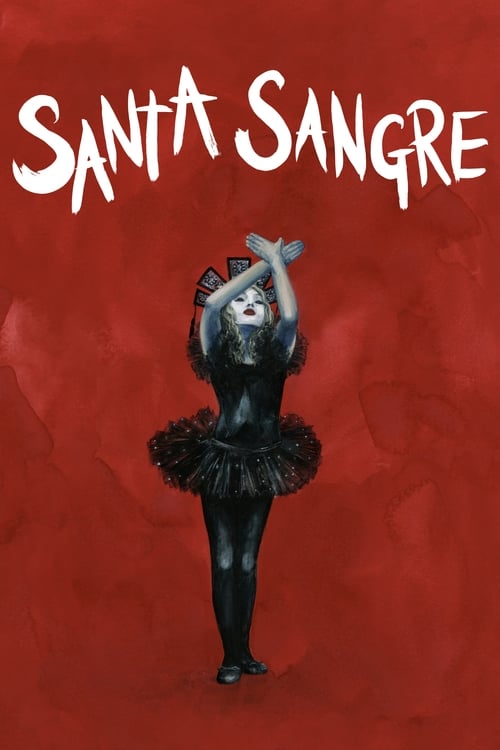
Santa Sangre
1989 · Alejandro Jodorowsky
When you want to be shaken loose — a challenge, not a comfort watch, for the night you're ready for something extreme, beautiful, and unlike anything else. Not for the squeamish.
What it's about
Fenix, a former boy magician raised in a Mexico City circus, escapes the mental institution where he's been confined and returns to his mother — an armless cult leader whose church worships a mutilated saint. He becomes her arms, standing behind her so the two move as one body, and at her command that body does terrible things. It's a fever dream of circus spectacle, religious obsession, and a childhood trauma that will not stay buried.
The experience
Overwhelming and hallucinatory — grotesque and tender in the same breath, with images (a dying elephant's funeral, a tattooed knife-thrower, the mother-and-son creature) that sear themselves in permanently. It's genuinely disturbing, but it plays more like an opera than a slasher.
Performances
Blanca Guerra is terrifying and magnetic as the mother, and Axel Jodorowsky — the director's own son — plays Fenix with a haunted, sleepwalker intensity that makes the two-bodies-one-will conceit horribly convincing.
The craft
Jodorowsky stages horror as carnival: saturated color, circus tableaux, Catholic iconography, and choreography that turns the mother-son pairing into a macabre dance act. Produced by Claudio Argento, it wears giallo blood over surrealist bones, and every frame is composed like a deranged religious painting. The bigger the screen, the deeper the trance.
Why it matters
It marked Jodorowsky's triumphant return after a decade away from filmmaking and became the gateway film to his whole midnight-movie legend — the rare art-house horror embraced by both cults.
Snapshot
Santa Sangre ("Holy Blood") is Alejandro Jodorowsky's florid return to feature filmmaking after nearly a decade of silence, a surrealist horror-melodrama that braids circus spectacle, Mexican Catholic iconography, and the architecture of the psychological thriller. Its central conceit is unforgettable: Fenix, a former circus magician confined to a mental institution, escapes to serve his armless mother, standing behind her and lending his own arms to her body so that the pair function as a single deranged organism — and, at her psychic command, he kills. The film is at once a blood-drenched giallo (it was produced by Claudio Argento, brother of Dario), a Fellini-esque memory-piece about a ruined childhood, and a near-explicit reworking of Psycho's dominating-mother delusion. After the commercial misfires and aborted projects of the late 1970s, it restored Jodorowsky's reputation as a maker of unrepeatable visionary cinema, and it remains the most narratively coherent — and arguably the most emotionally legible — of his major works.
Industry & production
Santa Sangre was an Italian–Mexican co-production, financed largely on the Italian side and shot on location in and around Mexico City. The decisive industrial fact is the involvement of producer Claudio Argento, who brought the project the genre-market credibility and European horror financing associated with the Argento name. The screenplay credit is shared by Jodorowsky with Roberto Leoni and Claudio Argento, a collaboration that gave the director's characteristically diffuse imagery a tighter, more conventional thriller spine than his earlier features possessed.
The film was made in English, with an international cast assembled around Jodorowsky's own family. His sons play the protagonist at two ages: Axel Jodorowsky as the adult Fenix and Adan Jodorowsky as the child. Blanca Guerra plays the mother, Concha; American actor Guy Stockwell (brother of Dean Stockwell) plays the brutish father, Orgo; Thelma Tixou plays the Tattooed Woman; and Sabrina Dennison plays Alma, the deaf-mute girl who is Fenix's salvation. Casting the director's children alongside professional actors is consistent with Jodorowsky's lifelong treatment of filmmaking as a family and ritual undertaking rather than a purely industrial one.
Commercially, the film occupied the art-house and midnight-movie circuit rather than the multiplex. Precise budget and box-office figures are not reliably documented in the public record, and I will not invent them; what is clear is that the picture was positioned as a festival and specialty release and found its durable audience through repertory screenings and home video rather than wide theatrical exhibition.
Technology
Technologically, Santa Sangre is conservative: it was shot on 35mm film with conventional late-1980s production tools and relies entirely on practical, in-camera, and makeup-based effects rather than optical or (then-nascent) digital trickery. Its most demanding "effects" are choreographic and prosthetic — the armless illusion, the knife-throwing act, the dismemberments — achieved through staging, costuming, and editing rather than technical novelty. The film's power comes from physical craft and color, not from any innovation in the apparatus, and this is worth stating plainly: it is an old-fashioned production in its means, even as its imagery feels unprecedented.
Technique
Cinematography
The cinematography is by Daniele Nannuzzi, working in a saturated, high-contrast register that suits the film's twin worlds of garish circus spectacle and morbid religious tableau. The camera favors bold primary color — the reds of blood and tent and church, the painted flesh of the Tattooed Woman — and a theatrical frontality that often presents action as if staged for a proscenium audience. Compositions repeatedly organize themselves around symmetry, ritual, and procession (the church congregation, the funeral cortège for the elephant), giving even the most grotesque events a ceremonial gravity. The visual scheme deliberately collapses the boundary between sacred and profane imagery, shooting murder and worship with the same lush devotional attention.
Editing
Edited by Mauro Bonanni, the film is structured as a frame narrative: the adult Fenix in the asylum, naked and bird-like atop a tree in his cell, gives way to an extended flashback to his childhood, before returning to the present for its descent into serial murder and final reckoning. This nesting is unusually disciplined for Jodorowsky, whose earlier films (El Topo, The Holy Mountain) proceed as picaresque chains of tableaux. Here the editing serves suspense and revelation, withholding and then disclosing the truth of the mother's "presence" in a manner that depends on classical thriller mechanics of misdirection.
Mise-en-scène / staging
Mise-en-scène is the film's signature dimension. Jodorowsky stages a procession of indelible set-pieces: the funeral of a circus elephant whose enormous coffin is tipped into a ravine and torn apart by the poor; the bulldozing of Concha's heretical church, built around a pool of "holy blood"; the painted, kohl-lined faces of clowns and performers; the asylum's chorus of vulnerable men, including those with Down syndrome, whom Fenix leads on a doomed night out. The arms-illusion act — Concha standing behind her son so that his arms become hers — is the supreme staging idea, a piece of physical theater that literalizes psychological possession. Throughout, the director draws on circus, lucha-libre culture, Catholic kitsch, and Day-of-the-Dead iconography to build a densely material, hand-crafted world.
Sound
The score is by the English composer Simon Boswell, who fuses orchestral writing, rock textures, and Latin idioms (mambo, Mexican folk) into a soundtrack as tonally promiscuous as the imagery. The music swings between the sentimental and the menacing, underscoring the film's oscillation between melodrama and horror. As the film was shot in English with an international cast, performances were built around English dialogue, though the soundscape — circus brass, religious chant, the city — is thoroughly Mexican in texture.
Performance
Performance pitches itself at a heightened, near-operatic level appropriate to the material. Blanca Guerra's Concha is monstrous and magnetic, a portrait of devouring maternal will; the role's physical demands — appearing armless, and executing the precisely choreographed two-bodies-as-one act with Axel Jodorowsky — required exact rehearsal so that the son's arms read convincingly as the mother's. Axel Jodorowsky carries the adult Fenix through wide-eyed terror, erotic confusion, and murderous compulsion, while Guy Stockwell's Orgo supplies the swaggering, doomed machismo whose violence sets the tragedy in motion. The non-professional and physically distinctive performers in the circus and asylum scenes lend the film a documentary strangeness in the tradition of Tod Browning's Freaks.
Narrative & dramatic mode
Beneath its surrealist surface, Santa Sangre runs on a remarkably classical engine: an Oedipal tragedy crossed with a serial-killer thriller. The dramatic mode is melodrama in the strict sense — a theater of extreme passions, maternal tyranny, sexual jealousy, and bodily mutilation — rendered through expressionist excess. The flashback structure builds toward the originating trauma (Orgo's infidelity, Concha's mutilation by acid, his amputation of her arms and his suicide), then tracks the adult son's psychic enslavement and its violent expression. The film's deepest structural debt is to Hitchcock's Psycho: the apparent survival and domination of the mother is revealed to be a delusion, the killings the son's own, the "mother" a voice and image he cannot exorcise. Where Jodorowsky departs is in the ending's redemptive turn — the love of the deaf-mute Alma breaks the spell, Fenix recognizes that his mother is not real, and he raises his arms in surrender, reclaiming them at last as his own.
Genre & cycle
The film sits at a busy intersection of genres. It is a horror film and, by lineage and production, a late entry adjacent to the Italian giallo tradition — stylized murders, a psychosexual mystery, an Argento producer — yet it is too surreal and too tender to be contained by that label. It is equally a circus film, a psychological thriller, and an avant-garde art film. Within Jodorowsky's own body of work it belongs to no neat cycle; it stands as a synthesis of his "midnight movie" mystique (the cult of El Topo and The Holy Mountain) with a newfound narrative discipline. It is also legible within a broader cycle of late-1980s art-horror that pushed the genre toward the operatic and the transgressive.
Authorship & method
Santa Sangre is unmistakably an auteur film, and its authorship is inseparable from Jodorowsky's larger persona as filmmaker, comic-book writer, tarot scholar, and originator (with Fernando Arrabal and Roland Topor) of the Panic Movement, a 1960s avant-garde dedicated to surreal, ritualized provocation. The film extends his lifelong concerns with psychomagic — his term for symbolic acts intended to heal psychic wounds — staging Fenix's crisis and cure as exactly such a ritual.
The authorship is genuinely collaborative at key points. The screenplay was shaped with Roberto Leoni and Claudio Argento, who reined Jodorowsky's imagery into a workable thriller; the cinematography of Daniele Nannuzzi and the editing of Mauro Bonanni gave the project its disciplined visual and temporal form; and Simon Boswell's score is integral to its tonal identity. Jodorowsky has stated that the film drew inspiration from the case of the Mexican serial killer Gregorio "Goyo" Cárdenas, the so-called Tacuba Strangler of the 1940s — a sourcing the director has discussed in interviews, and which I report as his attribution rather than as independently documented fact. The casting of his sons folds the method back into the family-as-ritual logic that governs all his cinema.
Movement / national cinema
The film resists a single national-cinema home, which is itself characteristic. It is a Mexican film in setting, texture, and cultural reference — the lucha culture, the popular Catholicism, the Mexico City locations — and Jodorowsky's career is deeply entangled with Mexico, where he made Fando y Lis and El Topo. Yet it is an Italian-financed, English-language, internationally cast production, which places it within the transnational European genre economy of its moment as much as within Mexican national cinema. Aesthetically it descends from the surrealist tradition that runs through Mexican film via Luis Buñuel, and from the Panic avant-garde of Jodorowsky's Paris years. It is best understood as exile cinema: the work of a Chilean-born, French-affiliated artist making a Mexican-set film with Italian money.
Era / period
Released in 1989, Santa Sangre arrives at the close of a decade and reads as both a throwback and a culmination. It revives the midnight-movie sensibility of the late 1960s and 1970s — the era of Jodorowsky's own cult ascendancy — while answering the more polished, genre-conscious horror market of the late 1980s. It also marks a personal turning point: the end of a long fallow period that included the collapse of Jodorowsky's celebrated, unrealized adaptation of Dune in the mid-1970s and the troubled reception of Tusk (1980). Coming after that drought, the film carries the charge of an artist reclaiming his medium, and period observers and later critics alike have framed it as a comeback.
Themes
The film's governing themes are maternal domination and the struggle for individuation. Fenix's literal lending of his arms to his mother dramatizes the psychoanalytic predicament of a self that cannot act except through the parent's will; his cure is the reclamation of his own hands, and with them his agency. Sexuality and violence are fused throughout — desire is punished, jealousy mutilates, and the body is the site where psychic wounds are inflicted and, finally, healed. Religion runs as a second spine: the heretical cult of the armless saint, the pool of holy blood, the bulldozed church, all interrogating faith as both consolation and madness. Trauma and memory organize the narrative; the circus stands as a lost Eden of childhood corrupted by adult cruelty. And underneath it all lies Jodorowsky's psychomagic — the conviction that symbolic, even grotesque, enactment can release a person from the grip of the past. Love, embodied by the silent Alma, is the film's redemptive counterforce.
Reception, canon & influence
Critically, Santa Sangre was widely received as Jodorowsky's strongest and most controlled film since El Topo, praised for marrying his unbridled imagery to a story an audience could follow and feel. It restored his standing after the wilderness years and has since been canonized as a touchstone of surrealist and art-horror cinema, sustained by repertory programming and successive home-video and restoration releases that introduced it to new generations.
The influences on the film are richly legible. Federico Fellini presides over its circus world and its bittersweet treatment of memory and spectacle (the lineage of La Strada and La dolce vita is felt throughout). Luis Buñuel's Mexican surrealism — the unsentimental poetry of Los Olvidados — informs its vision of the city's margins. Hitchcock's Psycho supplies its thriller architecture and its mother-delusion. Tod Browning's Freaks stands behind its embrace of physically distinctive performers, and German Expressionism behind its painted, theatrical extremity. Mexican popular culture — lucha libre, circus, Catholic ritual, Day of the Dead — is the soil from which its imagery grows.
Its influence forward is more diffuse but real. Santa Sangre helped consolidate Jodorowsky's status as a patron saint of transgressive, image-driven cinema, an inspiration cited by filmmakers and musicians drawn to the surreal and the grotesque; the director Nicolas Winding Refn has been a prominent latter-day champion associated with the film's restoration and revival. Its set-pieces — the elephant's funeral, the arms act — have become reference points in the vocabulary of cult cinema. A precise genealogy of works it directly shaped is harder to document than the film's own sources, and I will not overstate it; its legacy lives less in a school of imitators than in its standing as a singular object that licensed later directors to pursue the operatic, the sacred, and the horrific in the same breath.
A Deleuzian reading
A naked man crouches at the top of a painted tree inside his cell, knees drawn up, a fixed bird where a son used to be.
The full Deleuzian reading of Santa Sangre →
Reception
A modest art-house release in 1989 that Roger Ebert championed with four stars, it then spent years nearly impossible to see before a 2011 restoration and reissue cemented it as the consensus 'masterpiece' of Jodorowsky's filmography — his comeback film after a long absence from directing.
How Santa Sangre was received, from release to now →
Influences: the films it descends from and the films it influenced
- Psycho (1960) — Supplies the thriller architecture of a killer psychologically possessed by a domineering mother whose 'voice' compels the murders, the reveal withheld and reframed by a final twist — the skeleton Santa Sangre dresses in surreal flesh.
- Freaks (1932) — Establishes the practice of casting real physically distinctive and disabled performers as a dignified onscreen community rather than gawking spectacle, the direct model for the film's circus ensemble (the Tattooed Woman, the dwarf, the Down-syndrome performers).
- Los Olvidados (1950) — Provides the unsentimental surrealist poetry of Mexico City's margins — street children, pimps, junkies, dream-irruptions into squalor — the textured marginal urban world Fenix wanders after the asylum.
- La Strada (1954) — Models the itinerant circus as a theater of cruelty and tenderness — a brute strongman lashed to a fragile innocent — and the bittersweet performer-melodrama Jodorowsky tunes to operatic pitch.
- La Dolce Vita (1960) — Source of the processional set-piece and spectacle-as-memory; Santa Sangre's elephant funeral, with its mourners and bannered hearse winding through the streets, descends directly from Fellini's grand public parades.
- Un Chien Andalou (1929) — The grammar of dream-logic juxtaposition and matter-of-fact bodily mutilation as shock-image — the surrealist editing logic where one impossible cut yields a wound, which Jodorowsky inherits via the Panic Movement.
- The Cabinet of Dr. Caligari (1920) — German Expressionism's painted, theatrical artifice plus the figure of the somnambulist compelled to kill by a controlling master — mirrored in Fenix murdering as the puppet-arms of his armless mother.
- El Topo (1970) — Jodorowsky's own founding template of ritualized symbolic violence, the quest staged as psychomagic ordeal, and the casting of his own son — the method Santa Sangre refines into legible narrative.
- The Holy Mountain (1973) — Supplies the tarot-scholar's vocabulary of symmetrical, tableau-procession staging and esoteric sacred-grotesque iconography that Santa Sangre channels into the church-of-the-saint and Concha's cult.
- Deep Red (1975) — The giallo blueprint — black-gloved killings keyed to a buried childhood trauma and a misremembered primal scene — carried into the project by co-writer/producer Claudio Argento, who disciplined Jodorowsky's imagery into a tracking-the-killer thriller.
- The Beast with Five Fingers (1946) — The horror tradition of the autonomous, murderous disembodied hand/arm — limbs acting with a will not their own — which Santa Sangre literalizes in the 'arms illusion' where Fenix's hands become his mother's killing instruments.
- Pastoral: To Die in the Country (1974) — Builds an entire film from circus/misemono spectacle around a tyrannical mother who literally controls her son's body — the mother-tyranny-through-sideshow braid Terayama planted, extended into full narrative.
- The Dance of Reality (2013) — Extends the same family-as-ritual method — Jodorowsky casting his own sons and restaging autobiographical wounds as overt psychomagic healing — that Santa Sangre pioneered with the casting of Axel and Adan Jodorowsky as Fenix.
- Only God Forgives (2013) — Refn, a prominent champion of Santa Sangre's restoration, builds a hyper-stylized Oedipal nightmare of maternal domination compelling a son to ritual violence, staged in symmetrical tableaux and saturated neon — the film's craft transposed to Bangkok.
- Mandy (2018) — Inherits the license to pursue the operatic, sacred and horrific in one breath — drenched primary-color art-horror, a deranged cult, and grief staged as hallucinatory ritual — in the image-driven register Jodorowsky legitimized.
- Endless Poetry (2016) — Pioneers his family-casting method (son Axel in the lead) and psychodrama-as-therapy staging that Endless Poetry systematizes with sons Adan and Brontis in central roles.
- Suspiria (1977) — Shares the giallo-horror palette of saturated, unmotivated primary-color lighting — pooled deep reds and blues as expressionist emotional weather — that Daniele Nannuzzi's photography deploys across Santa Sangre's interiors.
- The Neon Demon (2016) — Pairs symmetry-and-procession staging with saturated primary-color lighting and a melodrama of bodily transgression, extending the same Argento-via-Jodorowsky aesthetic of beauty fused to the grotesque.
Similar films
- El Topo (1970) — influence & lineage · often watched together
- The Holy Mountain (1973) — influence & lineage
- Mandy (2018) — influence & lineage
- Suspiria (1977) — influence & lineage
- Freaks (1932) — influence & lineage · same viewing thread
- Mother Joan of the Angels (1961) — same viewing thread
- Suspiria (2018) — same viewing thread
- Un Chien Andalou (1929) — influence & lineage · often watched together
All the films related to Santa Sangre →
Watch it with: curated runs of related films
- Fever-Dream Horror — Watch these when you want horror that runs on dream logic — witches, circuses, crematoria and occult dread rendered as hand-crafted, hallucinatory nightmare rather than jump-scare.