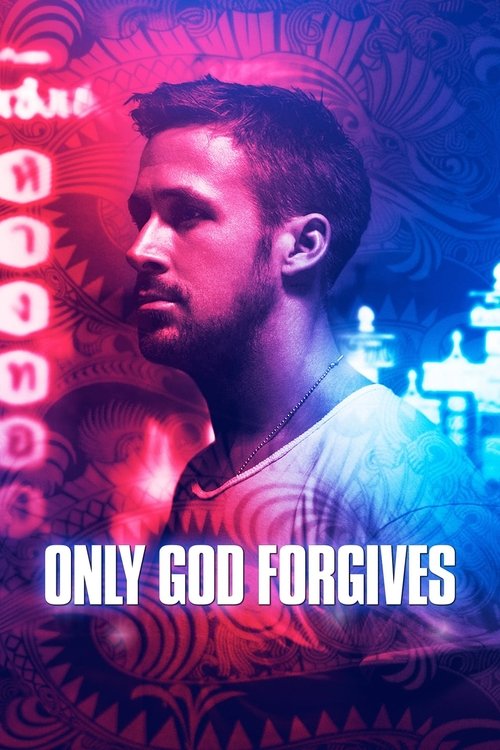
Only God Forgives
2013 · Nicolas Winding Refn
For when you want cinema as pure sensation — mood, color, and dread over plot — and you're willing to be unsettled rather than entertained. Absolutely not a comfort watch; reach for it when you want something to argue about afterward.
What it's about
In neon-soaked Bangkok, Julian runs a Thai boxing club that fronts his family's drug operation, drifting through the city's red corridors like a man already serving a sentence. When his brother is killed after committing a horrific crime, their terrifying mother flies in from America and demands vengeance. Standing in the way is Chang, a retired police lieutenant who dispenses his own brand of justice with eerie, unhurried calm.
The experience
Hypnotic and confrontational — dialogue is rationed to almost nothing, the camera holds on glowing empty rooms, and the violence, when it comes, is sudden and brutal. It feels less like watching a thriller than sinking into a fever dream that refuses to explain itself.
Performances
Kristin Scott Thomas is the shock here: cast wildly against type as Crystal, a venomous, bleach-blonde crime matriarch who cuts through the film's silence like a blade. Ryan Gosling strips his stillness down to almost nothing, and Vithaya Pansringarm's serene, implacable Chang is genuinely uncanny.
The craft
Every frame is composed like a painting — saturated reds and blues, symmetrical corridors, bodies posed in darkness — with Cliff Martinez's throbbing electronic score doing much of the storytelling. The sound design and color are the point: this one rewards a dark room, a good screen, and loud speakers.
Why it matters
Booed and cheered in equal measure at its Cannes premiere, it became one of the decade's most divisive art films and has since grown a devoted cult following as a pure expression of Refn's style-first cinema.
Snapshot
Bangkok at night, corridors the color of arterial blood, a man standing in the dark with his arms at his sides. Julian (Ryan Gosling) manages a Muay Thai boxing club — a front for his family's drug operation — with the inert passivity of someone who has already accepted his own guilt. His brother Billy rapes and murders a teenage prostitute, and is killed in turn by the girl's father on the instruction of Chang (Vithaya Pansringarm), a retired police lieutenant who moves through the film with the unhurried precision of a myth. Their mother Crystal (Kristin Scott Thomas) arrives from America and requires revenge. What follows is almost not a film in the conventional sense — plot events occur at wide intervals, dialogue is rationed to near-nothing, the camera holds on empty frames for measures of time that feel closer to trance than to narrative. Bangkok is rendered not as location but as state: a dream-city of deep corridors, neon light, and absolute moral consequence. Chang sings Thai pop songs at a karaoke bar between acts of calibrated violence. Julian stands in front of mirrors and does not move. The oedipal situation — Crystal's preferring the monstrous Billy, Julian's paralysis in the face of her demand, the final image of amputation and submission — is laid out with the directness of a diagram and the texture of a hallucination. Only God Forgives is Nicolas Winding Refn's most uncompromising film and, consequently, his most divisive.
Industry & production
The film was produced by Bold Films and Gaumont — the same pairing responsible for Drive (2011) — and distributed in the United States by RADiUS-TWC. It was shot entirely in Bangkok, Thailand, making it a fundamentally transnational production: Danish director, French and American financing, British and American leads, Thai setting and second lead. The project emerged directly from Refn's friendship and creative partnership with Ryan Gosling, which had formed during Drive; the two agreed to make a film together before any script existed. Refn has described developing the project during a period of personal difficulty, working through a preoccupation with violence, shame, and maternal power. He wrote the screenplay himself, marking a tightening of authorial control relative to Drive, for which Hossein Amini had adapted James Sallis's novel.
The decision to set and shoot the film in Bangkok appears to have originated in part from Refn's prior involvement with Thailand on a project that did not proceed; the city's specific visual character — its red-lit entertainment districts, its hierarchical architecture of pleasure and punishment — suited the material. The production was completed at a budget appropriate to the project's art-film ambitions; no verified figure is worth repeating here. Only God Forgives was in competition for the Palme d'Or at the 2013 Cannes Film Festival, where the jury was chaired by Steven Spielberg; the Palme was ultimately awarded to Abdellatif Kechiche's Blue Is the Warmest Color.
Technology
The film was shot on the ARRI Alexa, the digital camera that had become standard for high-end independent and prestige production by the early 2010s. Cinematographer Larry Smith used the camera's native dynamic range to achieve the deep blacks and intensely saturated primary colors — crimson, cobalt, amber — that define the film's visual world, working in close collaboration with the post-production color grading pipeline to push every image past naturalism into something closer to pigment painting. Anamorphic lenses were deployed selectively, and the extreme slow-motion passages that punctuate the film's acts of violence required high-frame-rate capture that Smith integrated into an otherwise static visual approach. The choice of digital did not foreclose any of the film's visual ambitions; the Alexa's latitude in handling extreme contrast was, if anything, essential to the specific look Refn and Smith were pursuing.
Technique
Cinematography
Larry Smith had shot Bronson (2008) for Refn before Only God Forgives, establishing a working method between them; his other career context — extensive work in the lighting department on Stanley Kubrick's late productions, including Eyes Wide Shut (1999) — is legible throughout this film in its Kubrickian commitment to symmetrical architecture, precise zone-of-focus control, and the use of controlled artificial light as the total environment of a shot. In Only God Forgives, these influences are pushed to an extreme that even Kubrick rarely reached: virtually every shot is a formally closed composition, the frame divided into mirroring halves, the human figure positioned within corridors and doorways as though placed on a chessboard. The camera moves infrequently and slowly; when it tracks, it does so as inevitably as a verdict rather than as a discovery. Long takes are the norm, and duration functions not as neorealist patience but as pressure — holding on an empty corridor until the vacancy acquires menace. Smith's work with color is the film's most immediately striking technical achievement: the boxing club's deep red interiors, the blue-gray haze of Bangkok streets, the orange glow of incandescent spaces are all designed rather than found, Bangkok reorganized into a palette that expresses moral geography rather than geographic reality.
Editing
Matthew Newman, who would go on to edit The Neon Demon (2016) for Refn, cut the film. His approach is the editing equivalent of the cinematography: austere, deliberate, with a consistent refusal of the rhythmic acceleration that conventional genre filmmaking uses to manage audience attention. Scenes routinely run past their apparent conclusion; cuts arrive slightly late, after the image has already given everything it is going to give. The effect of this rhythm across the film's ninety minutes is cumulative: an atmosphere of suspension, of consequence perpetually deferred. The violence sequences are not cut for shock or excitement — they are assembled with the same slow deliberateness as the dialogue scenes, their impact produced by accumulation rather than by editorial rhythm. Newman's most significant structural decision may be organizing the film not by causal momentum but as a series of discrete tableaux, each self-contained, the whole feeling less like a story than like a ritual ceremony observed from outside.
Mise-en-scène / staging
Refn's staging throughout the film is organized around the central motif of symmetry — a word that applies both to the compositions Smith photographs and to the thematic architecture of the film itself. Characters are placed on the central axis of the frame or carefully offset within symmetrical architectural forms; interiors are designed or modified to produce the deep corridors and centered doorways the compositions require. The Bangkok of Only God Forgives has been effectively rebuilt as a stage set, the city's actual geography dissolved into a series of formal spaces each color-coded to its dramatic function. Mirrors appear repeatedly and with purpose: Julian confronts his reflection before and after significant events; the film's preoccupation with narcissism, doubling, and the mother-son mirror dynamic is externalized in literal reflective surfaces. The boxing ring, though never used for legitimate competition, functions as a charged symbolic space — the place where violence is formalized and adjudicated, where the male body is simultaneously weapon and offering. The staging of violent acts has a ritualistic quality: Chang's punishments are carried out with surgical precision and an almost liturgical calm, each one prepared and concluded rather than simply executed. The film does not have a conventional climax in the thriller sense; it has a ceremony.
Sound
Cliff Martinez, who composed Drive for Refn, developed a score for Only God Forgives that is simultaneously more minimal and more culturally specific than their previous work together. Where the Drive score was rooted in synthesizer romanticism and American 1980s pop reference, the Only God Forgives music draws on Thai melodic and percussive elements absorbed into Martinez's characteristic electronic palette, producing a sound that is neither Western nor straightforwardly Asian but something liminal and disquieting. The score is deployed in long, undulating passages that function less as accompaniment than as atmospheric environment; it does not illustrate events but creates the register in which they occur. Of equal importance to the scored sequences are the karaoke performances: Chang sings Thai ballads in scenes that recur at intervals throughout the film, apparently disconnected from narrative events, and the effect is to place the figure of cosmic violence within a context of ordinary pleasure and popular culture — a juxtaposition the film never explains and does not need to. Sound design handles violence with notable restraint; the film refuses the amplified impact sounds of conventional action cinema, preferring a muffled, interior quality that makes violence feel closer to surgery than to combat.
Performance
Ryan Gosling delivers one of the most radically minimal performances by a lead actor in a commercially distributed English-language film of the era — his line count is extremely low by any standard, and his performance exists almost entirely in stillness, in the quality of attention in his eyes, in the precise degree of tension or collapse in his body. This is a deliberate and demanding strategy rather than a failure of material: Julian is a man who cannot act, whose entire dramatic problem is the impossibility of autonomous will, and the performance articulates this through its own incapacity for conventional expressiveness. Gosling's work here is in direct tension with his performance in Drive — where the Driver's silence was romantic and projective, inviting audience identification, Julian's silence is closed and opaque, producing not sympathy but unease.
Kristin Scott Thomas as Crystal is the film's most surprising element and its most overtly theatrical. Cast against the entire texture of her established screen persona — cool, intelligent, emotionally withheld women of refinement — she plays Crystal as a grotesque of maternal narcissism: bleach-blonde, foul-mouthed, covertly incestuous in her attachment to the dead Billy, openly contemptuous of Julian. The performance is large and stylized in a film that otherwise suppresses register, and the contrast is clearly intentional; Crystal is the film's only character who speaks at length, who explains herself, who performs, and the performance of performance is her characterization. Vithaya Pansringarm as Chang operates on an entirely different plane: he brings to the role a quality of absolute settled authority, neither threatening nor reassuring, the performance's lack of interiority converting the character from a psychology into a force. His karaoke scenes — composed, pleasant, ordinary — are among the film's most unsettling choices, in part because Pansringarm plays them straight, as though the singing and the sword are simply two modes of the same attention.
Narrative & dramatic mode
Only God Forgives is structured like a myth or a morality play rather than a psychological thriller. It has a premise — a crime, a demand for revenge, a reluctant instrument — but it is not interested in the mechanisms of plot, the procedures of investigation or pursuit, the escalating stakes of genre cinema. Events occur because they must, because the logic of the film's moral universe requires them, and the film is more interested in the texture of inevitability than in surprise or complication. Julian's inability to act throughout most of the film — his failure to kill Chang when he has the opportunity, his submission to the punishment he receives — is not a thriller's temporary obstacle but the film's central dramatic fact, and it does not resolve in the way genre convention would require. What the film offers instead of conventional narrative satisfaction is mythological completion: the punishment of all who deserve it, rendered in a form closer to ritual observation than to storytelling. The viewer's position is not the problem-solver's but the witness's.
Genre & cycle
The film operates against the crime thriller and martial arts conventions it superficially invokes, departing from them so systematically as to constitute a critique of genre rather than a participation in it. The Muay Thai setting, the drug-running family, the revenge framework — these are the costumes genre fiction provides, and Refn wears them only long enough to render them transparent. More precisely, the film belongs to a strand of European art cinema that has always found the American crime genre a productive field for formal and philosophical exploration: Melville, Leone, Wenders — directors who used genre structure as a skeleton around which to construct meditations on violence, masculinity, and moral order that the genre itself would not support. Within 2010s cinema, Only God Forgives participates in a cluster of films — Spring Breakers (Harmony Korine, 2012), Mandy (Panos Cosmatos, 2018) — that use genre materials as vehicles for hallucinatory formal experiment, prioritizing image and sensation over narrative coherence. Whether this cluster constitutes a cycle in the formal sense or merely a shared orientation awaits the perspective that only time provides.
Authorship & method
Refn wrote, produced, and directed the film, representing the fullest expression of auteur control in his career to that point. He has described the project as essentially confessional, a working-through of private psychological material rather than an adaptation or genre exercise, and has spoken in interviews about approaching filmmaking through emotional and sensory intuition rather than analytical planning — experiencing images and sounds before narratives. Whether this biographical-confessional account should be taken as literal description of method or as a cultivated authorial persona is a reasonable question; the formal precision of his films argues for a discipline that the interview persona of instinctive working does not fully explain.
The contribution of Larry Smith is inseparable from the film's visual achievement: Smith's background in classical studio lighting and his long association with Kubrick's technical perfectionism brought to the project a discipline of execution that realized rather than merely illustrated Refn's intentions. Cliff Martinez's contribution is similarly constitutive; the film without its score would be formally incomplete, the emotional architecture the music provides being something the image alone does not supply. Matthew Newman's editorial judgment, in sustaining an extremely slow cutting pace against whatever commercial pressures existed, is the less visible but equally essential structural achievement. The film is in a meaningful sense a collaboration between Refn's conception and the specific technical languages that Smith, Martinez, and Newman brought to it — a creative triangle that would continue, with Braier replacing Smith, into The Neon Demon.
Movement / national cinema
Only God Forgives belongs to no national cinema in any coherent sense. Its director is Danish; its financing French and American; its stars British and American; its setting Thai. It was enabled by the same international co-production infrastructure that has allowed a generation of European auteurs to work at scales and in locations unavailable within purely domestic funding structures, and its visual and thematic reference points — Kubrick, Tarkovsky, Hong Kong action cinema, Greek tragedy — are transnational rather than culturally specific. The film's engagement with Thailand and Thai culture has been a source of critical unease: the Bangkok it depicts is a Western fantasy of Asian inscrutability and ancient moral order, and the Thai characters — most importantly Chang — are rendered as mythological rather than social, as vessels for ideas about fate and justice rather than as human beings with specific cultural location. This Orientalist dimension of the film has been noted and debated without reaching consensus; it is, at minimum, a structural feature that distinguishes the film's relationship to its setting from what one would expect of a Thai production, and that warrants acknowledgment in any serious account.
Era / period
The film arrives in the immediate aftermath of Drive's success — which was both a critical and commercial event, crossing over from the art-house circuit into mainstream awareness — and represents Refn's decision to follow that leverage not by consolidating the formula but by abandoning it entirely. This is a specifically 2013 configuration: a director using the freedom provided by a recent success to make something more personally extreme, backed by the same producers and distributor who had profited from the earlier film. The result was commercially disappointing and critically divisive, a pattern familiar from the careers of directors who have periodically made exactly this choice. More broadly, the film belongs to a moment when the neon aesthetic — deep blacks, saturated color, electronic music, slow motion — was consolidating from a small number of distinctive films into a widely imitated style; Drive had been crucial to that consolidation, and Only God Forgives uses the same grammar at a temperature that most subsequent imitators did not attempt to match.
Themes
The Oedipus complex is the film's explicit organizing theme and not merely one interpretive frame among others: Crystal's preference for the dead Billy — the son who acted without restraint — over the living Julian, who is inhibited by conscience or fear, and the film's treatment of Julian's paralysis as a specifically maternal wound, makes the psychoanalytic reading not an imposition but a description of what the film is openly doing. The final image — Julian's hands, what happens to them, and the submission that follows — is the oedipal situation resolved at the level of the body rather than the psyche, punishment accepted from a figure who functions as both father-substitute and divine arbiter.
Chang as the instrument of cosmic justice is the film's theological proposition: that violence has a proper structure, that crimes produce their own punishments through a mechanism that operates without police procedure or legal process, that a figure exists who can perceive what is owed and collect it. This structure is Buddhist in its fatalism and Greek in its precision; neither tradition is invoked explicitly, but both are legible. The film's treatment of sin and punishment is rigorous: every character who has earned punishment receives it, in exactly the measure the crime warrants. Julian's crime is not the film's violence but his passivity — his failure to act, his submission to his mother's will, his willingness to inhabit a moral universe he has not chosen and from which he has not separated himself.
Masculinity and its failures — emasculation in the literal and symbolic senses, the male body as site of domination and submission, the relationship between the capacity for violence and the possession of selfhood — run through the film alongside its oedipal architecture. The female characters are drawn with a cruelty that feminist critics have found troubling: Crystal is monstrously characterized, and the women who appear in the boxing-club milieu are largely victimized or absent. The film does not appear to be interested in defending or qualifying these representations; whether this constitutes a deliberate formal provocation or an unreflective reproduction of misogynist structures is a question the film poses and declines to answer.
Reception, canon & influence
Backward influences. Refn has consistently cited Alejandro Jodorowsky as a fundamental influence throughout his career, and the mythological-surrealist framework of El Topo (1970) — the Western as spiritual ordeal, violence as sacrament, the protagonist's submission to a superior force as the film's destination — is the most direct generic antecedent for Only God Forgives. The compositional influence of Stanley Kubrick is rendered exceptionally precise by the presence of Larry Smith, whose career in Kubrick's lighting operations means that the formal debt passes not only through Refn's cinephile absorption of The Shining (1980) and 2001: A Space Odyssey (1968) but through the direct human transmission of someone who worked within Kubrick's technical system. Andrei Tarkovsky's slow cinema — the protracted takes, the refusal of conventional narrative time, the treatment of the image as a site of contemplation rather than information delivery — is legible throughout. David Lynch's contribution is less specific: the dream logic of Mulholland Drive (2001), the investigation of evil beneath glamorous surfaces, the refusal to explain — these are shared orientations rather than direct debts, though Refn has named Lynch as a crucial figure. The color grammar owes most immediately to Dario Argento's Suspiria (1977), whose saturated red-interior architecture Smith and Refn reproduced and intensified. Hong Kong action cinema of the 1980s and 1990s — John Woo in particular — informs the treatment of violence as choreography, as formal exercise in which moral stakes are expressed through movement rather than dialogue.
Critical reception. The Cannes premiere received one of the more dramatically mixed audience responses in the festival's recent history — boos and applause divided with an unusually clean opposition, suggesting the film had struck something real rather than merely irritated. Critics who responded positively argued for the film's formal rigor and its commitment to pure cinema in the sense Bresson and Dreyer intended: image and sound as primary carriers of meaning, language and psychology subordinate. Critics who responded negatively found the film empty rather than austere, its refusal of conventional engagement a failure of content masquerading as formal ambition; the charge of misogyny was advanced with some force. The comparison with Drive was inescapable and largely unfavorable in mainstream reception, where the accessible neo-noir pleasures of the earlier film had created expectations the new work had no interest in satisfying. Commercially, the film underperformed relative to its predecessor. The record of critical opinion has moderated somewhat since initial release, as the film has found an audience among viewers with the specific appetite for hallucinatory European art cinema it demands.
Forward influence and legacy. Only God Forgives is less straightforwardly influential than Drive, whose neon-noir aesthetic catalyzed a generation of imitation in cinema, television, and commercial production. The later film's influence is more diffuse and more selective: it is visible in work by filmmakers drawn to myth-inflected violence and rigorous non-naturalistic use of color. Panos Cosmatos's Mandy (2018), with its own palette of primary-color intensity and its submission of genre materials to psychedelic transformation, is a plausible successor in spirit if not in direct debt. Within Refn's own career, the film's concerns and methods feed directly into The Neon Demon (2016), which reprises many of its formal strategies — the Gaumont co-production, the collaboration with Matthew Newman, the Cliff Martinez score, the deep-color palette — while redirecting the mythological violence and oedipal psychology into a female milieu. Its position in the canon is genuinely uncertain: it is a film that demands to be taken seriously by its formal commitment and equally demands an accounting for its refusal of much that serious film culture values. It has not entered the consensus of essential 2010s cinema and shows no immediate signs of doing so, though the cult it maintains is devoted and its place in the scholarly literature on transnational art cinema and the aesthetics of slow violence is secured.
A Deleuzian reading
A man stands in a red corridor with his arms at his sides, looking at his own hands as if they belonged to someone else.
The full Deleuzian reading of Only God Forgives →
Reception
Booed at its Cannes 2013 press screening and savaged as a pretentious non-follow-up to Drive, it has since been steadily reclaimed as one of Refn's purest works — the 'actually, it's his best film' take is now a whole genre of Letterboxd review.
How Only God Forgives was received, from release to now →
Influences: the films it descends from and the films it influenced
- El Topo (1970) — The Western-as-spiritual-ordeal structure — in which the protagonist's ritual submission to a superior force is the narrative destination rather than the dramatic conflict, and violence is coded as sacrament rather than action — is the direct generic template for Julian's subordination to Chang; Refn has cited Jodorowsky explicitly as a foundational influence throughout his career.
- Eyes Wide Shut (1999) — Larry Smith, who shot Kubrick's Eyes Wide Shut as director of photography, directly transmitted to Refn's Bangkok production the compositional method of sustained artificial light, symmetrical ceremonial staging, and masked ritual as formal event; the underworld initiation ceremony at Somerton is an identifiable structural and visual precursor to Chang's karaoke throne.
- The Shining (1980) — The symmetrical corridor composition — hallways as spatial traps, mirror-geometry as psychological architecture — is Refn's most precisely reproduced Kubrick device; the Bangkok brothel's long-take corridor passages are The Shining's Overlook geometry transposed, a debt simultaneously cinephilic and technical through Larry Smith's working familiarity with Kubrick's visual system.
- Suspiria (1977) — The saturation of interior space with primary-color artificial light — red corridors as psychological rather than naturalistic description, color functioning as emotional atmosphere rather than environmental realism — is the immediate color grammar; Refn and Smith explicitly reproduced and intensified Argento's palette in Bangkok's red-lit spaces.
- Stalker (1979) — The treatment of the long take as a site of experiential rather than informational duration — the image held until it accrues weight, cut for contemplative rhythm rather than narrative efficiency — is the formal model for Refn's tableau structure and his systematic refusal of conventional dramatic pacing.
- Mulholland Drive (2001) — Dream-logic narrative structure that suspends causal explanation and positions violence and desire beneath a glamorous surface as architectural conditions rather than mysteries to be solved — both films treat the inexplicable as structural premise, and both investigate evil as something latent in the image's visual grammar before it is articulated dramatically.
- The Killer (1989) — Hong Kong action cinema's codification of violence as formal choreography — moral meaning expressed through spatial arrangement, movement geometry, and ritual posture rather than dialogue or psychology — is the immediate model for the ceremony-like staging of Chang's killings, in which the killer's composure is the film's moral argument.
- Valhalla Rising (2009) — Refn's direct formal laboratory for the same toolkit deployed in Bangkok: the near-mute protagonist whose interiority is withheld entirely, the mythological framework (Norse paganism) as narrative scaffold, and sustained silence as the primary expressive mode — Only God Forgives is the rerouting of this formal research through an oedipal rather than epic register.
- Drive (2011) — Shares the Cliff Martinez electronic score, the ARRI Alexa digital image, and the radical-minimalist silent protagonist whose morality is expressed through physical action rather than language — Drive deploys these tools in accessible neo-noir genre, while Only God Forgives submits the identical toolkit to mythological abstraction; the contrast between the two films defines the outer edges of the formal system.
- Fireworks (1997) — Refn's most Kitano-indebted film uses stationary frontal tableaux for scenes of ambient menace, deploys performance-through-facial-immobility across the cast, and scores brutal violence with a continuous Thai musical accompaniment—a near-systematic transposition of Hana-bi's visual grammar to Bangkok.
- Sonatine (1993) — Refn structures the film as a tonal descent through visual and sonic flatness — neon-overexposed Bangkok light functioning as a tropical equivalent to Sonatine's bleached Okinawan coast — with Cliff Martinez's sparse electronic score occupying the same structural role as Hisaishi's piano: a thin melodic line adrift in ambient silence.
- Santa Sangre (1989) — Refn, a prominent champion of Santa Sangre's restoration, builds a hyper-stylized Oedipal nightmare of maternal domination compelling a son to ritual violence, staged in symmetrical tableaux and saturated neon — the film's craft transposed to Bangkok.
- The Neon Demon (2016) — Reprises Only God Forgives's formal strategies collaborator by collaborator — Gaumont co-production, Matthew Newman editing, Cliff Martinez score, deep primary-color palette — while redirecting the mythological violence and oedipal psychology from a male combat framework into a female milieu; the craft continuity is traceable at the level of specific personnel and technical choices rather than general influence.
- Mandy (2018) — Primary-color saturation (red in particular) deployed as psychological atmosphere rather than environmental description, genre materials (revenge thriller) submitted to psychedelic-mythological transformation, and ritualistic violence staged as contemplative tableau rather than kinetic action — the film's formal logic follows the template established by Only God Forgives, with Cosmatos acknowledging the influence explicitly.
- Enter the Void (2009) — Both films submit Tokyo and Bangkok respectively as neon-saturated underworld spaces to a rigorous non-kinetic formal discipline — the city's visual excess is made contemplative rather than kinetic; both share the deliberate arrest of conventional dramatic momentum through protracted duration and the treatment of transgression as aesthetic material requiring formal distance rather than moral coding.
- Beyond the Black Rainbow (2010) — Deliberate long-take pacing, controlled artificial lighting as psychological atmosphere rather than illumination, and ritualistic violence submitted to a slow-cinema formal discipline — the film operates on the identical model of genre deconstruction (horror/science-fiction) through restraint and duration rather than genre intensification.
- Tropical Malady (2004) — The bifurcation into two formally distinct halves — the second submitting genre materials to a mythological Thai narrative framework in which a spirit-world logic replaces psychological causality — and the treatment of desire and violence through contemplative duration directly parallels Only God Forgives's structural method of using myth as formal armature rather than theme.
- Under the Skin (2013) — Radical performance minimalism in which an affectless protagonist traverses stylized urban and natural space with internal life withheld from the camera entirely, meaning conveyed through visual texture and electronic score rather than psychology, dialogue, or conventional dramatic revelation — the formal premise is identical, applied to a female and science-fiction context.
- The World of Kanako (2014) — Pushes neon expressionist color and tableau staging against corrupted-family violence to the brink of vacancy — the same 'style versus emptiness' debate, over similar material, in the same moment.
- Luther: The Fallen Sun (2023) — Larry Smith's saturated neon-and-sodium expressionist nocturnes, lighting as pure psychological color — the most extreme statement of the franchise's visual mode.
- Deliver Us from Evil (2020) — Parallel Bangkok nocturne: sodium-and-magenta practical sources pushed hard in the digital intermediate, shallow focus peeling a face off a dissolving background, and a lead withholding affect so completely that the tension lives in his stillness.
Similar films
- Drive (2011) — influence & lineage
- The Neon Demon (2016) — influence & lineage
- Mandy (2018) — influence & lineage
- Lady Vengeance (2005) — shared sensibility
- The Furious (2026) — shared sensibility
- Oldboy (2003) — shared sensibility
- Sympathy for Mr. Vengeance (2002) — shared sensibility
- Post Tenebras Lux (2012) — shared sensibility