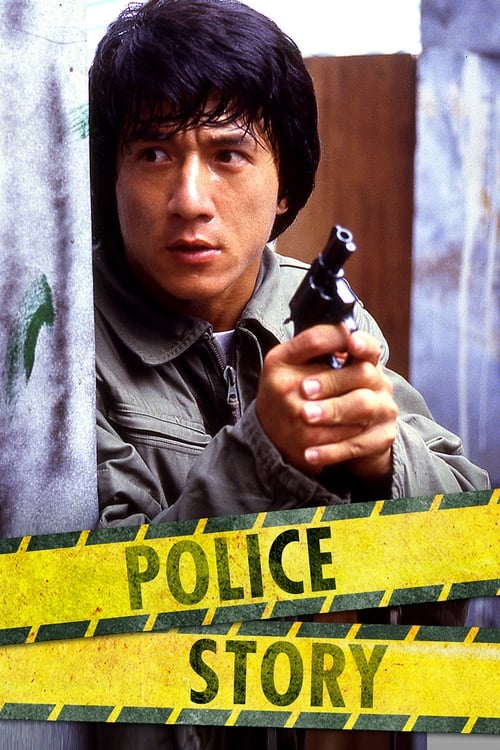
Police Story
1985 · Jackie Chan
For when you want pure adrenaline with a grin — a crowd-pleaser to put on with friends and shout at the screen. Total comfort viewing, as long as your comfort includes wincing at stunts that clearly hurt.
What it's about
A Hong Kong cop takes down a major drug lord almost single-handedly — tearing through a hillside shantytown in the process — and gets rewarded with the worst assignment on the force: babysitting the boss's secretary, the reluctant star witness against him. The gangster wants her silenced, the department wants a poster boy, and officer Chan Ka Kui is stuck in the middle, dodging hitmen, lawyers, and his own furious girlfriend.
The experience
It swings between slapstick farce and genuinely gasp-inducing danger, sometimes in the same scene — you laugh, then you flinch, because the falls are real and the glass is really breaking. The pace barely lets up, and the big set pieces land with a physical jolt no amount of CGI can fake.
Performances
Jackie Chan is the whole show: a comedian's timing welded to a stuntman's body, playing an ordinary guy in over his head while doing things no ordinary body should survive. Brigitte Lin brings real spark as the witness who wants no part of any of it.
The craft
Chan directs his own stunts and shoots them to prove they happened — wide frames, long takes, replays of the biggest hits from multiple angles. The demolition-derby chase through a hillside slum and the shopping-mall finale, all shattering glass and long drops, are landmarks of practical action filmmaking. The bigger the screen, the more your palms sweat.
Why it matters
It reset the bar for what action cinema could physically be, influencing decades of filmmakers and stunt design worldwide, and won Best Film at the first Hong Kong Film Awards. It's the movie that cemented Jackie Chan's signature persona after his Hollywood detour stalled.
Snapshot
Police Story (警察故事, Ging chaat goo si) is the film in which Jackie Chan consolidated the persona that would define his second decade as a star: the ordinary, put-upon civil servant whose body becomes an instrument of escalating physical risk. Produced by Golden Harvest and released in Hong Kong in December 1985, it followed a turbulent period in which Chan had attempted, with mixed commercial results, to crack the American market (The Big Brawl, 1980; the Cannonball Run films). Police Story is often read, with justification, as Chan reclaiming creative authority by doing the thing he did better than anyone: building a movie outward from stunts of his own design, shot to display rather than disguise their danger. The film won Best Film at the inaugural Hong Kong Film Awards for 1985, and its set pieces — a hillside shantytown demolished by cars, a bus pursued on foot, and a department-store finale conducted largely through panes of breakaway glass — became reference points for action cinema worldwide. It launched a franchise (four direct sequels plus loosely related reboots) and is frequently cited by Chan himself as a personal favorite. The synopsis is almost beside the point: a cop, framed and humiliated by the system he serves, fights his way back to legitimacy with his hands, his feet, and his refusal to stop falling.
Industry & production
Police Story was a Golden Harvest production, the studio that had backed Chan since the late 1970s and that functioned as Hong Kong's principal challenger to the older Shaw Brothers regime. By 1985 Chan was among the most bankable stars in Asia, and the production reflected that standing: location-heavy, stunt-intensive, and willing to absorb the costs of physical destruction and reshooting that Chan's working method demanded. The film is closely associated with Chan's own stunt collective, the Jackie Chan Stunt Team (Sing Ga Ban), the troupe of performers — many trained, like Chan, in the Peking Opera school tradition — who absorbed the falls, glass, and impacts the films required. Their willingness to take real injury for real footage is inseparable from the film's aesthetic and its production economics.
The making of Police Story is bound up in Hong Kong industry lore for the toll it took. The opening destruction of a hillside squatter village, in which vehicles plow downhill through flimsy dwellings, and the climactic shopping-mall battle were both notoriously hazardous. The mall sequence's signature image — Chan sliding down a multi-story pole strung with electrified lights and crashing through a glass canopy to the ground — is widely reported to have burned his hands and injured his back, and the production's reputation for sending stunt performers to the hospital earned the shopping center a grim nickname among the crew. These accounts are well established in interviews and behind-the-scenes material, though specific medical particulars should be treated as the kind of oft-repeated lore that resists precise verification. What is not in doubt is the film's organizing principle: real bodies, real glass, real falls, captured by multiple cameras and certified by the outtakes Chan famously ran under the end credits — a convention Police Story helped cement, turning the evidence of danger and failure into part of the entertainment.
Technology
The film was shot on 35mm in a largely naturalistic, available-and-augmented-light idiom typical of mid-1980s Hong Kong commercial production. Its technology is best understood not as novel hardware but as the orchestration of conventional tools toward extreme physical action. The breakaway glass, balsa furniture, sugar-glass panes, and rigged practical effects of the mall finale are stagecraft as much as cinema technology, and the production's real innovation lay in camera deployment: covering a stunt that could be performed only once, or at great cost, with enough simultaneous angles to guarantee a usable, legible take. Slow-motion replays of key impacts — a hallmark Chan would use throughout his career — are an editorial-technological choice meant to let an audience savor a blow that in real time passes too fast to register. There is no significant optical or early-digital trickery here; the film's claim on the viewer is precisely that what is seen was physically done.
Technique
Cinematography
The cinematography serves visibility above all. Chan's stated objection to the prevailing Hollywood action grammar — fast cutting and tight framing that hide the performer — produced a counter-aesthetic of wider lenses, fuller framing, and longer holds that keep the whole body, and often the whole geography of a space, inside the frame. The shantytown chase and the bus pursuit are shot to preserve spatial continuity: the viewer can read where Chan is relative to his targets and his obstacles, so that speed and risk are comprehended rather than merely felt. The department-store finale exploits the transparency and reflectivity of glass to multiply sightlines, layering action across planes. Camera placement is frequently low and frontal, privileging the clean read of an impact over expressive stylization.
Editing
Editing in Police Story is the connective tissue of the gag-structure Chan inherited from silent comedy and Peking Opera staging. Rather than dicing a fight into impressionistic fragments, the cutting tends to let an action beat play, then punctuate it — the celebrated technique of showing a single hard hit two or three times from different angles, or in a brief slow-motion stutter, to register its force. This "impact repetition" stretches screen time at the moment of contact, an editorial rhythm that reads as emphasis rather than confusion. The result is a montage built around clarity and payoff: setup, escalation, climactic blow, and the comic or painful aftermath, each given room to land.
Mise-en-scène / staging
Staging is where Chan's authorship is most legible. Every major sequence is conceived as a problem of space and objects: a hillside of fragile houses to be flattened, a double-decker bus to be chased and boarded, a shopping mall whose escalators, display cases, motorcycles, and chandeliers become weapons and hazards. This is the Buster Keaton inheritance made kinetic — the environment is not a backdrop but the co-star, and the choreography mines it for both danger and comedy. Props are deployed with a Peking Opera performer's sense of rhythm and reversal. The famous telephone-booth fight, in which Chan demolishes a phone box around an opponent, is a miniature of the method: a confined space, a set of breakable materials, and a body finding momentum through them.
Sound
The soundtrack works in the broad, emphatic register of 1980s Hong Kong commercial cinema. Foley is exaggerated for comic and visceral effect — the crack of impacts amplified well beyond realism, in the tradition of martial-arts sound design that treats every blow as percussion. As was standard practice for the period, dialogue was post-synchronized rather than recorded live, with the film released in Cantonese and circulated internationally in multiple dubs. The score and the theme song — Chan, like many Cantopop-era stars, performed associated songs — function to brand the film and its hero as much as to underscore drama; music is mood and identity, not subtle commentary.
Performance
Performance here means the whole expressive economy of Chan's body. As Chan Ka Kui he plays an everyman cop: earnest, comically harried, romantically clumsy with girlfriend May (Maggie Cheung, in an early and largely thankless but warmly played role), and pushed to the edge by institutional betrayal. The acting register is broad and ingratiating between set pieces — closer to physical comedy than to hard-boiled drama — which makes the danger of the action read as the suffering of a sympathetic ordinary man rather than the feats of a superhero. Brigitte Lin as the witness Selina and the antagonists provide the dramatic ballast, but the film belongs to Chan's capacity to make pain, exhaustion, and astonishment legible in motion. His performance is finally indivisible from his stunt work: the face reacting and the body falling are the same instrument.
Narrative & dramatic mode
Structurally, Police Story is a chassis built to carry set pieces, and it knows it. The plot — bust the drug lord, protect the witness, get framed for murder, clear your name — is a serviceable engine of pursuit, humiliation, and vindication. Its dramatic mode oscillates between two poles that Chan welds together: broad situational comedy (the overwhelmed cop juggling a suspicious girlfriend, a skeptical department, and a hostile witness, often via the running gag of multiple ringing telephones) and sincere melodrama of injustice (the honest officer betrayed by a corrupt system and a manipulative criminal). The tonal shifts can be abrupt by the standards of classical Hollywood construction, but they are characteristic of Hong Kong commercial cinema's appetite for mixing modes within a single film. The narrative's real function is to keep raising the stakes of physical confrontation until they can be discharged in the maximal violence of the mall — a structure inherited as much from comedy and the chase film as from the crime thriller.
Genre & cycle
The film sits at a deliberate hinge between genres. It belongs to the contemporary urban action-crime cycle that, in the mid-1980s, was pulling Hong Kong cinema out of the period kung-fu setting and into the modern city — a shift that John Woo's A Better Tomorrow (1986) would push further toward operatic gunplay. Police Story instead carries the empty-hand, prop-driven martial-arts tradition into the cop-thriller frame, fusing the kung-fu comedy Chan had pioneered (Snake in the Eagle's Shadow, Drunken Master, both 1978) with the procedural furniture of the police picture. It thereby helped inaugurate the Hong Kong action-comedy cop subgenre and, more broadly, the "stunt spectacular" mode in which the draw is the verifiable physical feat. Its lineage runs back to the silent slapstick of Keaton and Lloyd as much as forward into the gun-fu and "heroic bloodshed" cycles that would dominate the late 1980s.
Authorship & method
Police Story is an auteur work in an unusually literal sense: Chan directed it, starred in it, performed and designed its stunts, choreographed its action, and (with his stunt team) absorbed its injuries. He shares story and screenplay credit with Edward Tang, his frequent collaborator and one of the key writers who shaped the comic-everyman template of Chan's golden-age vehicles. The action direction is the work of Chan and his stunt team rather than an external choreographer, which is precisely the point — the film's signature is the indivisibility of direction, performance, and stunt design in a single sensibility.
Among collaborators, the most consequential are institutional and collective: Golden Harvest's production backing, which tolerated the cost and risk of his method; and the Jackie Chan Stunt Team, whose loyalty and skill made the multi-take, multi-angle approach feasible. The film's craft contributions — cinematography, editing, music — serve a coherent, performer-centered vision rather than asserting independent authorship; this is a body-first cinema in which the camera and cutting exist to certify and clarify what the body does. The end-credit outtakes are Chan's authorial signature made explicit: a paratext that frames the entire film as documentary evidence of real labor and real danger, and that invites the audience to value the work as much as the illusion. Specific below-the-line credits beyond the principal collaborators are not all equally documented in English-language sources, and I won't attribute roles I can't verify.
Movement / national cinema
The film is a landmark of the Hong Kong commercial cinema of its golden age — not of the more festival-oriented Hong Kong New Wave, but of the populist mainstream that ran parallel to it. It exemplifies the industrial vitality of mid-1980s Hong Kong: a small territory producing films of extraordinary kinetic ambition for a regional Chinese-language market and an expanding international cult audience. The Peking Opera training shared by Chan and many of his collaborators — the famous "Seven Little Fortunes" lineage that also produced Sammo Hung and Yuen Biao — is the deep substrate here, supplying the acrobatic, prop-and-rhythm-driven physical vocabulary that distinguishes Hong Kong action from its Hollywood and Japanese counterparts. Police Story is one of the purest expressions of that national-cinematic identity: locally rooted, globally legible through the universal language of the body in motion.
Era / period
1985 sits at the threshold of Hong Kong cinema's most celebrated stretch, the years before the 1997 handover concentrated the industry's energy and anxiety. Police Story belongs to the moment when contemporary settings, urban modernity, and ever-escalating production values were displacing the period costume film. It also reflects Chan's personal pivot after his unsatisfying American sojourn: a reassertion, on home ground and on his own terms, of a method Hollywood had not known how to use. The film's confidence — its willingness to spend bodies and budget on spectacle few other industries would attempt — is the confidence of an industry and a star at a creative peak.
Themes
For a film so devoted to motion, Police Story carries a consistent thematic charge: the honest individual against institutional indifference and corruption. Chan Ka Kui is humiliated by the bureaucracy he serves, framed by the system, and ultimately driven to settle matters with his own body when the machinery of justice fails him. There is a populist, even anti-authoritarian streak in this image of the lone good cop crushed between criminals and a self-protecting establishment — a theme that resonated across Hong Kong's action cinema of the era. Beneath that runs a quieter meditation on labor and the body: the film's whole apparatus insists that we watch a man literally hurt himself in the service of his work, and the outtakes turn that into the film's emotional close. Comedy and pain are not opposites here but the same continuum, the everyman's dignity asserted through what his body can endure.
Reception, canon & influence
Police Story was a major commercial success in Hong Kong and won Best Film at the inaugural Hong Kong Film Awards (honoring 1985), an early sign that the industry's critical establishment was prepared to take Chan's populist craft seriously. Over time it has hardened into canon: it appears routinely on lists of the greatest action films, is the subject of restoration and reappraisal in the West (including a Criterion Collection release that paired it with its 1988 sequel), and is widely regarded as the definitive statement of Chan's directorial and stunt artistry. Chan has repeatedly named it among the films he is proudest of.
Looking backward, the film's influences are explicit: the silent physical comedy of Buster Keaton and Harold Lloyd, whose architecture-and-objects gags Chan openly revered and adapted; the Peking Opera stage tradition of his training; and the kung-fu comedy idiom Chan himself had helped invent in the late 1970s. Looking forward, its legacy is enormous. Police Story spawned a long-running franchise (Police Story 2, 1988; Police Story 3: Super Cop, 1992; and later entries and reboots) and helped establish the contemporary Hong Kong action-comedy as an exportable global form. Its visibility-first action grammar — wide framing, sustained takes, impact repetition, and the proof-of-danger outtake reel — became a template emulated and homaged for decades, and is frequently invoked as a corrective model by Western filmmakers and critics dissatisfied with incoherent, over-cut action. Its DNA is visible in later stunt-forward cinema that prizes legible, performer-driven spectacle, and in the global recognition that eventually made Jackie Chan, on the strength of films like this one, one of the most influential action performers in cinema history.
A Deleuzian reading
Open on the pole.
The full Deleuzian reading of Police Story →
Reception
A smash in Hong Kong — it won Best Film at the 1986 Hong Kong Film Awards — but barely registered in the West for years; now, after decades of VHS-trader devotion and a Criterion release, it's routinely called one of the greatest action films ever made.
How Police Story was received, from release to now →
Influences: the films it descends from and the films it influenced
- Safety Last! (1923) — Lloyd's clock-tower 'thrill comedy' established the principle Chan inherits — comedy and genuine physical peril fused on a real performer's body at real height, with the camera held wide so the audience certifies the danger is unfaked.
- Steamboat Bill, Jr. (1928) — Keaton's collapsing-facade gag is the template for Chan's architecture-and-objects choreography: turning a built environment and its breakaway hazards into the antagonist, performed by a deadpan everyman in unbroken full-figure framing.
- The General (1926) — Keaton's insistence on spatial legibility — staging stunts in continuous wide shots so geography reads cleanly — is the direct grandfather of Chan's spatial-continuity action grammar.
- Enter the Dragon (1973) — Bruce Lee codified the full-body framing of martial combat for a global audience; Chan defines himself against Lee's invincibility but keeps the wide, head-to-toe shot that lets a strike's full kinetic arc be seen.
- Snake in the Eagle's Shadow (1978) — The film that launched Chan's kung-fu-comedy idiom — combining Peking Opera acrobatics with slapstick timing and an underdog everyman, the comic-physical persona Police Story transplants into modern dress.
- Drunken Master (1978) — Established Chan's signature of improvising fights from props and environment and of impact-repetition cutting (the same blow shown twice to register force), both carried wholesale into Police Story.
- Project A (1983) — Chan's own immediate precursor: the clock-tower fall openly homages Harold Lloyd and pioneers his proof-of-danger ethos and end-credit outtake reel, the paratext Police Story formalizes.
- Sherlock Jr. (1924) — Carries the real-injury physical-stunt-comedy lineage Keaton pioneered — Chan performs his own bone-breaking set-pieces in long takes and openly names Keaton as his model.
- Police Story 2 (1988) — Direct sequel that extends the set-piece-chassis structure and multi-camera stunt coverage, climaxing in another industrial-demolition finale built on breakaway hazards and explosive impact.
- Police Story 3: Super Cop (1992) — Pushes the proof-of-danger ethic further with Chan and Michelle Yeoh performing vehicle-top stunts on a moving train and helicopter, retaining the outtake reel as documentary certification of real labor.
- Rumble in the Bronx (1995) — Chan's North American breakout exports the Police Story formula intact — environmental choreography (the alleyway hovercraft, the appliance-shop brawl) shot wide, with the closing-credit blooper reel as signature.
- Ong-Bak: Muay Thai Warrior (2003) — Tony Jaa's wire-free, CGI-free manifesto borrows Chan's certification grammar directly — replays each stunt from multiple angles and runs failed-take outtakes to prove the performer truly did it.
- District 13 (2004) — Translates Chan's environmental choreography into parkour, treating the built cityscape as an obstacle course traversed by real performers in legible wide takes rather than cut-driven illusion.
- The Raid: Redemption (2011) — Evans's stairwell-and-corridor fights revive Chan's spatial-continuity ideal — sustained, full-body framing where the audience always knows where bodies are in the architecture — as a corrective to over-cut Western action.
- John Wick (2014) — Stunt-team-turned-directors explicitly cite Chan in shooting gunfights in wide, sustained takes so choreography reads, prizing the visible, performer-driven spectacle Police Story championed.
- Mad Max: Fury Road (2015) — Carries forward the practical-stunt, real-danger ethos — pole-cats and vehicle work performed by visible human bodies and clarified through coverage rather than faked, the legible-spectacle lineage Chan certified.
- Everything Everywhere All at Once (2022) — Its prop-comedy fights (the fanny-pack and dildo set-pieces) are direct love letters to Chan's improvised-object choreography and physical-comedy-everyman timing, staged for the same legibility.
- The Raid (2012) — Chan's insistence that the stunt performer and actor be the same body — physical cost rendered genuinely visible on screen — established the performer-as-spectacle philosophy Evans extends by casting Iko Uwais and Yayan Ruhian, actual Pencak Silat practitioners, so that technique and performance are inseparable rather than doubled by a stunt double.
- Confession of Murder (2012) — Establishes long-duration practical stunt photography as an ethical and aesthetic contract: the camera's extended attention to bodies performing real danger functions as authenticity guarantee, the standard Jung's action sequences inherit over CGI substitution.
- The Matrix Revolutions (2003) — Hong Kong action's geographically legible, full-body wire-and-stunt choreography fed Yuen Woo-ping's fight design for the rain-soaked Neo/Smith aerial duel.
- Wheels on Meals (1984) — Made a year earlier with the same Golden Harvest stunt-comedy unit, it perfects the environmental, prop-driven duel (Chan vs. Benny Urquidez) whose object-choreography logic Police Story scales up to a whole city.
- Mission: Impossible - Fallout (2018) — Model of the star as practical-stunt author whose real, unfaked physical risk (and visible injury) becomes the film's verifiable spectacle — the ethos behind Cruise's actual ankle-breaking rooftop leap.
Similar films
- Police Story 3: Super Cop (1992) — influence & lineage
- Enter the Dragon (1973) — influence & lineage
- Ip Man (2008) — often watched together
- Hard Boiled (1992) — shared sensibility
- A Better Tomorrow (1986) — shared sensibility
- The Killer (1989) — shared sensibility
- The Mission (1999) — shared sensibility
- Duel to the Death (1983) — shared sensibility
All the films related to Police Story →