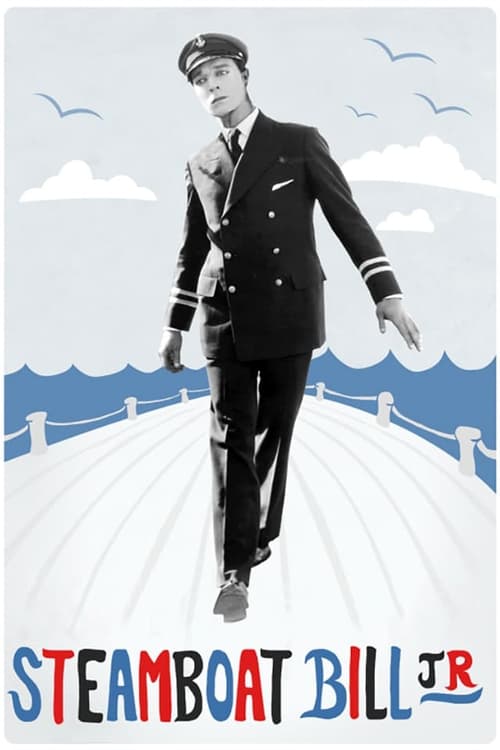
Steamboat Bill, Jr.
1928 · Charles Reisner
When you need a good laugh and a reminder of what movies could do before anyone could fake it — great for a night when you want delight without a single wasted minute. Total comfort, even at its most death-defying.
What it's about
A dainty, ukulele-toting college boy arrives in a Mississippi river town to meet the father he hasn't seen since infancy — a mountain of a steamboat captain who takes one horrified look at his son's beret and pencil mustache. While the old man tries to make a riverman out of him, Willie falls for the daughter of his father's wealthiest rival, and then a cyclone arrives to rearrange the entire town.
The experience
Pure joy with an undertow of astonishment — it ambles along as a charming father-son comedy and then erupts into one of the most jaw-dropping stretches of physical comedy ever filmed. You laugh, and then you gasp, and then you laugh at yourself for gasping.
Performances
Buster Keaton, deadpan amid chaos, doing stunts no studio would permit today — including the legendary falling house facade, performed for real with inches to spare. Ernest Torrence is a perfect gruff foil as the father.
The craft
The cyclone climax is a marvel of engineering and nerve: full-size buildings collapsing, whole streets torn apart, and Keaton performing in the middle of it all without trickery. Nearly a century on, the gag construction — each setup paying off with mechanical elegance — still plays like a masterclass. See it big if you ever can.
Why it matters
One of the crowning works of silent comedy and of Keaton's independent period, its falling-facade stunt is among the most referenced images in film history, endlessly homaged by comedians and action directors alike.
Snapshot
Steamboat Bill, Jr. is one of the last films Buster Keaton made as an independent producer-star, and by broad critical consensus one of the finest. Nominally directed by Charles Reisner, it is understood in Keaton scholarship as a Keaton film in every meaningful sense: he was the star, the controlling comic intelligence, and the architect of its gags. The story is slight by design — a foppish, ukulele-strumming college graduate, William "Willie" Canfield, Jr. (Keaton), arrives in the river town of River Junction to meet the gruff, mountainous steamboat captain father (Ernest Torrence) he has not seen since infancy, and promptly falls for Kitty King (Marion Byron), the daughter of his father's wealthy rival. From that premise the film builds toward a cyclone climax that remains among the most celebrated sustained set pieces in silent cinema, and that contains the single most famous stunt Keaton ever performed: the collapsing house facade whose open attic window passes cleanly over his motionless body. The film underperformed commercially on release, and its disappointment helped push Keaton into the MGM contract that would curtail his creative independence — a biographical irony that shadows the picture's reputation as a peak.
Industry & production
The film was made by Buster Keaton Productions under the aegis of producer Joseph M. Schenck, Keaton's brother-in-law and longtime backer, and released through United Artists in the spring of 1928. This arrangement placed Keaton among the era's genuinely independent comedian-auteurs, a model in which the star controlled his own unit, developed material collaboratively with a stable of gag writers, and shot largely on location and on his own schedule. Steamboat Bill, Jr. stands near the end of that arrangement. Within months Schenck folded Keaton's independent operation and moved him to Metro-Goldwyn-Mayer, a large, hierarchical studio whose assembly-line methods were fundamentally hostile to Keaton's improvisatory, gag-first working practice. Keaton himself later described the MGM move as the worst decision of his career, and Steamboat Bill, Jr. is thus routinely framed as the last full flowering of his autonomy before that decline.
Production is best remembered for the cyclone sequence, which required a large riverfront set — reportedly built along the Sacramento River in California — that was systematically destroyed by wind machines and rigged collapses. The famous building-front gag was, by every account, executed for real with no optical trickery: a heavy facade was dropped over Keaton, who stood on a precisely marked spot so that a pre-cut second-story window opening passed around him. The commonly repeated account, much of it stemming from Keaton's own later recollections, holds that the clearance was only a few inches and that crew members were unwilling to watch. Those anecdotal details should be treated as the received tradition rather than independently documented measurement; what is not in dispute is that the stunt was performed practically and in a single take, and that its danger was real.
Reliable box-office figures for the film are not something the historical record supplies with precision, and this dossier will not invent them; the secure claim is the qualitative one, well attested in Keaton biography, that the picture did not recoup as hoped and factored into the dissolution of his independent unit.
Technology
The film is a product of late-silent Hollywood technology: 35mm black-and-white photography on the orthochromatic stock standard before panchromatic film became widespread, hand-cranked or motor-driven cameras, and projection designed for a live musical accompaniment rather than a recorded track. It was made and released at the precise hinge of the sound transition — The Jazz Singer had appeared in 1927, and the industry-wide conversion to synchronized sound was already underway — which lends the film a valedictory quality as one of the last major works of pure silent comic technique.
Its most significant "technology," however, is mechanical and practical rather than photographic. The cyclone finale is built from wind machines, breakaway construction, collapsing walls, flying debris, and buildings rigged to disintegrate on cue. The signature falling-facade gag is the antithesis of trick photography: its entire effect depends on the audience understanding that the wall is genuinely massive and the performer genuinely beneath it. In an era when comic spectacle could be faked through under-cranking, doubles, or in-camera effects, Keaton's method was to make the peril literal and photograph it plainly, so that the camera functions as a witness rather than a conjurer.
Technique
Cinematography
The photography is credited to Bert Haines and Devereaux Jennings, cinematographers associated with Keaton's unit. Their style here is characteristically clean and functional in the Keaton manner: wide framings that keep the performer's whole body and his spatial relationship to the environment legible, minimal camera movement, and compositions that give physical gags room to read without cutting. This transparency is a deliberate aesthetic. Because so many of the film's effects depend on the viewer believing what they see — that the wall is real, that the wind is real, that Keaton is truly where he appears to be — the camera is positioned to certify space rather than to editorialize. The framing of the falling-facade shot is the definitive example: a stable, unbroken view that lets the geometry of the near-miss speak for itself.
Editing
The editing follows silent-comedy logic in which the cut serves the gag's clarity and rhythm, holding wide when the comedy is spatial and cutting only to sharpen a reaction or a reveal. The specific editorial credit on the film is not something the record fixes with confidence, and rather than attribute it speculatively this dossier notes the gap; what can be said securely is that the film's construction reflects the Keaton unit's house style, in which cutting is subordinated to the integrity of the physical performance.
Mise-en-scène / staging
Staging is where the film is richest. The production designs its world as a machine for comedy — the rickety steamboat, the rival's gleaming new vessel, the jail, the hospital, and above all the town that the cyclone dismantles. The celebrated storm sequence is a tour de force of environmental staging: entire building fronts topple, Keaton is blown down streets, and the physical set is choreographed to threaten and reconfigure around him. The falling-facade gag is the apotheosis of this principle, an image in which the set itself becomes the antagonist and survival is a matter of standing on exactly the right square foot of ground. Earlier, the film mines quieter staging comedy from confinement and mismatch — the running gag of a hat shop, in which Keaton's father tries to replace his son's effete beret with something more manly, is staged as a compact study in paternal disappointment.
Sound
The film was produced as a silent and carried no synchronized recorded soundtrack; it was designed for live musical accompaniment that would vary by venue, from a lone pianist to a full orchestra. There is no single "original score" to attribute, and various composers have written accompaniments for later restorations and home-video releases. Any specific scoring a modern viewer encounters is therefore a subsequent addition rather than an authorial element of the 1928 work, and should be understood as such.
Performance
Keaton's performance is the film's spine and the fullest expression of his comic persona: the "Great Stone Face," whose refusal to register emotion becomes the fixed point against which chaos is measured. His Willie is introduced as a citified dandy — pencil mustache, beret, ukulele — and the comedy of the first half turns on the gulf between this softness and his father's granite masculinity. Ernest Torrence, as Steamboat Bill Sr., gives the film its ballast: a large, glowering presence whose gradual, grudging paternal warmth supplies the emotional stakes that the storm then literalizes. Marion Byron is charming as Kitty. But the performance that endures is physical: in the cyclone, Keaton's absolute bodily commitment — the stillness inside catastrophe, the exact timing on which his life depends — turns stunt work into a kind of existential acting.
Narrative & dramatic mode
The dramatic mode is romantic comedy braided with a father-son reconciliation and capped by disaster spectacle. Structurally the film is patient, almost leisurely, in its first two acts, investing in character and situation — the reunion that curdles into disappointment, the forbidden romance across a business rivalry, the son's failure to measure up — before releasing all of that accumulated tension into the physical apocalypse of the finale. The narrative engine is the classic comic arc of inadequacy redeemed: the effete boy who cannot please his father becomes, in the crucible of the storm, the hero who rescues father, sweetheart, and rival alike. The cyclone is not a detour from the story but its emotional resolution rendered as pure kinetic event; Willie proves himself precisely when the world falls apart and he alone remains upright — sometimes literally.
Genre & cycle
The film belongs to the great cycle of American silent feature comedy of the 1920s, the mature phase in which the short-subject slapstick tradition of the 1910s had been extended into character-driven features by Keaton, Charlie Chaplin, and Harold Lloyd. Within Keaton's own body of work it sits with The General, Sherlock Jr., Our Hospitality, and The Navigator as a feature built around a large mechanical or environmental system — here the river, the steamboats, and the storm — that the persona must master. It also participates in a disaster-comedy lineage in which natural catastrophe becomes the stage for physical heroism. Its title nods to the popular song "Steamboat Bill," and it shares a naming coincidence with Disney's Steamboat Willie, released the same year — a coincidence of the moment rather than a documented influence in either direction, and best flagged as such.
Authorship & method
The authorship question is central. The directing credit belongs to Charles Reisner (sometimes rendered Charles F. Riesner), a capable studio director; but the scholarly and biographical consensus, grounded in how Keaton's unit demonstrably worked across his independent features, is that Keaton was the film's true creative author — devising and staging its gags, controlling its physical comedy, and shaping its rhythm. The distance between the paper credit and the creative reality is itself a recurring feature of Keaton's career and a reason his directorial genius was undervalued for decades.
The story and scenario are credited to Carl Harbaugh, a writer associated with Keaton's productions. Cinematography is credited to Bert Haines and Devereaux Jennings. The film had no original composer, being silent. The specific editor is not securely fixed in the record, and this dossier declines to guess. The method, in sum, was the collaborative gag-development practice of the Keaton unit: build the mechanical and environmental premises, then discover and refine the comedy through physical experimentation, with Keaton as the final arbiter of what worked.
Movement / national cinema
This is Hollywood cinema at the summit of the silent era, and specifically a product of the independent-producer model that briefly flourished within the American industry before consolidation. It belongs to no avant-garde movement; its lineage is the homegrown American slapstick tradition that ran from Mack Sennett's Keystone shorts through the feature comedians of the 1920s. Yet Keaton's rigorous, architectural sense of space and his fascination with machinery have long invited comparison to more self-conscious modernist sensibilities, and later critics — particularly in France — would claim him for a canon of cinematic artists rather than mere entertainers.
Era / period
Steamboat Bill, Jr. is a threshold work of 1928, made as synchronized sound was overtaking the industry. Its perfection of silent physical storytelling arrives at the very moment that idiom was being rendered commercially obsolete, which gives the film a retrospective poignancy. It is also a threshold in Keaton's life: the end of his independence and the prelude to the MGM years that diminished him. The picture therefore sits at a double sunset — of the silent form and of its maker's autonomy — a period pressure that critics have read into the film's imagery of a world literally blown apart.
Themes
Beneath the comedy runs a coherent set of concerns. The most prominent is masculinity and paternal expectation: the film stages a son's failure to embody his father's idea of manhood and his eventual redemption on those terms, though Keaton complicates any simple resolution by letting the "soft" son's ingenuity, not brute strength, save the day. A second theme is the individual dwarfed by overwhelming systems — familial, economic, meteorological — and the comic dignity of remaining upright within them; the storm literalizes a helplessness the persona meets with unflappable competence. A third is class and rivalry, the King–Canfield feud that structures the romance. And threaded through all of it is Keaton's signature theme of the human body negotiating a hostile physical world through precision, timing, and stoic will.
Reception, canon & influence
On release the film was a commercial disappointment, a fact that carries real weight in Keaton's story because it contributed to the end of his independent unit; the film thus arrived under-appreciated relative to its later stature. Its critical reputation grew enormously across the twentieth century, rising with the broader mid-century reappraisal of Keaton as one of cinema's supreme artists — a reassessment led in significant part by French critics and by the eventual rediscovery and restoration of his silent features. Today it is widely regarded as one of Keaton's essential works and a canonical silent comedy.
Influences on the film flow from the American slapstick tradition — the short-comedy grammar of Sennett-era Hollywood extended into feature form — and from the popular riverboat and disaster iconography of its moment, including the song that lends the title. Its influence forward is enormous and concentrated in a single image. The falling-facade stunt has become one of the most quoted shots in film history, restaged and paid homage to across generations of physical comedy and action filmmaking — Jackie Chan is the most frequently cited inheritor, an action-comedian who has repeatedly invoked Keaton as a model and reprised the falling-wall gag in his own work. More broadly, the film's insistence on real, unfaked danger, its architectural staging of comedy in physical space, and its demonstration that spectacle and character can resolve in a single kinetic event have made it a touchstone for filmmakers who prize practical stunt work over illusion. That its greatest effect is not a joke but a matter of life and death, played with a blank face and perfect stillness, is precisely what has kept it studied and imitated for nearly a century.
Reception
A box-office disappointment in 1928 — it was Keaton's last independent film before the fateful move to MGM that he called the worst mistake of his life — it's since been canonized as one of the summits of silent comedy, preserved in the National Film Registry.
How Steamboat Bill, Jr. was received, from release to now →
Influences: the films it descends from and the films it influenced
- Back Stage (1919) — First iteration of the collapsing-building-facade gag in which Keaton is spared by an open upper-story window, establishing the exact mechanical premise later perfected in the cyclone sequence.
- One Week (1920) — Turns a storm and a self-destructing house into a mechanized architectural antagonist the deadpan hero must physically survive, prototyping the building-as-set-as-adversary logic.
- Tillie's Punctured Romance (1914) — Codifies the Keystone short-comedy grammar of escalating physical mayhem that Keaton absorbed and re-engineered into architecturally-motivated, cause-and-effect feature gags.
- The General (1926) — Stages a full-scale locomotive as both physical antagonist and playing field, resolving spectacle and character in real large-scale practical destruction with no models or trickery.
- Modern Times (1936) — Literally feeds the individual through industrial machinery, extending Keaton's individual-dwarfed-by-systems staging into physical gags where the mechanized environment is the antagonist.
- Playtime (1967) — Places a deadpan human figure inside wide, deep-focus transparent framing where the built environment itself generates the comedy, extending architecture-as-antagonist into modernist space.
- Police Story (1985) — Resolves comedy and danger in single unfaked kinetic stunts performed by the star himself, carrying Keaton's practical-stunt ethos and architectural staging directly into action cinema.
- Project A Part II (1987) — Directly restages the falling-facade stunt — Chan spared by an open window as the wall crashes down — as explicit, self-acknowledged homage to Keaton.
- Mad Max: Fury Road (2015) — Insists on real, physically-staged vehicular stunt spectacle over digital trickery, keeping the danger legible precisely because it is actual, per the Keaton no-illusion principle.
- Mission: Impossible – Fallout (2018) — Grounds its thrill in star-performed practical stunts where the audience's knowledge that no trickery substitutes for genuine risk is the whole point, the direct inheritance of Keaton's method.
- Ratatouille (2007) — Keaton's architectural physical comedy — a small body navigating and being menaced by hostile mechanical environments — is the blueprint for the kitchen-as-deathtrap choreography.
- Black Cat, White Cat (1998) — Origin of the in-camera physical gag built on collapsing structures and precisely timed bodily peril, the practical slapstick mechanics Kusturica stages with pigs, geese and a wedding cake.
- Mon Oncle (1958) — The falling-facade gag establishes the contract Tati keeps with the Arpel house: architecture as verifiable physical fact staged in one unbroken wide shot, the joke legible in the frame itself with no cut to a reaction.
- Safety Last! (1923) — Builds thrill-comedy on genuine high-rise peril whose effect depends on the audience knowing the danger is unfaked — the same practical-stunt-no-trickery contract Keaton signs with the falling wall.
- Our Hospitality (1923) — Pits the great-stone-face hero against a real natural hazard (a waterfall rescue) staged with actual physical risk rather than trick photography or a set-bound illusion.
- Sherlock Jr. (1924) — Executes life-threatening real stunts like the water-tower fall with total facial stillness, subordinating cutting to the unbroken physical event exactly as the cyclone gag does.
- The Navigator (1924) — Treats an entire full-scale ship as a mechanical playground-antagonist, discovering gags through physical experimentation with the environment rather than through montage.
- Seven Chances (1925) — Converts a downhill boulder avalanche into an escalating environmental antagonist chasing a passive runner, the landscape-as-adversary counterpart to the cyclone.
Similar films
- The General (1926) — influence & lineage
- Sherlock Jr. (1924) — influence & lineage
- Modern Times (1936) — influence & lineage
- The Kid (1921) — shared sensibility
- City Lights (1931) — shared sensibility
- Deliverance (1972) — shared sensibility
- Battleship Potemkin (1925) — shared sensibility
- It's Such a Beautiful Day (2012) — shared sensibility