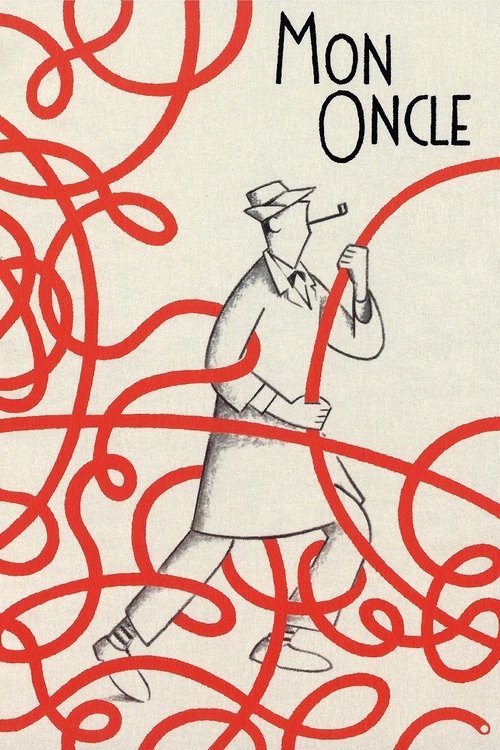
Mon Oncle
1958 · Jacques Tati
For a relaxed afternoon when you want to smile for two hours straight without a single joke being shouted at you — pure comfort viewing that still gives your eyes and brain plenty to do.
What it's about
Monsieur Hulot — pipe, raincoat, forward-tipping walk — lives happily in a ramshackle, sociable old Paris quarter, while his sister's family occupies an ultra-modern suburban villa where every gadget has a switch and every switch misbehaves. Hulot drifts between the two worlds, mostly to spirit away his young nephew, while his sister schemes to fix him up with a job at her husband's plastics factory and a suitable wife.
The experience
Gentle, nearly wordless comedy that works by accumulation: you watch the frame like a puzzle, spotting little gags going off in corners, and the laughs sneak up rather than land with a bang. It's playful and unhurried, with a quiet melancholy about a neighborhood way of life on its way out.
Performances
Jacques Tati's own Hulot is a marvel of physical comedy — a whole character built from posture, hesitation, and a walk, with barely a line of dialogue.
The craft
Tati builds his comedy architecturally: the crumbling old quarter and the gleaming modernist villa are two full-scale worlds designed down to the last absurd fountain and squeaking cushion, and the gags come from how people move through them. Sound is used like music — hisses, clicks, and footsteps do the work dialogue usually does — and the dense, wide-shot staging genuinely rewards a big screen where you can hunt the frame for jokes.
Why it matters
It won the Academy Award for Best Foreign Language Film and cemented Tati as one of comedy's great formal inventors, and its satire of gadget-driven modern living has echoed through visual comedy ever since.
Snapshot
Mon Oncle is the film in which Jacques Tati's comic system turned outward from the seaside holiday of Les Vacances de Monsieur Hulot (1953) and onto the material reconstruction of postwar France. Monsieur Hulot — pipe, raincoat, striped socks, umbrella, forward-tipping walk — is set between two worlds that the film builds as competing architectures: the Saint-Maur quarter, an old, crumbling, sociable neighborhood shot as a warren of stairs, courtyards, cafés and market stalls; and the Villa Arpel, a purpose-built modernist house belonging to his sister and her plastics-manufacturer husband, where every object has a function, every function has a switch, and the switches keep failing. The film's plot is thin by design: the Arpels attempt to normalize Hulot by finding him a job at Plastac and a wife next door, and their nephew Gérard prefers his uncle's world to theirs.
It was Tati's first film in color and his largest production to date, and it became his most internationally decorated: it won the Special Jury Prize at Cannes in 1958 and the Academy Award for Best Foreign Language Film for that year, giving Tati a level of official recognition he would never have again. The commercial and critical success of Mon Oncle is inseparable from what followed: it funded the ambition, and encouraged the scale, of Playtime (1967), the film that would ruin him financially. Mon Oncle is therefore both the culmination of Tati's accessible period and the sketch — in one house rather than a whole city — of the architectural comedy he would attempt at full scale a decade later.
Industry & production
Tati made Mon Oncle through his own production company, Spectra Films, which he had established to keep control of his projects after the success of Jour de fête (1949) and Les Vacances de Monsieur Hulot. The film was a French–Italian co-production, a standard structure in the late 1950s that gave French producers access to Italian financing and distribution; Tati's arrangement produced an Italian-language version, Mio zio, alongside the French release, and a partially reshot English-language version, My Uncle, in which some signage and dialogue fragments were changed for Anglophone markets. These parallel versions were not simple dubs — Tati reshot or re-staged material for them, a habit that reflects his conception of a film as a re-workable object rather than a fixed negative. He would return to that habit destructively later, recutting Playtime and Jour de fête over the years.
Production was long and expensive by French standards. Tati worked slowly, building and rebuilding gags on set, shooting far more than he used, and treating pre-production design as a primary rather than supporting activity. The Villa Arpel was constructed as a set — at the Victorine studios in Nice, with additional Paris-area work — rather than found, because no existing house could have delivered the exact geometry the gags required: the two round upstairs windows that become eyes when both Arpels look out, the sight lines that let the fish fountain be switched on and off in perfect rhythm with the doorbell, the garden path that forces guests into a stiff diagonal shuffle. The old quarter, likewise, was partly constructed rather than located. Tati's method of building both worlds gave him total control of the frame and total control of the budget's direction — most of the money went into space.
The film's success was substantial: strong domestic performance, the Cannes Special Jury Prize, the foreign-language Oscar, and wide international distribution. Precise admissions and grosses vary between sources and I will not assert figures here, but the outcome is undisputed in its consequence — it made Tati, briefly, a director who could raise money for anything, and he spent that credit on Playtime, building the "Tativille" set outside Paris. The trajectory from Mon Oncle's success to Playtime's bankruptcy is one of the clearest cases in postwar European cinema of an auteur's prize-winning hit financing his own artistic overreach.
Technology
Mon Oncle was Tati's first completed film in color, and the color is doing argumentative work. He had shot Jour de fête with an experimental French color process, Thomson-color, in 1947–49, but the process could not be reliably printed at the time and the film was released in black-and-white; a color version was only assembled decades later, after Tati's death, from the surviving color negative. Mon Oncle was shot in Eastmancolor, the single-strip negative stock that had by the mid-1950s displaced Technicolor's three-strip system across most of world production and made color affordable for a mid-budget European film.
Tati used it as a design system rather than as spectacle. The old quarter is rendered in warm, desaturated, dirty tones — ochre plaster, gray stone, faded shopfronts — while the Villa Arpel is a scheme of cold grays, sterile whites, pale greens and turquoise, with the garden's gravel and the fountain's pale stone fish keyed to the same chilly register. The Arpel kitchen's appliances gleam; the neighborhood's surfaces absorb light. Color is the fastest carrier of the film's central opposition, working before any gag begins.
The production also foregrounds a technology as subject. Arpel's factory makes plastic hose — the Plastac sequence, in which Hulot's inattention produces a run of lumpy, sausage-like tubing, is a joke about extrusion, tolerance and quality control, made at the exact historical moment when plastics were reorganizing French domestic life. The house itself is a catalog of consumer technology of the late 1950s: the automated garage door with its electric eye, the push-button kitchen, the intercom-like fittings, the fountain that is switched on for visitors and off for tradesmen. Tati's comedy is not anti-machine in a Luddite sense; the machines work. What fails is the fit between machines and bodies.
Technique
Cinematography
Photographed by Jean Bourgoin, whose long career included work with Renoir and Clément and who would later shoot part of The Longest Day, Mon Oncle is built almost entirely in wide and medium-wide shots at a level, slightly distanced eye. Tati's camera is famously undemonstrative: it does not push in for a reaction, does not cut to a close-up of an object to tell you a gag is coming, and rarely moves except to reframe. The effect is to convert the screen into a stage on which several things happen at once, and to hand the work of noticing to the viewer. This is the formal core of Tati's authorship, and it is often described — accurately — as a democratic style: the film does not point.
Compositionally, the film is organized by frames within the frame. Doorways, windows, gates, the trellis of the Arpel fence, the beaded curtains and archways of the old quarter all subdivide the image into zones where separate small events run in parallel. The most quoted image in Tati's whole body of work is the Villa Arpel façade at night with its two round windows lit, the parents' heads moving in them like pupils in a pair of eyes — a single static composition that makes the house a face, and makes the joke architectural rather than performed. In depth, Tati stages action from foreground to far background with everything held in adequate focus, so that a gag in the rear third of the shot competes for attention with the ostensible subject.
Editing
The cutting, credited to Suzanne Baron — an editor of significant standing who had worked in Bresson's and Louis Malle's orbit — is patient and shot-respecting. Shots are held long past the point where conventional comedy would cut, because the gag frequently needs duration: a rhythm has to establish before it can be broken. Tati's comic units are often built on repetition-with-variation across a sustained take — the fountain switched on, off, on; the Arpel guests circling the garden; Hulot's approach to his own apartment traversing an improbable zig-zag of stairs, landings and windows, presented in a single ascending composition rather than a series of cuts.
Editing serves juxtaposition at the macro scale as well: the film alternates blocks between the two worlds, and the shift is felt as a change in color temperature, sound density and human traffic before any narrative information arrives. Baron's work here is not invisible in the Hollywood sense — it is measured, and its restraint is the point. The film's celebrated slowness relative to American screen comedy of the period is a deliberate refusal of the reaction shot and the punchline cut.
Mise-en-scène / staging
This is the film's dominant expressive channel, and where its historical importance mainly sits. The Villa Arpel, designed with Tati's regular collaborator Jacques Lagrange (a painter who worked with Tati on the conception of his films' visual worlds), is one of the most consequential production designs in postwar cinema — a comic critique of International Style modernism executed with enough precision that it functions as real architecture. Its stepping-stone garden path, its kidney and geometric forms, its lawn that must not be walked on, its fish fountain, its dust-free surfaces, its window shapes: every element is both a plausible piece of design magazine modernism and a machine for producing bodily awkwardness. The house makes people walk wrong.
Against it, the old quarter is staged as a continuous social space: café, market, street dogs moving in a pack across cuts, workmen, children, a horse-drawn cart in the same frame as a car. Hulot's building is the counter-emblem to the Villa — an improvised vertical maze whose logic is accretion rather than plan, and whose most famous gag is a beam of sunlight that Hulot redirects by pivoting a window, so that a caged bird sings only when the light hits it. That gag is the film's thesis in miniature: the old world's technology is an unplanned side effect, and it produces pleasure; the new world's technology is planned, and it produces friction.
Staging is also how Tati manages his crowds. Human figures are arranged in the frame as graphic elements — the pack of dogs, the queue of guests, the schoolchildren, the two men at the roadside whom the boys trick into colliding. Tati choreographs traffic, not characters.
Sound
Tati's soundtracks are constructed entirely in post-production; nothing in Mon Oncle is meaningfully synchronous location sound. Dialogue is deliberately demoted to the status of noise — audible, sometimes semantically legible, often reduced to a burble of social formulae from which only phrases surface ("C'est joli, hein?" in the Arpels' idiom of self-congratulation). Because the film's meaning is carried visually, it plays with almost no subtitling loss, a fact that helps explain its international reach.
What replaces dialogue is a designed acoustic world. The Villa Arpel is a hard-surfaced echo chamber: the clack of Madame Arpel's heels on stone, the metallic ping of the kitchen fittings, the doorbell, the electric hum of appliances, the pneumatic sigh of the garage. Sound effects are exaggerated, isolated and rhythmically placed — the plastic hiss of the Plastac machinery, the fountain's gurgle. In the old quarter, sound is a warm continuous mix of voices, market cries, birds and street noise. As with color, the two soundscapes are the argument.
Alain Romans and Franck Barcellini supplied the score, dominated by a lilting, whistled and accordion-inflected theme associated with the old neighborhood — a Parisian chanson register that plays as nostalgic without turning maudlin, and that is deliberately withheld from the Arpel sequences. The theme became one of the most recognizable pieces of music in French cinema.
Performance
Tati's Hulot is a body defined by silhouette and gait: the too-short trousers, the forward lean, the tentative half-stride, the umbrella held like a rudder. He is not, importantly, a comic protagonist in the American sense — he does not want anything strongly, does not scheme, and is rarely the direct cause of the gag. He is a disturbance that passes through systems. Tati reduces his own screen time relative to Les Vacances, giving substantial stretches to the Arpels, to Gérard and the boys, and to the neighborhood's ensemble.
The supporting playing is stylized toward type and gesture. Jean-Pierre Zola as Charles Arpel is bluff, proprietorial, corporate; Adrienne Servantie as Madame Arpel performs house-pride as a set of repeated rituals — the wiping, the demonstrating, the fountain switch — with a physical precision closer to mime than to naturalism. Alain Bécourt's Gérard is played straight, without child-actor cuteness, and the boys' gang is directed as documentary-like street behavior. Tati cast heavily from non-professionals and near-amateurs throughout his career, and the ensemble here has the slightly unpolished texture that results.
Narrative & dramatic mode
Mon Oncle is only nominally plotted. Its structure is a set of alternations between two spaces, punctuated by episodes — the garden party, the factory, the school run, the market — that function as self-contained comic essays. The nearest thing to a plot engine is the Arpels' campaign to assimilate Hulot: give him a job, marry him to the neighbor, make him useful. It fails, and the film's resolution is expulsion rather than integration — Hulot is sent away to a provincial post, and Arpel, seeing his son off, finally produces a moment of shared play with Gérard in the airport parking lot, an ambiguous ending in which the modern father inherits a fragment of the uncle's gift precisely as the uncle is removed.
The dramatic mode is observational and structural rather than psychological. Characters have no interiority to speak of; they have habits. Conflict is not between people but between two orders of life, and the film's sympathies, while clearly with the old quarter, are more complicated than simple nostalgia — the old world is also dirty, aimless and going away, and Tati never sentimentalizes Hulot as competent. Comedy arises from mismatch and from the audience's superior vantage on a fully visible situation, not from surprise. This is one reason Tati's films reward repeat viewing: the gags are distributed spatially, and no single pass catches them all.
Genre & cycle
The film belongs to a European tradition of visual, largely wordless comedy descended from silent slapstick but slowed and de-dramatized. Within French cinema it sits in a small line running through René Clair's early sound comedies — À nous la liberté (1931) in particular, with its factory satire and machine choreography — and through Tati's own mentors and antecedents in music-hall mime, notably Max Linder's tradition and the physical-comedy training Tati acquired as a stage performer doing sporting-mime routines in the 1930s.
It is also the second entry in the Hulot cycle: Les Vacances de Monsieur Hulot (1953), Mon Oncle (1958), Playtime (1967), Trafic (1971), with the character effectively dissolved into the crowd by the later films. Within that cycle Mon Oncle is the pivot — the point at which Tati's subject shifts definitively from leisure and social ritual to the built environment, and the point at which Hulot begins to recede as a protagonist.
More broadly it belongs to a mid-century international cycle of modernity-satire — films and cultural commentary contending with mass consumption, suburbanization, appliances and corporate life. Tati's distinction within that cycle is that he argues almost entirely through space and sound rather than through dialogue or dramatized social conflict.
Authorship & method
Tati wrote (with Jacques Lagrange and Jean L'Hôte), directed, and starred, and his authorial control extended to design, sound construction, and the pacing of every gag. His method was closer to an architect's or a choreographer's than a screenwriter's: worlds were designed first, and gags were discovered inside them, often over long shooting periods and long post-production. Lagrange's contribution as painter-collaborator on the visual conception — and in the Villa Arpel's design in particular — is central enough that Mon Oncle is properly discussed as a Tati–Lagrange work in its visual dimension; Lagrange continued with him through Playtime and Trafic.
Jean Bourgoin's cinematography supplied the clean, evenly lit, deep-space image the staging required — a professional classical craftsman's work put at the service of an anti-classical use of the frame. Suzanne Baron's editing gave the film its patience. Alain Romans, who had scored Les Vacances, and Franck Barcellini provided the melodic identity. Tati's sound work, built with his post-production team, is the least credited and most distinctive element: he treated the entire track as composable material, a practice that anticipates later sound design as a discipline.
His perfectionism was both his signature and his undoing. The scale of control that produced Mon Oncle's coherence became, on Playtime, an unfinanceable ambition, and Tati completed only two features afterward.
Movement / national cinema
Mon Oncle appeared in French cinema at the exact moment of the nouvelle vague's emergence — Le Beau Serge (1958), Les Quatre Cents Coups and À bout de souffle (1959–60). Tati was not of that movement and was in many ways its opposite in method: studio-built, storyboarded in effect, slow, expensive, and rooted in music-hall rather than cinephilia. Yet the Cahiers du cinéma critics regarded him as an authentic auteur — a filmmaker whose personality saturated every element — and André Bazin's advocacy of deep-focus, long-take realism, in which the spectator is left free to scan the image, provided a critical vocabulary that fit Tati's practice almost perfectly, even though Tati arrived at it from comedy rather than realism.
Nationally, the film is a document of French postwar reconstruction and the beginning of the Trente Glorieuses' consumer phase: the suburban villa, the small industrialist, the appliance, the car, and the systematic clearance of old quarters that would accelerate through the 1960s. Tati's quartier is presented as already condemned; the demolition and building sites at the edges of his frames are not incidental.
Era / period
1958 in France: the Fourth Republic collapsing, de Gaulle returning to power, the Algerian war unresolved — none of which enters the film directly. What enters is the material texture of the moment: plastics, appliances, private cars, the new suburb, the office and the factory, and the collision between an urban fabric built over centuries and a design ideology of the tabula rasa. The Villa Arpel is a satire of a specific ideological formation — the domesticated International Style filtering into bourgeois taste through design magazines — at the point when it was becoming a mass aspiration rather than an avant-garde program. The film is thus an unusually precise period document while also being, on its own terms, a comedy without topical references.
Themes
The body versus the plan. The house's forms are legible, rational and hostile to how humans actually move. Every Arpel gag is generated by the gap between designed use and lived use.
Function as performance. The Arpels' possessions exist to be demonstrated. The fountain runs for visitors of adequate status; the kitchen is exhibited; the garden is toured. Modernity here is not efficiency but display.
Play as the missing term. Gérard's world with the boys — pranks, whistling, sweets, dirt, unstructured street time — is the film's positive value, and it is available in the old quarter and unavailable in the villa. The ending's parking-lot prank between father and son is the film's tentative hope: play can be transmitted.
Sociability versus isolation. The old quarter is a network; the villa is a walled unit with an automatic gate. The film's most sustained argument is spatial: one world puts people in contact, the other separates them and calls the separation comfort.
Ambivalence toward nostalgia. Tati does not present the old quarter as sustainable. It is dusty, improvised, and already partly rubble. Hulot is unemployable within either system, and the film ends by dispatching him. The critique of modernity is not a proposal for return.
Reception, canon & influence
The film's contemporary reception was Tati's best. It took the Special Jury Prize at Cannes in 1958 and the Academy Award for Best Foreign Language Film, and it traveled internationally with unusual ease because it barely depends on language. In France it consolidated Hulot as a national comic figure. Critical accounts have consistently praised its architectural intelligence and its sound design, while a persistent minority line — audible in some contemporary and later criticism — has found it schematic in its two-worlds opposition and gentler in its satire than Playtime, which pursues the same argument without the safety of a sympathetic old quarter to cut back to. That comparison has largely defined the film's critical position: Mon Oncle is the accessible masterpiece, Playtime the difficult one, and critical prestige over the following decades shifted toward the latter, with Playtime accumulating a formidable reputation in the Sight and Sound poll tradition while Mon Oncle retained the wider audience.
Backward — what shaped it. Silent slapstick's construction of gags from physical space (Keaton above all, in the treatment of environments and machines as antagonists); Chaplin's Modern Times (1936) as a precedent for factory satire, though Tati's is cooler and less sentimental; René Clair's À nous la liberté (1931) for the mechanized-labor comedy and for a French tradition of musical, semi-abstract sound comedy; the French music-hall and mime tradition in which Tati trained; and, on the design side, the actual discourse of postwar modernist architecture and industrial design, which the film absorbs closely enough to satirize accurately.
Forward — what it shaped. The most direct legacy is a lineage of directors who build comedy or unease out of architecture and blocking rather than dialogue and cutting: Roy Andersson's static, deep-frame tableaux; Aki Kaurismäki's deadpan spatial comedy; elements of Wes Anderson's frontal, dollhouse-like framing and his treatment of buildings as characters. Tati's approach to sound — a fully constructed, exaggerated, semantically demoted track — is a recognized ancestor of later sound design practice and is regularly cited in that context.
Beyond cinema, Mon Oncle has had an unusual second life inside architecture and design culture. The Villa Arpel is taught and exhibited as a piece of design criticism; it has been physically reconstructed for museum exhibition, and it appears routinely in architectural writing as shorthand for the failure mode of design that privileges image over inhabitation. Few films have been absorbed so thoroughly into a neighboring discipline's self-critique.
The film also seeded Tati's own future: the Villa Arpel's glass, geometry and reflective surfaces are the prototype for Playtime's Tativille, and the crowd-level, protagonist-dissolving staging of the later film is visible here in embryo whenever Tati lets the neighborhood or the garden party run without Hulot at the center. In that sense Mon Oncle's most important influence was on the film that would end its director's career as a large-scale filmmaker — the prize-winning success that bought the freedom to make something no one would pay for twice.
A Deleuzian reading
The house at night, seen from the garden.
The full Deleuzian reading of Mon Oncle →
Reception
No flop-to-classic story here — it won the Special Prize at Cannes in 1958 and the Best Foreign Language Film Oscar, and was a hit in France. The wrinkle: some of the young French critics of the day found its anti-modern satire a bit easy, a reservation that has largely evaporated as it settled into uncontested canon.
How Mon Oncle was received, from release to now →
How to watch Mon Oncle: what to notice on a first viewing
- Watch the back third of the frame, not Hulot. Jean Bourgoin shoots wide, level, deep-focus compositions. Tati never cuts to a reaction or to an object to warn you a gag is loading. A second joke often runs behind the one you are watching. The film refuses to point, so noticing becomes your job and no single pass catches everything in it.
- Watch how people walk across the Arpel garden. Stepping stones set in gravel, a lawn nobody may touch, a path cut into pieces that do not join up. Guests cross in a stiff diagonal shuffle. The house makes people walk wrong. The design is plausible and expensive and still hostile to bodies, which is where every villa gag comes from.
- Listen to the villa: heels, pings, hums, gates. None of this is location sound. Tati builds the entire track afterward. The house clacks and hisses on hard surfaces while the old quarter carries voices, market cries, and an accordion theme. The two soundtracks make the argument, since the music simply stops the moment you enter the modern house.
- Watch Madame Arpel demonstrate her own kitchen. Adrienne Servantie plays house-pride as ritual, closer to mime than to acting. The wiping, the tour, the switch for the fish fountain, which runs for guests of standing and stays off for tradesmen. That switch holds the household's entire theory of other people, and nobody has to say a word about it.
- Watch Hulot climb the stairs to his apartment. He goes in at one opening and comes out three windows over, all inside one ascending composition. The building has no plan, only accretion, and he keeps vanishing into it. Most of that house stays off screen, which is exactly what makes it feel livable next to the villa.
The whole guide to watching Mon Oncle, with the keys for a rewatch →
Influences: the films it descends from and the films it influenced
- The Electric House (1922) — Keaton's gadget-automated home — escalator, mechanical dining table, self-serving conveniences that turn on their owner — is the direct structural model for the Villa Arpel's push-button kitchen and the garden's self-defeating appliances.
- Steamboat Bill, Jr. (1928) — The falling-facade gag establishes the contract Tati keeps with the Arpel house: architecture as verifiable physical fact staged in one unbroken wide shot, the joke legible in the frame itself with no cut to a reaction.
- À nous la liberté (1931) — Clair choreographs assembly-line labor as musical ballet with speech demoted beneath rhythm and effect — the template for Mon Oncle's plastics-factory sequence, where the machine's cadence rather than dialogue drives the gag.
- Le Million (1931) — Post-synchronized sound composed as a score — footsteps, crowd murmur and sung exchanges standing in for naturalistic speech — the French precedent for Tati building his entire track in post as a semantically demoted design object.
- Modern Times (1936) — The feeding-machine sequence (a labor-saving device tested on the body it mangles) plus the restriction of human voice to loudspeakers and radios prefigure both the Arpel kitchen gags and Tati's handling of speech as one more mechanical noise.
- Jour de fête (1949) — Tati's first feature derives its gags from a village's actual geography and dubs its entire soundtrack after the fact — the method (fixed spatial layout plus wholly reconstructed sound) that Mon Oncle applies to a purpose-built modernist house.
- Les Vacances de M. Hulot (1953) — Direct parent of the performance system: the pipe-and-stoop silhouette read at wide-shot distance, the loping gait as characterization, the twanging dining-room door as recurring sonic gag, and an episodic structure with no plot to resolve.
- Monsieur Hulot's Holiday (1953) — Extends the wide-shot-plus-designed-sound method from a seaside hotel to the Arpel house, making architecture itself the gag machine — gate, kitchen appliances and fish fountain as sound-emitting objects staged in depth against Hulot's unchanged gait.
- Playtime (1967) — Extends the Villa Arpel's glass, right angles and reflective surfaces into an entire built city, and completes the protagonist-dissolving staging Mon Oncle already rehearses whenever the garden party or the old quarter runs without Hulot at its center.
- Trafic (1971) — Continues the Tati–Lagrange design authorship by making the camping-car's fold-out gadgetry the same joke as the Arpel kitchen — a designed object whose features multiply faster than any human use for them, revealed one deadpan demonstration at a time.
- The Ladies Man (1961) — Lewis's four-storey cutaway boarding-house set, shot frontally so simultaneous action reads across the whole facade in deep focus, is Hollywood's most literal extension of Tati's house-as-face staging and frames-within-frames blocking.
- Songs from the Second Floor (2000) — Every gag is one locked-off deep-focus wide take in a purpose-built, drained-of-color set with the punchline placed in the background and no cutaway to any reaction — Tati's refusal of the reaction shot hardened into a complete grammar.
- The Match Factory Girl (1990) — Opens with a wordless mechanized-production sequence and then stages its comedy through immobile deadpan bodies in flat, color-blocked wide frames with dialogue withheld — Tati's demotion of speech and reliance on blocking, stripped of whimsy.
- Les Favoris de la lune (1984) — Builds ensemble chain-gags in which objects circulate through a city while dialogue is mixed as ambient murmur and no single figure anchors the frame — the crowd-level, decentered staging Mon Oncle tests in its street and garden-party scenes.
- Divine Intervention (2002) — A silent observer-protagonist and gags constructed from the fixed geometry of a house, a gate and a road, held in static wide shot until the joke completes itself — Hulot's architectural comedy and mime precision transposed to occupied Nazareth.
- The Life Aquatic with Steve Zissou (2004) — The cross-sectioned Belafonte, filmed head-on in a single lateral move so a vessel reads as a facade of lit compartments, is Anderson's most explicit debt to the Arpel house's frontal, dollhouse framing in which windows behave as eyes.
- The Illusionist (2010) — Animated from an unproduced Tati screenplay, it reconstructs the craft wholesale: a character legible only by silhouette and gait, near-total absence of intelligible dialogue, and comic timing carried entirely by discrete exaggerated sound effects.
- The Square (2017) — Satirizes curated design culture from inside its own glass-and-concrete rooms using long static wide takes that withhold the reaction shot and let social embarrassment accumulate in real time — Tati's architecture-as-comedy method aimed at the museum.
- A Pigeon Sat on a Branch Reflecting on Existence (2014) — Deadpan choreography of small human figures against geometric architecture, with sound effects and minimal dialogue used as recurring comic motifs rather than exposition.
- Amélie (2001) — Precise, near-wordless comic framing of a gadget-filled world where mechanisms perform the gags supplies the visual-comedy lineage critics locate in Amélie's contraptions and sight gags.
- Red Desert (1964) — Antonioni physically painted industrial locations to control a color scheme and laid an electronic-industrial sound bed over them — the same procedure as Tati's Eastmancolor design of the villa and his post-built vocabulary of bleeps, clacks and hums.
- Good Morning (1959) — A near-contemporary deadpan satire of gadget-driven consumer modernity in which comedy arises from architecture, appliances and near-wordless choreography rather than dialogue — Ozu's TV-envy plot's Western twin.
Similar films
- Modern Times (1936) — influence & lineage · same viewing thread
- PlayTime (1967) — influence & lineage
- Monsieur Hulot's Holiday (1953) — often watched together
- Caché (2005) — often watched together
- Weekend (1967) — often watched together
- Trouble in Paradise (1932) — often watched together
- Amélie (2001) — shared sensibility
- The 400 Blows (1959) — shared sensibility
All the films related to Mon Oncle →
Watch it with: curated runs of related films
- The Great Silent Clowns — The masters of physical comedy back to back — watch these to feel the unbroken line from Chaplin's Tramp and Keaton's stone face to Tati's tiptoeing Monsieur Hulot.