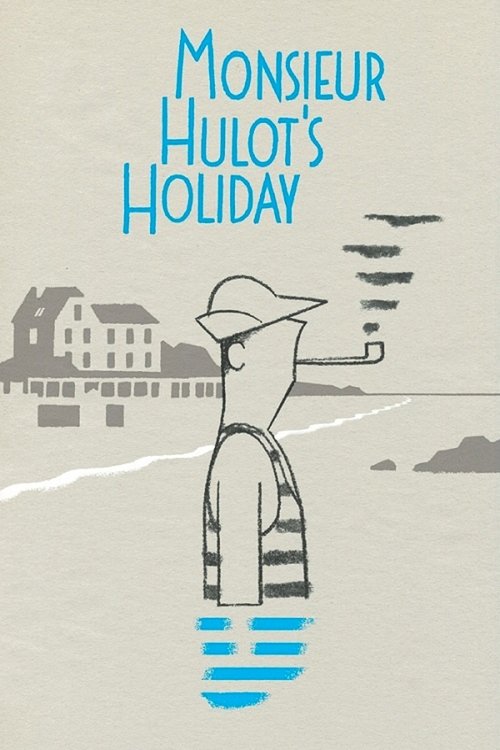
Monsieur Hulot's Holiday
1953 · Jacques Tati
For a lazy Sunday afternoon when you want to smile for ninety minutes straight — pure comfort, and lovely to share with kids, parents, or anyone who thinks old movies aren't funny. Zero stress, endless charm.
What it's about
Monsieur Hulot — pipe-smoking, forward-leaning, unfailingly polite — arrives at a modest seaside hotel in Brittany for his summer holiday. There's no plot to speak of: guests eat, play tennis, take walks, and endure their scheduled leisure, while Hulot's every good intention sets off small catastrophes involving boats, dogs, and fireworks. The fortnight simply unfolds, one beautifully engineered mishap at a time.
The experience
Gentle, sunny, and quietly hilarious — the gags drift in without fanfare, often in the background, and half the fun is catching them. It's the rare comedy that relaxes you like an actual vacation.
Performances
Tati himself, as Hulot, gives one of cinema's great physical performances — a whole character built from posture, stride, and impeccable timing, with barely a line of dialogue.
The craft
Nearly wordless, the film tells its jokes through choreography and sound: a dining-room door's twang, a sputtering car, a radio drifting through a lobby. Every frame is composed like a comic strip panel where something is always happening in the corner, which makes it endlessly rewatchable.
Why it matters
It launched Tati to international stardom, introduced one of film comedy's immortal characters, and influenced generations of visual comedians. Sight-gag filmmaking has been measured against it ever since.
Snapshot
Les Vacances de Monsieur Hulot is a comedy about a summer holiday at a modest Breton beach hotel, in which almost nothing happens and everything is observed. Jacques Tati's second feature introduced the character who would define the rest of his career: Hulot, the pipe-smoking, forward-leaning bachelor whose politeness is total and whose effect on the world is catastrophic. The film has essentially no plot. Guests arrive at the Hôtel de la Plage, pass a fortnight of meals, walks, tennis, card games and enforced leisure, and depart. Tati organizes this into a loose calendar of days, punctuated by the dining-room gong and the radio, and fills it with gags that arrive without emphasis — frequently in the background, frequently after the ostensible subject of the shot has moved on.
What makes the film historically consequential is less the character than the method. Tati constructs comedy in depth rather than in close-up, refuses the reaction shot, builds his soundtrack entirely in post-production as a designed object rather than a record, and trusts the spectator to find the joke rather than pointing at it. The result was a film that traveled: it made Tati an international name, won him admirers among critics who were then inventing the politique des auteurs, and established a comic grammar that runs forward through Pierre Étaix, Otar Iosseliani, Roy Andersson, Wes Anderson and Aki Kaurismäki. Shot largely on location at Saint-Marc-sur-Mer, near Saint-Nazaire, it is also a document of a specific French moment: the first postwar decade in which ordinary salaried people took a seaside holiday, and did not quite know what to do with it.
Industry & production
Tati came to features late and sideways. He had spent the 1930s as a music-hall performer whose act consisted of sporting pantomimes — impersonations of a tennis player, a boxer, a goalkeeper, a horse and rider — performed in silence with meticulous physical observation. That act is the true origin of everything in this film: the tennis sequence in Hulot is a music-hall turn transplanted into a fiction. After the war he made a series of shorts, and in 1949 turned one of them, L'École des facteurs, into his first feature, Jour de fête, a village comedy about a rural postman that succeeded well enough in France to make a second feature possible.
Les Vacances de Monsieur Hulot was produced by Fred Orain through Cady Films, the company associated with Tati's early work, with Discifilm also involved; Tati's production arrangements across his career were characteristically hands-on and would later, with Playtime, become financially ruinous. The shoot was long by the standards of a modest French comedy, protracted by weather and by Tati's insistence on getting each gag exactly as he had conceived it. The production worked on location at Saint-Marc-sur-Mer on the Atlantic coast, using the real beach, the real hotel frontage and the real tidal light, with the local geography — beach, sea wall, hotel terrace, road — becoming the film's fixed stage. The village has since renamed its beach after the character, which is a fair index of how completely the film absorbed the place.
Tati worked without stars. The cast is largely non-professional or semi-professional, chosen for physical type and rhythm rather than for name value, which is one reason the hotel guests read as sociological specimens rather than as characters: the retired couple walking in single file, the strolling businessman perpetually summoned to the telephone, the ex-officer recounting his war, the earnest young leftist intellectual delivering theory to a bored listener. Nathalie Pascaud plays Martine, the young woman staying at a villa nearby, whose presence gives the film its faint, unconsummated romantic thread. Tati himself plays Hulot.
Commercially the film performed strongly in France and, more unusually for a French comedy, exported well; it played in the United States and Britain and gave Tati a durable international profile. Precise figures for its returns are not something I can state reliably here, and I will not invent them. What is documented is the consequence: the success of Hulot is what allowed Tati to spend the following years developing Mon Oncle (1958) and then to gamble everything on Playtime (1967).
Technology
The film was shot in black-and-white 35mm, in the standard Academy ratio, with no widescreen ambitions — Tati's later deep-focus experiments in Playtime would use 70mm, but here the tools are conventional. What is technologically distinctive is the sound.
Like most French production of the period, and like Tati's practice throughout his career, the film was post-synchronized: there is effectively no usable location dialogue track, and the entire audio world — footsteps, doors, waves, the dining-room gong, the radio, the fragments of speech — was assembled in the studio afterward. Many directors treated post-synchronization as a technical necessity to be disguised. Tati treated it as the whole point. Because every sound had to be chosen and placed by hand, he could build an audio track with no obligation to realism: sounds could be exaggerated, delayed, isolated or withheld. The most famous single instance is the dining-room door, whose spring gives a hollow, resonant boing every time it swings — a sound that is not what such a door produces, but what such a door means. Once established, it becomes a comic engine that requires no visual gag at all.
The soundtrack also uses the technology of leisure as content. The hotel radio, the loudspeaker announcements at the railway station (garbled to the point of pure noise, sending passengers stampeding from platform to platform), the gramophone playing Alain Romans's theme — these are the mechanisms by which modern life instructs people where to be and when. Tati's later films would sharpen this into a thesis about glass, steel and automated modernity; here it is still gentle, but the interest is already fully formed.
Technique
Cinematography
Photographed by Jacques Mercanton, with Jean Mousselle also credited on camera, the film's visual scheme is one of consistent distance. Tati shoots in long and medium-long shot, frequently from a slightly elevated or laterally displaced position, holding the frame still while events accumulate inside it. There are very few close-ups in the film, and the ones that exist are functional rather than expressive. Hulot is almost never given a face in close-up; he is a silhouette — the tilted forward lean, the too-short trousers, the pipe, the hat — legible entirely at a distance, which is precisely the point. A silhouette can be recognized in the background of a shot at any depth.
The photography exploits the real Atlantic light. Much of the beach material has the flat, hazy gray of an overcast French seaside afternoon, and the film's sense of tedium is partly a photographic achievement: the light itself looks like waiting. Depth of field is generous, keeping foreground and background simultaneously readable, because the composition frequently runs a foreground event and a background event at once and declines to tell you which is the joke. The camera moves sparingly. When it does, it is usually reframing to keep a stage intact rather than following a subject for emphasis.
Editing
Cut by Suzanne Baron, Charles Bretoneiche and Jacques Grassi, the editing is defined by what it refuses. There is no reaction shot in the conventional comic sense — no cut to a face registering surprise so the audience knows how to feel. There is no cut-in to isolate a gag's mechanism. The shot is generally allowed to run until the situation has exhausted itself, and the cut arrives when Tati is finished with the space, not when he is finished with the joke.
The consequence is that the spectator must do the work of looking. In a Hollywood comedy of the same period, editing directs attention to the site of the gag; in Tati, editing withholds that direction, and jokes can occur unnoticed on first viewing. This is a deliberate structural choice, and it explains the film's unusual rewatch behavior: viewers report finding new gags on second and third viewings, which is not a compliment one pays to films that edit for emphasis. At the macro level, the film is organized by day-units and by the rhythm of hotel routine rather than by cause and effect; scenes are strung along a holiday's duration, and the ending is simply departure.
Mise-en-scène / staging
This is where the film's real originality lies. Tati stages comedy the way an architect plans circulation. The hotel lobby, dining room, terrace, beach and road form a fixed set of connected spaces, and the film returns to them repeatedly, so that the audience develops a working knowledge of the geography — which is a prerequisite for jokes that depend on offscreen space and on the relation between one room and another.
Within the frame, Tati composes in layers. A gag typically has a foreground event, a middle-ground reaction and a background consequence, all live at once, none privileged by framing. The dining-room scenes are the clearest case: guests eat in ordered rows while, at the periphery, Hulot's passage produces a small chain of disturbances. Tati is also unusually attentive to bodies as graphic elements — the guests walking in file, the choreography of deck chairs, the near-identical postures of people performing leisure. Human beings in the frame are treated with the same compositional weight as objects, which produces the film's characteristic tone: affectionate, but from an entomological distance.
The gags themselves are frequently mechanical in the plainest sense. Hulot's sputtering Amilcar, the kayak that folds in half like a jaw, the flat tire that acquires leaves and gets mistaken for a funeral wreath, the shed of fireworks ignited in the night — all are chains of physical cause and effect that Tati sets running and then observes. What distinguishes them from silent-comedy set pieces is that Hulot rarely triumphs over them, and never displays virtuosity in overcoming them. He is not Keaton, who masters machines. He is the man who leaves them worse than he found them and walks away politely.
Sound
The soundtrack is the film's second script. Dialogue exists but carries almost no information: it is largely fragmentary, half-heard, drowned, or reduced to social noise — greetings, the intellectual's monologue, the businessman's telephone summons. Hulot himself barely speaks; his name, mumbled, is close to the whole of his contribution. This is not silence as nostalgia for the silent era. It is a specific argument that in a resort full of talking, almost nothing is being said.
Against the near-void of language, Tati builds a dense, hyper-specific world of object sound: the door's spring, footsteps on wooden floors, the tennis ball's implausibly emphatic report, the fireworks, the sea. These sounds are frequently used as punctuation, arriving a beat after the image or standing in for an event kept offscreen. Alain Romans's recurring theme, "Quel temps fait-il à Paris?", functions less as score than as an object within the fiction — the tune the resort plays at itself — and it acquires, by repetition, the melancholy that the film never states outright.
Performance
Tati's Hulot is a construction of line and rhythm rather than psychology. The forward tilt, the short trousers and striped socks, the umbrella, the pipe, the bouncing stride with its lifted heel — these are music-hall economy, designed to be read instantly at a hundred feet. Hulot has no interiority, no backstory, no stated occupation, no arc. He wants nothing except to be pleasant, and his defining trait is a courteousness so complete that it prevents him from noticing the damage he causes.
Crucially, Hulot is not the protagonist in the usual sense; he is a catalyst who wanders through a film that is largely about everyone else. The supporting performances are pitched at behavioral observation rather than characterization: the retired couple's synchronized walk, the businessman's air of importance, the waiter's weary vigilance. Nathalie Pascaud's Martine is given warmth and almost no dramatic function — the romance never becomes one, which is itself the observation. Tati directed non-professionals for gesture and tempo, and the ensemble reads as a catalog of postures rather than a cast of characters.
Narrative & dramatic mode
The film is close to plotless by design. It has a beginning (arrival), an end (departure) and a duration in between, structured by the recurrence of meals, days and weather rather than by conflict and resolution. There is no antagonist, no goal, no crisis. The nearest thing to a dramatic line — Hulot's interest in Martine — resolves into a handshake and a departure.
What replaces plot is accumulation. The film builds a set of spaces, rhythms and running gags, and then lets them recombine. Motifs return with variation: the door, the gong, the radio, the boat, the car. This is the structure of a music-hall program or a suite rather than of a drama, and it is the reason Tati is often described as a formalist working in comedy. It also creates the film's characteristic emotional undertow. Because nothing is dramatized, the ending — guests packing, the beach emptying, Hulot waving to almost no one — arrives as an unforced statement about the passing of time, and about how little of a holiday remains once it is over.
Genre & cycle
Formally the film belongs to a lineage of physical comedy running from Max Linder and the French comic tradition through American silent comedy, and Tati's debts to Keaton and to Chaplin's earlier work are visible in the priority given to the body and the frame. But Hulot deliberately declines silent comedy's escalation logic. There is no climactic chase, no engineered crescendo. The one large-scale set piece, the fireworks accident, is staged as chaos observed rather than chaos mastered.
The film also inaugurated a cycle of its own. Hulot returns in Mon Oncle (1958), Playtime (1967) and Trafic (1971), each time in a more thoroughly modernized environment, and the character's meaning shifts across the series: in the holiday film he is a disruption in an ordinary world, whereas by Playtime he is a residue of the human inside architecture that has no place for him. Within French cinema of the 1950s, this was an outlier — a comedy that competed with neither the boulevard farce nor the star vehicles of the period, and whose closest kin were arguably not comedies at all.
Authorship & method
Tati is one of the least ambiguous auteurs in film history: he conceived, co-wrote, directed and starred, and controlled staging and sound to an unusual degree. The screenplay is credited to Tati with Henri Marquet, with additional contributions associated with Pierre Aubert and Jacques Lagrange; Lagrange, a painter, became Tati's most important long-term collaborator on the visual conception of his films, and the graphic sensibility that organizes Tati's frames — people as shapes, spaces as diagrams — owes a great deal to that partnership.
Cinematography by Jacques Mercanton, with Jean Mousselle; editing by Suzanne Baron, Charles Bretoneiche and Jacques Grassi; music by Alain Romans, whose theme is inseparable from the film's memory. Baron would go on to a substantial career in French editing, and her work here is essential to the film's method precisely because it is self-effacing: the achievement is in the refusal to cut for emphasis.
Tati's method was famously slow and iterative. He worked from drawings and detailed gag conception, rehearsed physical business at length, and reshot until the timing matched what he had planned. He was known to revise his films after release — Monsieur Hulot's Holiday exists in more than one version, with material added, trimmed and re-sounded across reissues in later decades, which is why viewers comparing prints sometimes find gags present in one and absent in another. Anyone writing about a specific gag should specify which version they are describing.
Movement / national cinema
The film sits in a peculiar position in French cinema. It is not part of the "tradition de qualité" that the young critics at Cahiers du cinéma were attacking, nor is it a New Wave film — it precedes the Wave by half a decade. Yet it was embraced by that critical generation, because it demonstrated exactly what they were arguing for: a film whose meaning was in its mise-en-scène, made by a man whose signature was legible in every frame, produced outside the studio's literary-adaptation machinery, shot on real locations with non-professionals.
André Bazin's advocacy matters here. Bazin's theoretical preference for the long take, depth of field and unfragmented space — the argument that cutting imposes meaning while sustained framing permits ambiguity — found in Tati an almost programmatic illustration in the unlikely register of comedy. In this sense Hulot connects to Italian neorealism's location shooting and non-professional casting more than to any comic tradition, while remaining entirely uninterested in neorealism's social urgency.
Era / period
1953 is early in the French postwar recovery, and the film is precisely dated by its subject. Paid holidays had been won in France in 1936, but mass seaside vacationing for salaried city people became a broad social fact in the postwar years, and Tati's hotel is a portrait of that new institution in its awkward adolescence. His guests are not wealthy; they are respectable, budget-conscious, and slightly at a loss. The film's central irony is that leisure has become a schedule — the gong, the meal, the walk, the prescribed pleasure — and that Hulot, the only guest with no idea how to perform it correctly, is also the only one visibly enjoying himself.
The period's other presences are quieter. The ex-military man's war anecdotes place the war a decade back and already turned into a routine. The intellectual's earnest political theorizing, ignored by his listener, gently registers the era's ideological climate. The businessman's telephone anticipates the thesis Tati would develop for the next twenty years: that modern efficiency follows people on holiday and does not let them rest.
Reception, canon & influence
The film was well received in France and abroad and was recognized on the international circuit — it screened at Cannes and won the Prix Louis-Delluc, and it earned Tati and Marquet an Academy Award nomination for writing, which is a notable outcome for a film in which the script's function is largely to specify silence. Its reputation grew steadily. Critics in France, including the Cahiers circle, treated Tati as a serious formalist, and the international art-house circuit made him a rare case of a comedian admitted to the auteur canon without qualification. In later decades the film has appeared consistently in critical polls of major films and has been widely restored and reissued; the character's iconic standing is such that Saint-Marc-sur-Mer's beach carries his name.
Looking backward, the influences are legible: the French music-hall and mime tradition that Tati came from and that shaped Hulot's body; American silent comedy, particularly Keaton's compositional intelligence about machines and space; and the documentary attentiveness of location-based European filmmaking after the war. The gag-as-mechanism, the sporting pantomime, the character defined by silhouette — all predate the film in Tati's own act.
Looking forward, its influence is unusually broad for a comedy. The Hulot cycle itself follows directly, and Playtime is the extreme extension of this film's logic — the frame so full of simultaneous incident that no viewer can see all of it. Pierre Étaix, who worked with Tati, carried the method into his own features. The idea that comedy can be built from a static wide shot, a designed soundtrack and rigorous background staging runs through Otar Iosseliani, Roy Andersson's tableau comedies, Aki Kaurismäki's deadpan minimalism, Jacques Rivette's and Éric Rohmer's interest in observed social behavior, and — in a more decorative register — Wes Anderson's frontal, symmetrical staging. Elia Suleiman's political comedies of stillness are close descendants. In animation, Sylvain Chomet's The Illusionist (2010) was built from an unproduced Tati screenplay and is an explicit act of homage.
The deeper legacy is a proposition rather than a style: that a filmmaker can decline to tell the audience where to look, and that the resulting act of searching is itself pleasurable. Almost every subsequent director who builds jokes in the background of a wide shot is working within a grammar this film made legible.
A Deleuzian reading
There's a door between the kitchen and the dining room at the Hôtel de la Plage, and every time someone goes through it, it goes *boing*.
The full Deleuzian reading of Monsieur Hulot's Holiday →
Reception
A genuine hit in France in 1953 and an art-house sensation abroad — it even landed Tati an Oscar nomination for the screenplay of a nearly wordless film. Seventy years on it hasn't needed rescuing so much as re-explaining: each generation rediscovers that its shambling non-plot is the whole point.
How Monsieur Hulot's Holiday was received, from release to now →
How to watch Monsieur Hulot's Holiday: what to notice on a first viewing
- Notice Hulot is almost never shown in close-up. Tati shoots him in long or medium-long shot, a silhouette of forward lean, short trousers, and a pipe. You can spot him at any depth in the frame, even in the background. A silhouette reads at a hundred feet, so a joke can land anywhere in the shot, not just center frame.
- Listen for dialogue turned into background noise, not words. Conversations are fragmentary, half heard, or drowned out, while object sounds like doors, footsteps, and a tennis ball's report come through crisp and exact. The people at this hotel barely say anything worth hearing. The things around them are what actually speak.
- Watch the retired couple walk everywhere in perfect step. Tati treats guests as bodies and postures as much as characters, from the couple's synchronized stride to the deck chairs lined up in identical rows. You learn who these people are from how they hold their bodies, long before anyone speaks a line.
- Follow the door, the gong, and the radio each time they return. The film has almost no plot, so these small objects and sounds recur instead, marking the days and giving the loose structure its shape. Repetition does the work a plot usually does: it tells you time is passing and the holiday is a cycle.
The whole guide to watching Monsieur Hulot's Holiday, with the keys for a rewatch →
Influences: the films it descends from and the films it influenced
- The Navigator (1924) — Keaton's practice of staging a body against an oversized machine in an unbroken wide shot — the gag legible as a geometric relation between figure and apparatus rather than as a face reacting — is the compositional grammar Tati applies to the kayak, the taffy machine and the hotel's swinging dining-room door.
- Modern Times (1936) — Chaplin's solution to sound — human speech withheld while amplified and mechanical voices (the factory viewscreen, the phonograph salesman) come through fully intelligible — is exactly Tati's split, where the station loudspeaker and hotel radio are crisp and the guests' talk is mixed as tonal babble.
- Le Million (1931) — Clair built comedy from post-synchronized, deliberately non-naturalistic sound — the backstage scramble scored to a roaring rugby crowd — establishing the wholly constructed, location-unanchored soundtrack that Tati rebuilt in the studio down to the individual spring of each door.
- À propos de Nice (1930) — Vigo's observational cataloging of a resort promenade — the leisure class filmed at a distance as repeated social behavior, deckchairs and strolling as raw material — supplies the plotless documentary survey structure Tati imposes on Saint-Marc-sur-Mer.
- The Rules of the Game (1939) — Renoir's deep-focus multi-plane staging, with several actions running simultaneously across foreground, middle and background and overlapping speech mixed as ambient chatter, is the comedy-in-depth model Tati transposes to the hotel lounge and dining room.
- Bicycle Thieves (1948) — The postwar neorealist protocol Tati adopts wholesale — non-professional performers cast for physiognomy and gait, real locations shot in available light, and dialogue and effects laid in entirely after the fact.
- Jour de fête (1949) — Tati's own prototype for the method: a running gag stated and then varied across a single fixed location, a protagonist defined by silhouette and vehicle, villagers played by locals, and speech treated as regional noise rather than exposition.
- Mon Oncle (1958) — Extends the wide-shot-plus-designed-sound method from a seaside hotel to the Arpel house, making architecture itself the gag machine — gate, kitchen appliances and fish fountain as sound-emitting objects staged in depth against Hulot's unchanged gait.
- Playtime (1967) — The logical extreme of this film's refusal to direct the eye: 70mm frames staged so densely with simultaneous incident that no cut can privilege one gag, taking the no-reaction-shot principle to the point where the audience must do the editing.
- Yoyo (1965) — Étaix, who worked with Tati as assistant and gagman, carries over the music-hall-trained body and the gag conceived as a mechanism executed inside a static wide frame with a near-wordless, fully constructed soundtrack.
- The Party (1968) — One location, one courteous disruptor, and escalation built from sustained wide shots and object sound — the lost shoe in the water channel, the malfunctioning plumbing — instead of cutaway punchlines; Edwards working openly from Hulot's causal model.
- Favorites of the Moon (1984) — Iosseliani's plotless circulation of objects and people through a city, with key events glimpsed at the edge of the frame and the soundtrack driven by off-screen incident, generalizes Tati's refusal of a protagonist-centred plot into a whole civic structure.
- The Match Factory Girl (1990) — Deadpan performance stripped of the reaction beat, dialogue cut to a handful of flat lines, and narrative carried instead by the amplified sound of machinery and handled objects — Tati's dialogue-as-noise principle rendered in a minor key.
- Songs from the Second Floor (2000) — Comedy composed entirely as locked-off deep-focus tableaux with the joke deliberately placed in the background and no cut to signal where to look — Tati's proposition converted into an exhaustive formal system.
- Divine Intervention (2002) — A silent watching protagonist inside a locked-off wide shot, with gags constructed as repeated variations on a fixed situation — the neighbor's rubbish, the checkpoint — applying Hulot's running-gag-variation architecture to occupation.
- The Illusionist (2010) — Animated from an unproduced Tati screenplay and rebuilding his devices as drawing: the character defined by silhouette and gait, dialogue reduced to unintelligible murmur, and gags timed to object sound in held wide compositions.
- The Grand Budapest Hotel (2014) — Anderson's frontal, planimetric wide shots of a hotel treat guests and staff as graphic shapes moving through a diagram of rooms, lifts and corridors — the Lagrange–Tati people-as-shapes staging carried into a decorative register.
- A Scene at the Sea (1991) — Tati's deadpan seaside comedy staged in static wide shots, with gags playing out in the depth of a held frame, feeds the observational beach tableaux and their dry background humor.
- Local Hero (1983) — Seaside comedy in which the joke lives in the depth of the wide frame and in ambient sound — surf, doors, a distant loudspeaker — rather than in dialogue; the model for Forsyth's background-event staging and coastal atmosphere track.
- The Ladies Man (1961) — Lewis's giant cutaway boarding-house set, shot head-on in sustained wide takes so that multiple simultaneous actions play across the cells of the frame, is the same architecture-as-diagram comedy Tati was staging in the Hôtel de la Plage.
Similar films
- PlayTime (1967) — influence & lineage · same viewing thread
- Mon Oncle (1958) — influence & lineage · often watched together
- The Rules of the Game (1939) — influence & lineage
- The Party (1968) — influence & lineage · same viewing thread
- Sherlock Jr. (1924) — same viewing thread
- Céline and Julie Go Boating (1974) — often watched together
- The Swimming Pool (1969) — often watched together
- Trouble in Paradise (1932) — often watched together
All the films related to Monsieur Hulot's Holiday →
Watch it with: curated runs of related films
- Sight Gags and Soft Hearts — Watch these when you want comedy built from movement, timing, and architecture rather than punchlines — a gentle soul politely adrift in a bustling, beautifully machined world.