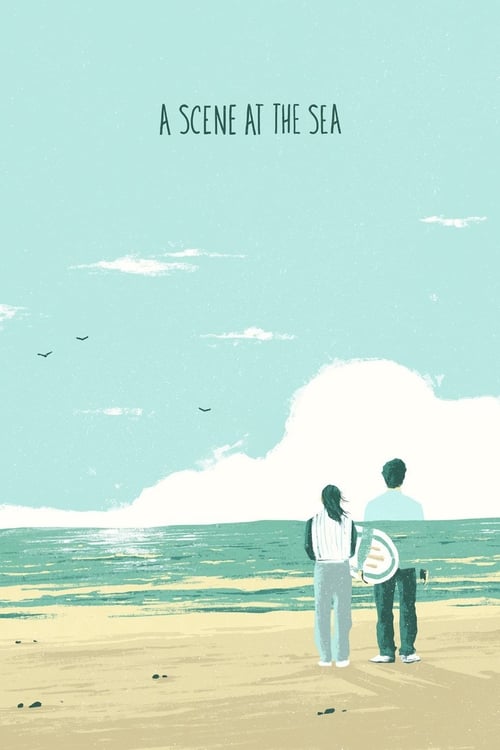
A Scene at the Sea
1991 · Takeshi Kitano
For when you want calm — a meditative, gentle film for a quiet evening, especially if you're in the mood to feel something without being told what to feel.
What it's about
A deaf garbage collector finds a broken surfboard on his route, repairs it, and quietly resolves to teach himself to surf. His girlfriend, also deaf, waits on the beach through every wipeout and small victory as he works his way from laughingstock to genuine competitor. It's a love story and a sports story told almost entirely without words.
The experience
Serene, patient, and unexpectedly moving — long quiet takes of sea and sky, deadpan comic beats, and a tenderness that builds without a single dramatic speech. It works on you like the tide: slow, steady, and deeper than it looks.
The craft
Kitano composes in static wide shots and lets silence do the storytelling, trusting glances and body language over dialogue, while Joe Hisaishi's tender score carries the emotional current. The editing has a musical patience to it — repetition and small variation, like waves.
Why it matters
The film where Kitano's true voice emerged from under his violent-cop persona, establishing the stillness-and-elegy style that would define his celebrated later work.
Snapshot
A Scene at the Sea (あの夏、いちばん静かな海, Ano natsu, ichiban shizuka na umi, literally "That Summer, the Quietest Sea") is Takeshi Kitano's third feature and the film in which his authorial voice, still half-buried under genre in his first two pictures, surfaces whole. A deaf-mute garbage collector named Shigeru finds a broken surfboard on his refuse route, repairs it, and teaches himself to surf; his equally deaf girlfriend Takako waits on the beach through every failure and small triumph until, without warning, the sea takes him. That is nearly the entire plot. Around it Kitano builds a film of static long takes, near-total wordlessness, deadpan comedy, and Joe Hisaishi's tender score — a work that trades the sudden violence of Violent Cop (1989) and Boiling Point (1990) for stillness, patience, and elegy. It is both a radical departure and a Rosetta Stone: the contemplative rhythm, the abrupt off-screen death, the fixation on the ocean, and the composer partnership that would define Sonatine (1993) and Hana-bi (1997) all begin here. Critically dismissed or ignored by some in Japan on release, it has since been widely reappraised as one of Kitano's finest and most personal films.
Industry & production
The film was made under Kitano's own aegis as a rising figure in the Japanese film industry — a television superstar (as "Beat" Takeshi, half of the manzai duo The Two Beats) who had improbably become a director when he took over Violent Cop from Kinji Fukasaku in 1989. By 1991 Kitano had directorial autonomy that few Japanese filmmakers of his generation enjoyed, largely because his celebrity guaranteed a certain baseline of financing and attention regardless of a project's commercial prospects. That leverage is what made A Scene at the Sea possible at all: a slow, near-silent art film about deaf surfers, starring unknowns and without Kitano himself on screen, is not a project the market would have generated on its own.
Production is associated with Kitano's professional orbit — the "Office Kitano" management and production apparatus and the broader V-cinema/theatrical ecosystem of early-1990s Japan (with Bandai/Totsu-type backing typical of his films of the period). I want to be candid that the precise financing and distribution arrangements are not well documented in English-language sources, and I will not invent specifics. What is clear and important is the film's economic modesty: it was shot on location on the coast, with a small cast and a compact crew, and its aesthetic of duration and restraint is inseparable from that scale. The commercial performance of the film in Japan is not something for which I can cite reliable figures, and contemporaneous reception suggests it was not a major box-office event; its reputation was built afterward, on video, in retrospectives, and through Kitano's growing international standing.
Technology
Technologically the film is unremarkable by design, and that plainness is the point. It was shot on 35mm color film with a largely fixed camera and available coastal light. There are no optical showpieces, no elaborate camera rigs, no visual effects. The surfing footage is captured from the shore or the shallows in long lenses and wide masters rather than with the water-housing, in-the-barrel immersion that a sports film would demand — a deliberate refusal of spectacle that keeps the viewer where Takako is, watching from the sand. The most consequential "technology" in the film is arguably acoustic rather than optical: the decision to build the soundtrack around near-silence and a recurring musical theme, using the recording and mixing to foreground ambient sea-sound and Hisaishi's score in the near-absence of dialogue. In an era when Japanese cinema had every tool for maximalism available, Kitano's choice was subtraction.
Technique
Cinematography
The photography, by Katsumi Yanagijima — Kitano's regular cinematographer across this stretch of his career — is the film's defining formal instrument. Yanagijima and Kitano favor the locked-off frame: the camera is planted, often at a slight distance, and simply holds while action enters, occurs, and leaves. Horizons are level and low; the sea occupies great planes of the image; figures are frequently small within wide compositions, dwarfed by sand, water, and sky. Color is cool and washed — blues, grays, the pale neutrals of an overcast beach — rather than the saturated postcard palette a surf movie invites. Crucially, Kitano withholds the reverse angle and the reaction shot far more often than convention allows, so that we, like the deaf lovers, are frequently denied the easy legibility of faces and instead read posture, distance, and waiting. The camera's refusal to chase the surfing is itself a thesis: heroism here is something glimpsed from far off, not ridden alongside.
Editing
The cutting is elliptical and patient, and it is the clearest early statement of what would become Kitano's signature editorial temperament. Scenes are held past the point of narrative necessity and then dropped abruptly; transitions elide the connective tissue a mainstream film would supply; and the film's pivotal event — Shigeru's death — occurs entirely in the gaps, off-screen, registered only by an empty sea and a returning board. Kitano is celebrated as an editor of his own films, and the montage sensibility on display here — especially the closing sequence, which resolves the film not through drama but through a tender assembly of photographs — anticipates the freeze-frame and photo-album motifs he would return to across his career. (I'll note honestly that I won't assert the exact editing credit on this specific title beyond the fact that the film's rhythm is unmistakably authored; the sensibility is Kitano's.)
Mise-en-scène / staging
Staging is minimal and frontal, closer to observation than to blocking. Kitano composes deadpan tableaux — the two idle young men who loiter and comment; Takako sitting immobile on the beach with the surfboard; the amateurish surf competition with its bored officials — and lets them play out in real time. The humor and the pathos share the same flat, uninflected staging, so that a gag and a heartbreak are delivered in the identical register. This is where Kitano's manzai comedy background meets a Bressonian austerity: the comic timing is precise, but it is timing built from stillness and repetition rather than movement.
Sound
Sound is arguably the boldest element. The two central characters are deaf, and the film honors that subjectivity by stripping speech almost entirely from the drama; communication is gesture, gaze, and presence. Into that silence Kitano pours Joe Hisaishi's score, which does much of the film's emotional work — the recurring, melancholy-tender main theme functioning as the lovers' unspoken interior. Ambient sound (surf, wind, traffic) is used sparingly and pointedly. The interplay of imposed silence and swelling music is the film's most affecting formal device.
Performance
The performances are cast for stillness. Kuroudo (Claude) Maki plays Shigeru with an impassive, closed physicality — his surfing improves while his face barely changes — and Hiroko Oshima's Takako is defined by patient watchfulness, an economy of expression that makes her few gestures carry enormous weight. Because both leads are playing deaf-mute characters, the acting is entirely behavioral: no dialogue to lean on, only the body. Notably, Kitano does not appear in the film — a striking choice given that he had headlined his first two features — and his absence lets the picture's quietness stand without his star charisma pulling focus.
Narrative & dramatic mode
The dramatic mode is anti-dramatic. A Scene at the Sea is structured as a series of small, repeated actions — Shigeru carrying his board to the water, wiping out, being ignored at competitions, slowly earning respect — rather than as a plotted rise-and-fall. Conflict is muted; antagonists barely exist; the "sports movie" arc of training and triumph is present only as a faint, ironized ghost. The film withholds catharsis at every turn, most devastatingly at the climax, where the expected moment of victory or defeat is replaced by absence: Shigeru simply does not come back from the sea. The ending refuses to dramatize the death, offering instead an elegiac coda of images. This is a narrative built on ellipsis, ritual, and the accumulation of the ordinary — a mode Kitano would refine but never state more purely than here.
Genre & cycle
Nominally the film sits at the intersection of drama, romance, and comedy, and it genuinely contains all three — a love story, deadpan comic vignettes, and an underdog-surfer premise. But it belongs to no genre in the ordinary sense; it is closer to the tradition of the minimalist art film. Within Kitano's own filmography it inaugurates the "contemplative" cycle that runs against his "yakuza/violence" cycle, and it is the crucial hinge between them. Where Violent Cop and Boiling Point had genre scaffolding (the rogue-cop thriller, the crime picture), A Scene at the Sea discards genre almost entirely, proving that the Kitano tone — stillness punctuated by sudden mortality — could exist independent of violence. The lessons learned here are re-imported into the crime films: Sonatine's beach interludes and Hana-bi's tenderness are unimaginable without this film.
Authorship & method
A Scene at the Sea is a near-complete statement of Kitano's method as an auteur: he directed and wrote it, shaped its distinctive editing rhythm, and imposed on it a personal sensibility — the fascination with the sea, the linkage of love and death, the deadpan humor, the abrupt off-screen violence-of-fate — that recurs throughout his work. The film is also the origin point of his single most important creative partnership. Joe Hisaishi composed the score here, beginning a collaboration that would continue through Kitano's major films of the 1990s and into the early 2000s (up to Dolls, 2002); Hisaishi's melodic, emotionally direct writing became half of the Kitano signature. Cinematographer Katsumi Yanagijima established here the locked-off, horizon-level visual grammar he would extend across subsequent Kitano films. The absence of Kitano-the-actor is itself an authorial decision, evidence that at this early stage he was consciously testing whether his directorial vision could stand apart from his performing persona. The film answers: emphatically yes.
Movement / national cinema
The film is a landmark of the Japanese cinematic revival of the late 1980s and 1990s, a period when a new generation of filmmakers — Kitano foremost among them — restored international attention to Japanese cinema after a relatively fallow stretch. Kitano's minimalism is often read against two national lineages: the transcendent stillness and low, fixed camera of Yasujirō Ozu (the level horizons, the "pillow shot" pauses, the domestic patience) and the ascetic behaviorism of Robert Bresson (character as gesture, drama drained of theatricality). Yet Kitano's flatness is also native to Japanese television comedy, his own trade, giving his art-cinema austerity a comic undertow that neither Ozu nor Bresson shares. The film thus sits at a genuinely Japanese crossroads — classical national tradition, European modernism, and TV-age popular comedy — and helped define what "Kitano cinema" would mean to the world festival circuit that soon embraced him.
Era / period
Made in 1991, the film belongs to the early years of Japan's post-bubble era, and its mood of muted melancholy and modest, unglamorous coastal life reads, in hindsight, against that deflating national moment — though I'd caution against over-reading it as direct economic allegory, which the film does not invite. Within Kitano's own timeline it predates his near-fatal 1994 motorcycle accident and the intensified reckoning with death that marked Hana-bi; it is the work of a director still early in his career, unusually free to experiment, and consolidating a style. It also arrives just before the international festival breakthroughs that would make Kitano a global art-cinema name by mid-decade, so it functions as the quiet foundation on which that later recognition was built.
Themes
The governing themes are silence, persistence, love, and impermanence. Silence is both the characters' literal condition and the film's aesthetic principle — deafness becomes a metaphor for a communication that runs beneath and beyond language, expressed in the lovers' patient co-presence. Persistence in the face of indifference structures Shigeru's arc: he pursues surfing not for glory but as a kind of pure devotion, and the film treats that devotion with unsentimental respect. Above all the film is about impermanence and the nearness of death to ordinary happiness — the sea that gives Shigeru his purpose is the same sea that erases him, without warning or meaning. The closing photo-montage crystallizes the theme: love survives only as memory and image, and the film's tenderness is inseparable from its grief. Water, throughout, is the great ambivalent element — freedom, love, and death at once.
Reception, canon & influence
Critical reception. On release the film's reception was mixed to muted, particularly in Japan, where a slow, near-silent art film sat awkwardly against Kitano's mass-media persona as a comedian; it did not register as a major event. Its reputation grew substantially over the following decade as Kitano's international stature rose (culminating in the Hana-bi Golden Lion at Venice in 1997) and as critics returned to his back catalog. In that reappraisal A Scene at the Sea is now frequently ranked among his best and most personal works, and cited as the film where his voice first fully cohered.
Influences on the film (backward). The clearest antecedents are Ozu's fixed-camera stillness and elliptical domestic rhythm; Bresson's minimalist, behavior-based dramaturgy and refusal of psychological explanation; and, more diffusely, the deadpan comic tradition of Kitano's own manzai and television work. Some critics also invoke a Tati-like quality in the film's observational comic tableaux. Kitano's first two features supply the immediate internal precedent — specifically the motif of abrupt, off-screen or unglamorized death — which this film abstracts from a crime context into a purely existential one.
Legacy (forward). The film's forward influence runs first and most concretely through Kitano's own cinema: the contemplative long-take style, the sea imagery, the sudden elegiac death, and above all the Hisaishi scoring model are carried directly into Sonatine and Hana-bi, the films that made Kitano an international auteur. More broadly, A Scene at the Sea stands as an early, influential example of the slow, minimalist register that would become prominent in world art cinema in the following decade, and it helped establish the international image of Kitano as a director of stillness and melancholy rather than merely of violence. Its most enduring bequest may simply be the Kitano–Hisaishi partnership itself, one of the signal director-composer collaborations in modern cinema, which began on this quiet beach.
A Deleuzian reading
Half a surfboard, sticking out of somebody's garbage.
The full Deleuzian reading of A Scene at the Sea →
Reception
Barely seen outside Japan on release — Kitano wasn't yet an international name, and this quiet, violence-free film flopped commercially even at home. Once Sonatine and Hana-bi made him a festival darling, cinephiles worked backwards and found it, and it's now routinely called his hidden masterpiece.
How A Scene at the Sea was received, from release to now →
How to watch A Scene at the Sea: what to notice on a first viewing
- Watch the camera stay planted far from the surfing itself. Kitano and Yanagijima hold the camera at a distance on the sand rather than getting in the water, so Shigeru stays a small, dark shape against a wide gray frame. You watch him the way Takako does, from the shore, never up close with the thrill.
- Listen for music filling in where speech would normally be. Because both leads are deaf, the film strips out almost all dialogue, and Hisaishi's melancholy-tender theme carries the emotion that words would usually deliver. The music becomes the lovers' unspoken interior life, since neither of them can hear it either.
- Watch a joke get staged exactly like a quiet, sad moment. Kitano lets comic scenes, like the idle young men loitering and commenting, play out in the same flat, real-time register as the film's tender or melancholy moments. Nothing on screen is telling you whether to laugh or feel a pang, so you decide for yourself.
- Watch Shigeru's face stay the same as his surfing improves. Maki plays him with an impassive, closed physicality throughout, so his growing skill on the board never registers as pride, frustration, or joy on his face. The devotion reads as pure because it never performs itself for anyone watching.
The whole guide to watching A Scene at the Sea, with the keys for a rewatch →
Influences: the films it descends from and the films it influenced
- Late Spring (1949) — The sub-eye-level locked tripod and cutaways to unpeopled space are the exact grammar Yanagijima transposes to horizon-level beach frames held with no camera movement.
- Tokyo Story (1953) — Ozu's elision of the decisive event — a death delivered as aftermath rather than dramatized scene — is the template for the film's off-screen drowning revealed only by an abandoned surfboard.
- Pickpocket (1959) — Bresson's 'model' acting — performers drained of demonstrative expression, meaning carried by pared gesture — underwrites the deaf couple's behavioral stillness and refusal of psychological explanation.
- Au Hasard Balthazar (1966) — The fragmentary, cause-suppressing scene construction that withholds interior states models the film's anti-dramatic ellipsis between beats.
- Les Vacances de Monsieur Hulot (1953) — Tati's deadpan seaside comedy staged in static wide shots, with gags playing out in the depth of a held frame, feeds the observational beach tableaux and their dry background humor.
- L'Avventura (1960) — Antonioni's dedramatization — a disappearance that dissolves plot into duration and landscape rather than resolving it — prefigures the film's willingness to let narrative evaporate into sea and time.
- Violent Cop (1989) — Kitano's debut establishes the locked-off frame and the abrupt, unglamorized burst of violence that this film abstracts from crime into pure existential fate.
- Boiling Point (1990) — Its idle-youth beach interludes and off-screen death supply the immediate internal precedent that A Scene at the Sea purifies into an entirely contemplative register.
- Sonatine (1993) — Directly inherits the seaside idyll of childlike games, the elegiac sudden death, and Hisaishi's melodic scoring model born on this beach.
- Maborosi (1995) — Kore-eda builds grief from locked-off distant long takes, near-silence, and an unexplained off-screen death, extending the same stillness-as-mourning craft.
- Hana-bi (1997) — Carries forward the photo/painting-montage coda, Hisaishi's emotionally direct melody, and the coupling of tranquil stillness with abrupt violence-of-fate.
- Kikujiro (1999) — Extends the Kitano–Hisaishi partnership and the episodic, deadpan beach/road structure of gentle comic tableaux over a melodic recurring theme.
- Dolls (2002) — The final Hisaishi collaboration pushes the locked, painterly tableaux and love-and-death fatalism to their formal extreme, closing the arc begun here.
- Elephant (2003) — Van Sant's durational locked-off/steadicam takes, near-silence, and violence held off-frame or at a distance extend the slow-minimalist register this film helped seed in world art cinema.
- Stranger Than Paradise (1984) — Jarmusch's static, single-setup deadpan tableaux separated by black-out ellipses share the same minimalist-comic dramaturgy of stillness punctuated by cuts to nothing.
- The Match Factory Girl (1990) — Near-wordless behavioral performance and frontal, locked compositions build emotion from withheld affect in the same deadpan-minimalist grammar.
Similar films
- Fireworks (1997) — influence & lineage
- Sonatine (1993) — influence & lineage
- Maborosi (1995) — influence & lineage
- Kikujiro (1999) — influence & lineage
- Tokyo Story (1953) — influence & lineage
- Violent Cop (1989) — influence & lineage
- Late Spring (1949) — influence & lineage
- August in the Water (1995) — same viewing thread
All the films related to A Scene at the Sea →
Watch it with: curated runs of related films
- Unmoored in Modern Japan — Watch these when you want Japanese cinema at its most restless — lives knocked off their axis by divorce, disaster, migration, or heartbreak, and the strange grace of piecing them back together.