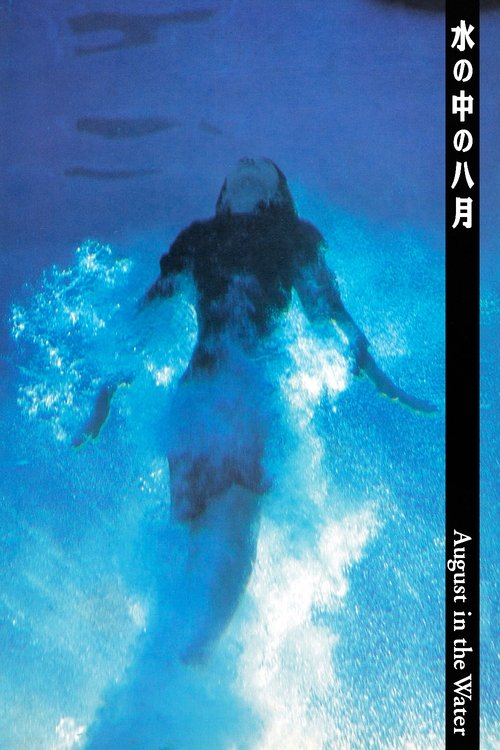
August in the Water
1995 · Gakuryu Ishii
For a late night alone when you want to drift rather than be gripped — a film to sink into like warm water. Pure mood-bath, not comfort food and not a challenge exactly, but it asks your patience and pays it back in wonder.
What it's about
During a strange summer in Fukuoka — drought creeping in, meteors falling — a high-school diving champion survives an accident and starts to sense something vast rearranging itself around her. What begins as a story about a girl, a boy who admires her, and a city running out of water slowly opens into a science-fiction vision about her place in the universe.
The experience
Slow, radiant, and hypnotic — plot loosens its grip and atmosphere takes over, all shimmering water, cicada drone, and ambient pulse, until you feel less like you're watching it than absorbing it. It's cosmic without a wink of irony, and it leaves you in a genuinely altered, dreamlike state.
The craft
Gakuryu Ishii, who invented Japanese punk cinema on pure velocity, here reverses himself completely into stillness and light — and the control is remarkable. Hiroyuki Onogawa's ambient score fuses with water, stone, and insect noise into a single sound-world; this one rewards a dark room, good speakers, and zero distractions.
Why it matters
For decades it was almost impossible to see outside Japan, traded in murky rips like a relic, which only deepened its cult standing; it's now treasured as the summit of Ishii's second, meditative career.
Gakuryu Ishii — then Sogo Ishii — invented Japanese punk cinema as a student with Crazy Thunder Road and Burst City, all velocity and shrapnel. In the nineties he reversed himself completely, and this is the summit of that second life: a slow, radiant science-fiction reverie set in Fukuoka during a strange summer of drought and falling meteors, where a high-school diving champion survives an accident and begins to sense the universe reorganizing itself around her. Plot dissolves into atmosphere — shimmering water, cicada drone, stone, static, the ambient pulse of Hiroyuki Onogawa's score — until the film seems less watched than absorbed, a cosmic vision taken entirely seriously and entirely without irony. For decades it was nearly impossible to see outside Japan, circulating in murky rips traded like relics, a scarcity that only deepened its legend among adventurous viewers; restoration finally returned its aquatic blues to full saturation. Few films argue so gently that transcendence might be a matter of light and water.
Reception
Barely seen outside Japan for decades — it didn't even have an English Wikipedia page until recently — it survived on fan-subbed bootlegs before a restoration, a JAPAN CUTS retrospective Q&A with Ishii, and a late-2024 Criterion Channel arrival turned it into a proper rediscovery story.
How August in the Water was received, from release to now →
Influences: the films it descends from and the films it influenced
- Solaris (1972) — Ishii's shimmering-water close-ups treat the pool surface as a sentient membrane exactly as Tarkovsky films weeds undulating beneath the lake — texture and reflection as metaphysical event rather than backdrop.
- Stalker (1979) — The plotless drift toward a threshold of transcendence, held together by drones over submerged debris and durational tracking, is lifted straight from the Zone's grammar of patient, dialogue-thin questing.
- 2001: A Space Odyssey (1968) — The cosmic-vision finale — human consciousness dissolving into stellar imagery via wordless, music-driven abstraction — is the template for August's leap from summer-town realism into astral transcendence.
- Picnic at Hanging Rock (1975) — Weir's sun-hazed, ambient-scored disappearance of schoolgirls into an unexplained landscape force is the direct forebear of Ishii's apocalyptic-summer diffusion and refusal to resolve the vanishing.
- Days of Heaven (1978) — Magic-hour naturalism and the biblical locust plague give Ishii his model for insect-swarm/cicada texture and nature photographed as omen rather than scenery.
- Crazy Thunder Road (1980) — Ishii's own foundational punk-kineticism film — the aggressive handheld velocity he here deliberately inverts into stillness, making August a self-negating answer to his early style.
- Charisma (1999) — Kurosawa extends Ishii's ambient apocalyptic mode — a quiet ecological/cosmic catastrophe carried by drone and desaturated stillness rather than spectacle.
- Eureka (2000) — Aoyama's three-hour monochrome duration and post-trauma landscape-cinema inherit August's faith that slow-cinema time itself, not plot, delivers transcendence.
- Electric Dragon 80000V (2001) — Ishii's later return to punk voltage re-literalizes August's abstract 'human as energy conduit' theme, proving the metaphysics of the water film underwrote his electric period.
- Tropical Malady (2004) — Apichatpong's plotless-atmosphere structure, insect/cicada sound-beds, and dissolve of self into nature carry forward August's grammar of transcendence-through-environment.
- Silent Light (2007) — Reygadas stages transcendence in real durational time with natural-light landscapes and a near-mute soundtrack, the same patient staging Ishii uses to earn his cosmic turn.
- The Tree of Life (2011) — Malick's whispered, plotless cosmic-montage — water motifs braided with childhood summer and universal genesis — is the fullest bloom of the transcendental-vision method August prototyped.
- Enter the Void (2009) — Noé pushes August's dissolution-of-self climax into first-person floating POV, extending the same ambition to render consciousness leaving the body as pure image and drone.
- Burst City (1982) — Same authorial hand: the strobing riot-montage of Burst City and the becalmed aquatic drift of August are two poles of Ishii's single obsession with energy fields and bodily dissolution.
- Angel Dust (1994) — Immediate predecessor sharing Hiroyuki Onogawa's ambient score; both convert urban/psychological dread into a metaphysical hum, pioneering the drone-as-narrator technique August perfects.
- Tetsuo: The Iron Man (1989) — Core Japanese-punk-cinema peer: Tsukamoto's body-as-cosmic-conductor and industrial sound-design share Ishii's conviction that the human form is an antenna for larger energies.
- Suzaku (1997) — Kawase's cicada-drenched rural-summer soundscape and documentary-grained attention to light and water run parallel to Ishii's cicada-drone and nineties Japanese slow-cinema texture.
Similar films
- Angel Dust (1994) — influence & lineage
- Solaris (1972) — influence & lineage
- A Scene at the Sea (1991) — same viewing thread
- Moving (1993) — same viewing thread
- All About Lily Chou-Chou (2001) — same viewing thread
- Picnic at Hanging Rock (1975) — influence & lineage · often watched together
- Tropical Malady (2004) — influence & lineage · often watched together
- Angel's Egg (1985) — often watched together
All the films related to August in the Water →
Watch it with: curated runs of related films
- Unmoored in Modern Japan — Watch these when you want Japanese cinema at its most restless — lives knocked off their axis by divorce, disaster, migration, or heartbreak, and the strange grace of piecing them back together.