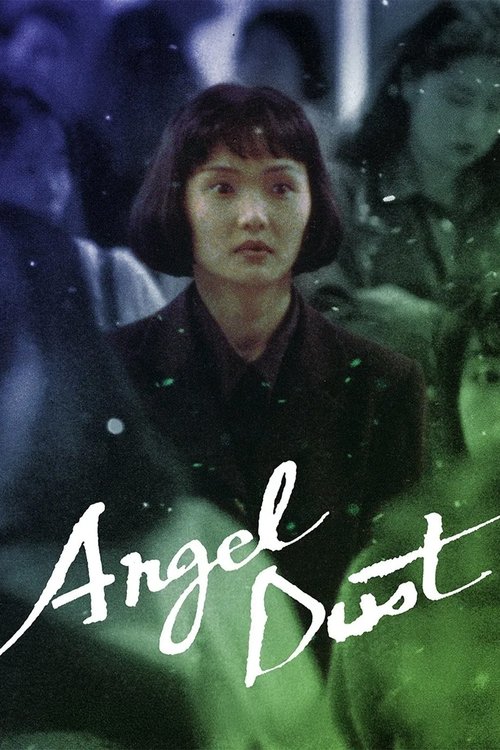
Angel Dust
1994 · Gakuryu Ishii
For a late night when you're craving something genuinely eerie and cerebral — dread over jump scares, atmosphere over answers. This is unsettle-me viewing, not comfort viewing.
What it's about
Every Monday at rush hour, a young woman is murdered on the Tokyo subway. A psychiatric profiler is pulled into the hunt, and the trail leads her toward a former colleague who 'deprograms' cult members — and into the queasy territory where curing a mind shades into colonizing it. The case gets less about catching a killer and more about how easily a self can be rewritten.
The experience
Cold, hypnotic, and deeply unsettling — less a shock machine than a slow contamination, with a droning soundscape that gets under your skin and stays there. It leaves you unsure of what you saw, in the best way.
The craft
Gakuryu Ishii, who'd made his name with punk-fueled assaults on Japanese cinema, returned from years away with something unrecognizably controlled: Tokyo shot as an ambient organism of surveillance monitors, crowd-flow, and electromagnetic hum. The sound design does as much of the horror as the images — good speakers or headphones transform it.
Why it matters
Released months before the 1995 Tokyo subway sarin attack, its imagery of subway death and cult psychology came to read as unbearable prophecy, making it one of the key seismographs of 1990s Japanese anxiety and a touchstone of the era's psychological thrillers.
Gakuryu Ishii (then Sogo Ishii) had detonated Japanese cinema in his twenties with punk assaults like 'Crazy Thunder Road' and 'Burst City'; after nearly a decade away from features, he returned with something unrecognizably cold and controlled. A psychiatric profiler is drawn into the case of a serial killer striking Tokyo's rush-hour subway every Monday, a hunt that leads her toward a former colleague who 'deprograms' cult members — and toward the porous border between curing a mind and colonizing it. Released in 1994, months before the Aum Shinrikyo sarin attack turned its imagery of subway death and cult psychology into unbearable prophecy, the film now reads as a seismograph of its decade's anxieties. Ishii shoots Tokyo as an ambient organism — surveillance monitors, crowd-flow, electromagnetic hum — with a droning sound design that gets under the skin long before anything happens. Its DNA is everywhere in the J-horror and psycho-thriller wave that followed; Kiyoshi Kurosawa's 'Cure' is unthinkable without it.
Reception
Barely seen outside festivals in 1994 and hard to find for decades, it's since been reappraised as a missing link between Ishii's punk-era anarchy and the hypnotic Japanese psychological thrillers of the late '90s.
How Angel Dust was received, from release to now →
Influences: the films it descends from and the films it influenced
- Burst City (1982) — Ishii's own punk-cinema kineticism — strobing montage and industrial noise — is here cooled and slowed into ambient dread, the same director inverting his method into stillness.
- The Manchurian Candidate (1962) — Establishes the programmed-killer-with-a-trigger structure that Angel Dust adopts: a subject conditioned by a controlling authority to kill on cue (the Monday 6pm subway pattern echoing the playing-card trigger).
- Manhunter (1986) — Its empathic profiler who psychologically merges with the killer — rendered in cold, clinical framing over droning synth ambience — is the template for Angel Dust's forensic psychiatrist dissolving into her quarry.
- The Silence of the Lambs (1991) — Supplies the dyad of a female investigator locked against a manipulative psychiatrist-mentor, the interview room as a chamber of psychological domination rather than information exchange.
- The Conversation (1974) — Its investigative method of obsessively replaying and re-scrubbing surveillance recordings is Angel Dust's own — the deprogrammer poring over subway footage until observer and evidence contaminate each other.
- Vertigo (1958) — Models the Svengali dynamic of a controlling man psychologically remaking a woman, which Angel Dust literalizes as the deprogrammer/brainwasher relationship between psychiatrist and analyst.
- Blade Runner (1982) — Its rain-soaked city rendered as a breathing organism, married to drone-and-texture sound design, is the direct forebear of Angel Dust's 'ambient organism Tokyo' cinematography.
- Videodrome (1983) — Frames psychiatry and media as clinical instruments of mind control and conditioning, the same fusion of institutional authority and reprogramming that drives Angel Dust's cult/deprogramming plot.
- Jacob's Ladder (1990) — Chemically-induced paranoid hallucination staged with the subway/underground as a hell-space — literally the drug-and-transit nexus (angel dust/BZ) that Angel Dust names and inherits.
- Cure (1997) — Directly descends: a mesmerist who hypnotically triggers ordinary people to kill, carried by droning ambient sound and an affectless detective who is himself eroded — Kurosawa's acknowledged debt to Ishii's atmosphere.
- Charisma (1999) — Extends the 'landscape/city as sick organism' cinematography and long, drone-scored takes of environmental dread that Angel Dust pioneered in its Tokyo exteriors.
- Pulse (Kairo) (2001) — Builds atmospheric horror almost entirely from low-frequency drone design and desaturated urban emptiness, the ambient-dread grammar Angel Dust seeded into J-horror.
- Ring (1998) — Converts the serial-death procedural into a curse-investigation whose muted palette and sound-driven dread carry the restrained, clinical J-horror tone Angel Dust helped codify.
- Suicide Club (2001) — Extends the mass-mind-control-meets-subway-death motif into a full cult contagion, with a synchronized station atrocity that reads as the direct offspring of Angel Dust's collective-death prophecy.
- Perfect Blue (1997) — Runs a parallel psycho-thriller of dissolving identity under psychiatric and media manipulation, the same cold interrogation of a controlled, splitting mind rendered through unreliable perception.
- Zodiac (2007) — Shares the obsessive, procedurally rigorous, ultimately unresolved serial-killer investigation in which the investigator's fixation consumes him — Angel Dust's cold procedural in a Western register.
- August in the Water (1995) — Immediate predecessor sharing Hiroyuki Onogawa's ambient score; both convert urban/psychological dread into a metaphysical hum, pioneering the drone-as-narrator technique August perfects.
Similar films
- Cure (1997) — influence & lineage
- Ring (1998) — influence & lineage
- Videodrome (1983) — influence & lineage
- Pulse (2001) — shared sensibility
- Ghost in the Shell (1995) — shared sensibility
- Creepy (2016) — shared sensibility
- Perfect Blue (1998) — shared sensibility
- August in the Water (1995) — shared sensibility