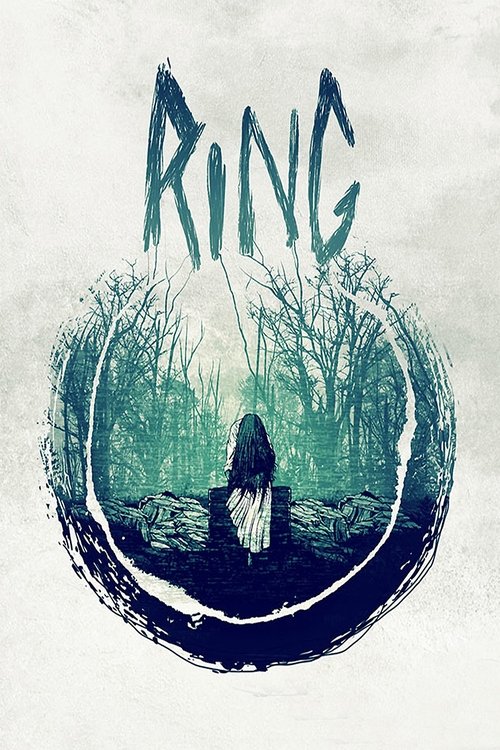
Ring
1998 · Hideo Nakata
When you're craving a real scare — not gore, but the creeping kind that makes you nervous about your own TV afterward. Best watched at night, alone or with one brave friend.
What it's about
A rumor circulates among teenagers: watch a certain unmarked videotape and you die exactly seven days later. When a journalist investigating a cluster of strange deaths finds the tape and watches it herself, the legend stops being a story — now she has a week to trace the curse to its source, with her own child pulled into the danger.
The experience
Slow, quiet, and relentlessly ominous — it builds dread out of gray light, dead air, and things half-glimpsed rather than jump scares. By the end the tension is almost unbearable, and its signature image will follow you home.
The craft
Nakata's direction is a masterclass in withholding: murky cinematography, an unnerving sound design of hums and static, and a curse built around ordinary household technology. It doesn't need a big screen so much as a dark room — the film turns the television you're watching it on into the threat.
Why it matters
The film that defined Japanese horror for the world at the turn of the millennium, launching a franchise, a famous American remake, and a decade-long international wave of vengeful-ghost horror.
Snapshot
Ring (リング, Ringu) is the film that, more than any other single title, defined the international image of Japanese horror at the turn of the millennium. Directed by Hideo Nakata from Hiroshi Takahashi's adaptation of Koji Suzuki's 1991 novel, it turns a deceptively simple urban legend — watch a certain unmarked videotape and you die seven days later — into a slow, dread-saturated procedural about a journalist racing to break a curse before it claims her son. Its power lies less in spectacle than in atmosphere and withholding: a muffled, waterlogged world of gray light and dead air, climaxing in one of the most reproduced images in modern horror, the drowned girl Sadako crawling from a television set. Released in Japan on 31 January 1998, the film became a phenomenon across East Asia, seeded a franchise and a wave of imitators, and prompted Gore Verbinski's 2002 Hollywood remake, which carried the J-horror template to the West.
Industry & production
Ring emerged from a specific moment in late-1990s Japanese film financing, when home-video and television interests were underwriting theatrical features and when the Kadokawa media empire's interest in Suzuki's bestselling novels made adaptation commercially attractive. The production is inseparable from its unusual twin: Ring was shot and released simultaneously with Rasen (Spiral), an adaptation of Suzuki's direct sequel novel, directed by Jōji Iida, with the two films sharing actors and conceived as a paired theatrical event distributed by Toho. The gamble was lopsided. Nakata's Ring was the runaway success and Rasen the commercial disappointment, an imbalance that effectively voided Rasen's status as the "official" sequel and led the producers to commission a fresh follow-up, Ring 2 (1999), again directed by Nakata, that ignored Iida's film entirely.
The picture was made on a modest budget with a compressed schedule typical of the period's genre production, and it carried no expectation of becoming a landmark; its success was a surprise that retroactively reorganized the Japanese horror landscape. Exact box-office figures vary across sources and I will not assign a precise number, but the consensus of the record is unambiguous: Ring was a major hit in Japan and a substantial draw across South Korea, Hong Kong, Taiwan and Singapore, where it helped consolidate a regional appetite for the new Japanese horror. Its commercial proof-of-concept made the cursed-video premise a franchise asset and made Nakata, briefly, the most internationally visible Japanese horror director of his generation.
Technology
Few horror films are as thematically wedded to a specific technology as Ring is to the analog videocassette. The curse propagates through a physical artifact — an unlabeled VHS tape — and through the telephone, which delivers the death sentence as a ringing call immediately after viewing. This grounding in consumer media is essential rather than incidental: the horror is a contagion that travels along the everyday infrastructure of late-twentieth-century domestic life, the VCR and the landline, objects so ordinary they disarm suspicion. The film's eventual escape clause — that the curse is survived only by copying the tape and showing it to another person — reframes the supernatural as something disturbingly close to a chain letter or a virus, a self-replicating message that demands propagation. This is the conceptual engine that later commentators would read as eerily prophetic of viral media and networked contagion, even though the film itself is firmly analog. The cursed video's own imagery — degraded, stuttering, full of cryptic symbols, a mirror, a crawling figure — exploits the textures of damaged magnetic tape, the visual noise and tracking error that VHS users knew intimately, so that the medium's material decay becomes part of the dread.
Technique
Cinematography
Junichirō Hayashi's photography is central to the film's reputation and to the broader J-horror look it helped codify. The palette is desaturated and cold, dominated by grays, sickly greens and the blue cast of overcast daylight and television glow, with water — rain, the sea, the well — recurring as both image and atmosphere. Hayashi favors stillness and restraint: compositions hold, the camera observes rather than chases, and negative space is left deliberately open so that the viewer's eye searches the frame for a threat that is usually withheld. Interiors feel underlit and damp; the cursed tape's footage is shot in a degraded, high-contrast register that sets it apart as found, corrupted material. This is horror built on what is not shown and on the menace latent in ordinary domestic space, an aesthetic of suggestion that became enormously influential precisely because it was so reproducible.
Editing
The cutting, credited to Nobuyuki Takahashi, prioritizes patience and dread accumulation over shock rhythm. The film's structure is essentially that of an investigation, and the editing tracks Reiko's deductive process — the ticking seven-day clock provides the metronome — while parceling out the tape's imagery in fragments that the narrative gradually decodes. Crucially, the editing resists the rapid stinger-driven grammar of contemporary Western horror; jolts are rationed and earned. The celebrated final sequence depends entirely on editorial control of duration: the protracted, almost unbearable patience with which Sadako's emergence from the well-image and through the television is allowed to play out, defying the viewer's expectation that the cut will arrive to release the tension.
Mise-en-scène / staging
Nakata stages horror in flat, mundane, contemporary spaces — apartments, schools, news offices, ferries, a rural inn — so that the uncanny erupts from the ordinary. The film's iconography is austere and repeatable: the television set as portal, the ring of the telephone, the stone well, the curtain of long black hair obscuring a face. Sadako's design is the masterstroke of the staging — a figure in a white shift with hair fallen forward, moving in a broken, jerking gait (achieved through reverse-motion technique that gives her motion its wrong, deboned quality). She is almost never seen whole or clearly, which preserves her as a figure of dread rather than display. Water motifs saturate the production design, binding the well, the sea and the leaking, sodden imagery into a single drowning logic.
Sound
Ring's sound design is, with its photography, the most imitated element of its craft. Kenji Kawai's score is sparse and dissonant, deploying scraping, metallic and groaning textures rather than melody, and much of the film's terror is carried by sound rather than music: amplified ambient noise, the hum and hiss of the tape, distorted electronic whines, and above all the strategic use of near-silence. The telephone's ring is weaponized into a sound of pure dread. Kawai's contribution — abrasive, industrial, anti-melodic — established a template for the unsettling sonic palette that subsequent J-horror would draw upon, and it is arguably the single most important factor in the film's capacity to disturb.
Performance
Nanako Matsushima anchors the film as Reiko Asakawa, the journalist and mother, playing the role with a controlled, increasingly frayed naturalism that keeps the supernatural plausible; her maternal stakes — the threat to her son Yōichi — supply the emotional through-line. Hiroyuki Sanada, a major star, brings gravity and a faint coldness to Ryūji Takayama, Reiko's ex-husband and intellectual collaborator, whose ambiguous psychic sensitivity and ultimate fate give the film its devastating final turn. The performances are deliberately restrained, pitched below the register of melodrama, which suits Nakata's documentary-adjacent staging and lets the horror, rather than the acting, carry the intensity.
Narrative & dramatic mode
The film's dramatic mode is the supernatural procedural — an investigation structured by a deadline. Reiko functions as detective, assembling clues from the tape, tracing its provenance to the island, the volcano, the psychic Shizuko and her daughter Sadako, and finally to the well. This ratiocinative spine gives Ring an unusual rigor for a ghost story; the audience solves the puzzle alongside the protagonists. The masterstroke is the third-act reversal: Reiko, having recovered Sadako's remains from the well, believes she has performed the appeasement that lifts curses in the traditional ghost story — and survives her own seventh day. But when Ryūji dies on schedule, the rule is exposed. Sadako cannot be appeased; she can only be passed on. The film thus rejects the redemptive logic of the classical kaidan, in which honoring the wronged dead resolves the haunting, and substitutes a bleak, modern logic of obligatory transmission. Reiko's final realization — that to save her son she must make him a vector, copying the tape and showing it to her own father — closes the film on moral horror rather than relief.
Genre & cycle
Ring sits at the head of the "J-horror" cycle of roughly 1998–2005, the international shorthand for a wave of atmospheric Japanese supernatural films built on dread, female vengeful ghosts, cursed media and domestic settings. While it did not invent these elements, its success made it the cycle's keystone and commercial template. The cycle it galvanized includes Takashi Shimizu's Ju-on franchise, Kiyoshi Kurosawa's Pulse (Kairo, 2001) — for which Hayashi also shot — and Nakata's own Dark Water (2002), as well as the Ring sequels and prequel. Ring also established the export pattern of the cycle: regional Asian success followed by Hollywood remakes (The Ring, The Grudge, Dark Water, Pulse), making J-horror a globally legible brand for several years.
Authorship & method
Hideo Nakata, who had apprenticed in the studio system and directed the earlier ghost feature Don't Look Up (Joyūrei, 1996), is a director of restraint and atmosphere rather than gore, and Ring is the fullest expression of his patience-based method: dread built through duration, composition, sound and withholding. His key collaborators are essential to the achievement and recur across the cycle. Screenwriter Hiroshi Takahashi made decisive structural changes from Suzuki's novel, most notably changing the protagonist from the novel's male journalist to the female Reiko and streamlining the book's more science-fictional, viral-DNA conceit toward pure supernatural dread; Takahashi's reconception of Sadako as an avenging onryō figure, drawing on Japanese ghost-theater tradition, shaped the film's iconography. Cinematographer Junichirō Hayashi and composer Kenji Kawai supplied, respectively, the visual and sonic signatures that define both the film and the broader movement, while editor Nobuyuki Takahashi sustained its controlled tempo. The film is genuinely a product of this collaborative ensemble, several of whom would carry its aesthetic into the cycle's later titles.
Movement / national cinema
As the central text of J-horror, Ring is a national-cinema phenomenon with a clear lineage. It draws on the deep Japanese tradition of the kaidan, the ghost story, and specifically the onryō — the vengeful spirit, typically female, wronged in life and returning with destructive power. Sadako's visual presentation, with her white garment and obscuring fall of long black hair, descends from the iconography of figures such as Oiwa in the Yotsuya Kaidan tradition and from the yūrei of classical ghost painting and kabuki. Where mid-century Japanese horror cinema — including the lush, theatrical kaidan films of the 1960s — staged such hauntings in period settings, Ring relocates the onryō into contemporary urban, media-saturated Japan, and that translation of an ancient form into the world of VCRs and tabloid journalism is precisely its innovation.
Era / period
The film is a document of late-1990s Japan: its anxieties about media saturation, the unease beneath consumer normalcy, and a built environment of nondescript apartments and offices belong unmistakably to the period. It arrives, too, at a transitional technological moment, capturing the analog video culture of the VHS era just before digital media displaced it — which lends the film, in retrospect, an additional layer of period poignancy, as the very technology that carries its curse was on the cusp of obsolescence.
Themes
The film's governing themes interlock around transmission and the inescapable. Foremost is contagion: the curse as a self-replicating message that survives only by spreading, a conception that invites readings about viral media, rumor, trauma and the ethics of saving oneself by endangering another. Closely bound to this is maternity and inheritance — Reiko's drive is maternal, the curse passes through bloodlines and generations (Shizuko to Sadako), and the resolution forces a mother to implicate her child and father in the chain. Media and mediation run throughout: the tape, the television, the photograph (the curse distorts faces in still images), the telephone — technology as the channel through which the dead reach the living. There is a persistent motif of water and drowning, from the well to the sea to the sodden imagery, binding the film's deaths and its origin to suffocation and submersion. And underlying all of it is a refusal of catharsis: unlike the traditional ghost story, the wronged spirit here cannot be laid to rest, and grief, guilt and obligation simply circulate without end.
Reception, canon & influence
Critically and commercially, Ring was the breakout success of its moment and has since been canonized as a landmark of horror cinema, regularly cited among the most influential horror films of the past several decades and credited with reorienting the genre internationally toward atmosphere, restraint and the supernatural after a long Western emphasis on slashers and gore.
Influences on the film run backward into Japanese tradition and Suzuki's source material. The deepest debt is to the kaidan/onryō lineage and its theatrical and pictorial iconography of the long-haired female ghost. Suzuki's 1991 novel supplied the premise, and notably the figure of Sadako and her mother echo the novel's invocation of early-twentieth-century Japanese fascination with psychic phenomena — the Meiji/Taishō-era clairvoyance experiments associated with figures such as the psychics studied in that period — material the film carries over in compressed form through Shizuko's storyline. Hiroshi Takahashi's screenplay is the crucial filter that converted Suzuki's more science-fictional novel into a purely supernatural register.
What the film shaped is extensive and durable. Domestically it spawned an immediate franchise — Ring 2 (1999) and the prequel Ring 0: Birthday (2000), both with Nakata's collaborators in key roles, plus the supplanted Rasen — and made Sadako a permanent fixture of Japanese popular culture. Across Asia it accelerated the J-horror cycle and a parallel boom in regional horror. In the West, its influence was decisive: Gore Verbinski's The Ring (2002) was a major American success and triggered a wave of Hollywood remakes of Asian horror, with Nakata himself directing the American The Ring Two (2005) and the Hollywood remake of his own Dark Water (2005). Beyond remakes, the film's craft vocabulary — desaturated photography, abrasive sound design, the spectral long-haired woman, the cursed-media premise, dread through withholding — became a genre-wide toolkit, imitated to the point of cliché, which is itself the surest measure of how thoroughly Ring reset the terms of contemporary horror.
A Deleuzian reading
Press play.
The full Deleuzian reading of Ring →
Reception
A modest-budget TV-adjacent production that became Japan's biggest horror hit of its era and launched the entire J-horror boom — and after the 2002 American remake sent Western fans back to the source, the original hardened into the consensus pick as the scarier, better film.
How Ring was received, from release to now →
Influences: the films it descends from and the films it influenced
- Tokaido Yotsuya Kaidan (1959) — Its disfigured, long-haired Oiwa onryo who contorts and crawls into frame established the visual grammar of the vengeful female ghost that Sadako's hair-veiled, broken-limbed emergence directly revives.
- Ugetsu (1953) — Renders its ghostly woman through patient long takes and atmospheric dread rather than spectacle, the kaidan-cinema template of restraint Nakata adopts wholesale.
- Kwaidan (1964) — Its stylized, theatrically composed kaidan tableaux and Toru Takemitsu's abrasive musique-concrète soundtrack model the atmosphere-over-shock approach and dissonant, anti-melodic scoring Kenji Kawai extends.
- Kuroneko (1968) — Codified the long-haired female onryo gliding through negative space with unnatural floating/reverse motion — the precise staging vocabulary Nakata reuses for Sadako's exit from the well and the television.
- The Haunting (1963) — Builds terror entirely through withholding, off-screen sound and architectural framing while never showing the supernatural — the scare-via-the-unseen, duration-control method central to Ring's dread.
- Don't Look Now (1973) — Associative cross-cutting, a desaturated palette punctuated by water-and-drowning motifs, and a horrific third-act reveal of a small figure prefigure Ring's editing-and-reversal architecture.
- Don't Look Up (Joyurei) (1996) — Nakata's own earlier ghost feature where he first developed the patience-based, duration-driven haunting method and assembled the collaborative approach he refined in Ring.
- Angel Dust (1994) — Converts the serial-death procedural into a curse-investigation whose muted palette and sound-driven dread carry the restrained, clinical J-horror tone Angel Dust helped codify.
- Ring 2 (1999) — Direct sequel carrying the same ensemble (Takahashi, Kawai, Hayashi) and extending the withholding-and-duration aesthetic into the same desaturated, water-logged register.
- Ring 0: Birthday (2000) — Franchise prequel that elaborates Sadako's onryo origin while preserving the restrained-performance, anti-melodic-sound toolkit established by Nakata's film.
- Ju-on: The Grudge (2002) — Built its franchise on Ring's long-haired onryo and foregrounded the death-rattle croak/click vocalization, pushing the weaponized-sound design into a signature aural motif.
- Dark Water (2002) — Nakata reapplies the cursed water-and-drowning motif and apartment-bound dread with identical restraint, again adapting a Koji Suzuki source through the same supernatural-procedural lens.
- A Tale of Two Sisters (2003) — Korean extension of the restrained-atmosphere J-horror grammar, deploying controlled tempo, a cold palette and a destabilizing third-act reversal of what the viewer has been shown.
- Shutter (2004) — Thai cursed-media variant that transposes Ring's cursed-image conceit from videotape to photographs, with the long-haired onryo manifesting through developed prints.
- The Ring (2002) — The official Hollywood remake that ports the desaturated palette, cursed-VHS premise and well-bound onryo iconography wholesale into American studio horror, triggering the Asian-remake wave.
- It Follows (2014) — Abstracts Ring's transmissible-curse contagion (a death passed by contact and viewing) and pairs it with an anti-melodic analog-synth score and slow, negative-space staging of the approaching figure.
- Smile (2022) — A recent transmissible-curse contagion film whose passed-along death sentence and dread-through-withholding structure descend directly from Ring's cursed-media-spreads-death template.
- Audition (1999) — Contemporaneous J-horror that weaponizes a slow, naturalistic build of duration and silence before detonating a brutal third-act reversal — the same withholding-then-rupture structure.
- Pulse (Kairo) (2001) — Extends the cursed-technology-as-contagion premise from VHS to the internet, using vast negative space and desaturated grain to stage spectral figures in slow, durational dread.
- Cure (1997) — Nakata crystallizes the same atmospheric, ambient-dread J-horror mode emerging in late-'90s Japan — contagion-as-curse, muted palette, slow accrual over shock — that Cure helped define a year earlier.
- Serpent's Path (1998) — Written the same year by Hiroshi Takahashi, and built on the same two devices — dread generated by information withheld from the viewer rather than revealed, and a recording treated as a physical vector of harm (the tape there, the played-back footage in the warehouse here).
Similar films
- The Ring (2002) — influence & lineage
- Kuroneko (1968) — influence & lineage
- A Tale of Two Sisters (2003) — influence & lineage
- Don't Look Now (1973) — influence & lineage
- Pulse (2001) — same viewing thread
- Perfect Blue (1998) — same viewing thread
- Cure (1997) — shared sensibility
- [REC] (2007) — shared sensibility
All the films related to Ring →
Watch it with: curated runs of related films
- Screens That Swallow You — A run of films where the screen — a pirate broadcast, a haunted website, a monitor, a late-night monster-of-the-week show — stops being a window and becomes a doorway that pulls the watcher bodily through into unreality.