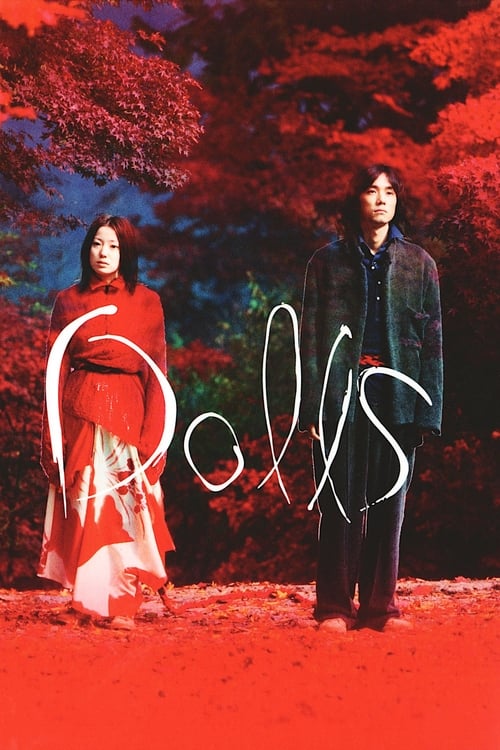
Dolls
2002 · Takeshi Kitano
When you want to be swept into pure visual beauty and don't mind a broken heart — a film for a contemplative, melancholy night, not a casual watch.
What it's about
Three stories of love carried past the point of reason, set in a stylized Japan that turns with the four seasons. At the center is a young man who walks out on an arranged marriage after learning what his abandonment did to the woman he actually loved; bound to her by a length of red cord, the two wander the country as beggars. Around them circle an aging yakuza boss returning to a woman from his past and a pop idol whose devoted fan takes his obsession to an extreme.
The experience
Slow, ravishing, and quietly crushing — closer to a fable or a dream than a plotted drama. It asks for patience and pays you in images; the sadness accumulates rather than strikes.
The craft
Kitano opens with traditional bunraku puppet theater and lets its logic seep into the live-action stories, staging his lovers like figures moved by fate. The seasonal color design — costumes by Yohji Yamamoto against blazing autumn reds and snow — makes this one of the most gorgeous films of its decade, and it absolutely rewards the biggest, best screen you have.
Why it matters
A deliberate turn away from the deadpan yakuza cinema that made Kitano's international name, and proof of his range as a pure visual stylist.
Snapshot
Dolls is Takeshi Kitano's most consciously beautiful film and, by his own framing, a deliberate turn away from the deadpan yakuza cinema that had made his international name. Three loosely braided tales of love pushed past the edge of reason unfold across a stylized Japan organized by the four seasons. The central thread follows Matsumoto, who abandons an arranged marriage on his wedding day when he learns that Sawako, the woman he jilted, has attempted suicide and been left mentally broken; racked with guilt, he binds himself to her with a length of red cord and the two wander the landscape as "bound beggars." Around them orbit a second story of an aged yakuza boss returning to the woman who has waited decades for him on a park bench, and a third of a disfigured pop idol and the obsessive fan who blinds himself rather than look on her scars. The film takes Japanese Bunraku puppet theater as its governing conceit, opening on a live puppet performance and treating its human figures as marionettes moved by forces of obligation and longing they cannot resist. It is at once Kitano's least violent major work and among his most emotionally absolutist.
Industry & production
Dolls was produced through Kitano's home base at Office Kitano, the company that had backed most of his directorial work since the early 1990s and functioned as both production and talent agency for "Beat" Takeshi. By 2002 Kitano occupied an unusual double position in the Japanese industry: a ubiquitous mainstream television comedian and celebrity at home, and a festival-circuit auteur abroad, particularly after Hana-bi won the Golden Lion at Venice in 1997. Dolls was made from that position of secured prestige, which afforded Kitano the latitude to make a film with little commercial-genre scaffolding — no gangster shoot-outs to anchor the marketing, only a set of stylized melodramas.
The film premiered in competition at the 2002 Venice International Film Festival, the venue most identified with Kitano's international reputation. It did not take the festival's top prize that year, and by most accounts its reception there was respectful rather than rapturous. Precise budget and box-office figures for Dolls are not something I can state reliably, and I will not invent them; what the record does support is that the film was positioned as an art-house / festival release internationally rather than a wide commercial title, and that its domestic profile leaned on Kitano's celebrity and on the fashion-world interest generated by Yohji Yamamoto's involvement.
Technology
Dolls is a photochemical film of the early-2000s Japanese art cinema, shot and finished on 35mm at a moment just before digital acquisition became normal for prestige features. There is no evidence that it deployed novel imaging technology; its ambitions are almost entirely aesthetic and compositional rather than technical. The most "technological" dimension of the production is arguably logistical: the film's seasonal structure required location shooting across markedly different Japanese landscapes and weather — cherry blossom, high summer green, the celebrated blaze of autumn foliage, and snow — which places heavy demands on scheduling and continuity but not on any special apparatus. The costume construction by Yamamoto's atelier is likewise a craft rather than technological achievement, though the sheer physical presence of the garments — their scale, weight, and color saturation — is engineered to register on film in a way that shapes the whole visual scheme.
Technique
Cinematography
The photography, by Kitano's longtime collaborator Katsumi Yanagijima, is the film's most immediately striking feature. Yanagijima and Kitano abandon the flat, drab palettes of the earlier crime films for a scheme of super-saturated color keyed to season and to costume. Compositions are frequently frontal, planar, and symmetrical, holding the human figures at a slight remove as if arranged on a stage or in a diorama. The camera tends toward stillness and patient framing rather than expressive movement; when the bound couple crosses a field of autumn leaves or walks a snowbound road, the image is composed as a tableau, the red cord and the reds and golds of the setting doing the emotional work. This pictorialism — landscape as lacquered surface — is central to the film's identification of people with dolls: they are placed within a frame rather than allowed to move it.
Editing
Kitano edited the film himself, a role he had taken on across his directorial work and one integral to his authorial signature. The cutting is characteristically unhurried, favoring the held shot and the elliptical jump over conventional coverage; Kitano habitually withholds the moment of violence or catharsis and lets the aftermath carry the scene, and Dolls extends that grammar to melodrama, often cutting away from or around emotional climaxes. The three stories are interleaved rather than fully cross-cut in parallel, so that the film's rhythm is one of return and rhyme — motifs and images recur across the strands — more than of accelerating suspense.
Mise-en-scène / staging
Staging is where the puppet conceit is literalized. The film brackets its human action with Bunraku performance, and throughout, characters are blocked and posed with a deliberate, arranged quality that recalls the marionette. Yohji Yamamoto's costumes are the dominant element of the mise-en-scène: the bound beggars in particular are dressed in vivid, sculptural garments whose color announces each season, so that clothing becomes landscape and mood. Sets and locations are chosen and framed for graphic clarity — the recurring park bench, roads and fields, a seaside — and the overall design subordinates naturalism to a controlled, painterly stylization.
Sound
The score is by Joe Hisaishi, and Dolls stands as the final collaboration between Hisaishi and Kitano after a run of films stretching back to the early 1990s. Hisaishi's music here is elegiac and melodic, leaning into the film's romantic-tragic register rather than counterpointing it with irony, and it functions almost as a fourth narrative thread binding the disparate stories. Kitano's sound design otherwise tends toward restraint and pockets of silence, consistent with his broader practice of letting quiet frame the few decisive events.
Performance
Performance in Dolls is pitched toward stillness and iconicity rather than psychological naturalism, in keeping with the puppet metaphor. Miho Kanno, as the broken Sawako, plays much of the film in a near-mute, affectless register, her expressiveness located in posture and gaze; Hidetoshi Nishijima's Matsumoto carries a fixed burden of guilt. The supporting strands feature veteran presences — including performers associated with an older era of Japanese cinema in the roles of the aging boss and the woman on the bench — whose weathered faces contribute to the film's elegiac tone, alongside Kyoko Fukada as the idol Haruna. The ensemble is directed to hold and to endure rather than to emote outwardly.
Narrative & dramatic mode
The film's dramatic mode is anti-classical melodrama by way of Japanese theater. Its explicit model is the puppet play of Chikamatsu Monzaemon, and with it the classic Bunraku tension between giri (duty, social obligation) and ninjō (human feeling) that so often resolves, in that tradition, in the double love-suicide (shinjū). Dolls imports this structure of feeling: its lovers are undone precisely by the collision of obligation and desire, and the whole is oriented toward a fated, sacrificial end rather than toward resolution or growth. Narratively the film is anthological, three tales linked by theme and by recurring motifs (the red cord, waiting, blindness, the seasons) rather than by plot mechanics. Causality is loosened; the stories are presented as variations on a single idea — love as a binding that survives even the destruction of the self — so the film reads more as a set of parables than as a conventional story.
Genre & cycle
Within Kitano's own filmography, Dolls belongs to the contemplative, lyrical strain rather than the crime cycle — closer in spirit to A Scene at the Sea and Kikujiro than to Sonatine or Hana-bi, though it converts their gentler moods into full-blown tragedy. More broadly it sits at the intersection of art-house melodrama and a self-consciously "traditional" Japanese aesthetic cinema that draws on classical theater and on the seasonal, pictorial sensibility of Japanese visual culture. It is not part of any large contemporaneous cycle of similar films; if anything it is a deliberately singular, personal statement, which is part of how it was received — as an auteur's turn inward.
Authorship & method
Dolls is emphatically a Kitano film in the strong authorial sense: he directed, wrote, and edited it, exercising control across the film's conception and its rhythm. It is also, unusually, a film defined by two decisive external collaborators. The first is Yohji Yamamoto, whose costume design is not decoration but a structuring principle — the garments carry the film's color scheme, its seasonal logic, and much of its identification of humans with dolls, giving Dolls a rare status as a genuine collaboration between a filmmaker and a fashion designer. The second is composer Joe Hisaishi, whose long partnership with Kitano reaches its end here, and whose lyrical score supplies the emotional throughline the elliptical editing withholds. Cinematographer Katsumi Yanagijima, another core member of Kitano's repeated crew, executes the saturated, planar visual style. Kitano's method across the film is one of subtraction and stylization: strip narrative to parable, compose in tableaux, hold the frame, and let costume, color, landscape, and music do the expressive labor. The result marks a self-conscious reinvention by a director who had become identified with a single genre.
Movement / national cinema
The film is a product of contemporary Japanese national cinema, and it engages that national tradition unusually directly. Where much internationally circulated Japanese cinema of the period looked outward (horror, anime, genre), Dolls looks inward and backward, to Bunraku and to Chikamatsu, and to a pictorial vocabulary of the seasons deeply embedded in Japanese art. It thus functions partly as a dialogue between a modern auteur and classical Japanese performance and visual culture. At the same time it is very much a festival-era film, made for and consecrated by the international circuit — an artifact of the moment when Kitano was one of Japanese cinema's most visible auteur exports.
Era / period
Dolls arrives in the early 2000s, a hinge period for both Kitano and the industry. Kitano had just made Brother (his English-language, transnational yakuza film) and would soon move on to Zatoichi and then the self-reflexive "Takeshis'"/Glory to the Filmmaker!/Achilles and the Tortoise trilogy in which he interrogated his own authorship. Dolls stands at the threshold of that more experimental, self-examining late phase: it is the point at which he most fully sets aside the crime genre to pursue pure aesthetic and emotional form. Technologically and industrially it belongs to the last years of photochemical, festival-driven art cinema before digital workflows and streaming reshaped distribution.
Themes
The film's governing theme is love as a form of binding that outlasts reason, identity, and the body — literalized in the red cord that ties Matsumoto to Sawako. From this radiate its other preoccupations: guilt and expiation (Matsumoto's atonement for his abandonment); waiting and fidelity across time (the woman on the bench); and the tension between seeing and devotion (the fan who blinds himself so as to love the idol without confronting her disfigurement). Running beneath all three is the Chikamatsu opposition of obligation and feeling, and the sense of characters as puppets moved by fate. The seasonal cycle supplies a further theme of transience — the Japanese sensibility of impermanence — as beauty and love alike pass toward an end that the film treats as inevitable rather than tragic in the conventional sense.
Reception, canon & influence
Critical reception of Dolls was notably divided, and honestly so this should be stated plainly rather than smoothed over: admirers received it as Kitano's most ravishing and formally daring film, a bold act of self-reinvention, while skeptics found its beauty airless and its emotion more designed than felt — the charge that its human figures are as inert as the dolls it invokes. That split reflects the film's own gamble, staking everything on stylization.
Looking backward, the film's influences are explicit and cultural more than cinematic: Bunraku puppet theater and the plays of Chikamatsu Monzaemon; the classical Japanese aesthetics of the seasons and of impermanence; and Kitano's own prior work, which Dolls both extends (the elliptical style, the recurring crew) and repudiates (the abandonment of genre violence). Yamamoto's design brings the separate lineage of contemporary Japanese fashion into the film.
Looking forward, Dolls is best understood as a pivot within Kitano's authorship. It cleared the ground for the more self-reflexive late films by demonstrating his willingness to break with the crime persona, and it stands as a reference point in discussions of cinema's dialogue with fashion and with classical theater. Its broader influence on other filmmakers is diffuse and hard to trace with confidence — I would not overstate a direct lineage — but within its own auteur's body of work it remains a landmark: the film in which Kitano most completely subordinated story to image and treated his characters, openly, as puppets of love and fate.
A Deleuzian reading
Two people cross a field of autumn leaves.
The full Deleuzian reading of Dolls →
Reception
Divisive at its Venice 2002 premiere — half the critics called it Kitano's most ravishing film, the other half found it glacial and empty — it has since quietly become the secret-favorite Kitano pick, rehabilitated largely on the strength of its images.
How Dolls was received, from release to now →
Influences: the films it descends from and the films it influenced
- Ugetsu (1953) — Establishes the painterly long-take tableau in which wandering figures move through mist-laden landscape as a register of transience, and dramatizes giri-ninjō as the engine of tragedy — the exact fusion of stillness, seasonal atmosphere, and duty-versus-feeling that Kitano abstracts.
- Tokyo Story (1953) — Codifies the frontal, symmetrical, low static composition and the 'pillow shot' pause that holds an emptied frame — Kitano's held tableaux and refusal to cut on emotional cues descend directly from this grammar of stillness.
- Gate of Hell (1953) — Pioneers the deliberately super-saturated Eastmancolor jidaigeki palette, treating dyed-textile color as the film's primary expressive medium — the ancestor of Dolls' color-as-structure logic carried by costume.
- Kwaidan (1964) — Builds an anthology of parables inside painted, artificial studio skies with saturated seasonal backdrops, staging ghostly figures in frozen theatrical tableaux — the direct model for Dolls' stylized-artifice-over-realism approach and its interwoven parable structure.
- Double Suicide (1969) — Adapts Chikamatsu directly and keeps the black-hooded bunraku kurogo puppeteers visibly on screen manipulating the actors, making explicit the puppet-of-fate conceit that Dolls frames with its opening Bunraku prologue.
- Ran (1985) — Uses Emi Wada's costumes as the load-bearing structural and color scheme — armies color-coded by textile — so that garment design, not dialogue, organizes the drama, prefiguring Yamamoto's costume-as-structuring-principle in Dolls.
- A Scene at the Sea (1991) — Kitano's own near-silent minimalism with a lyrical Joe Hisaishi score supplying the emotion that sparse dialogue withholds — the template of silence-restraint and music-as-throughline that Dolls perfects.
- Hana-bi (1997) — Self-ancestor establishing Kitano's elliptical editing (he cuts as editor), his own naïf paintings inserted as imagery, and the Yanagijima planar frame — the mature style Dolls extends after stripping away the crime genre.
- Kikujirō (1999) — Structures a road journey as discrete chaptered vignettes carried by Hisaishi's sentimental theme — the episodic, music-anchored travel form that Dolls reworks with the bound-beggars couple crossing the seasons.
- Kikujiro (1999) — Extends the same method — Hisaishi score, frontal painterly tableaux, withheld emotion — pushing the static composition and formal stillness of Kikujiro to a more stylized extreme.
- Zatōichi (2003) — Immediately after Dolls, Kitano returns to genre but keeps the newly heightened stylization — choreographed, rhythmic, near-musical staging and bold formal patterning — showing how Dolls loosened his commitment to realist crime.
- House of Flying Daggers (2004) — Extends the color-coded-costume melodrama into an explicitly seasonal, snowbound tragedy of doomed lovers, sharing Dolls' method of letting fabric, landscape, and seasonal shift carry a fated-love parable.
- Takeshis' (2005) — The self-reflexive late film Dolls made possible: having broken with the crime persona through pure stylization, Kitano turns the camera on his own doubled image, subordinating story to image exactly as Dolls first dared.
- The Assassin (2015) — Recasts wuxia as an art-house tableau film of held static frames, extreme silence, and super-saturated textile color, letting costume and landscape displace plot — the fullest later realization of Dolls' image-over-narrative wager.
- Zatoichi (2003) — Immediate predecessor with cinematographer Katsumi Yanagijima, formalizing the saturated color-blocked, rigorously composed frame Kitano carries into the jidaigeki.
- In the Mood for Love (2000) — Turns costume (Maggie Cheung's rotating cheongsam) into the film's structuring device and organizes a story of thwarted love through elliptical omission and repeated, painterly framings — the same subordination of narrative to textile, color, and restraint.
- Hero (2002) — Released the same year, it segments its melodrama into monochrome color blocks in which costume and dyed fabric carry the storytelling — a parallel, independent instance of color-and-costume-as-structure in East Asian art melodrama.
- Spring, Summer, Fall, Winter... and Spring (2003) — Organizes a near-wordless parable of love and karma explicitly by the cycle of seasons, using landscape and silence in place of dialogue — the same seasonal-impermanence architecture and restraint Dolls deploys.
Similar films
- Tokyo Story (1953) — influence & lineage · same viewing thread · often watched together
- Fireworks (1997) — influence & lineage · often watched together
- In the Mood for Love (2000) — influence & lineage
- Perfect Days (2023) — same viewing thread
- Memoirs of a Geisha (2005) — shared sensibility
- The Life of Oharu (1952) — shared sensibility
- Kokuho (2025) — shared sensibility
- Zatoichi (2003) — shared sensibility
All the films related to Dolls →
Watch it with: curated runs of related films
- The Weight of the Unspoken — A run of quietly shattering films where the largest feelings never get said aloud — love that outlasts reason, grief that gathers over a single family dinner, a long marriage cracked open by one old letter.