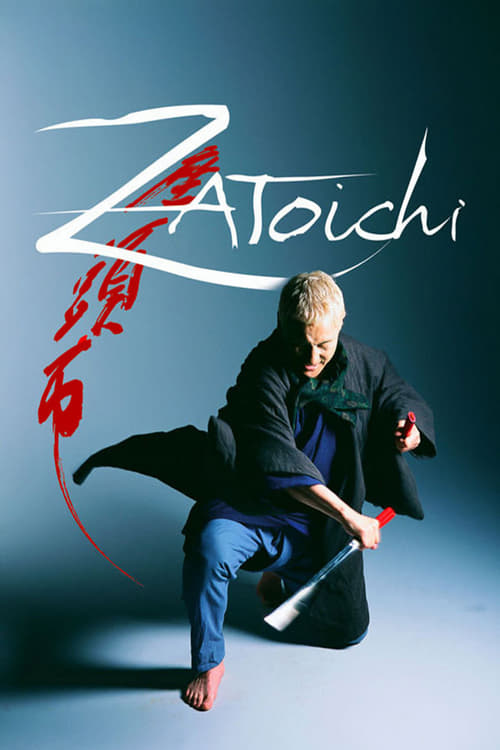
Zatoichi
2003 · Takeshi Kitano
For when you want an action movie with personality — something stylish and a little strange that entertains without asking much, but is made well enough to reward paying attention. Comfort viewing with a body count.
What it's about
A blind wanderer drifts into a rural Japanese village being bled dry by warring gangs. He earns his keep as a masseur, cleans up at the dice table thanks to ears sharper than anyone's eyes, and carries a cane that conceals a blade he can use faster than men who can see. As the gangs squeeze the townspeople and a pair of geisha pursue a private score to settle, he quietly decides the village is worth defending.
The experience
Playful and deadpan until it's suddenly not — long stretches of dry comedy and gambling-den lounging punctured by sword fights that are over in seconds. It's violent but bouncy, almost musical, and it keeps catching you off guard with how much fun it's having.
Performances
Takeshi Kitano plays the blind swordsman himself with a bleached-blond crop and an almost total stillness — a hero built out of small smirks and sudden motion. Tadanobu Asano brings quiet melancholy to a masterless samurai hired as gang muscle, the one opponent who feels genuinely dangerous.
The craft
Kitano directs, edits, and stars, cutting the film to a beat: farmers hoeing fields and rain on rooftops become percussion, and the swordplay lands in short, shocking bursts rather than long duels. The stylized digital blood splashes like paint, and the whole thing builds toward an exuberant musical flourish that has to be seen. Turn the sound up — the rhythm is half the movie.
Why it matters
It revived one of Japanese cinema's most beloved long-running heroes for a new generation and won Kitano the Silver Lion for direction at Venice, becoming the most crowd-pleasing hit of his career and introducing many Western viewers to his work.
Snapshot
Zatoichi is Takeshi Kitano's irreverent, formally playful revival of one of Japanese popular cinema's most durable heroes: the blind masseur, gambler, and peerless swordsman who roams a lawless rural Japan. Kitano — performing as he always does under the screen name "Beat" Takeshi — directs, edits, and stars, taking the iconic role made famous by Shintarō Katsu and refashioning it in his own deadpan, percussive, blood-spattered idiom. The film premiered at the 2003 Venice Film Festival, where Kitano received the Silver Lion for direction, and it became one of the most warmly received works of his career, both at home and abroad. It is at once a crowd-pleasing genre entertainment — arguably the most accessible film Kitano had made — and a sly auteur exercise, threading his signature concerns (sudden violence, blank-faced comedy, fate, performance and disguise) through the conventions of the period sword film. The result sits somewhat apart from the contemplative yakuza tragedies (Sonatine, Hana-bi) that built his international reputation, trading their melancholy stillness for a brighter, more rhythmic, almost musical-comedy register, culminating in a celebrated tap-dance finale.
Industry & production
The Zatoichi character originated at Daiei Studios in 1962 and anchored one of the most successful franchises in Japanese film history — some two dozen features plus a long-running television series — built almost entirely around Shintarō Katsu, who embodied the role for over a decade until his death in 1997. Kitano's film is therefore not an adaptation of a single source so much as an intervention into a beloved national property, undertaken several years after the franchise's defining star had died.
The production was mounted through Kitano's own creative orbit. His longtime producing partners Masayuki Mori and Tsunehisa Saitō — the team behind his Office Kitano operation — shepherded the project, with backing drawn from the established consortium of Japanese media companies (television, advertising, and home-video interests) that typically financed Kitano's work. The decision to make a jidaigeki (period film) at all marked a deliberate pivot: Kitano had spent the 1990s as the poet laureate of the contemporary Japanese crime film, and a costume swordplay picture promised a broader domestic audience while letting him test his sensibility against classical material. By most accounts the gamble paid off commercially, the film performing strongly in Japan; precise figures are best left to the box-office record rather than asserted here.
Technology
The most discussed technical choice in Zatoichi is its use of digital effects for bloodshed. Where the Katsu films relied on practical squibs and stage blood, Kitano renders many of his sword wounds with computer-generated arterial spray — stylized, almost calligraphic arcs of digital blood that read as deliberately artificial. This was a pointed aesthetic decision rather than a concession to realism: the CGI gore is exaggerated and graphic in a way that foregrounds its own unreality, aligning the violence with the film's broader theatricality. The technology situates Zatoichi in the early-2000s moment when digital compositing became affordable enough to inflect even mid-budget genre filmmaking, and Kitano exploits it less for seamless illusion than for expressive punctuation. Elsewhere the film is technically conventional for its period — shot on 35mm with traditional production design — so that the digital flourishes stand out all the more against an otherwise tactile, handcrafted world of mud, rain, and timber.
Technique
Cinematography
Katsumi Yanagijima, Kitano's regular cinematographer, shoots the film in the director's characteristically restrained register: clean, frontal, often static compositions that favor stillness and balance over kinetic camera movement. Kitano tends to stage action in flat, almost planimetric frames and then let violence erupt within them, and Zatoichi follows suit — the camera frequently holds steady while bodies fall, withholding the swooping coverage typical of action cinema. The rural village setting is rendered in earthy, naturalistic tones, with the muted palette of wet fields and wooden interiors set against the bright punctuation of the digital blood. The image is unfussy and legible, a deliberately plain visual ground that lets Kitano's editing and staging carry the rhythm.
Editing
Kitano edits his own films (here, as customarily, working closely with his cutting room), and his editing is central to the film's distinctive tempo. His long-established method is elliptical: he frequently cuts away from or compresses the act of violence itself, showing the instant before and the aftermath while eliding the blow, so that swordfights resolve in a flash and the consequence registers before the eye has fully tracked the cause. This produces the abrupt, percussive quality for which his action is known — combat as a sudden discharge rather than a sustained set-piece. The cutting also governs the film's comedy, with deadpan beats held a touch too long or snapped off early. Crucially, the editing is rhythmically attuned to the soundtrack; the film's musical sequences depend on a precise synchronization of cut and beat.
Mise-en-scène / staging
Kitano stages the film as a kind of rural fable, organizing it around a handful of vivid spaces — a gambling house, a teahouse, muddy lanes, terraced fields. His blocking is theatrical in the best sense: characters arranged with deliberate symmetry, action choreographed to land cleanly within the frame. The most inventive staging dissolves the boundary between labor and dance. Farmers hoeing the fields, workers in the rain, carpenters at their hammers — their movements are choreographed and scored so that everyday toil becomes rhythmic performance, building toward the film's full-blown musical finale. This conceit, in which the diegetic world keeps slipping into stylized rhythm, is the film's signature staging idea and the clearest sign of Kitano remaking the genre on his own terms.
Sound
Keiichi Suzuki, who had scored Kikujiro for Kitano, provides the music, and sound is arguably the film's most original dimension. Suzuki's score does not merely accompany the action; it grows out of it. The sounds of the village — hoes striking earth, rain drumming, hammers falling — are organized into percussive rhythm, blurring the line between sound effect and music so that the labor of the fields becomes a beat. This culminates in an exuberant tap-dance number performed by the ensemble, choreographed with a Japanese tap troupe, that closes the film on a note of pure performance utterly foreign to the somber Katsu pictures. The fusion of folk-musical, percussion, and genre swordplay gives Zatoichi a buoyancy unique within Kitano's filmography.
Performance
Kitano's own performance is built from his familiar minimalism — an impassive face, economical movement, sudden flickers of humor and lethality. His Zatoichi (here with bleached blond hair, a small but telling departure from the shaven-headed Katsu image) is watchful and unreadable, the blankness doing much of the dramatic work. Among the supporting cast, Tadanobu Asano brings a worn melancholy to Hattori, the ailing ronin who takes work as a gang bodyguard to pay for his wife's care, giving the film its tragic counterweight. The revenge plot is carried by a pair of geisha siblings whose performance hinges on disguise and gender ambiguity, a thread that pays off in revelation and underscores the film's preoccupation with hidden identity. The ensemble playing extends to the villagers, whose choreographed labor makes them participants in the film's musical fabric.
Narrative & dramatic mode
The narrative is a classic swordsman-arrives-in-a-troubled-town structure: a drifting hero enters a village strangled by warring gangs and, almost incidentally, becomes the agent of justice. Around this spine Kitano braids subplots — the dying ronin's tragic bargain, the two siblings' patient quest to avenge their murdered family — that intersect with the main action and supply the film's emotional stakes. The dramatic mode is tonally mobile, swinging between bloody seriousness and broad comedy, between fatalistic tragedy and the near-vaudeville of the musical interludes. Kitano withholds and surprises: information about characters' true identities and motives is parceled out through revelation, and the film's closing moments introduce a teasing ambiguity about Zatoichi's blindness itself, leaving the hero's most basic attribute an open question. This refusal of full disclosure, and the comfort with abrupt tonal shifts, is thoroughly characteristic of Kitano's storytelling.
Genre & cycle
Zatoichi belongs to the chanbara (sword-fighting) strain of jidaigeki, the Japanese period film, and specifically to the lone-swordsman tradition of wandering, déclassé heroes that runs through postwar Japanese cinema. It engages directly with its own franchise heritage — the Daiei/Katsu cycle — and with the broader genre's conventions of itinerant justice, gang warfare, and stylized duels. But it also imports the rhythms of other forms: the musical, in its dance numbers; the comedy, in its deadpan gags; and Kitano's own contemporary crime films, whose treatment of violence it transposes onto a period canvas. The film thus reads as both a faithful entry in a long genre lineage and a hybridized, knowingly modern reinvention of it.
Authorship & method
Zatoichi is an unusually complete expression of single authorship: Kitano directs, stars, and edits, and the film bears his stylistic signature in every department — the flat compositions, the elliptical violence, the deadpan comic timing, the sudden eruptions of brutality. Yet it is also a film of deep collaboration with a settled creative team. Cinematographer Katsumi Yanagijima realizes the clean, static look Kitano favors; composer Keiichi Suzuki devises the percussive, labor-into-music conceit that defines the film's identity; and the producing partnership of Mori and Saitō provides the institutional base. Working within an inherited property rather than original material, Kitano's method here is one of appropriation and transformation: he takes a national icon and runs it through his own sensibility, keeping the character's essential outline while reorganizing tone, rhythm, and spectacle around his preoccupations. The film demonstrates how thoroughly his authorship resides in tempo and tone — in editing and sound as much as in direction.
Movement / national cinema
The film belongs to contemporary Japanese cinema and to the international ascent of Kitano as an auteur — a figure who, through 1990s festival successes, became one of the most recognized Japanese directors of his generation. Zatoichi connects that auteurist standing to the deep tradition of Japanese genre filmmaking: the studio-era chanbara of Daiei and its peers, and the broader jidaigeki heritage associated with names like Kurosawa in the popular imagination. It is national cinema in a double sense — engaging a property that is itself a piece of Japanese popular-cultural memory, and circulating internationally as an emblem of Japanese film. The film's success abroad, capped by its Venice recognition, situates it within the early-2000s global appetite for Asian genre cinema.
Era / period
Made and released in 2003, the film reflects its moment in its embrace of digital effects and in its confident, festival-oriented auteurism. As a period piece it is set in a loosely rendered feudal-era rural Japan — a world of gambling houses, gang bosses, masseurs, and wandering ronin — but Kitano treats the setting with evident freedom rather than antiquarian fidelity, allowing anachronistic flourishes (most plainly the climactic tap dance) to coexist with the historical surface. The period is a stage for play as much as a reconstruction, consistent with a postmodern willingness to mix registers that marks the film as a product of its early-2000s present.
Themes
Several Kitano preoccupations surface. Foremost is the relationship between blindness and sight: a hero who cannot see yet perceives everything, set against a world of characters who hide behind disguises — the ambiguously gendered geisha, the masked motives of gang bosses — so that the film becomes a meditation on what is concealed and what is truly perceived, climaxing in the destabilizing hint that Zatoichi's own blindness may be a performance. Violence and its consequences recur, rendered as both shocking and stylized. Fate and chance run through the gambling motif and the tragic arc of the dying ronin. And performance itself — labor as dance, identity as disguise, the swordsman as showman — emerges as the film's deepest theme, the principle that turns a revenge plot into a musical. Beneath the play runs a current of melancholy, particularly in the ronin subplot, that ties the film back to the tragic undertow of Kitano's earlier work.
Reception, canon & influence
Critically, Zatoichi was among Kitano's most positively received films, embraced by international audiences as an accessible and entertaining work that retained his distinctive voice; the Venice Silver Lion conferred institutional prestige, and the film is frequently cited as a high point of his post-1990s career. Its backward-looking influences are explicit: the Daiei franchise and Shintarō Katsu's definitive performance, the wider chanbara and jidaigeki traditions, and Kitano's own body of contemporary crime cinema, whose handling of violence and tone he carried into period dress. Its forward influence is harder to measure with precision, and the honest position is that the film's legacy lies less in a school of imitators than in its demonstration of how a canonical genre property could be reinvented through a singular authorial sensibility — and in its standing as the work that introduced many international viewers to both Zatoichi and Kitano. It remains a touchstone in discussions of the modern jidaigeki and of Kitano's range, valued especially for the audacity of fusing the sword film with the musical.
A Deleuzian reading
A hoe comes down into wet earth.
The full Deleuzian reading of Zatoichi →
Reception
A crowd-pleasing triumph on arrival — Silver Lion at Venice 2003, the People's Choice Award at Toronto, and Kitano's biggest box-office hit at home — and it's still seen as the moment art-house Kitano threw a party everyone was invited to.
How Zatoichi was received, from release to now →
Influences: the films it descends from and the films it influenced
- The Tale of Zatoichi (1962) — The Daiei source property whose blind masseur and reverse-grip iaijutsu (drawing and cutting in a single concealed motion) Kitano inherits wholesale, keeping the character outline while reorganizing tone and tempo around himself.
- Yojimbo (1961) — Supplies the 'masterless swordsman arrives in a town split between two rival yakuza factions and plays them against each other' narrative armature that structures Kitano's plot.
- Sanjuro (1962) — Its climactic single elliptical sword-stroke answered by an eruptive arterial geyser is the direct prototype for Kitano's strike-then-spurt rhythm, here rendered in CGI blood.
- Harakiri (1962) — Establishes the static, frontal, symmetrically balanced jidaigeki framing — stillness as menace — that Yanagijima's clean compositions reprise.
- Lone Wolf and Cub: Sword of Vengeance (1972) — Codifies the exaggerated, spectacle-driven blood spray of severed limbs and decapitations that Kitano modernizes by swapping practical squibs for digital fountains.
- The Sword of Doom (1966) — Pioneers the abrupt detonation of mass swordplay erupting out of held stillness, the on/off violence dynamic Kitano builds his editing around.
- Sonatine (1993) — Kitano's own template of deadpan minimalist performance punctuated by sudden brutal eruptions and childlike play, ported here from modern crime into period dress.
- Hana-bi (1997) — Perfects the elliptical-violence cut — eliding the blow itself to show only the instant before and the aftermath — that defines Zatoichi's combat editing.
- Dolls (2002) — Immediate predecessor with cinematographer Katsumi Yanagijima, formalizing the saturated color-blocked, rigorously composed frame Kitano carries into the jidaigeki.
- Seven Brides for Seven Brothers (1954) — Its barn-raising number choreographing manual labor into dance is the ancestor of composer Keiichi Suzuki's labor-as-percussion conceit, where farmers' hoes and rain become rhythm.
- Singin' in the Rain (1952) — The exuberant ensemble tap idiom Kitano quotes directly in the anachronistic tap-dance curtain-call finale that fuses chanbara with the Hollywood musical.
- 13 Assassins (2010) — Later digital-era jidaigeki that extends the reinvented period sword film, marrying classical chanbara staging to contemporary kinetic editing in the lineage Kitano helped revive.
- Sukiyaki Western Django (2007) — Carries forward Zatoichi's genre-hybrid audacity, splicing the samurai film with the Western the way Kitano spliced it with the musical.
- Outrage (2010) — Returns the elliptical-violence grammar and deadpan minimalism, refined on Zatoichi, back to the modern yakuza film, confirming the technique as portable across genre.
- Kill Bill: Vol. 1 (2003) — Contemporaneous chanbara pastiche treating heightened, stylized blood spray as a self-aware aesthetic flourish rather than realism — the same digital-era reinvention of the sword film.
- Ichi the Killer (2001) — Early-2000s Japanese ultraviolence using CGI-augmented gore as overt stylization, the digital-blood vocabulary Kitano adopts in a more controlled register.
- The Twilight Samurai (2002) — Concurrent revival of the jidaigeki built on a low-status, reluctant swordsman, demonstrating the same impulse to reanimate the period genre through a personal authorial lens.
- Memories of Matsuko (2006) — A period drama that resolves into a full tap-dance production number, the same device of letting a choreographed musical set-piece burst incongruously out of a non-musical tragedy.
Similar films
- The Tale of Zatoichi (1962) — influence & lineage
- Sonatine (1993) — influence & lineage
- Yojimbo (1961) — influence & lineage
- Ichi the Killer (2001) — influence & lineage
- Outrage (2010) — influence & lineage
- Dolls (2002) — influence & lineage
- Fireworks (1997) — influence & lineage
- Sanjuro (1962) — influence & lineage
All the films related to Zatoichi →