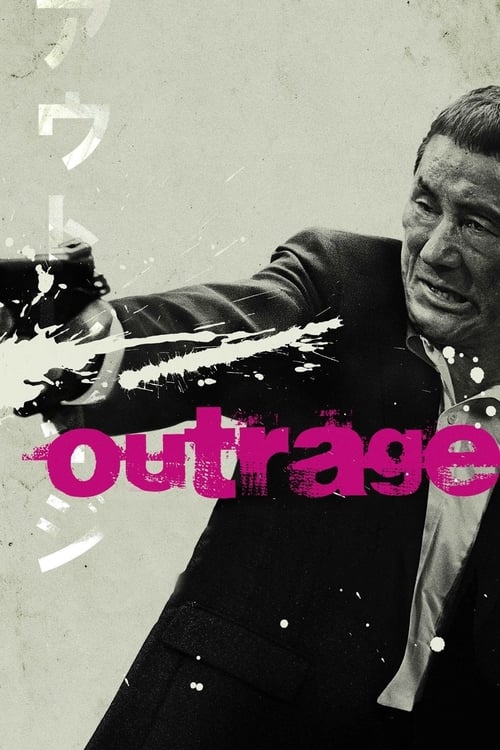
Outrage
2010 · Takeshi Kitano
For when you're in the mood for something hard and unsentimental — a stripped-down crime picture with no heroes and no comfort. Definitely a challenge watch: bracing, violent, and icy by design.
What it's about
In Tokyo's criminal underworld, a ruling yakuza boss orders a subordinate clan to discipline another, and the job falls to a hardened enforcer named Otomo. What starts as a staged provocation spirals into an escalating chain of betrayals, as bosses sacrifice loyal men like chess pieces and every bow and handshake conceals a knife. It's a gang war where the real battlefield is the boardroom above it.
The experience
Cold, brutal, and blackly funny in a deadpan way — violence arrives suddenly, without music or sentiment, and the film treats it as business. It's less a rollercoaster than a slow vice tightening; you watch with grim fascination rather than rooting interest.
Performances
Takeshi Kitano directs himself as the enforcer Otomo with his trademark impassive stillness — a stone face that makes every eruption land harder.
The craft
Kitano strips the gangster film to its skeleton: flat compositions, abrupt cuts, violence staged with clinical precision and zero glamour. The dialogue scenes — men in suits trading threats over tea and formal courtesies — are as tense as the killings, and the film's austere control is the whole point.
Why it matters
It marked Kitano's deliberate return to the yakuza genre that made his name after years of experimental work, was selected for competition at Cannes, and launched a successful trilogy — proving his cold late style had commercial teeth.
Snapshot
Takeshi Kitano's Outrage is a coldly engineered yakuza film in which every alliance is temporary and every handshake is a prelude to murder. Released in Japan on 12 June 2010 and selected for competition at the Cannes Film Festival the same year, it marked Kitano's deliberate return to genre filmmaking after an introspective experimental trilogy (Takeshis', 2005; Glory to the Filmmaker!, 2007; Achilles and the Tortoise, 2008) in which he had interrogated his own public persona and creative identity. Where those films were self-consciously eccentric and critically divisive, Outrage is austere and efficient: a film stripped of sentimentality, lyrical digression, and the melancholy that had distinguished his earlier crime pictures. The result is something simultaneously recognizable as Kitano and startlingly impersonal — a machine for producing corpses, watched by a director who refuses to flinch or mourn. The film launched a trilogy, continued in Outrage Beyond (2012) and Outrage Coda (2017), and consolidated Kitano's standing as the defining auteur of the post-classical Japanese yakuza film.
Industry & production
Outrage was produced through Office Kitano, the production company that has managed Kitano's film work for decades and allowed him an unusual degree of creative autonomy within the Japanese industry. The film was co-financed and released through Bandai Visual and Warner Bros. Japan, the latter providing mainstream theatrical distribution across the country. Kitano wrote the screenplay himself — as he does for all his directorial projects — and cast the film from a pool of character actors and established presences in Japanese genre cinema, including Kippei Shiina, Jun Kunimura, Tetta Sugimoto, Tomokazu Miura, Hideo Nakano, and Ryo Kase. Kitano himself plays Otomo, a mid-rank enforcer in the Ikemoto clan.
The production context was shaped by the aftermath of the experimental trilogy, which had been praised by certain critics as evidence of Kitano's restless self-examination but had performed poorly at the Japanese box office and generated mixed international responses. Outrage was understood within the industry — and described by Kitano in promotional interviews — as a conscious recalibration: a film that would meet audience expectations for genre entertainment while maintaining his directorial signature. Whether this constitutes compromise or disciplined constraint has remained a point of critical debate. The film was submitted as Japan's official entry for the Academy Award for Best International Feature Film, though it did not advance to the final shortlist.
Technology
Outrage was shot on film, consistent with Kitano's practice during this period, and exhibits the controlled, high-contrast palette that has characterized his collaboration with cinematographer Katsumi Yanagijima. The production made no notable use of digital intermediate manipulation or then-emerging digital acquisition; the visual texture is resolutely photochemical, with deep blacks and a clinical flatness to interior light that suits the film's institutional subject matter — yakuza offices, private rooms, golf courses, and restaurants rendered as spaces of bureaucratic terror rather than noir atmosphere. There is nothing technically experimental in Outrage; its choices are those of suppression and economy.
Technique
Cinematography
Katsumi Yanagijima, Kitano's cinematographer on virtually all of his directorial work from the mid-1990s onward, shoots Outrage in compositions that emphasize geometry over expressionism. Rooms are often filmed frontally, with characters arranged in deliberate spatial relationships that encode hierarchy without editorializing it. The camera holds its position with unusual patience: long takes predominate, and the frame does not chase action. Violence, when it arrives, is frequently photographed with the same static equanimity as conversation — a choice that makes death feel administrative rather than dramatic. There are no dramatic push-ins, no whip-pans of the kind familiar from Hong Kong action cinema, no rack-focus to signal significance. The flatness is the point. It suggests a world in which killing is simply a transaction.
Editing
Kitano edits his own films, typically credited under a pseudonym, and his approach in Outrage is among his most compressed. Scenes are cut at or just after their informational threshold — rarely before the violence, rarely dwelling in its aftermath. The rhythm is staccato, with brief scenes that establish, escalate, and terminate quickly, generating a cumulative sense of attrition. There are few transitional devices; cuts between scenes are blunt and declarative. This economy gives the film an unusual density: the running time is relatively short for a film covering so much organizational plotting, and the viewer is kept slightly off-balance by the pace at which characters are introduced and then removed from the narrative.
Mise-en-scène / staging
Kitano stages confrontation with a studied lack of theatrical escalation. Characters sit or stand at distances from one another that would read as politely professional in any other context; the violence that erupts from these compositions is shocking precisely because nothing in the blocking has predicted it. He favors institutional settings — the conference table, the private dining room, the club — where the rituals of yakuza hierarchy are visible as social performance. Costumes are dark and conservative; the wardrobe design underlines rather than decorates the film's subject, which is power dressed as etiquette. When outdoor spaces appear — the golf course, a stretch of road — they carry the same evacuated quality as the interiors, as though the world beyond yakuza business has ceased to exist.
Sound
The sound design in Outrage is characterized by abruptness. Gunshots and acts of physical violence carry a blunt, non-glamorized acoustic quality — dry, percussive, unadorned by reverb or dramatic swells. Music is used sparingly; the film's score, composed for the production, functions as punctuation rather than atmosphere, and extended stretches of the film are accompanied only by ambient sound and dialogue. This austerity of the soundtrack reinforces the visual strategy: nothing is added to make the violence easier to process emotionally. The record on specific technical credits for sound design and exact musical attribution in Outrage is thinner in English-language sources than for Kitano's earlier work, and claims about the specific composer should be treated with some caution.
Performance
Kitano's performance as Otomo is characteristically impassive. He holds his face in a condition of studied blankness — the result of both directorial choice and the partial facial paralysis he sustained in a 1994 motorcycle accident, which has given his screen presence a distinctive asymmetry that he has incorporated rather than concealed. Otomo is not presented as a charismatic antihero; he has no private life, no redemptive arc, no explicit inner life. He is a man defined entirely by organizational function. The supporting cast matches this mode: the film contains no notable scenery-chewing, no operatic villainy. Everyone operates in a register of suppressed menace that occasionally tips into casual brutality. This ensemble flatness amplifies the sense that what we are watching is systemic rather than individual — that the killing is produced by the structure of the organization, not by personality.
Narrative & dramatic mode
The plot of Outrage turns on an order from the top of the Sanno-kai, the dominant yakuza conglomerate in the film's world. The chairman instructs his underboss Kato to sever ties with the Murase gang, a rival organization with whom the Ikemoto clan — itself subordinate to Kato — has maintained friendly relations. This order initiates a cascade of betrayal and violence that proceeds downward through the hierarchy: Kato double-crosses Ikemoto, Ikemoto sacrifices Otomo, and Otomo, left with nothing, turns the violence back upward. The narrative is less a revenge plot than an organizational diagram being disassembled from within. Characters die not because of personal enmity but because the logic of the institution demands it.
This is a fundamentally different dramatic mode from the Hollywood crime film, in which individual psychology drives plot. Outrage is closer in spirit to Kinji Fukasaku's Battles Without Honor and Humanity series (1973–74) — another yakuza chronicle in which men are ground up by institutional forces indifferent to their individual fates — than to the Western gangster tradition. Kitano has no interest in the interior life of his characters. The film is deliberately depopulated of subjectivity, which creates a formal discomfort that is central to its effect.
Genre & cycle
Outrage belongs to the yakuza eiga (yakuza film) tradition that has been a continuous thread in Japanese popular cinema since the 1960s. The genre has two broad lines. The first, associated with studios like Nikkatsu in its earlier phase and later Toei, developed the ninkyo-eiga (chivalry film): yakuza as feudal loyalists, defined by codes of honor. The second, pioneered above all by Fukasaku at Toei from the early 1970s, replaced the chivalric model with a brutalist naturalism in which yakuza are violent opportunists shaped by postwar social chaos. Kitano's own career has operated primarily within this second tradition, inflected by his art-cinema training and his particular interest in stillness.
Outrage arrives at a moment when the yakuza film had become an uncertain commercial proposition in Japan; the genre's mainstream viability had declined since its peak in the 1970s and 1980s, and Kitano's return to it was in some ways a deliberate act of genre rehabilitation. His willingness to make two sequels suggests both commercial success and genuine investment in the narrative world he had constructed.
Authorship & method
Kitano — known primarily to Japanese audiences as "Beat Takeshi," the television comedian and variety show personality — occupies an unusual position in world cinema: a mass entertainer whose film work, viewed as a body, constitutes a significant auteur corpus. He writes, directs, edits, and performs in his own films, a control over the filmmaking process that is close to absolute and that has remained stable across four decades of production.
His primary collaborator in Outrage is Yanagijima, whose long-running partnership with Kitano has produced some of the most distinctive cinematographic work in contemporary Japanese cinema. The spareness of Outrage represents a refinement of the visual language they had developed together across many films: held frames, deliberate compositions, resistance to the rhetoric of the moving camera. The production design and wardrobe, while not individually credited in most English-language discussions of the film, reflect the same institutional aesthetic that Kitano imposes across all departments.
Movement / national cinema
Outrage is a product of the contemporary Japanese art-genre hybrid — films that pursue festival circulation and critical attention through formally rigorous directorial vision while remaining commercially legible through genre convention. It sits alongside the work of Hirokazu Kore-eda (in drama), Takashi Miike (in extreme genre), and Ryûsuke Hamaguchi (in literary adaptation) as evidence of the continued vitality of director-led Japanese cinema in the early twenty-first century, even as the studio structures that had once supported the genre film in Japan had substantially contracted.
Kitano's relationship to Japanese national cinema is complicated by his double status as beloved television personality and internationally acclaimed filmmaker — two identities that the experimental trilogy had explicitly thematized, to considerable critical interest but limited popular engagement. Outrage sets that reflexive project aside and occupies a more conventional position within the tradition of the Japanese genre film.
Era / period
The film belongs to the period immediately following the global financial crisis, when several major directors — including some associated with the politically inflected cinema of the 1990s — were renegotiating their relationship to commercial genre. In Japan specifically, the period was marked by a renewal of interest in crime cinema, partly through the influence of Korean genre films (which had achieved significant penetration in the Japanese market through the 2000s) and partly through a domestic nostalgia for the Toei yakuza films of the Fukasaku era. Kitano's Outrage benefited from and contributed to this renewed attention.
Themes
Outrage is organized around the proposition that loyalty is a fiction sustained by organizational interest and abandoned the moment it becomes costly. Every relationship in the film — between bosses and subordinates, between ally clans, between the institution and its members — proves to be contingent, reversible, and ultimately predatory. Otomo is not a tragic figure because tragedy requires something that has been genuinely lost; he has never possessed loyalty in any form that was not merely instrumental. The film offers no alternative to this world: there is no outside, no decent civilian life glimpsed as contrast, no nostalgia for the chivalric yakuza code. The violence is not redemptive, not cathartic, and not fun. It is the normal operation of a social institution.
This bleakness distinguishes Outrage from the more melancholy films of Kitano's earlier period — Sonatine (1993), with its suicidal fatalism, or Hana-bi (1997), with its tender romantic subplot — in which individual suffering was registered as loss. In Outrage, there is no register for loss. The film presents bureaucratic violence as the natural condition of organized social life, and in doing so gestures, obliquely, toward something beyond the yakuza film itself.
Reception, canon & influence
Critical reception. Outrage was received warmly, if not rapturously, upon its Cannes 2010 premiere, where it competed for the Palme d'Or (awarded that year to Apichatpong Weerasethakul's Uncle Boonmee Who Can Recall His Past Lives). Critics largely welcomed it as a return to form after the experimental trilogy, noting its formal control and the black humor generated by its relentless body count. Some reviewers found its emotional coldness to be a limitation — the film's refusal of interiority was read by some as artistic austerity and by others as simple emptiness. The consensus in serious film criticism positioned it as a significant but not quite major Kitano work: impeccably made and correctly instinctive about genre, but perhaps lacking the lyrical depth of his finest films.
Influences on the film (backward). The primary antecedent is Fukasaku's Battles Without Honor and Humanity cycle, whose desacralized, structuralist view of yakuza organization clearly informs Kitano's approach. Seijun Suzuki's stylized, absurdist yakuza films of the 1960s (Tokyo Drifter, 1966; Branded to Kill, 1967) offer a different but also relevant precedent for treating genre conventions as formal objects rather than earnest narrative frameworks. Kitano's own earlier films — particularly Sonatine, whose use of stillness and sudden violence Outrage both inherits and deliberately flattens — are an obvious internal reference. The influence of Sam Peckinpah's organizational violence and Jean-Pierre Melville's criminal proceduralism has been noted in discussions of Kitano's crime films generally, though the specific links are not well documented in the scholarly literature.
Legacy and forward influence. Outrage spawned two direct sequels and effectively revived Kitano's commercial standing in Japan. Its formal approach — the held frame, the bureaucratic plot, the violence rendered without affect — has been influential on subsequent Japanese genre filmmaking, though the specific transmission of influence is difficult to trace with precision. More broadly, the film belongs to a body of work that has trained international audiences and filmmakers in what might be called the Kitano mode: stillness as dramatic strategy, deadpan as emotional register, and the refusal of catharsis as a philosophical position. That mode has been absorbed widely enough that it now constitutes a recognizable stylistic option within world genre cinema, available to filmmakers who have no direct contact with Kitano's work. The trilogy as a whole has secured a durable position in the canon of contemporary yakuza cinema, and Outrage as its opening installment — the film in which Kitano most purely distills the organizational logic he would continue to explore — stands as a defining document of the genre in its twenty-first century form.
A Deleuzian reading
A room shot dead-on.
The full Deleuzian reading of Outrage →
Reception
When it premiered in competition at Cannes 2010, many critics shrugged — Kitano returning to yakuza territory after a decade of arty experiments, but colder and crueller than Sonatine or Hana-bi. It's since been reappraised as a deliberately nihilistic satire of gangsterdom-as-corporate-politics, and it launched what became his only trilogy.
How Outrage was received, from release to now →
Influences: the films it descends from and the films it influenced
- Battles Without Honor and Humanity (1973) — Fukasaku's desacralized, ensemble-driven yakuza proceduralism—treating the gang as a bureaucratic system whose internal politics drive the plot without a moral center—is the direct structural template for Outrage's organizational narrative logic and depopulated subjectivity.
- Tokyo Drifter (1966) — Suzuki's practice of treating yakuza genre conventions as formal objects—loyalty codes rendered absurd, violence staged for aesthetic shock rather than dramatic weight—licenses Kitano's own detachment from genre sincerity and his refusal to honor the yakuza film's usual codes of sacrifice.
- Branded to Kill (1967) — Suzuki's collapse of yakuza institutional hierarchy into arbitrary, absurdist violence—the hitman rank-system as black comedy—anticipates Outrage's bureaucratic plot machinery in which organizational authority dissolves into reciprocal elimination without cathartic resolution.
- Le Samouraï (1967) — Melville's construction of the professional criminal as a figure of depopulated subjectivity—impassive register, minimal dialogue, procedural pacing that refuses psychological interiority—is the primary European template for the performance mode and narrative economy that Kitano deploys across Outrage's ensemble.
- The Wild Bunch (1969) — Peckinpah's structuring of violence as organizational dissolution—multiple factions with competing loyalties destroying each other through reciprocal betrayal—provides the multi-faction plot architecture Outrage adopts and strips of its elegiac American-Western affect.
- Violent Cop (1989) — Kitano's directorial debut establishes the foundational performance register—impassive face, institutional yakuza framing, sudden explosive action without emotional preparation—that Outrage inherits and extends from a single protagonist to a full suppressed-menace ensemble.
- Boiling Point (1990) — Kitano develops here the ensemble-depopulated narrative architecture—multiple male figures moving through institutional spaces without legible motivation or psychological interiority—that Outrage crystallizes into a purely systemic yakuza organizational plot.
- Sonatine (1993) — The Kitano/Yanagijima static-frontal frame language and stillness-before-violence rhythm achieved their first mature form in Sonatine; Outrage inherits this visual grammar while deliberately flattening its lyrical interludes into pure procedural momentum, treating the inherited aesthetic as a genre instrument rather than a lyrical one.
- Hana-bi (1997) — Yanagijima's high-contrast held frames, frontal compositions, and deliberate refusal of the moving camera—and Kitano's self-edited staccato rhythm—reached full crystallization in Hana-bi; Outrage applies this established cinematographic language intact while stripping all lyrical episodes for organizational proceduralism.
- Zatoichi (2003) — Returns the elliptical-violence grammar and deadpan minimalism, refined on Zatoichi, back to the modern yakuza film, confirming the technique as portable across genre.
- Outrage Beyond (2012) — The direct sequel extends Outrage's staccato editing rhythm and systemic elimination plot—adding police corruption as an institutional layer—while Yanagijima's static-frontal cinematography and high-contrast palette carry forward unchanged, the formal system now operating as the established grammar of a trilogy.
- Outrage Coda (2017) — The trilogy's conclusion applies the same Kitano/Yanagijima visual grammar and organizational elimination architecture to a geopolitically expanded scale—Korean and Japanese syndicates replacing domestic factions—while further compressing the already minimal emotional register into pure institutional transaction.
- Yakuza and the Family (2020) — Fujii explicitly inherits Kitano's institutional staging of yakuza organizational logic—offices, hierarchical confrontations conducted through deadpan exchange, systemic not psychological causation—while introducing a generational framing that acknowledges the depopulated organizational yakuza depiction as the genre norm that Kitano's Outrage trilogy helped define.
- Election (2005) — To stages triad organizational succession with the same bureaucratic proceduralism and ensemble suppressed menace as Outrage—criminal hierarchy depicted with corporate institutional logic, violence arising from systemic rather than personal causation, and confrontations conducted through deadpan exchange in offices and meeting rooms.
- Gomorrah (2008) — Garrone treats the Camorra as a bureaucratic system depicted through institutional spaces, ensemble suppressed menace, and non-escalating confrontation staging—the same organizational-not-psychological proceduralism Kitano employs, though in a neorealist Italian register rather than a stylized Japanese one.
- A Prophet (2009) — Audiard's prison as total institution whose hierarchical logic entirely drives the plot—with ensemble staging of menace through deadpan containment rather than overt threat—runs a parallel formal course to Outrage's yakuza-organization-as-closed-system conceit, both films treating criminal bureaucracy as the only legible social reality.
Similar films
- Sonatine (1993) — influence & lineage
- Violent Cop (1989) — influence & lineage
- Fireworks (1997) — influence & lineage
- Branded to Kill (1967) — influence & lineage
- Ichi the Killer (2001) — shared sensibility
- Battle Royale (2000) — shared sensibility
- Zatoichi (2003) — shared sensibility
- 13 Assassins (2010) — shared sensibility
All the films related to Outrage →