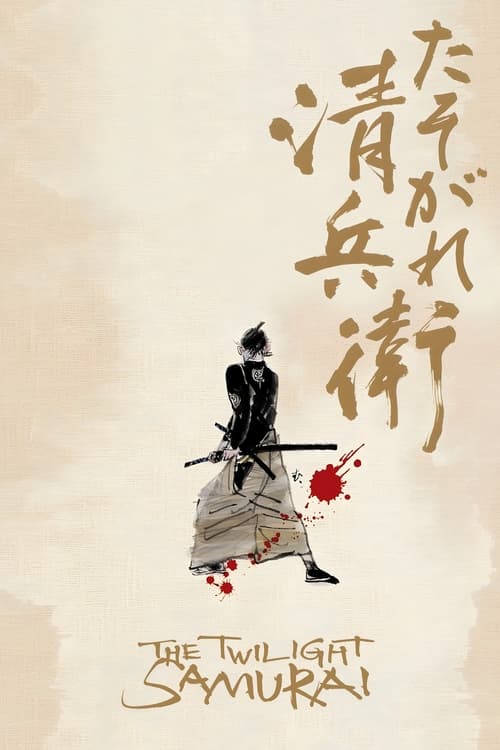
The Twilight Samurai
2002 · Yoji Yamada
For when you want a slow, soulful film about an ordinary decent person — a love story and a character study more than an action picture. Comfort viewing that sneaks up on you and leaves a lump in your throat.
What it's about
In the last years of Japan's feudal order, Seibei Iguchi is a low-ranking samurai who works as a clan warehouse clerk, counting stores by day and hurrying home at dusk — colleagues mock him as 'Twilight Seibei' — to care for his two small daughters and his senile mother. He's a widower, broke, unwashed, and quietly content with this small life. Then Tomoe, a childhood friend he never stopped loving, re-enters his world, and his clan hands him an order that a man of his rank cannot refuse: kill another samurai.
The experience
Gentle, patient, and quietly devastating — a domestic drama in samurai clothes that earns its two moments of violence by making you care first. It moves at the pace of chores and seasons, then tightens into something almost unbearably tense and moving.
Performances
Hiroyuki Sanada gives one of the great understated performances of his career — a swordsman's grace hidden under a clerk's stoop — and Rie Miyazawa makes Tomoe's warmth and sadness register in the smallest gestures.
The craft
Yoji Yamada, a veteran of decades of working-class dramas, brings that eye to the samurai film: candlelit interiors, muddy lanes, the real economics of a poor retainer's household. When the swordplay finally comes it's cramped, frightened, and fought in real rooms rather than choreographed for glory — a payoff that rewards your patience and a good quiet screen.
Why it matters
It swept Japan's academy awards, earned an Oscar nomination for best foreign-language film, and reframed the samurai genre for a new century — launching Yamada's late-career trilogy of revisionist period films and introducing many Western viewers to Sanada.
Snapshot
The Twilight Samurai (Tasogare Seibei) is a period drama that deliberately unmakes the samurai film from the inside. Its hero, Seibei Iguchi (Hiroyuki Sanada), is not a wandering swordsman but a widowed low-ranking retainer in the fictional Unasaka domain during the bakumatsu — the twilight of the Tokugawa order in the 1860s. He counts dried fish and stores in a clan warehouse, hurries home at dusk to two young daughters and a mother lost to senility, and is mocked by colleagues for smelling of the farm and the sickroom. The drama turns not on vengeance but on economics, love deferred, and the collision between private tenderness and inherited obligation, crystallized when the clan orders this reluctant, gentle man to kill. Directed by Yoji Yamada — the veteran Shochiku craftsman best known for the decades-long Tora-san comedies — the film became a signal event in Japanese cinema, sweeping the Japanese Academy Prizes and earning an Academy Award nomination for Best Foreign Language Film. It is at once a humanist chamber piece and a quiet argument about what the genre had, for half a century, chosen not to show.
Industry & production
The film was produced and distributed by Shochiku, the studio at which Yamada had spent his entire career, and it arrived as something of a summing-up: Yamada, then in his early seventies, was directing his first full jidaigeki after roughly four decades of contemporary comedy and domestic drama. That pedigree matters. Shochiku's house identity — the "Ofuna flavor" of gentle, observational films about ordinary people — is legible throughout, and the studio's willingness to back a slow, unglamorous period piece from its most bankable comedy director speaks to Yamada's institutional standing.
The screenplay adapts the short fiction of Fujisawa Shūhei, a hugely popular chronicler of the daily lives of provincial, low-status samurai, whose humane, unspectacular vision of the class was central to the film's revisionist stance. The script draws principally on the title story "Tasogare Seibei" and other Fujisawa stories; the precise combination of sources is sometimes reported slightly differently, so I note that rather than assert an exact list. Yamada co-wrote the screenplay with Yoshitaka Asama. The film was a critical and commercial success in Japan and traveled widely on the festival circuit, competing at the Berlin International Film Festival in 2003 before its international release. Concrete box-office figures I will not invent, but its awards profile — a near-sweep of the domestic Academy Prizes and the Oscar nomination at the 76th Academy Awards — established it as one of the most honored Japanese films of its era.
Technology
This is not a technologically experimental film, and its craft lies precisely in restraint. Shot photochemically on 35mm in the standard idiom of early-2000s Japanese studio production, it eschews the wire-work, speed-ramping, and digital augmentation that had begun to saturate the global martial-arts film of the period. There is little or no reliance on visible digital effects; the world is built physically, through sets, costume, weather, and light. The most consequential "technology" here is old: the discipline of naturalistic lighting and the choice to keep interiors dim, lit as if by the actual daylight and lamplight available to an impoverished household. The climactic confrontation is staged in near-darkness, trusting film stock and careful exposure rather than any digital rescue of the shadows.
Technique
Cinematography
Mutsuo Naganuma's photography is the film's quiet engine. The palette is muted — grays, browns, the cold blue of a snowbound riverbank — and the compositions favor stillness and the horizontal, domestic frame over the sweeping landscapes of the classical samurai epic. Interiors are low-key and often underlit, the human faces emerging from gloom, which both signals poverty and refuses the burnished heroism of genre convention. Naganuma reserves the film's few passages of visual lyricism — the river, the seasons, the daughters at their reading — for emotional punctuation, so that beauty registers as something precious and fragile rather than as spectacle.
Editing
Cut by Iwao Ishii, the film moves at an unhurried, observational tempo built on scenes allowed to breathe. Yamada and Ishii resist the accelerating rhythm that action cinema had normalized; the editing is patient, letting domestic routine accumulate weight so that when violence finally comes it lands as rupture. The celebrated final duel is notable partly for how little it is cut — the long, talky lead-up in a shadowed house extends the sequence far beyond genre expectation, delaying and almost dissolving the fight into conversation.
Mise-en-scène / staging
The production and costume design foreground material poverty with near-documentary conviction: patched clothing, a threadbare household, the labor of daily survival. Seibei's world is one of ledgers, storehouses, and the smell — repeatedly invoked in dialogue — of the sickroom and the fields. Staging tends toward the low, seated compositions of Japanese domestic drama, bodies arranged on tatami, sightlines organized around the shoji and the hearth. This is the vocabulary of the shomin-geki (the "common people" drama) transposed into the nineteenth century, and it is the film's most radical formal decision.
Sound
Isao Tomita — the composer internationally famous as a pioneer of synthesizer music — supplies a score that is, strikingly, lyrical and largely acoustic, foregrounding melody and restraint over electronic experimentation. The music is used sparingly, often withheld during the hardest domestic scenes so that ambient sound — wind, river, the scrape of daily work — carries the emotional load. When the score does enter, it tends toward elegy, underscoring the film's valedictory tone. A retrospective voice-over narration, delivered by Seibei's elder daughter recalling her father from the vantage of old age, frames the whole; it lends the film the texture of remembered life and quietly announces, from the first, that this is a story about a world already passing.
Performance
Hiroyuki Sanada gives a performance of deliberate de-heroization — stooped, weary, courteous, his physical grace as a swordsman held almost entirely in reserve until the final act. The restraint is the point: he plays competence hidden inside humility. Rie Miyazawa, as the childhood friend Tomoe, brings a luminous, contained warmth to a role built on things unsaid, and the film's central romance is conducted almost entirely through glances, small kindnesses, and social propriety observed. The butoh dancer Min Tanaka, as the cornered opponent Zenemon Yogo, turns the climactic antagonist into a figure of ruined, garrulous pathos rather than menace — an actor's coup that redefines the meaning of the duel. The child performers, and the depiction of the daughters' education and affection, ground the film's stakes in the everyday.
Narrative & dramatic mode
The dramatic mode is domestic and elegiac rather than heroic. The narrative is organized around obligations that are financial and familial before they are martial: Seibei's poverty, his refusal to remarry for his daughters' sake, his love for Tomoe that social precedence forbids him to declare. Conflict is internal and ethical — the tension between what a man wants and what his rank permits — and the plot's single act of ordered violence arrives late, as an intrusion into a life the film has taught us to value for its ordinariness. The framing narration converts the whole into memory and eulogy, so that the dominant register is not suspense but retrospection: we are watching a good, small life recovered from the wreck of a vanished order.
Genre & cycle
Formally a jidaigeki, the film is pointedly an anti-chanbara — it withholds and interrogates the swordplay that defines the genre. It belongs to a revisionist lineage that runs against the mythologizing samurai film, closer in spirit to the humanist, institutionally critical period dramas of Masaki Kobayashi (Harakiri, Samurai Rebellion) than to the action cinema of the postwar boom. What Yamada adds is the fusion of jidaigeki with shomin-geki: the samurai reimagined not as warrior or masterless ronin but as harried civil servant and single parent. The film also inaugurated a loose cycle of Yamada's own — his so-called samurai trilogy, continued in The Hidden Blade (2004) and Love and Honor (2006), each likewise adapting Fujisawa and each foregrounding low-ranking retainers caught between duty and feeling.
Authorship & method
Yamada's authorship here is that of the studio classicist redirecting a lifetime's tools toward new material. The comedic humanism and attentiveness to family life honed across the Tora-san films are visible in the tenderness and comic small-scale of the household scenes; what is new is their transplantation into history and their charge of tragedy. His key collaborators sustain this ethos: co-writer Yoshitaka Asama; cinematographer Mutsuo Naganuma, whose muted, low-key images translate poverty into visual grammar; editor Iwao Ishii, whose patience gives the film its contemplative pulse; and composer Isao Tomita, whose restrained, melodic scoring resists sentimentality. The governing method is subtraction — of spectacle, of heroic scale, of genre reflex — in service of observed human detail.
Movement / national cinema
The film sits within a specifically Japanese tradition rather than any international movement. Its deepest roots are in Shochiku's Ofuna-style domestic realism — the lineage of Ozu and Naruse's attention to ordinary households and quiet disappointment — which Yamada carries forward and grafts onto the period film. It is not a product of the Japanese New Wave, whose confrontational modernism Yamada never shared; it is, rather, the late flowering of studio-era classicism, made by one of its last great practitioners. In the context of early-2000s Japanese cinema, it reasserted the artistic and commercial viability of unhurried, character-driven historical drama at a moment dominated globally by kineticism and effects.
Era / period
The film is set in the closing years of the Tokugawa shogunate, on the eve of the Meiji Restoration, in a provincial domain far from the political center. That timing is thematically load-bearing: the samurai class is materially impoverished and about to be rendered obsolete, and the narration's closing revelation — that Seibei would die soon after in the civil violence attending the collapse of the old regime — casts his private struggles against the backdrop of an entire social order's disappearance. Made in 2002, the film also reads as a turn-of-the-millennium reckoning with national myth, a deliberate correction to decades of romanticized screen samurai.
Themes
Its central themes are the dignity of the ordinary and the cost of the code that governs it. The film insists on the value of a modest, loving domestic life — child-rearing, work, small pleasures — as against the honor-bound violence the culture prizes. It examines rigid social precedence as a trap that separates people who love each other; the futility and waste of duty-driven killing; the erosion of a class and a way of life by economic and historical forces beyond any individual's control; and the transmission of memory and value across generations, embodied in the daughters and their education. Underlying all of it is a demythologizing impulse: the suggestion that true worth lies not in the sword but in the reluctance to draw it.
Reception, canon & influence
Critically, the film was widely acclaimed at home and abroad as a mature, deeply humane achievement, praised for its emotional restraint, its performances, and its rethinking of the samurai myth; it competed at Berlin in 2003, dominated the Japanese Academy Prizes, and was nominated for the Academy Award for Best Foreign Language Film. Its influences run backward to Fujisawa Shūhei's revisionist source fiction, to the socially critical jidaigeki of Kobayashi, and to the Shochiku domestic-realist tradition of Ozu and Naruse — a synthesis of the period film and the family drama. Its forward legacy is clearest in Yamada's own subsequent samurai films, which extended its method into a coherent late-career cycle, and in its role in reaffirming a market and critical appetite for slow, humanist period cinema. For Hiroyuki Sanada it was a career-defining lead; his international visibility grew substantially in the years that followed. Within the broader canon, The Twilight Samurai is now routinely cited as a benchmark of the modern, anti-heroic samurai film — the work that most persuasively argued the genre could be about staying alive for one's children rather than dying well.
Reception
An instant triumph at home — it swept the Japan Academy Prizes and landed a Best Foreign Film Oscar nomination — and abroad it has only grown, steadily climbing from arthouse discovery to consensus pick for the great modern samurai film.
How The Twilight Samurai was received, from release to now →
How to watch The Twilight Samurai: what to notice on a first viewing
- Notice how dim and underlit the indoor scenes are. Mutsuo Naganuma keeps interiors low-key, faces emerging out of gloom, which signals poverty instead of the burnished look samurai films usually have. The film looks poor on purpose, refusing the polish that would make Seibei's hardship look romantic.
- Notice the patched clothing and worn household objects. Costume and production design foreground material poverty with near-documentary conviction, down to the mended fabric and the state of the furniture. The film argues its whole case about status and hardship through objects, before any dialogue does.
- Watch how low and seated most compositions are. Staging keeps bodies on tatami and sightlines organized around sliding doors and the hearth, the vocabulary of ordinary domestic drama rather than a war epic. A samurai film gets staged like a story about an ordinary household instead.
- Listen for scenes with no music at all. Isao Tomita's score goes quiet during the hardest domestic moments, leaving wind, river, and the scrape of daily work to carry the feeling instead. The hardest scenes get the least musical help, which makes them land harder, not softer.
- Watch how little physical grace Seibei shows early on. Hiroyuki Sanada plays him stooped, weary, and courteous, a man who hurries home at the end of the day and keeps his head down. You read his tiredness and his low standing from his body before he says a word.
The whole guide to watching The Twilight Samurai, with the keys for a rewatch →
Influences: the films it descends from and the films it influenced
- Tokyo Story (1953) — Supplies the tatami-level low-height camera and static domestic staging that Yamada transplants into Seibei's poverty-stricken household, letting furniture, doorways, and seated conversation carry emotion instead of movement.
- Late Spring (1949) — Establishes the widowed-parent-and-daughter household whose central drama is a marriage that means loss — the structural template for Seibei's bond with his daughters and the elegiac cost of duty.
- Floating Clouds (1955) — Models the Shochiku/shomin-geki grammar of economic precarity — worn clothes, ledger-book anxiety, and understated melancholy — that Naganuma's muted palette renders as the visual texture of low-ranking samurai poverty.
- Twenty-Four Eyes (1954) — Represents the Ofuna-realism humanist mode Yamada inherits: sentiment earned through observed ordinary lives and the passage of time rather than dramatic incident, sustaining feeling without melodramatic underlining.
- Harakiri (1962) — The revisionist keystone cited in the facets — exposes the bushido code as institutional cruelty and stages combat as desperate, un-glamorous survival, directly authorizing Twilight's anti-chanbara ethic and single decisive duel.
- Samurai Rebellion (1967) — Fuses domestic family drama with the period film so that a household's private dignity collides with clan authority — the exact genre synthesis (home + history) Yamada's method depends on.
- Seven Samurai (1954) — De-mythologizes the swordsman as hungry, mud-caked, and mortal, and treats swordplay as labor rather than balletic display — the de-heroized lead lineage Sanada's Seibei extends.
- The Human Condition (1959) — Its patient, morally serious observation of an ordinary man ground down by an unjust system supplies the humanist-critique backbone beneath Twilight's dignity-of-the-ordinary theme.
- The Ballad of Narayama (1958) — An earlier Shochiku treatment of ordinary rural people facing survival and duty with restraint, part of the studio's humanist realist tradition from which Yamada draws his empathy for the un-storied poor.
- Samurai I: Musashi Miyamoto (1954) — Yamada works in explicit revisionist dialogue with Inagaki's prestige-jidaigeki model, deploying the same static-observational framing and kabuki-informed performance restraint while deflating the heroic register to domestic scale — a critique only coherent against Inagaki's template of the spiritually exalted swordsman.
- Samurai III: Duel at Ganryu Island (1956) — Extends the sword-versus-plow theme and renunciation narrative, valuing a swordsman's withdrawal into domestic life over spectacle, resolved in one reluctant duel.
- Humanity and Paper Balloons (1937) — Fuses shomin-geki domestic realism with the impoverished low-ranking samurai, rendering honor as a daily economic burden — the modern revival of Yamanaka's humanist common-people jidaigeki.
- The Hidden Blade (2004) — The second Fujisawa Shūhei adaptation in Yamada's trilogy, replicating the low-key underlit look, observational tempo, and de-heroized bakumatsu retainer to confirm Twilight's method as a repeatable cycle.
- Love and Honor (2006) — Completes the trilogy by pushing subtraction further — a blinded, low-ranking swordsman whose domestic marriage, not martial glory, is the drama, extending the same Naganuma muted grammar and household staging.
- Hara-Kiri: Death of a Samurai (2011) — Directly remakes Kobayashi's revisionist source to re-indict the bushido code, carrying the anti-heroic, code-critical strand of Twilight's lineage into 21st-century jidaigeki.
- When the Last Sword Is Drawn (2003) — A contemporaneous humanist jidaigeki that reframes a Shinsengumi swordsman as a provincial father sending money home, sharing Twilight's family-over-honor thesis and retrospective narration structure.
- Sword of Desperation (2010) — Another Fujisawa Shūhei adaptation drawing on the same source sensibility — a subdued, low-ranking retainer, restrained interiors, and a single climactic duel treated with lethal economy rather than spectacle.
- 13 Assassins (2010) — Part of the same mid-2000s jidaigeki revival Twilight helped reopen; though it restores mass spectacle, it too grounds its swordsmen in class grievance and duty rather than romantic heroism.
- Departures (2008) — A modern-set shomin-geki whose dignity-of-humble-work theme, restrained melodic scoring, and observational patience mirror Twilight's method of finding tragedy and grace in ordinary provincial life.
- Zatoichi (2003) — Concurrent revival of the jidaigeki built on a low-status, reluctant swordsman, demonstrating the same impulse to reanimate the period genre through a personal authorial lens.
Similar films
- The Hidden Blade (2004) — influence & lineage · same viewing thread
- Harakiri (1962) — influence & lineage · same viewing thread
- Samurai Rebellion (1967) — influence & lineage · same viewing thread
- 13 Assassins (2010) — influence & lineage · same viewing thread
- Seven Samurai (1954) — influence & lineage
- Tokyo Story (1953) — influence & lineage
- The Last Samurai (2003) — same viewing thread
- The Sword of Doom (1966) — same viewing thread
All the films related to The Twilight Samurai →
Watch it with: curated runs of related films
- The Samurai Code on Trial — A run of chanbara films that draw the sword only to turn it against the myth of honor itself — watch them together and the bushido ideal keeps curdling into cruelty, nihilism, and doubt.