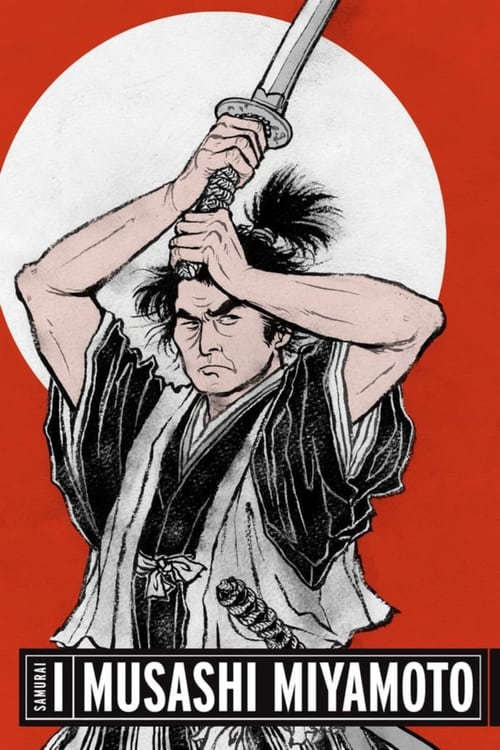
Samurai I: Musashi Miyamoto
1954 · Hiroshi Inagaki
For when you're in the mood for a proper epic on a rainy weekend — heroism, hardship, and a redemption arc you can sink into. Pure comfort for anyone who loves classic adventure storytelling.
What it's about
In Japan just after the great battle of Sekigahara in 1600, a wild, low-born young man named Takezo dreams of glory as a warrior — and gets war's ugly reality instead. Hunted, betrayed, and nearly destroyed by his own fury, he's taken in hand by a Buddhist priest who sees something worth saving, beginning his transformation into Miyamoto Musashi, the legendary swordsman. It's the first chapter of a trilogy: the story of how a feral kid starts becoming a disciplined man.
The experience
A big, sweeping, old-fashioned adventure — battles, escapes, doomed romance — told with real emotional weight underneath the action. It moves like a great serialized novel, which is exactly what it's adapted from, and it leaves you wanting the next chapter immediately.
Performances
Toshiro Mifune plays Takezo as a cornered animal slowly learning to be human — all coiled physical rage in the early stretch, with flickers of the gravity he'll grow into. It's star acting in the grandest sense.
The craft
Shot in rich early-1950s color when most Japanese films were still black and white, it's gorgeous — painted skies, forests, and battlefields that genuinely reward a big screen. Inagaki directs in a sweeping, romantic register, closer to a Hollywood epic than to austere samurai drama.
Why it matters
It won an honorary Academy Award for Best Foreign Language Film and helped announce Japanese cinema to Western audiences in the 1950s, launching one of the most beloved trilogies in the samurai genre.
Snapshot
Hiroshi Inagaki's Samurai I: Musashi Miyamoto is the opening chapter of a trilogy tracing the legendary swordsman Miyamoto Musashi from violent, rootless youth to disciplined warrior-philosopher. Released by Toho in September 1954, the film adapts the first portion of Eiji Yoshikawa's enormously popular serialized novel Musashi (Asahi Shimbun, 1935–1939), covering the years immediately following the Battle of Sekigahara (1600) and the symbolic death-and-rebirth of the protagonist, who enters the story as the feral Shinmen Takezo and emerges, imprisoned and transformed by Buddhist counsel, as Miyamoto Musashi. Shot in color at a moment when Japanese cinema was announcing itself to the world, the film won an honorary Academy Award for Best Foreign Language Film at the 1956 ceremony — the first Japanese production to receive an Oscar — and helped constitute the international image of the samurai genre for decades. It is a work less interested in kinetic combat than in formation: the making of a man fit to be a legend.
Industry & production
Toho Studios, Japan's largest and best-capitalized production company in the postwar period, commissioned the project as a prestige vehicle and a calculated commercial enterprise. Inagaki had already directed a version of the Musashi story during the 1940s — a three-part adaptation produced under wartime conditions that carried rather different ideological freight — and Toho's decision to remake it in the liberalized, export-conscious climate of the early 1950s reflects both commercial instinct and the studio's ambitions for the international market. The same year, Toho also released Ishiro Honda's Gojira and, in a different register, Akira Kurosawa's Seven Samurai — a remarkable single-studio year that announced the range of what Japanese genre filmmaking could accomplish. Samurai I operated within this context as a more classically romantic and narratively accessible entertainment than Seven Samurai, aimed partly at domestic audiences already devoted to Yoshikawa's novel and partly at Western distributors seeking something simultaneously exotic and emotionally legible. Toshiro Mifune, cast as Musashi, was by 1954 the most internationally visible Japanese film actor, his reputation established by Kurosawa's Rashomon (1950) and Ikiru (1952); his attachment to the project was both a bankable draw and a statement of seriousness. The screenplay was written by Tokuhei Wakao and Inagaki himself, compressing Yoshikawa's sprawling first volume into roughly ninety minutes by concentrating on two narrative engines: the pursuit of Takezo by the samurai establishment, and the transformative influence of the monk Takuan Sōhō.
Technology
Samurai I was shot in color at a time when the transition from black-and-white was still far from universal in Japanese cinema. The color process used by Toho in this period drew on Eastmancolor negative stock, which was being adopted across many national industries in the early 1950s as a cost-effective alternative to the earlier three-strip Technicolor system; Japanese labs had developed relationships with both Fujifilm and Eastman Kodak. The film's palette — earthy autumnal foliage, the deep lacquer of armor, the white of Otsu's kimono against cedar forest — was integral to Inagaki's pictorial conception from the outset. The deployment of color here is notably more disciplined than the near-hallucinatory chromatic experiments in Teinosuke Kinugasa's Gate of Hell (1953, also shot on Eastmancolor), orienting it toward emotional legibility rather than painterly display. The production employed standard Toho studio facilities alongside location work in the Kyoto region, the historical heartland of period-drama production, and the combination of built interiors and natural landscape was managed with the logistical efficiency that characterized Toho's well-capitalized jidaigeki operations. No unusual technical innovations are documented for this production; the film's significance lies in its skillful application of available tools rather than in formal experimentation.
Technique
Cinematography
The cinematography, credited to Kazuo Yamada, is characterized by a measured compositional stillness that aligns the film with traditional Japanese pictorial values — the asymmetric balance of figures within a frame, foreground elements used to layer depth without restlessness, and a preference for mid-to-long shots that situate characters within landscape rather than fragmenting them through close-cutting. Yamada makes deliberate and expressive use of the forest sequences: the dense cedar groves that shelter and conceal Takezo become visually oppressive, their vertical columns dividing and imprisoning the frame, while the later open landscapes through which Musashi travels carry a deliberately released, horizontal airiness. The film's color work tends toward warm, amber-tinted light in intimate interior scenes and cooler, more desaturated tones in exterior scenes of hardship and violence, a tonal grammar that reinforces the dramatic arc without calling attention to itself. Long-held static shots, often from a slight elevation, give the film its contemplative, almost theatrical quality; the camera rarely follows action aggressively, preferring to observe.
Editing
The editing follows a classical, largely invisible continuity style. Cuts are motivated by narrative and emotional logic rather than rhythmic dynamism; there is none of the percussive tempo-cutting that Kurosawa would explore in action sequences, and the film's most dramatic passages — the capture of Takezo, his three-year imprisonment in the castle keep — are handled through ellipsis and close concentration on faces rather than through kinetic montage. The result is an editing register that privileges emotional accumulation over excitement, appropriate to a film whose central concern is interiority and transformation. Scene transitions frequently use dissolves to signal the passage of time, giving the narrative a measured, chronicle-like flow.
Mise-en-scène / staging
Inagaki's staging descends from a theatrical tradition — he came of age as a director in the late silent period when jidaigeki drew heavily on kabuki and shimpa conventions — and the blocking of actors within the frame frequently reflects stage compositional habits: figures arranged at deliberate distances, dialogue exchanges in three-quarter profile, entrances and exits given ceremonial weight. The film's decisive staging choice is the treatment of Musashi's confinement. Takezo is quite literally sealed inside a storehouse at the castle; Inagaki stages the transformation through the mechanism of a single book — Takuan lowers texts through a small opening — and the character we meet emerging is changed not by visible action but by implied, off-screen interiority. This restraint, this insistence on what cannot be shown, is the film's central formal gesture and its most revealing one about Inagaki's conception of cinema as controlled withholding.
Sound
The score was composed by Ikuma Dan, a prominent figure in postwar Japanese concert music who drew on both Western orchestral idiom and Japanese melodic sensibility. Dan's work for the trilogy represents a characteristic postwar hybrid: string writing and brass structures derived from European late-Romanticism carrying melodic lines shaped by pentatonic modes and the ornamental figures of gagaku and traditional song. The score is emphatic at dramatic peaks and discreet in quieter passages, functioning within a conventional Hollywood-influenced model of illustrative underscore. There is no attempt at period-documentary authenticity in the sound design; the battle sequences at Sekigahara use standardized sound effects, and the film does not foreground acoustic texture as a compositional element. The net effect is emotionally effective and historically of its moment — the integrated sound-and-image grammar of mid-century prestige cinema applied to a Japanese subject.
Performance
Toshiro Mifune's performance is the film's central event and the source of most of its international reputation. His Takezo is physically volcanic in the first act — the wide-legged stance, the explosive lateral movement, the jaw set in something between fury and anguish — and the challenge the role sets him is to perform a convincing diminuendo: not to gradually become quieter, but to show the suppression of that force as itself a dramatic act. The result is one of Mifune's most internally complex early performances, in part because the visual grammar of the film allows the actor's face to carry what the story is not permitted to show directly. The contrast with Kuroemon Onoe as the monk Takuan is revealing: Onoe brings a classical, kabuki-trained stillness to the role, and the exchange of force between the two performers in their pivotal confrontation carries the film's philosophical argument in bodily rather than verbal terms. Kaoru Yachigusa as Otsu maintains a lyrical, restrained affect that operates within the film's romantic-melodrama register, her performance measured carefully against the expectation of the devoted, waiting woman that the Musashi legend had canonized.
Narrative & dramatic mode
The film operates in the mode of the legend-formation narrative: not the biography of a man but the myth of a figure who is being made into something larger than an individual. Its dramatic structure is essentially a rite of passage — descent, ordeal, ascent — mapped onto a historical and geographical framework. Yoshikawa's novel drew on this structure explicitly, having internalized it from both Japanese folk narrative and the bushido mythology being elaborated in the Meiji and Taisho periods, and Inagaki's adaptation preserves its three-beat logic: the battle that destroys the old identity, the wilderness ordeal and capture, the enlightenment-through-confinement. The romantic subplot involving Otsu and the rival Matahachi provides a human-scale drama of loyalty and betrayal that grounds the legend in recognizable emotional experience, but the film's primary emotional investment is in a transformation that cannot be dramatized through conventional scenes — a spiritual education conducted in secret, offscreen, during three years of imprisonment. This is a film about the gap between who a person was and who they will become, and its most characteristic narrative move is the ellipsis.
Genre & cycle
Samurai I belongs to the jidaigeki (period drama) genre and more specifically to the sub-tradition of the kengeki (sword drama), though it is distinguished from the more acrobatic chanbara tradition by its psychological weight and moral seriousness. The postwar decade saw a significant reformulation of the jidaigeki: under the Allied occupation, period films with feudal or nationalistic content had faced restriction, and the genre reemerged in the late 1940s and early 1950s in dialogue with both the democratic values nominally promoted by the occupation authorities and the persistent popular appetite for historical adventure. This produced a range of works from Kurosawa's revisionist, socially critical samurai films to more conservative heroic narratives like Inagaki's, which rehabilitated the warrior code without the prewar militarist inflection. The Musashi cycle specifically belongs to a cycle of films centered on historical swordsmen — Sasaki Kojiro, Miyamoto Musashi, various Edo-period masters — who served as screens for meditation on individual excellence, ethical formation, and the proper use of violence. Inagaki's trilogy contributed to making Musashi the central figure of this cycle, a position the legend has retained in Japanese popular culture.
Authorship & method
Hiroshi Inagaki (1905–1980) is one of the major figures of Japanese studio cinema whose international reputation has remained systematically undervalued relative to his domestic significance and the commercial and historical importance of his output. He began directing in 1928 and over a career spanning five decades made more than sixty films, working predominantly within the jidaigeki and action genres. His directorial method was rooted in the studio craftsman tradition: precise, efficient, oriented toward the emotional and narrative demands of the material rather than toward personal stylistic assertion. He did not share Kurosawa's appetite for formal experimentation or Kenji Mizoguchi's uncompromising artistic austerity; his films are generous, legible entertainments shaped by a deep understanding of genre convention and a sure instinct for performance. The collaboration with Mifune across the trilogy was central to both men's careers, and Inagaki's ability to channel and modulate Mifune's physical intensity — allowing it full expression in some scenes, holding it in check in others — is a directorial achievement whose difficulty is easy to underestimate. The screenplay contributions of Tokuhei Wakao, who worked with Inagaki across multiple projects, reflect an understanding of how to structure long-form literary material for the screen while preserving the emotional architecture that made Yoshikawa's novel a generational experience for Japanese readers. Kazuo Yamada's cinematographic work served Inagaki's pictorial conception with consistent skill, and Ikuma Dan became the trilogy's musical voice, his score giving the series a tonal continuity across its three installments.
Movement / national cinema
The film is a product of what may be called the classical period of Japanese studio cinema — the decade from approximately 1950 to 1960 during which Toho, Daiei, Shochiku, and Nikkatsu were producing films of extraordinary range and quality, and during which Japanese cinema achieved its first sustained international visibility. Samurai I belongs specifically to the Toho wing of this movement, which tended toward large-scale, technically polished productions in popular genres alongside the prestige art films of Kurosawa. Its international success — the Oscar, wide distribution in the United States and Europe under the shortened title Samurai — made it one of the primary points through which Western audiences encountered Japanese cinema in the 1950s, alongside Rashomon (1950), Ugetsu (1953), and Gate of Hell (1953). In this sense the film participates in a national-cinema moment of assertion and self-presentation, in which Japanese studios were simultaneously producing for domestic audiences with deep roots in local tradition and addressing international audiences with newly configured generic and visual languages.
Era / period
The film's production moment — 1954 — carries multiple historical pressures. The Allied occupation had ended in 1952, and Japan was negotiating a new cultural identity that could both acknowledge the catastrophe of the war and sustain national self-respect. The choice of Musashi as subject is not politically innocent: Musashi is the figure of individual self-cultivation and mastery achieved through renunciation of destructive impulse, a model of disciplined excellence emptied of the specific militarist content that had made the legend serviceable to prewar propaganda. Inagaki's Musashi becomes a warrior through rigorous ethical formation, not through martial conquest; the film's structure insists on the internal transformation as primary and the external violence as subordinate. This recalibration of the warrior legend for postwar conditions is characteristic of a broader movement in Japanese jidaigeki to preserve the genre's popular appeal while disarticulating it from the values that had made it politically toxic.
Themes
The film's central preoccupation is formation — the question of what kind of person one can become and what it costs to become them. Takezo's violence at Sekigahara is not evil but it is wild, undirected, socially dangerous; Takuan's intervention frames the transformation not as punishment but as education, the channeling of excess force into purposive excellence. The film is thus invested in a particular understanding of discipline as not suppression but refinement — a Confucian and Buddhist inflection of the bushido tradition. Alongside this runs a meditation on leaving: Musashi's emergence as a new identity requires the abandonment of the relationships and loyalties that constituted his previous self, and the film treats this cost with genuine feeling rather than easy heroic resolution. Otsu's waiting, Matahachi's desertion of his obligations, the grief of the mother figures — these register as real losses within the economy of a story that might otherwise present transformation as pure gain. There is also a persistent spatial thematic: the forest as wilderness and concealment, the castle as both prison and school, the open road as the space of the life to come. Inagaki organizes his locations not merely as background but as stages in a moral geography.
Reception, canon & influence
Backward influences: The most direct influence is Eiji Yoshikawa's source novel, which had itself synthesized multiple earlier accounts of Musashi's life — some historical, many legendary — and filtered them through the late-Meiji and Taisho-period elaboration of bushido as a spiritual code for modern Japan. Inagaki's earlier 1940s version of the material established the structural template the 1954 film refined. Internationally, the influence of John Ford's westerns on Japanese period filmmakers of the postwar generation has been widely noted — the landscape framing, the epic scale, the use of space as moral register — and while Inagaki's visual style is quite different from Ford's, the generic ambition of building a national hero legend through genre cinema is a recognizable shared project.
Critical reception and canonization: The Academy Award for Best Foreign Language Film — conferred at the 1956 ceremony for the film's American release — was the first Oscar given to a Japanese production and had a disproportionate effect on the film's international distribution and reputation. Critical response in Japan was strongly positive; the film was a major domestic commercial success. In the West, critical reception was warmer in popular than in scholarly venues, where Kurosawa's more formally demanding work tended to define the canon of postwar Japanese cinema at Inagaki's expense. The film has not been as consistently elevated in academic film studies as Seven Samurai or the Mizoguchi masterworks of the same period, a discrepancy that arguably reflects the field's preferences for formal complexity over narrative accessibility as a criterion of cinematic significance.
Forward influence: The trilogy's influence on the subsequent representation of Musashi in Japanese popular culture is total — it effectively established the visual and narrative template for the character that later films, television dramas, manga, and video games would inherit or consciously revise. More diffusely, Samurai I contributed to the Western pop-cultural image of the samurai as a figure of spiritual as well as martial discipline, a linkage that would prove enormously generative: George Lucas's acknowledged debt to Japanese samurai cinema in the conception of the Jedi in Star Wars (1977) draws on a complex of associations that Inagaki's trilogy helped consolidate in the Western imagination. The film's specific achievement — making an extended interior transformation cinematically compelling through restraint, performance, and the strategic use of ellipsis — is less often credited as a formal influence, but it offers a model of the prestige epic that later directors working in historical genres, in Japan and elsewhere, would find instructive.
A Deleuzian reading
Start with the cedar forest.
The full Deleuzian reading of Samurai I: Musashi Miyamoto →
Reception
It charmed the West on arrival — an honorary Oscar, lush Eastmancolor, Mifune — but decades of cinephilia have filed it under 'the other 50s samurai films,' handsome and sincere where Kurosawa was radical; the Criterion trilogy box has since made it a beloved gateway drug to the genre.
How Samurai I: Musashi Miyamoto was received, from release to now →
Influences: the films it descends from and the films it influenced
- Chuji's Travel Diary (1927) — Ito's silent chambara established the kengeki template of the wandering swordsman moving through social strata via episodic confrontations — the narrative chassis Inagaki inherits and spiritualizes into a multi-episode formation arc.
- The Story of the Last Chrysanthemum (1939) — Mizoguchi's sustained long-take, distanced camera holding kabuki-trained actors without cutting to closer coverage is the direct precedent for Inagaki's static-observational framing — the refusal to interrupt theatrical performance with analytic editing.
- Miyamoto Musashi (1940) — Inagaki's own earlier black-and-white version of the Yoshikawa material established the three-episode spiritual-formation arc as the structural template the 1954 Eastmancolor trilogy refined and internationalised.
- Sanshiro Sugata (1943) — Kurosawa's martial rite-of-passage — young fighter discovering inner Way under a Zen-influenced master, with elliptical time-jumps marking spiritual stages rather than dramatizing training — is the narrative template Inagaki's Musashi trilogy directly inherits.
- She Wore a Yellow Ribbon (1949) — Ford and Winton Hoch's Technicolor grammar of landscape-as-moral-register — skies, distances, and light-quality as emotional weather for heroic myth-building — is the Western model Inagaki transposes into Eastmancolor landscape-integration across the Musashi films.
- Gate of Hell (1953) — Kinugasa's Fujicolor work treated color as tonal grammar rather than spectacle — deliberately desaturated registers for interiority, saturated reds as moral alarm — establishing the chromatic restraint Inagaki extends in Eastmancolor the following year.
- Harakiri (1962) — Kobayashi repurposes the prestige-jidaigeki formal register Inagaki established — slow pacing, kabuki-inflected performance, elliptical flashback structure — turning the same ceremonial grammar against the bushido ideology Inagaki's trilogy had celebrated.
- The Tale of Zatoichi (1962) — The first Zatoichi film inherits the commercially viable serialized wandering-swordsman legend format Inagaki's trilogy proved workable: a recurring hero defined by a spiritual code, episodic encounters, and a disability that displaces martial power onto inner discipline.
- Sword of Doom (1966) — Okamoto inverts Inagaki's spiritual-formation arc — Ryunosuke achieves technical perfection alongside moral emptiness — while retaining the same kengeki grammar of stillness-before-violence and elliptical time; the inversion is only fully legible against Inagaki's positive template.
- Star Wars (1977) — Lucas's Jedi concept distils the spiritual-warrior formation narrative Inagaki consolidated: a young man's elliptical training toward inner mastery under a sage mentor, with the sword as index of spiritual rather than merely technical development — the specific cluster of associations Inagaki's Oscar-winning trilogy had embedded in Western popular imagination.
- Kagemusha (1980) — Kurosawa's return to jidaigeki epic uses color as deliberate emotional grammar — battle-banner palettes, landscape tonalities marking psychological states — extending the Eastmancolor tonal approach Inagaki and Kinugasa had established as the period film's prestige register in the 1950s.
- Twilight Samurai (2002) — Yamada works in explicit revisionist dialogue with Inagaki's prestige-jidaigeki model, deploying the same static-observational framing and kabuki-informed performance restraint while deflating the heroic register to domestic scale — a critique only coherent against Inagaki's template of the spiritually exalted swordsman.
- Samurai II: Duel at Ichijoji Temple (1955) — The trilogy's first film established Mifune's performance template—explosive kinetic release preceded by absolute stillness—and the bildungsroman arc of pride tested by asceticism that Samurai II inherits as its central dramatic architecture.
- Ugetsu (1953) — Mizoguchi uses temporal ellipsis and offscreen space to enact transformation the film refuses to dramatize directly — the same strategy Inagaki employs when Musashi's chrysanthemum-room breakthrough happens between dissolves rather than on screen.
- Sansho the Bailiff (1954) — Mizoguchi compresses decades of legend into a feature by using temporal dissolves rather than dramatizing every stage of suffering — the same elliptical editing structure Inagaki uses to collapse Musashi's formation years into a poetic rather than literal timeline.
- Seven Samurai (1954) — Both films deploy Mifune's physicality within the postwar jidaigeki revival at Toho, but where Kurosawa exhausts it through kinetic action-editing, Inagaki's diminuendo strategy holds the intensity in reserve — the contrast makes each film's formal choice visible as a choice.
Similar films
- Seven Samurai (1954) — influence & lineage
- Harakiri (1962) — influence & lineage
- The Tale of Zatoichi (1962) — influence & lineage
- Gate of Hell (1953) — influence & lineage
- Ugetsu (1953) — influence & lineage
- Kagemusha (1980) — influence & lineage
- Sansho the Bailiff (1954) — influence & lineage
- Samurai III: Duel at Ganryu Island (1956) — shared sensibility