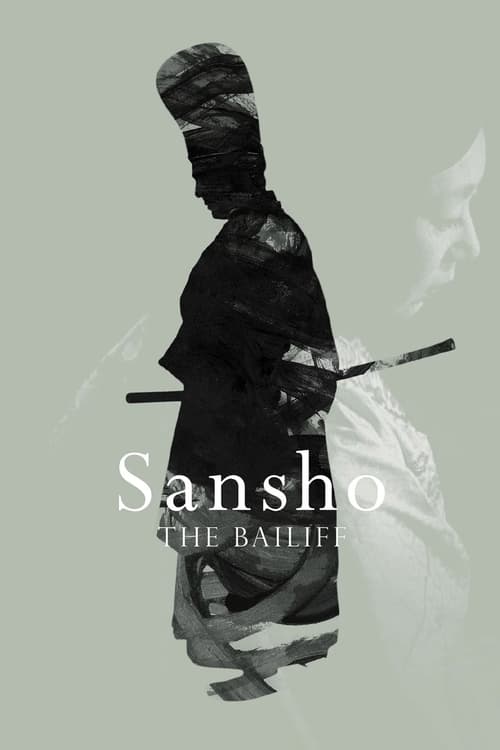
Sansho the Bailiff
1954 · Kenji Mizoguchi
For when you want to be genuinely moved and don't mind being wrecked — a film to sit with in silence afterward. This is challenge viewing of the most rewarding kind, not a casual weeknight pick.
What it's about
In feudal Japan, an idealistic provincial governor is exiled for putting his peasants before his orders, and his wife and two children set out to rejoin him. On the road, slave traders tear the family apart: the mother is sold into prostitution, the children into brutal servitude on the estate of Sansho, a bailiff who brands runaways. The film follows the children as they grow up in bondage, clinging to their father's creed that without mercy, a man is not human.
The experience
Slow, grave, and quietly devastating — the cruelty is never sensationalized, which somehow makes it cut deeper. It builds toward a sorrow so distilled that the ending stays with people for decades.
Performances
Kinuyo Tanaka is shattering as the mother, her few scenes carrying the grief of the entire film.
The craft
Mizoguchi stages the tragedy in long, flowing takes and immaculately composed wide shots, letting landscapes — water, mist, roads — absorb the suffering rather than underline it. The restraint is the power: the camera keeps a compassionate distance, and the images have a calm beauty that makes the cruelty unbearable. It rewards a dark room and full attention.
Why it matters
One of the crowning works of Japanese cinema's golden age and a Venice prizewinner, it fixed Mizoguchi's international reputation and its ending is routinely cited among the most affecting in film history.
Snapshot
Sansho the Bailiff (Sanshō Dayū) is the third of three consecutive late masterworks Kenji Mizoguchi made for Daiei in the early 1950s, following The Life of Oharu (1952) and Ugetsu (1953). Adapted from Mori Ōgai's 1915 literary reworking of a medieval folk legend, it transposes a sermon-ballad of family rupture into a sustained meditation on cruelty, mercy, and the helplessness of moral conviction before entrenched social power. Set in Japan's Heian period, it follows a provincial governor's wife and two children torn apart by slave traders: the mother sold into prostitution, the children — Zushio and Anju — delivered into bondage on the manorial estate of the tyrant Sansho. Over years of servitude the film tracks the slow erosion and eventual recovery of the father's humanist creed in his son, paid for by his daughter's self-sacrifice. The picture won the Silver Lion at the 1954 Venice Film Festival, completing an extraordinary three-year run of awards for Mizoguchi at that festival, and has since become one of the most revered films in the international canon — frequently cited by critics and filmmakers as among the most emotionally devastating works the cinema has produced.
Industry & production
The film was produced by Daiei, one of the major studios of Japan's postwar "golden age," under studio head Masaichi Nagata, who had also overseen Rashomon and Ugetsu. By 1954 Mizoguchi was the studio's most prestigious director, his international stature confirmed by Venice prizes for Oharu and Ugetsu; this gave him latitude to mount a costly period production with elaborate location and studio work at Daiei's Kyoto facilities. The project reunited the creative team behind Ugetsu — most importantly cinematographer Kazuo Miyagawa and screenwriter Yoshikata Yoda, Mizoguchi's principal writing collaborator across his late career. The screenplay is credited to Yoda and Fuji Yahiro, working from Ōgai's story. Daiei's commercial logic favored jidaigeki (period drama) with literary pedigree and export potential, and Mizoguchi's run of festival success made his refined, "art-cinema" period films a viable prestige line for the studio. The production should be understood within this dual mandate: a domestic commercial release that also functioned as Japan's cultural ambassador on the European festival circuit during the years when Japanese cinema was being discovered abroad.
Technology
Sansho was shot on black-and-white 35mm in the standard Academy ratio, the prevailing format for Japanese studio production in 1954, before the industry's mid-decade shift toward color and widescreen. Mizoguchi worked within conventional studio technology of the period — orthodox film stocks, sound-on-film recording, soundstage interiors combined with location exteriors — but pushed its expressive limits through the mobility of his camera. The film's reputation rests less on technological novelty than on the disciplined exploitation of mature tools: long sustained takes requiring precise camera movement, careful exposure control to render mist, water, and foliage in fine tonal gradation, and integrated location sound and music. The famous concluding crane movement, which lifts the camera off the figures on the shoreline and pans across the sea, exemplifies how Mizoguchi and Miyagawa deployed standard crane and dolly equipment for effects of overwhelming emotional and spatial release rather than spectacle.
Technique
Cinematography
Miyagawa's photography is central to the film's standing. He was already among the most celebrated cinematographers in Japan, having shot Rashomon (1950) and Ugetsu, and his work here is a study in atmospheric tonality — silvered mists over water, the textures of reeds and forest, faces caught in low, diffused light. Miyagawa serves Mizoguchi's preference for the extended take and the mobile long shot, in which the camera tracks, cranes, and reframes rather than cutting in to detail. Compositions frequently keep figures at a distance and within their landscape, refusing the consoling intimacy of the close-up at moments of extreme suffering; the spectator is held at a contemplative remove. The handling of natural elements — the lake into which Anju walks, the coastal expanse of the final reunion — gives the imagery the quality of unfurling ink-wash painting, an effect often noted in critical accounts of the film's scroll-like visual rhythm.
Editing
The film was cut by Mitsuzō Miyata. Editing in Mizoguchi's late work is notable for its restraint: the long-take aesthetic means that much of the dramatic shaping occurs within shots through camera movement and staging rather than between them. Cuts tend to fall at junctures of time and place — the film covers many years of separation — so that ellipsis carries narrative weight, the passage of years registering as abrupt gaps that mirror the characters' severed lives. The withholding of conventional reaction-shot cutting at climactic moments is a deliberate strategy of emotional containment, allowing feeling to accumulate rather than be punctuated.
Mise-en-scène / staging
Mizoguchi's hallmark is the integration of figure, décor, and camera into a single choreographed unit — the so-called "one scene, one shot" tendency. The manorial estate of Sansho is staged as a total social environment of forced labor, branding, and confinement, the geography of oppression made legible through deep, populated compositions. The period reconstruction is meticulous, a quality consistent with the studio's prestige jidaigeki and with the art direction of Mizoguchi's late films, which aimed at historical density rather than decorative pageantry. Movement of actors within the frame — the way bodies are arranged in relation to thresholds, screens, and open ground — carries the film's themes of hierarchy and powerlessness without underlining them in dialogue.
Sound
Music is credited principally to Fumio Hayasaka, the composer most associated with Akira Kurosawa (Rashomon, Seven Samurai), working with traditional musicians; the score draws on Japanese instrumentation rather than Western symphonic idiom. The single most important sonic device is a recurring lament — the mother, exiled and crippled on Sado Island, sings out the names of her lost children. This song operates as the film's emotional through-line, a thread of memory that crosses the distances separating the family and ultimately guides the reunion. Diegetic sound — water, wind, the labor of the estate — is woven into the texture with the same care as the photography, and the spareness of the soundtrack at key moments intensifies the film's atmosphere of grief.
Performance
The performances are governed by Mizoguchi's preference for emotional gravity over demonstrative acting. Kinuyo Tanaka, Mizoguchi's frequent leading actress, plays the mother Tamaki; her arc from dignified wife to broken, blind old woman anchors the film's tragic frame. Kyōko Kagawa as Anju gives the film its moral center, her quiet resolve culminating in a death of extraordinary restraint. Yoshiaki Hanayagi plays the adult Zushio, charting the hardening and eventual moral reawakening of the son. Eitarō Shindō embodies Sansho as an almost emblematic figure of institutional cruelty. The acting style throughout favors stillness and suppression, in keeping with a film that locates its devastation in withheld emotion.
Narrative & dramatic mode
The narrative is structured as a tragedy of separation and partial restitution spanning many years. An idealistic governor is exiled for defending peasants against the demands of the central authorities; his parting instruction to his son — that a man without mercy is not a human being, and that all people are entitled to happiness — becomes the film's ethical refrain. The family's journey to rejoin him is broken by slave traders, after which the film cross-cuts across the years between the enslaved children and the distant, ruined mother. The dramatic mode is one of accumulating sorrow punctuated by acts of conscience: Anju's sacrificial death to enable Zushio's escape, Zushio's rise to office and his use of power to abolish the bondage system, and his final renunciation of that office to seek his mother. The ending is neither triumphant nor consoling — reunion comes only amid total loss — and the film's emotional logic insists that moral victory and personal devastation are inseparable. This refusal of catharsis, the granting of an ethical resolution at the cost of every worldly comfort, is the source of the film's overwhelming pathos.
Genre & cycle
Sansho belongs to the jidaigeki (period film) tradition, and more specifically to the strand of literary-historical drama that Mizoguchi cultivated in his final years. It sits within his self-contained late cycle of Daiei period films — Oharu, Ugetsu, Sansho — that share a concern with suffering across feudal history, an aesthetic of the long take and the painterly landscape, and a tragic moral vision. Unlike the action-oriented samurai films that dominated popular jidaigeki, these works are contemplative humanist tragedies, closer to the literary adaptation tradition than to the sword film. The picture is also a key entry in Mizoguchi's lifelong cinema of social victimhood, particularly the suffering of women and the powerless under unjust systems.
Authorship & method
The film is the product of Mizoguchi's tightly knit late-career workshop. Screenwriter Yoshikata Yoda was his indispensable collaborator, and the adaptation reflects their method of reshaping a literary source toward Mizoguchi's humanist and tragic preoccupations; the film notably amplifies the social-critique and compassion themes latent in the material. Cinematographer Kazuo Miyagawa translated Mizoguchi's directorial instincts — the mobile long take, the figure held within landscape — into images of exceptional tonal beauty. Composer Fumio Hayasaka supplied a score rooted in traditional idiom, with the mother's lament as its organizing motif, and editor Mitsuzō Miyata shaped the film's elliptical time scheme. Mizoguchi himself was famously exacting on set, demanding repeated rehearsal and refusing to break long takes into conventional coverage; the result is a directorial signature in which authorship is legible in the very grammar of camera movement and staging. Made within two years of his death in 1956, Sansho represents the culmination of a stylistic discipline refined over decades.
Movement / national cinema
The film is a touchstone of the Japanese cinema's postwar golden age, the period in which directors including Mizoguchi, Kurosawa, and Ozu brought Japanese film to sustained international attention. Within that national cinema, Mizoguchi represents a refined, aestheticized, and socially engaged tendency distinct from Kurosawa's dynamism or Ozu's domestic minimalism. Sansho's international visibility — secured through the Venice festival — made it part of the wave by which Japanese cinema entered the Western critical consciousness in the 1950s, reshaping global ideas of what film art could achieve. Its rootedness in Japanese literary and folk tradition (the sermon-ballad source, the Heian setting, the traditional musical idiom) makes it at once distinctly national and broadly humanist in address.
Era / period
Though produced in 1954, the film is set in the Heian period, around the 11th century, in a feudal order of provincial governors, manorial estates, and legalized slavery. Its production era — Japan in the wake of war, defeat, and occupation — informs its concerns even at this historical remove: the meditation on tyranny, the abuse of the powerless, the tension between just authority and corrupt power, and the value of mercy all resonate with the moral reckoning of postwar Japanese culture. The film's vision of a benevolent reformer who can abolish an unjust institution only by stepping outside the system, and who pays for it personally, can be read as a deeply ambivalent reflection on the possibility of social justice.
Themes
The film's governing theme is the relationship between cruelty and mercy, dramatized as a question of whether moral conviction can survive in a world organized around exploitation. The father's creed — that without mercy one is not human, and that all are entitled to happiness — is tested across the narrative: Anju keeps faith with it unto death, while Zushio loses and then reclaims it. Allied themes include the powerlessness of the individual conscience against social systems; sacrifice as the precondition of any moral act; the suffering of women, a Mizoguchi constant, embodied in both mother and daughter; and a Buddhist-inflected sense of transience and compassion in the face of irreparable loss. The ending's fusion of ethical fulfillment with total personal ruin crystallizes the film's tragic conviction that goodness in an unjust world is real but cannot redeem its own cost.
Reception, canon & influence
Sansho the Bailiff was honored with the Silver Lion at the 1954 Venice Film Festival, the third consecutive year Mizoguchi was recognized there, cementing his standing as a leading figure of world cinema during Japanese film's international breakthrough. Looking backward, the film draws on layered sources: the medieval sermon-ballad (sekkyō-bushi) tradition of the Sanshō-dayū legend, mediated through Mori Ōgai's 1915 prose version, itself further transformed by Yoda and Mizoguchi toward a more pointed social and humanist statement — a lineage of adaptation across folk, literary, and cinematic registers.
Its forward legacy has been profound, particularly among critics and filmmakers. The French Cahiers du cinéma generation held Mizoguchi in the highest regard — Jacques Rivette's advocacy of Mizoguchi is well documented — and the film has been a fixture of critical canons and "greatest films" surveys for decades, regularly described as one of the cinema's supreme tragic achievements. Its influence is felt less through direct imitation than through its example of a contemplative, ethically serious cinema built on the long take, landscape, and emotional restraint; it stands as a foundational reference point for arthouse and "slow cinema" sensibilities and for filmmakers drawn to Mizoguchi's integration of moral gravity and formal beauty. Specific lines of attributed influence on individual later directors should be stated cautiously — the record of Mizoguchi's general impact on world cinema is robust, but precise claims of one-to-one inspiration are best treated as part of a diffuse and widely acknowledged prestige rather than documented borrowing. What is not in doubt is the film's enduring position: a work routinely invoked as evidence of cinema's capacity for tragic and humane expression at the highest level.
A Deleuzian reading
The camera does not follow Anju into the water.
The full Deleuzian reading of Sansho the Bailiff →
Reception
It won the Silver Lion at Venice in 1954 — Mizoguchi's third Venice prize in three consecutive years — making him briefly the most garlanded Japanese director in the West, before Kurosawa and Ozu came to dominate that conversation; today it's climbed back, a fixture of Sight & Sound's greatest-films polls.
How Sansho the Bailiff was received, from release to now →
Influences: the films it descends from and the films it influenced
- The Story of the Last Chrysanthemum (1939) — Established Mizoguchi's one-scene-one-shot grammar — sustained lateral tracking long takes that hold actors at full length and let scenes play without coverage, the staging discipline Sansho refines.
- The 47 Ronin (1941) — Mizoguchi's earlier jidaigeki experiment in austere, slow-burning long-take staging and crane-assisted framing of figures within architecture and landscape, a dry run for Sansho's period formalism.
- The Rules of the Game (1939) — Deep-focus moving-camera choreography that keeps several planes of action alive within one continuous take — the staging-in-depth Mizoguchi openly admired and adapted to his own mobile long take.
- Sunrise: A Song of Two Humans (1927) — The unbroken gliding camera that carries figures lyrically through landscape, a precedent for Sansho's mobile long takes that bind the human body to terrain and weather.
- Floating Weeds (1959) — Miyagawa carried his luminous tonal control and precise figure-in-frame composition from Sansho into Ozu's color work, transmitting the same cinematographic sensibility into a wholly different grammar.
- Harakiri (1962) — Turns the jidaigeki into a formal moral indictment via rigorously composed long-held framings that detonate into violence, inheriting Sansho's use of period setting as ethical critique rather than spectacle.
- A City of Sadness (1989) — Hou (an avowed Mizoguchi admirer) stages family-separation tragedy in distant static-to-slow long takes that hold the frame through emotional climaxes, building meaning by ellipsis exactly as Sansho does.
- Flowers of Shanghai (1998) — The slowly encircling long take orbiting figures in interior tableaux, with restraint substituting for melodrama — a direct extension of Mizoguchi's mobile-camera contemplation of women's confinement.
- The Travelling Players (1975) — Scales Mizoguchi's long take to landscape and historical time, using elliptical leaps and the figure held within sweeping space as the unit of both narrative and moral duration.
- Andrei Rublev (1966) — Sustains long-take ethical gravity in which suffering is observed without redemptive payoff, inheriting Sansho's conviction that contemplative duration is itself the vehicle of moral seriousness.
- Sátántangó (1994) — Pushes the long take to extreme duration as a moral and physical endurance, the most radical descendant of Sansho's principle that the unbroken shot, not the cut, carries ethical weight.
- Nobody Knows (2004) — Observes the tragedy of abandoned, separated children with patient restraint and a refusal of melodramatic catharsis, the emotional discipline and child-suffering subject Mizoguchi pioneered in Sansho.
- Woman in the Dunes (1964) — Mizoguchi's patient observational camera — long takes that watch characters endure unjust social confinement without editorial intervention — is the humanist Japanese tradition Teshigahara inherits; Segawa calibrates the same respect for duration in depicting the woman's suffered domestic routine.
- The Human Condition I: No Greater Love (1959) — Long-take, deep-staged realization of moral-realist tragedy in which a conscientious individual is slowly ground down by an exploitative institution he cannot escape.
- Raise the Red Lantern (1991) — Static, distanced long-take compositions stage women crushed by feudal patriarchy, withholding close-ups so the architecture and social order dominate the frame — Zhang's tragic-mode staging descends from this.
- Red Beard (1965) — The founding statement of humanist jidaigeki — compassion asserted against feudal cruelty through austere deep-staged long takes — the studio-classicism tradition Red Beard consummates.
- The Life of Oharu (1952) — Crystallized the suffering-of-women tragedy as elliptical episodic descent, the camera held at a compassionate distance from degradation — the same structural and ethical engine Sansho runs on.
- Ugetsu (1953) — Made by the identical Miyagawa–Hayasaka–Yoda workshop one year earlier; the dissolving crane long take and traditional-idiom lament score are the literal house style Sansho extends.
- Rashomon (1950) — Kazuo Miyagawa's cinematography — the same operator as Sansho — pioneering camera movement through dappled forest light and direct shooting toward the sun, plus a shared Fumio Hayasaka score.
- Au Hasard Balthazar (1966) — Shares Sansho's refusal of catharsis and performance-by-restraint, treating cruelty and mercy with austere ellipsis and a withholding of emotional underlining that the audience must complete.
- Samurai I: Musashi Miyamoto (1954) — Mizoguchi compresses decades of legend into a feature by using temporal dissolves rather than dramatizing every stage of suffering — the same elliptical editing structure Inagaki uses to collapse Musashi's formation years into a poetic rather than literal timeline.
- Gate of Hell (1953) — A contemporaneous postwar jidaigeki built on scroll-like long-take composition and Buddhist tragedy of self-sacrifice, sharing Gate of Hell's ceremonial tempo and moral register.
- Chikamatsu Monogatari (1954) — The same-year Yoda/Miyagawa/Hayasaka collaboration, sharing Chikamatsu's off-center compositions and low-key monochrome depth-staging of cruelty within a rigid social order.
- Street of Shame (1956) — Miyagawa's medium-long framing holds figures pinned within oppressive architecture — the visual thesis of bodies held in place by structures — which Street of Shame recasts as the brothel-as-total-environment.
- Floating Clouds (1955) — Parallel Golden-Age treatment of suffering and endurance in which emotional devastation is staged in distanced, unemphatic compositions rather than close-up appeals to the viewer.
Similar films
- The Life of Oharu (1952) — influence & lineage
- Ugetsu (1953) — influence & lineage
- Rashomon (1950) — influence & lineage
- Harakiri (1962) — influence & lineage
- Chikamatsu Monogatari (1954) — shared sensibility
- Street of Shame (1956) — shared sensibility
- Moving (1993) — shared sensibility
- Memoirs of a Geisha (2005) — shared sensibility
All the films related to Sansho the Bailiff →