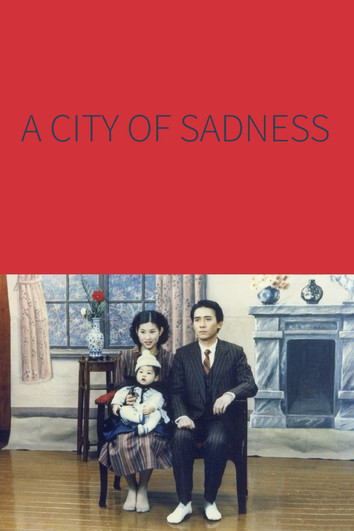
A City of Sadness
1989 · Hou Hsiao-hsien
For when you want a serious, absorbing epic that treats history through one family's kitchen table — a film to sit with, not half-watch. Bring your full attention and expect to carry it around afterward.
What it's about
In the years between Japan's surrender in 1945 and the consolidation of Kuomintang rule, the four Lin brothers of a Taiwanese port town are pulled apart by history: one runs the family restaurant amid gangster entanglements, one never returns from the war, one comes back broken by torture and false accusation, and the youngest — a deaf-mute photographer — is drawn into leftist intellectual circles. Through weddings, funerals, and dinners, the family absorbs the violence of the February 28 Incident and the political terror that followed.
The experience
Stately, mournful, and quietly devastating — the film keeps its distance, letting violence happen at the edges of long, contemplative shots, so grief accumulates rather than erupts. It asks patience and repays it with real emotional weight.
Performances
Tony Leung Chiu-wai, playing a deaf-mute, delivers one of the great wordless performances — everything passes through his eyes and his written notes, and he becomes the film's still, watching conscience.
The craft
Hou shoots in long, fixed takes framed through doorways and windows, keeping the camera at a respectful remove while letters, intertitles, and multiple languages weave the history together. The compositions are painterly and the pacing deliberate; it's a film whose quiet demands a dark room and no distractions.
Why it matters
The first Taiwanese film to openly depict the February 28 massacre, made just after martial law lifted, it won the Golden Lion at Venice — a first for Chinese-language cinema — and stands as the defining work of the Taiwanese New Wave.
Snapshot
A City of Sadness is Hou Hsiao-hsien's epic chronicle of a Taiwanese family, the Lins, across the pivotal years between Japan's 1945 surrender and the consolidation of Kuomintang (KMT) rule around 1949. Structured around four brothers of a Jiufen family — a restaurateur entangled with gangsters, a doctor lost to the war, a brother broken by torture and false accusation, and the youngest, a deaf-mute photographer (Tony Leung Chiu-wai) drawn into leftist intellectual circles — the film uses the household as a lens onto the "February 28 Incident" of 1947 and the White Terror it inaugurated. It was the first Taiwanese feature to address the 228 massacre openly, arriving barely two years after the lifting of martial law, and it became the first Chinese-language film to win the Golden Lion at the Venice Film Festival (1989). Formally, it is Hou at his most rigorous: long static takes, distant framing, elliptical construction, offscreen catastrophe, and a polyphony of languages. It is widely regarded as one of the summit works of world cinema and the keystone of Hou's "Taiwan Trilogy."
Industry & production
The film was produced within Taiwan's commercial industry at the tail end of the New Taiwan Cinema movement, financed through Era International (led by producer Chiu Fu-sheng), with additional backing typical of the period's cross-territory arrangements that brought Hong Kong star power to a Taiwanese art film. The casting of Tony Leung Chiu-wai, then a rising Hong Kong television and film actor, was a commercial calculation as much as an artistic one, giving an austere historical drama marquee value. Shooting took place largely on location in the former gold-mining town of Jiufen (Chiufen) in the hills above Keelung, whose steep alleys, tiled roofs, and sea vistas supply the film's texture; the film's success is credited with reviving Jiufen as a tourist destination, one of cinema's more tangible afterlives.
The production's central pragmatic problem became its defining aesthetic solution. Tony Leung could not convincingly speak the Hokkien (Taiwanese) or Mandarin the role demanded, and Hou — by widely repeated accounts — resolved this by making the character Wen-ching deaf and mute, a decision that transformed a casting limitation into the film's most resonant metaphor for a silenced people. In Taiwan the film was a notable domestic success, unusual for so demanding a work; precise figures should be treated cautiously, but its commercial performance and its Venice triumph together made it a national event. Its release so soon after martial law ended (July 1987) also made it a test case for how far Taiwanese cinema could now speak about the recent past.
Technology
A City of Sadness was shot on 35mm color film using conventional late-1980s equipment, with no reliance on optical spectacle or technical novelty; its innovations are compositional rather than mechanical. The most consequential "technological" choice is its embrace of the intertitle — a device inherited from silent cinema — to render the deaf-mute protagonist's written communication and the letters and diary entries that thread through the narrative. This produces a hybrid grammar in which image, ambient sound, spoken dialogue in several tongues, and printed text all carry narrative weight simultaneously. Location sound recording across a multilingual cast, and the layering of that speech against radio broadcasts and music, reflects the period's practical sound methods rather than any advanced post-production apparatus. The film's power derives from restraint in the use of available tools rather than from any new ones.
Technique
Cinematography
The photography — credited to Chen Huai-en, a longtime Hou collaborator — is built on the director's signature vocabulary of the fixed camera, the long shot, and the sustained take. Interiors are frequently framed frontally through doorways and window openings, nesting the family within thresholds and layered planes that recall traditional composition; the camera holds at a contemplative distance rather than pressing into faces. Natural and available light dominates, giving domestic scenes a muted, tactile realism. The framing consistently subordinates individuals to the architecture and landscape around them — the boarding house, the hospital, the mountain town — so that history appears to act upon figures who are dwarfed within the frame. Movement, when it occurs, is minimal and motivated; the default is stillness, inviting the viewer to scan a dense image rather than be directed through it.
Editing
Longtime Hou editor Liao Ching-song shapes the film's celebrated ellipticality. Scenes are held long past conventional dramatic beats, then cut with abrupt temporal leaps that omit precisely the events a mainstream historical film would stage: arrests, executions, and the 228 violence itself largely occur in the gaps between shots or offscreen entirely. The result is a narrative of aftermaths and absences, where the viewer reconstructs catastrophe from letters, rumors, radio, and the changed faces of survivors. This gapped structure demands active inference and has been both praised as a profound formal analog to historical trauma and criticized as difficult to follow — a difficulty the film treats as thematically essential rather than a flaw to be smoothed.
Mise-en-scène / staging
Hou's tableau method organizes action in depth and across the full width of the frame, with multiple family members occupying a single unbroken shot around meals, sickbeds, and business dealings. The recurring space of the shared table — eating, drinking, negotiating, mourning — becomes the film's dramatic engine, the site where public history enters private life. Staging privileges the ensemble over the star; characters enter and exit the frame's fixed borders while the household persists. The physical world is rendered with documentary specificity: the mining-town alleys, the family restaurant, the photographer's studio. This density of environment is inseparable from meaning, grounding the political epic in the concrete daily life of one clan.
Sound
The soundtrack is a deliberate babel. Characters speak Taiwanese Hokkien, Mandarin, Cantonese, Japanese, and Shanghainese, dramatizing a society fractured along lines of origin, class, and colonial history — the incomprehension between "mainlander" arrivals and native Taiwanese is enacted in the very grain of speech. Against this, the deaf-mute Wen-ching inhabits a pointed silence, communicating through written notes rendered as intertitles. Radio broadcasts — the Japanese Emperor's surrender, later KMT proclamations — puncture the domestic soundscape with the voice of the state. The evocative, melancholic score by the Japanese ensemble S.E.N.S. lends a plangent lyricism that offsets the film's restraint without dictating emotion.
Performance
Performance is calibrated to Hou's distant camera and long takes: understated, behavioral, resistant to the emotive close-up. Tony Leung Chiu-wai, deprived of speech, gives a performance built entirely on gesture, gaze, and stillness, and it stands among his most admired. The veteran puppet master and actor Li Tianlu — a fixture of Hou's cinema — anchors the ensemble with weathered authority. Xin Shufen (Chen Sownyung), as Hinomi, whose voiceover and diary supply much of the film's narration, brings a quiet gravity that carries the perspective of memory. The ensemble's naturalism, in which no single performance dominates, reinforces the film's vision of history as collective experience.
Narrative & dramatic mode
The film operates in an epic-elliptical register that pointedly refuses melodrama. Rather than a plot of escalating confrontations, it offers a chronicle of a family absorbing successive blows over four years, its dramatic peaks displaced into gaps, letters, and reported speech. Multiple narrational channels coexist: the omniscient held shot, Hinomi's retrospective diary voiceover, radio, and the intertitled writing of the mute protagonist. Time advances in leaps marked by births, deaths, and political ruptures, framed at the outset by the surrender broadcast and the birth of a child. The mode is contemplative and accretive — meaning gathers through repetition and juxtaposition rather than causal drive — placing considerable interpretive responsibility on the viewer and treating historical understanding itself as a difficult, mediated act.
Genre & cycle
Nominally a historical drama and family saga, A City of Sadness belongs to the tradition of the national historical epic while systematically deforming its conventions: the sweep is present but the spectacle, battle scenes, and heroic individuals are withheld. It sits within a cycle of late-1980s and 1990s art cinema reckoning with suppressed twentieth-century histories, and within Hou's own oeuvre it initiates a loose trilogy on Taiwan's modern history, continued by The Puppetmaster (1993) and Good Men, Good Women (1995). It also extends the New Taiwan Cinema's characteristic mode — realist, autobiographically and historically inflected, formally austere — onto the largest possible canvas, transforming the movement's intimate coming-of-age stories into national tragedy.
Authorship & method
The film is a landmark of Hou Hsiao-hsien's authorship, consolidating the style he had developed through A Summer at Grandpa's, A Time to Live and a Time to Die, and Dust in the Wind: the long take, the fixed frame, ellipsis, distance, and a faith in observation over exposition. Hou's method famously tolerates and even courts opacity, trusting accumulation over explanation. He worked with an established creative team. The screenplay is credited to Wu Nien-jen and Chu Tien-wen; Chu, a major novelist, was Hou's essential long-term writing collaborator, and their partnership shaped the literary sensibility of his historical films. Chen Huai-en's cinematography and Liao Ching-song's editing translate Hou's temporal patience into image and cut, while S.E.N.S. provides the score. The presence of Li Tianlu — whose own life would become the subject of The Puppetmaster — links the film to Hou's abiding interest in oral memory and personal testimony as routes into national history.
Movement / national cinema
A City of Sadness is central to Taiwanese cinema and often read as a culminating work of the New Taiwan Cinema (the movement associated with Hou, Edward Yang, and their peers that emerged in the early 1980s). Where the movement had specialized in intimate, realist accounts of ordinary Taiwanese life, this film extended that ethos to the foundational trauma of the postwar state. It is also a milestone in the international recognition of Chinese-language and Taiwanese cinema: the Golden Lion marked a decisive arrival on the world stage and helped position Hou as a leading figure of global art cinema. Its multilingualism and its focus on the friction between native Taiwanese and mainland arrivals make it a defining text in debates about Taiwanese identity and the very idea of a distinct national cinema.
Era / period
The film depicts 1945–1949 but was made in 1988–1989, and both frames matter. Its subject — the KMT takeover after Japanese colonial rule, the 228 Incident of 1947, and the onset of the decades-long White Terror — had been effectively unspeakable in public life for forty years. Martial law was lifted in Taiwan only in July 1987, and the film's appearance so soon after is inseparable from its significance: it was the first feature to bring the 228 massacre onto screens, participating in and accelerating a broader social reckoning as Taiwan democratised. The work thus belongs to two eras at once — the violent postwar founding it portrays, and the tentative post-authoritarian opening in which portraying it first became possible.
Themes
The film's governing themes are historical trauma, silence, and memory. The deaf-mute protagonist is its central figure of a people rendered voiceless by successive regimes, and the motif of communication through writing, letters, and intertitles foregrounds the mediated, fragile nature of testimony. Family and lineage — birth, marriage, death, the endurance of the household — measure the human cost of political upheaval. Language and identity are dramatized through the film's deliberate babel of tongues, mapping the fault lines between Taiwanese and mainlander, colonized and colonizer. Running beneath all of it is the question of how a society remembers atrocity that the state has forbidden it to name, and how ordinary people persist within, and are marked by, forces they cannot control.
Reception, canon & influence
Internationally, A City of Sadness was received as a major event, its Golden Lion establishing Hou among the foremost living directors and drawing sustained critical attention to Taiwanese cinema; it has since been a fixture of critics' and scholars' assessments of the greatest films of its era. Domestically its reception was charged and complex — a commercial success and a source of national pride, yet also the object of debate over its handling of the still-raw 228 history, with some finding its ellipticality evasive and others its refusal of spectacle profoundly ethical.
Looking backward, the film draws on the observational realism and long-take tradition Hou had refined across the 1980s and on the New Taiwan Cinema's literary, autobiographical impulse (the collaboration with novelist Chu Tien-wen is central here); its use of intertitles reaches back to silent-era grammar. Looking forward, it anchors Hou's own historical trilogy and stands as a touchstone of "slow cinema" and contemplative long-take practice, its influence visible in the international art-house directors who adopted duration, distance, and ellipsis as expressive tools. Within Taiwan it helped legitimize 228 as a subject for art and public memory, opening space for subsequent cultural reckonings with the White Terror. Its revival of Jiufen as a cultural landmark is a further, unusually concrete legacy. Where the historical record on internal production details is thinner — precise budget and box-office figures, for instance — those specifics are best left unstated rather than reconstructed; the film's canonical stature, by contrast, is firmly established.
A Deleuzian reading
It begins in the dark.
The full Deleuzian reading of A City of Sadness →
Reception
It won the Golden Lion at Venice in 1989 — the first Taiwanese film ever to do so — and was a genuine box-office event at home, yet for decades it was nearly impossible to see properly in the West; the recent 4K restoration finally turned a legendary 'have you actually seen it?' title into something people can watch.
How A City of Sadness was received, from release to now →
How to watch A City of Sadness: what to notice on a first viewing
- Notice how far back the camera stays from every scene. Hou frames the family frontally through doorways and windows, holding at a distance rather than pushing into faces, so figures sit dwarfed inside the architecture around them. The distance makes you scan the whole image yourself instead of being pointed at what matters.
- Notice how often the family gathers around one table. Meals, deals, and mourning all happen at the same table across the film, the household holding a single unbroken shot while people enter and leave it. Watching who sits down and who is missing tells you what has happened better than any scene of the event itself would.
- Listen for how many different languages are spoken. Characters shift between Hokkien, Mandarin, Cantonese, Japanese, and Shanghainese, and people often fail to understand each other in the very grain of the speech itself. You can hear a fractured society before anyone explains what has fractured it.
- Watch for the written notes that stand in for speech. Wen-ching, deaf and mute, communicates on paper, and the film renders his notes as intertitles, borrowed from silent cinema for a household otherwise full of talk. In a house full of five spoken languages, the one person you have to actually read is the one who cannot speak.
- Listen for the radio breaking into the household's quiet. Official broadcasts, the surrender, later proclamations, arrive over the domestic soundscape as the voice of the state entering a private room. History keeps arriving through a speaker in the corner, never as an event you are shown directly.
The whole guide to watching A City of Sadness, with the keys for a rewatch →
Influences: the films it descends from and the films it influenced
- Tokyo Story (1953) — Supplies the low, frontal framing of domestic interiors and the family gathered at the shared table, along with the elliptical registering of a death that happens offscreen between scenes rather than being dramatized.
- Sansho the Bailiff (1954) — Models the historical-tableau long take that holds at a fixed distance from suffering, letting cruelty and grief play out in depth within the frame instead of cutting in for emphasis.
- L'Avventura (1960) — Establishes the dedramatized ellipsis in which the pivotal catastrophe occurs offscreen and is never resolved, forcing narrative meaning to accrue through absence and duration.
- The Travelling Players (1975) — Builds a national-historical epic out of extended sequence-shot tableaux that fold political massacre into the offscreen and let years of history pass inside a single sustained frame.
- Paisà (1946) — Provides the neorealist template for treating occupation and historical atrocity through distanced observation and offscreen violence, privileging witnessed aftermath over depicted event.
- Dust in the Wind (1986) — Hou's immediately prior consolidation of the fixed frame, the long take, and rural-to-city family ellipsis, whose deaths and departures register obliquely rather than through scene-level payoff.
- A Time to Live and a Time to Die (1985) — His autobiographical family saga where successive parental deaths are staged at emotional and physical distance, training the withheld, accumulation-over-explanation method carried into the 228 material.
- The Time to Live and the Time to Die (1985) — The culmination of this film's method: distanced tableaux, a multilingual (Hokkien/Mandarin/Japanese) soundscape, and mass historical violence held offscreen while the camera stays fixed on the family interior.
- Taipei Story (1985) — The Golden Lion winner that carried the New Cinema's static tableau long-take method to international canonization, the export triumph Taipei Story's craft anticipated.
- The Boys from Fengkuei (1983) — Scales the long-take, static-tableau, elliptical-narration method to historical epic, letting off-screen and withheld events carry the story — the canonized culmination of the grammar Fengkuei crystallized.
- The Puppetmaster (1993) — Extends the same historical trilogy by pushing multi-channel narration further, intercutting Li Tianlu's direct-to-camera oral testimony with staged reconstruction of the events he recounts.
- Platform (2000) — Traces national upheaval across a decade through a single troupe in distant, sustained long takes, letting epochal political change arrive offscreen and be felt in the characters' altered daily gestures.
- Maborosi (1995) — Adopts the static, far-off long-take composition and locates a death entirely offscreen, so that grief is conveyed through withheld information and figures dwarfed within frontal frames.
- Colossal Youth (2006) — Frames marginalized figures frontally in doorways and thresholds and holds each shot past narrative need, turning distance and stillness into a mode of preserving suppressed historical memory.
- Uncle Boonmee Who Can Recall His Past Lives (2010) — Applies slow-cinema stillness and silence to buried state violence (the anti-communist killings), letting historical trauma register through what is unspoken and held rather than depicted.
- Long Day's Journey into Night (2018) — Explicitly inherits Hou's elliptical memory structure and extended-take grammar, organizing the film around duration and fragmented recollection instead of causal exposition.
- Destiny (2006) — Static long-take framing with medium-shot dominance, diegetic naturalistic sound as the sole affective carrier, and the practice of allowing personal-historical fate to accumulate through observational duration rather than expressive close-up — formal vocabulary Demirkubuz transposes to the Turkish urban context.
- Roma (2018) — Hou's compositional method — wide-frame deep-focus staging with figures positioned at middle distance, slow lateral pans tracking action across crowded domestic interiors, historical upheaval registered as pressure on private life — provides the architectural model for Cuarón's simultaneous personal/political staging and his preference for distance over close-up intimacy.
- The Assassin (2015) — The observational long-take distance, action pushed off-screen, and reliance on the viewer to assemble an elliptical narrative is the Taiwan New Cinema grammar Hou ports into period genre.
- Peppermint Candy (2000) — Hou's long-take, observational staging of a nation's suppressed historical trauma (the 2-28 massacre) models the long-take/observational-realism approach Lee and DP Kim Hyung-koo use to frame Gwangju and the dictatorship years.
- Millennium Mambo (2001) — Established the static/long-take grammar and Liao Ching-sung's elliptical editing that Mambo inherits, here turned from historical memory onto the immediate present.
- What Time Is It There? (2001) — Taiwanese New Wave stasis: wide static tableaux with crucial action pushed off-screen or into deep space, the long-take grammar Tsai inherited and stripped further.
- A Brighter Summer Day (1991) — The New Taiwan Cinema companion piece that stages KMT-era historical trauma through long-take ensemble blocking in deep, dimly lit domestic space, the camera observing rather than isolating.
- Rebels of the Neon God (1992) — Carries New Taiwan Cinema's durational aesthetic into the city, holding on static frames and near-wordless waiting until time itself becomes the expressive material.
- Sátántangó (1994) — Radicalizes duration as an expressive device, using extreme long takes and slow lateral movement to make the passage of time, rather than plot, the viewer's primary experience.
- Yi Yi (2000) — The founding Taiwanese New Cinema method of the static, distant wide frame and long take observing a family across time, letting duration rather than cutting shape the drama.
- Goodbye, Dragon Inn (2003) — Taiwanese New Wave long-take deep-focus staging in static wide frames, letting action play out at a distance without cutting in — the shared regional grammar of unhurried framing.
Similar films
- Dust in the Wind (1986) — influence & lineage · same viewing thread
- Tokyo Story (1953) — influence & lineage · often watched together
- A Brighter Summer Day (1991) — influence & lineage · same viewing thread · often watched together
- Maborosi (1995) — influence & lineage
- Raise the Red Lantern (1991) — same viewing thread · often watched together
- The Time to Live and the Time to Die (1985) — same viewing thread
- Taipei Story (1985) — same viewing thread
- Flowers of Shanghai (1998) — same viewing thread
All the films related to A City of Sadness →
Watch it with: curated runs of related films
- Sinophone Slow Cinema — A run of Chinese-language films — Taiwan's New Wave and its mainland and Bi Gan heirs — where time pools and city, family, and memory recur; watch them near each other, from A Brighter Summer Day to An Elephant Sitting Still, for how they rhyme on drift and the weight of the past.