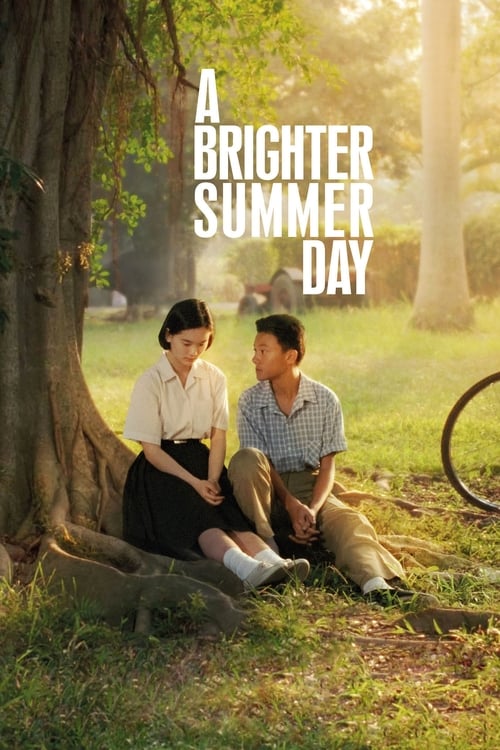
A Brighter Summer Day
1991 · Edward Yang
For when you have a whole evening (or two) to give a masterpiece and want to disappear completely into another time and place. This is a commitment watch — challenging in scale, but one of those films people call a life experience.
What it's about
Taipei, the early 1960s. Xiao Si'r is a bright junior-high boy from a mainland-émigré family — people uprooted to Taiwan after 1949, living in borrowed houses, waiting for a life that never quite arrives. Over four hours, he drifts between night school, street gangs, rock 'n' roll, a strained family, and his first love, a girl named Ming — a world reconstructed around a real 1961 juvenile crime that shocked Taiwan. It's a whole society told through one adolescence.
The experience
Unhurried and immersive — it earns its length by making you live in this world until you know every alley and radio song, then lets an undertow of dread pull the coming-of-age story somewhere darker. It's tender, absorbing, and finally shattering.
Performances
A teenage Zhang Zhen, in his screen debut as Xiao Si'r, carries the epic with a watchful stillness that makes his gradual unmooring quietly heartbreaking.
The craft
Yang stages scenes in long, patient wide shots — often lit by flashlights and bare bulbs in the dark — letting violence and tenderness happen at the edge of the frame. The period reconstruction is total: pop songs, uniforms, Japanese-era houses, all of it building a documentary-solid world for a fiction. On a big screen its darkness and detail become enveloping.
Why it matters
Long hard to see outside Taiwan and now restored to its full length, it's widely held up as Edward Yang's masterpiece and one of the towering achievements of the Taiwanese New Cinema — the film that turned a national wound into an epic.
Snapshot
A Brighter Summer Day (牯嶺街少年殺人事件, literally "The Guling Street Youth Murder Incident") is Edward Yang's fourth feature and the film most often nominated as his masterpiece. Running close to four hours in its complete version, it reconstructs the world of mainland-émigré families in early-1960s Taipei through the story of Xiao Si'r (Zhang Zhen), a bright junior-high student drawn into the orbit of youth street gangs, and his doomed attachment to a girl named Ming. The film is anchored in fact: in 1961 a teenager stabbed a girl to death on Guling Street, an event contemporaneous with Yang's own adolescence, and Yang has described it as the first murder by a minor to seize public attention in Taiwan. Around that kernel Yang builds an epic of displacement — of families uprooted from the mainland after 1949, waiting for a return that will never come, their children improvising an identity in the interregnum. It is simultaneously an intimate coming-of-age story and a panoramic social history, and it belongs to the first rank of the Taiwan New Cinema.
Industry & production
The film was produced in the early 1990s under the Central Motion Picture Corporation (CMPC), the state-affiliated studio that had, in the early 1980s, given the Taiwan New Cinema its institutional foothold. By 1991 that movement's first energy had dissipated commercially, and Yang worked in a difficult financing environment for the kind of long, uncompromising art film he intended. The production is generally understood to have been protracted and materially constrained; the four-hour running time and large ensemble of largely non-professional young performers made it an unusually ambitious undertaking for its scale of resources. Yang's own company, Yang & His Gang Filmmakers, is associated with the production alongside CMPC.
The film's most consequential post-production fact concerns its length. Yang's preferred cut runs roughly 237 minutes (just under four hours); a substantially shorter version — around three hours — circulated in some territories, and for years the complete film was difficult to see in good quality outside festival and archival contexts. This scarcity shaped its reputation: it was long a legendary title known more by report than by viewing in the West. The situation was decisively changed by the Criterion Collection's 2016 restoration and release of the full-length version, undertaken with the involvement of the World Cinema Project; that restoration is the reason the film's stature has risen so markedly among later audiences. Precise budget and box-office figures are not part of the reliably established record, and I will not invent them.
Technology
A Brighter Summer Day is a photochemical film shot on 35mm and conceived for celluloid projection, its widescreen frames built around available and practical light sources appropriate to a low-electrification early-1960s setting. Much of the film's distinctive texture derives not from novel apparatus but from disciplined use of conventional resources: long takes, deep staging, and a palette dominated by pooled artificial light — flashlights, a single overhead bulb, headlamps, the beam of a film-studio lamp — against enveloping darkness. The 2016 4K restoration is itself a technological chapter in the film's life, recovering detail and tonal range in the many near-dark scenes that earlier prints and video transfers had crushed into murk; the film's reception history is inseparable from the availability of an image that finally does its cinematography justice.
Technique
Cinematography
The photography, credited to Zhang Huigong (also romanized Chang Hui-kung), is among the film's supreme achievements and one of the reasons it is spoken of alongside the great works of composed, painterly widescreen cinema. Yang favors the wide, static or slowly reframing long take over cutting; the camera holds at a middle distance, letting figures move within an architecture of doorways, windows, corridors and courtyards. Light is used with unusual expressive economy: repeated motifs of a torch or a flashlight cutting through blackness; the recurring image of a large lamp "borrowed" from a film studio that becomes a small emblem of illumination and theft; scenes staged so that faces slide in and out of shadow. This is a cinema of thresholds — characters observed through frames-within-frames, half-glimpsed, partially occluded — which formalizes the film's themes of surveillance, secrecy and the difficulty of seeing others (and oneself) clearly. Color is muted and documentary, the greens and browns of uniforms and concrete, punctuated by the electric intrusions of American pop modernity.
Editing
The cutting works against conventional dramatic emphasis. Yang and his editors let scenes run to their full duration and frequently withhold the establishing information that would orient a viewer immediately; relationships and allegiances among the large cast must be assembled by the audience over time. Ellipses are severe — significant developments occur between scenes and are inferred — while individual scenes are protracted, so that the rhythm alternates long stillness with abrupt gaps. This structure demands and rewards attention; it is one reason the film's full-length version is essential, since the shorter cut necessarily sacrifices the accretive, novelistic patience on which the whole design depends.
Mise-en-scène / staging
If any single element defines the film it is Yang's mise-en-scène. He composes in depth, distributing action across foreground and far background, and blocks his large ensemble with an almost theatrical precision that nonetheless reads as lived behavior. Spaces recur and accumulate meaning: the school and its examinations, the family's cramped Japanese-style house, the pool hall and concert stage where the gangs congregate, the film studio where Si'r's sister and others cross paths, the night streets. Yang treats architecture sociologically — the compartmentalized rooms and sliding partitions of émigré domestic life, the institutional corridors of the school — so that setting is never mere backdrop but an expression of a society in provisional arrangement. The staging's patience allows small objects (a flashlight, a tape recorder, a Japanese sword, a transistor radio, a baseball bat) to acquire the weight of talismans.
Sound
Sound is central rather than decorative. The film's very texture is bound up with the intrusion of American rock-and-roll into Taipei: Elvis Presley looms as a cultural icon, and the phrase "a brighter summer day," which supplies the English title, derives from a mishearing/appropriation of the lyric in Presley's "Are You Lonesome Tonight?" A local band's cover performances thread through the film, and one of the young characters is nicknamed "Cat" in homage to this borrowed musical culture. This soundtrack of imported pop is not nostalgia but argument: it dramatizes a generation constructing selfhood out of a foreign vernacular because the inherited one — mainland China, the parents' lost world — is unavailable to them. Against the pop, Yang sets long stretches of ambient near-silence and the small sounds of rooms, so that the music arrives as both liberation and dislocation.
Performance
Yang worked largely with young non-professionals, and the ensemble performance is remarkable for its unforced naturalism across dozens of speaking roles. Zhang Zhen (Chang Chen), then a teenager in his first significant role, plays Si'r; the part launched a major career, and his casting is bound up with the film's authenticity — his own father, Zhang Guozhu (Chang Kuo-chu), plays Si'r's father, and the family scenes draw palpable charge from that real kinship. Yang's direction of the young cast favors behavioral truth over projected emotion; the performances are watchful, inward, and only intermittently eruptive, which makes the eventual violence land with documentary shock rather than melodramatic release.
Narrative & dramatic mode
The film's mode is novelistic realism on an epic scale, closer to Dickens or to the nineteenth-century social novel than to conventional screen drama. It braids a Bildungsroman — Si'r's schooling, first love, and moral corrosion — with a panoramic portrait of a community, and it declines the tidy causal chains of genre. The central killing, known from the outset to anyone aware of the historical case and structurally inevitable within the film, is presented not as a whodunit but as a sociological and moral question: how does a sensitive, intelligent boy arrive at such an act? Yang's answer is diffuse and cumulative — a matter of institutions (school, police, gangs, family), of a girl who will not be possessed or saved, and of a whole displaced society's disorientation — rather than a single trauma. The dramatic satisfactions are those of accumulation and pattern-recognition; meaning arrives late and all at once.
Genre & cycle
Nominally a crime drama with a coming-of-age romance at its center, the film uses genre elements — the youth gang picture, the juvenile-delinquent film, the doomed romance — while transcending each. It converses with the international post-war youth-film cycle (the anxieties of Rebel Without a Cause and its worldwide progeny are explicitly in play, given the Elvis-and-rock context), but Yang localizes and historicizes that cycle within the specific predicament of mainland-émigré Taiwan under martial law. It also participates in the broader art-cinema tradition of the long-form social epic. To call it a "gang film" or a "teen romance" is accurate and radically insufficient at once.
Authorship & method
Edward Yang (Yang Dechang, 1947–2007) is the film's authorial center, and A Brighter Summer Day is his most autobiographical work: he was of the generation and milieu it depicts, a child of mainland émigrés growing up in 1960s Taipei, and the Guling Street murder was a formative event of his youth. Trained originally as an engineer and having worked in the United States before returning to filmmaking, Yang brought a systematizing, architectural intelligence to his cinema; his films are famously structured, diagrammatic in their tracing of social networks. He is credited as director and co-writer, working with collaborators including screenwriters associated with his circle (the screenplay is a collective effort with Yang, and I will not overstate individual attributions I cannot verify precisely). The cinematography is by Zhang Huigong (Chang Hui-kung). The film's naturalist performance style reflects Yang's method of casting non-professionals and drawing behavior rather than acting from them. Yang would go on to make Yi Yi (2000), his other universally acknowledged masterpiece, before his early death from cancer in 2007. Where specific crew attributions (editor, art direction, individual co-writers) are concerned, the widely circulated record is less firm than for Yang and Zhang, and I flag that rather than guess.
Movement / national cinema
The film is a summit of the Taiwan New Cinema (Taiwan New Wave), the movement that emerged around 1982 under the CMPC and reoriented Taiwanese film toward realism, local history, and personal memory. Yang and Hou Hsiao-hsien are its twin figureheads, and the two are habitually paired and contrasted — Hou the poet of rural Taiwan and long-duration lyricism, Yang the anatomist of the modern city and its social systems. A Brighter Summer Day arrived after the movement's initial wave and is sometimes read as both its culmination and a work made in its commercial aftermath. It is inseparable from the political texture of its subject: the Kuomintang's martial-law state, the White Terror, and the psychology of exile shared by the mainlander (waishengren) community, whose insecurity and surveillance-shadowed anxiety pervade the film.
Era / period
Made in 1991, the film is set some thirty years earlier, in 1960–61 Taipei. That doubled temporality is essential: it is a 1990s work of memory reconstructing the early-1960s world of the director's own adolescence. The period setting is rendered with dense specificity — school uniforms and examinations, curfews and identity checks, tape recorders and imported records, the material scarcity and political wariness of martial-law Taiwan. The parents' generation lives suspended in the recent past of the mainland and the 1949 rupture; the children live in a present saturated by American cultural imports. The film's historical argument is precisely about this gap between eras and generations, and about a society caught between a lost homeland and an unmade future.
Themes
Displacement and exile are the film's foundational theme: an émigré community waiting for a return that cannot come, its authority hollowed out, its children improvising identity from foreign materials. From this flow the film's other concerns — the search for belonging that drives boys into gangs; the corrosive pressure of institutions (school, police, the state) on the individual, culminating in the father's humiliation under political interrogation, a quiet devastation that mirrors and helps precipitate the son's collapse; the impossibility of possession and rescue in love, embodied in Ming, whose refusal to be any one person's salvation is both the film's mystery and its tragedy. Darkness and light recur as literal and moral motifs. Above all the film meditates on how private violence grows out of public conditions — how a whole disoriented society is present in a single boy's knife.
Reception, canon & influence
A Brighter Summer Day was recognized on the international festival circuit at the time of its release and is generally understood to have won significant honors in Asian festival contexts, though for years its Western reputation ran ahead of its actual availability, sustained by critics who had seen it at festivals and by its scarcity. The decisive shift came with the 2016 restoration and Criterion release, after which the film consolidated its standing as one of the great works of world cinema; it has since placed prominently in major critical polls of the greatest films ever made, and is routinely cited as one of the finest films of the 1990s and of Asian cinema tout court.
Looking backward, the film draws on the international post-war youth picture (the Rebel Without a Cause lineage) and its rock-and-roll iconography, on the tradition of the long-form realist social novel, and on the specific documentary impulse and autobiographical realism of the Taiwan New Cinema that Yang helped found. Its use of Presley and imported American pop is a direct absorption of the very cultural influence its characters live inside.
Looking forward, its legacy is broad. It confirmed Yang's international authorship and, together with Yi Yi, secured his place beside Hou in the canon of Asian art cinema; it launched the career of Chang Chen, later an internationally recognized actor. Its patient, architecturally composed long-take realism has been widely influential on subsequent slow-cinema and art-house filmmaking across Asia and beyond, and it is frequently invoked as a touchstone by later directors of the historical epic of memory. Perhaps its greatest present influence is as a rediscovered model of what the long-form film can do — an argument, renewed for each new audience since 2016, that patience, density, and social scope belong at the center of cinema's ambitions.
A Deleuzian reading
Start with the flashlight.
The full Deleuzian reading of A Brighter Summer Day →
Reception
Acclaimed on release (it won Best Film at the 1991 Golden Horse Awards) but then nearly impossible to actually watch — for two decades it circulated in a truncated cut and murky bootlegs, a legendary 'greatest film you can't see.' The 2009 World Cinema Foundation restoration and 2016 Criterion release finally made it available, and it promptly settled into consensus-masterpiece status.
How A Brighter Summer Day was received, from release to now →
How to watch A Brighter Summer Day: what to notice on a first viewing
- Watch for a flashlight or torch cutting through darkness. Yang repeatedly lights scenes with a single torch, headlamp, or borrowed studio lamp against enveloping blackness, so you are often straining to see who is where. The darkness is not atmosphere. It is how much a teenager can actually perceive of the world he's stuck in.
- Notice how long the camera holds without cutting away. Yang favors wide, static or slowly reframing long takes at a middle distance, letting figures move through doorways and corridors rather than cutting to follow them. You watch this world the way you'd actually watch a room, patiently, from one fixed vantage.
- Notice characters viewed through doorways, windows, or partitions. Yang keeps framing people through architecture within the shot itself, so you often see someone half-occluded rather than looking straight at them. You are made to feel like a watcher who never gets the full picture, which is exactly Si'r's position too.
- Listen for Elvis and rock and roll entering ordinary scenes. A local band covers American songs throughout the film, arriving out of long stretches of near-silence, so the music always sounds imported rather than native to this world. The kids are building an identity out of borrowed sound because the one their parents lost isn't available to them.
- Notice small objects like a tape recorder or a sword recurring. Yang lets particular objects, a flashlight, a tape recorder, a Japanese sword, a transistor radio, pass through different hands and scenes until they gather unusual weight. By the time an object returns, it is carrying history from every scene it has already been in.
The whole guide to watching A Brighter Summer Day, with the keys for a rewatch →
Influences: the films it descends from and the films it influenced
- Rebel Without a Cause (1955) — Supplies the juvenile-delinquent-film template and the widescreen gang-and-knife choreography plus the rock-era iconography that Yang's characters literally consume and imitate.
- The 400 Blows (1959) — Model for the autobiographical bildungsroman built on a non-professional child lead whose behavior is observed and drawn out rather than 'acted.'
- Tokyo Story (1953) — Source of the low, static deep-staging inside domestic interiors and the doorway/threshold frames-within-frames that compartmentalize characters in depth.
- L'Eclisse (1962) — Provides the dedramatized method of ambient near-silence, architecturally composed empty space, and psychological exposition withheld from the cut.
- The Rules of the Game (1939) — Precedent for staging an entire social network in deep focus, with multiple planes of simultaneous action mapping a class system inside one frame.
- The Terrorizers (1986) — Yang's own earlier experiment in diagrammatically mapping intersecting urban lives across rigorously geometric long-take frames, the method ABSD scales up.
- Taipei Story (1985) — Establishes Yang's low-key-lit, glass-and-window compositions of characters dwarfed by modernizing Taipei architecture.
- The Time to Live and the Time to Die (1985) — Fuses autobiographical adolescent memory with national history in patient long takes and threshold-framed interiors — the personal-memoir-as-historical-witness template this film set.
- That Day, on the Beach (1983) — Scales the engineer's-precision method — worlds built first in space and time, meaning accruing within — to epic length, extending the debut's architectural approach to social memory.
- Yi Yi (2000) — Extends the same authorial architectural long-take realism and reflection/window frames-within-frames across a novelistic multi-strand family portrait.
- Platform (2000) — Carries forward the generational epic that indexes historical change through imported pop music and observes it from patient long-take distance.
- Nobody Knows (2004) — Inherits the non-professional child cast whose real behavior is drawn over long shoots, with private catastrophe unfolding under indifferent public conditions.
- Peppermint Candy (2000) — Continues the structuring of private violence as an index of authoritarian public conditions across a memory-driven historical timeline.
- Roma (2018) — Reconstructs an autobiographical period childhood in deep-staged long takes with immersive ambient sound doing the exposition the dialogue withholds.
- Rebels of the Neon God (1992) — Transposes the Taipei juvenile-delinquent milieu into ambient long-take alienation, the same city's disaffected youth seen a generation on.
- Moonlight (2016) — A three-part bildungsroman of a boy's formation through elliptical time-jumps and emotionally withheld cutting; Jenkins cites Yang as a direct touchstone.
- An Elephant Sitting Still (2018) — Sustains the four-hour novelistic scope, low-key palette, and drifting long-take realism to trace youth despair against constricting social conditions.
- Sympathy for Mr. Vengeance (2002) — Sustained-duration staging of working-class violence rendered without aesthetic elevation, in unbroken time that forces absorption rather than observation; the Taiwanese New Wave's temporal grammar that the Korean New Wave directly absorbs as its pacing convention.
- Burning (2018) — Yang's practice of staging youth violence within naturalistic domestic and suburban space using static long takes held at a patient compositional distance — the camera never rushing toward rupture — is the formal ancestor of Hong Kyung-pyo's patient framings of Paju periphery; both directors use precise distance to make violence feel structural rather than personal.
- All About Lily Chou-Chou (2001) — Epic, naturalistic anatomy of East Asian teen gang hierarchy and its escalation into fatal violence, staged with documentary patience rather than genre thrill.
- House of Hummingbird (2019) — Anchors adolescent interiority to a specific fraught national-historical moment through patient long-take duration and period-precise mise-en-scène.
- A City of Sadness (1989) — Shares the Taiwan New Cinema long-take tableau and the severe ellipsis that filters national-historical trauma through the fortunes of a single family.
- Once Upon a Time in Anatolia (2011) — Shares long-duration, low-key nocturnal realism where narrative information is withheld and meaning accrues through landscape and ambient sound.
- What Time Is It There? (2001) — Sibling Taiwanese New Wave method — patient distanced framing of youth alienation rooted in a precisely observed Taipei, sharing the movement's refusal of coverage-style cutting.
Similar films
- Taipei Story (1985) — influence & lineage · same viewing thread
- Yi Yi (2000) — influence & lineage · same viewing thread
- An Elephant Sitting Still (2018) — influence & lineage · same viewing thread
- A City of Sadness (1989) — influence & lineage · same viewing thread · often watched together
- What Time Is It There? (2001) — same viewing thread · often watched together
- In the Heat of the Sun (1994) — same viewing thread
- A Sun (2019) — same viewing thread
- The Time to Live and the Time to Die (1985) — same viewing thread
All the films related to A Brighter Summer Day →
Watch it with: curated runs of related films
- Sinophone Slow Cinema — A run of Chinese-language films — Taiwan's New Wave and its mainland and Bi Gan heirs — where time pools and city, family, and memory recur; watch them near each other, from A Brighter Summer Day to An Elephant Sitting Still, for how they rhyme on drift and the weight of the past.