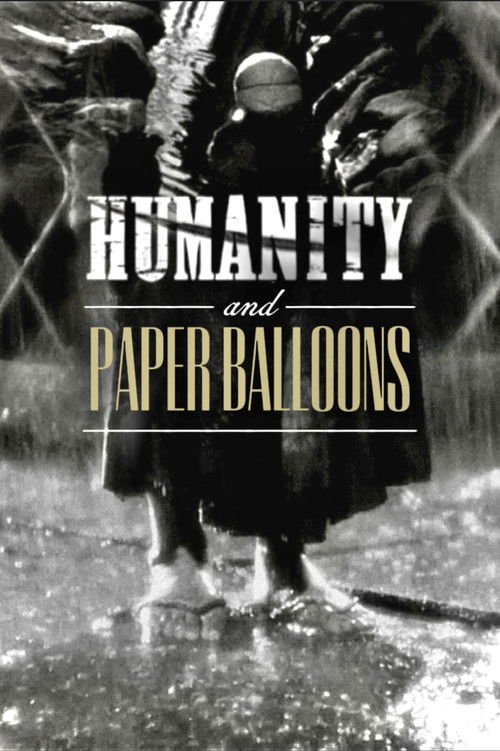
Humanity and Paper Balloons
1937 · Sadao Yamanaka
For when you want something short, humane, and genuinely sad — a film to sit with, not escape into. This is a challenge-and-reward evening, not comfort viewing.
What it's about
In a rain-soaked tenement in Edo-era Japan, a masterless samurai goes door to door hoping his late father's connections will win him a position, while his neighbor, a disgraced hairdresser turned gambler, cooks up a reckless scheme involving a wealthy pawnbroker's daughter on the eve of her marriage. Around them, a whole alley of poor neighbors drinks, schemes, and gets by. It's a samurai-era film with no heroics — just pride, poverty, and the small humiliations of asking for help.
The experience
Quiet, wry, and slowly devastating — it has the loose warmth of a neighborhood comedy that keeps darkening at the edges. The rain and the crowded alley get under your skin, and the ending lands with a hush rather than a bang.
The craft
Yamanaka strips the period film of spectacle: no redemptive swordplay, just precise ensemble staging in a slum set so lived-in you can smell the wet wood. The framing and rhythm are remarkably modern for 1937, and the film's few emblematic images — like a paper balloon drifting in a gutter — do the work of whole speeches.
Why it matters
Widely held up as one of the finest Japanese films of the prewar era, and freighted with tragedy: it was the last film Yamanaka completed before being conscripted, and he died within a year, with only three of his films surviving complete.
Snapshot
Humanity and Paper Balloons (Japanese: Ninjō kami fūsen) is a period film that behaves like the opposite of one. Set in a rain-soaked Edo tenement, it uses the costume and calendar of the samurai era to tell a story with no heroes, no redemptive swordplay, and no consolation. It is best known today for a grim biographical irony: it was the last film Sadao Yamanaka completed before he was conscripted, and he died on the Chinese mainland in 1938, not yet thirty. Of the many films he made in a compressed career, only three survive complete, and this is the one most often held up as his masterpiece and as one of the finest works of prewar Japanese cinema. The film opens on a death and closes on one, framing the poverty and futility of its slum community between two suicides, and it ends with an image — a child's paper balloon drifting in a muddy gutter — that has become one of the most quoted closing shots in Japanese film.
Industry & production
The film was produced by P.C.L. (Photo Chemical Laboratories), the Tokyo studio that in 1937 merged into the newly consolidated Toho combine; Humanity and Paper Balloons thus sits at the very hinge of the Toho lineage. Its most distinctive production feature is the collaboration with Zenshinza, the progressive kabuki troupe founded in 1931 whose members carried a reformist, socially conscious sensibility from the stage into film. The troupe supplied the principal cast, which gives the ensemble its unusual cohesion — these were actors used to working together as a company rather than as assembled stars.
The context of 1937 presses on the film from outside. It appeared in the same year that full-scale war with China began, and Yamanaka received his conscription notice at essentially the moment the film was released — the detail most repeated in accounts of his life. Whether or not the timing is as neat as legend makes it, the fact is firmly established that he was drafted, sent to the mainland, and died there of illness in 1938. The film's fatalism therefore reads, in hindsight, as almost unbearably pointed, though it would be an overreach to claim Yamanaka intended it as direct commentary on the war that had barely started. Much of the granular production record — budgets, shooting schedule, box-office performance — is thin or unavailable in English-language scholarship, and I will not invent figures to fill those gaps.
Technology
The film is a synchronized sound production (a "talkie"), made well into the Japanese industry's sound era, which had arrived somewhat later and more unevenly than in Hollywood. It is shot on black-and-white 35mm in the standard Academy-ratio frame of the period. Beyond these baseline facts, the surviving prints — the film was for decades known only through imperfect materials before later restoration efforts — bear the marks of their age, and any assessment of its "look" has to reckon with the condition of what came down to us rather than with a pristine original.
Technique
Cinematography
Yamanaka's slum is a built, enclosed world, and the camerawork keeps it that way. The film favors the confined geometry of the nagaya — the long tenement row — with its narrow alley, overhanging eaves, and communal well, shot so that the frame rarely opens onto anything like freedom or sky. Rain recurs as both atmosphere and structure, streaking the alley and pooling in the gutter that will hold the final image. The compositions tend toward the horizontal and the boxed-in, using doorways, lattices, and the tenement's wooden partitions to divide the frame and to trap figures within it. I do not have a confident attribution for the director of photography to offer here, and rather than name the wrong person I will flag that the crew credits below the level of director and screenwriter are not well documented in the sources available to me.
Editing
The cutting is patient and observational rather than propulsive. Yamanaka builds his tenement as an ensemble space, letting scenes breathe and moving between the parallel miseries of the ronin's household and the barber's schemes without hurrying to plot. The film's most celebrated structural gesture is at the level of macro-editing: it is bracketed by two deaths, and the rhyme between the opening suicide and the closing one gives the whole a closed, circular shape that comments on its characters' entrapment more eloquently than any single cut.
Mise-en-scène / staging
This is the film's supreme achievement. The tenement is a fully realized social organism — landlord, barber, blind masseur, drunkards, wives at piecework, gamblers — and Yamanaka stages it as a continuous, overlapping community rather than a backdrop for principals. The opening sets the tone with savage economy: a poor samurai has hanged himself, having long since pawned his real sword and left only a bamboo substitute in its scabbard, and his neighbors mark the death less with grief than with an excuse to drink. That single detail — the empty scabbard — condenses the film's whole thesis about the gap between the dignity the era pretends to and the destitution it actually produces. Otaki's paper balloons, made as piecework in the ronin's cramped home, are the counter-motif: fragile, decorative, worthless, and finally the vehicle for the closing image.
Sound
As a sound film, it uses dialogue naturalistically, and the Zenshinza players' theatrical training gives the talk a lived-in, overlapping quality. Traditional instrumentation and the ambient noise of the tenement — rain, chatter, the clatter of the alley — do much of the atmospheric work. I do not have a reliable credit for the composer or a documented account of the score's construction, so I will not attribute the music to a specific hand.
Performance
The ensemble is anchored by two contrasting leads. Chōjūrō Kawarasaki plays Unno Matajūrō, the masterless samurai who clings to the hope that his dead father's former lord will take him into service, and whose repeated, humiliating attempts to petition the great man form the film's spine of quiet degradation. Kan'emon Nakamura plays Shinza, the barber-hairdresser, a townsman with none of the samurai's pretensions to honor and all of his defiance — it is Shinza who runs an unsanctioned gambling game and, in the act that drives the second half, kidnaps the daughter of the wealthy pawnbroker to spite the local boss and the moneyed order he represents. The performances are pitched low and human; the samurai is pathetic rather than tragic in the grand sense, and the barber is reckless rather than heroic, and the film draws its power from refusing to inflate either.
Narrative & dramatic mode
The mode is ironic realism organized as ensemble tragedy. Two plot lines run in parallel — the ronin's fruitless pursuit of patronage and the barber's abduction scheme against the pawnbroker — and they converge on a shared bleakness rather than a triumphant climax. There is no catharsis in the classical sense; the kidnapping resolves not into justice but into further violence, and the samurai's story ends not in restored honor but in a domestic death that mirrors the film's opening. The dramatic engine is social entrapment: everyone is caught by money, rank, and obligation, and the plot's function is to demonstrate that there is no exit.
Genre & cycle
Formally the film is jidaigeki — a period film set in the Tokugawa/Edo past. But it belongs to the strain of the genre that turned its conventions inside out. Where mainstream jidaigeki celebrated the swordsman's prowess and the samurai code, Yamanaka drained the form of heroism and spectacle, importing instead the values of the shomin-geki, the contemporary drama of ordinary lower-class life, into a historical setting. The result is sometimes discussed as an "anti-jidaigeki" or a humanist period film: the costumes and topknots remain, but the moral universe is that of the tenement, and the sword — quite literally, in the bamboo blade of the opening — is exposed as an empty symbol.
Authorship & method
Yamanaka was a prodigy who directed his first features very young and worked at extraordinary speed through the 1930s, building a reputation for wit and humanity within the commercial period-film industry before his death cut the career off in his twenties. Because most of his output is lost — only three complete films survive, this one together with Tange Sazen and the Pot Worth a Million Ryo (1935) and Priest of Darkness / Kōchiyama Sōshun (1936) — any account of his development rests on a fragmentary record, a point worth stating plainly. What the survivors show is a director drawn to the comic and the compassionate, increasingly willing to let irony curdle into despair.
The key documented collaboration on this film, beyond the Zenshinza troupe, is the screenplay by Shintarō Mimura, whose script gives the tenement its density of incident and its bleak symmetry; the story derives from the Edo-period theatrical tradition associated with kabuki dramatist Kawatake Mokuami. For the other craft roles — cinematography, editing, music — I have already noted that reliable attributions are not available to me, and I decline to guess at names.
Movement / national cinema
The film sits within the golden decade of 1930s Japanese studio cinema, the same milieu that produced the early masterworks of Ozu and Mizoguchi. Yamanaka is frequently grouped with them as one of the great talents of the period, and he is often described as having moved in the same circles — he was, by well-attested accounts, admired by his contemporaries and part of a generation of filmmakers pushing Japanese cinema toward psychological and social realism. The Zenshinza connection ties the film specifically to the progressive theatrical currents of the era, and P.C.L./Toho locates it within the rise of the modern integrated studio.
Era / period
The setting is Edo Japan under the Tokugawa order, but the film's historical consciousness is double. It looks back at the feudal past with none of the nostalgia the genre usually supplied, and it was made at a moment — 1937, the outbreak of war in China — when the Japanese state was mobilizing exactly the martial and hierarchical ideals the film quietly demolishes. That collision between a fatalistic period drama and an ascendant militarism is central to how the film is now read, though, again, the record does not support claims that Yamanaka set out to make an explicit anti-war statement.
Themes
The film's governing theme is the futility of honor and hope under crushing social hierarchy. The samurai's code is exposed as hollow — a bamboo sword, a lord who will not receive him, a dignity with no material basis. Poverty is not a background condition but the determining force of every life in the tenement. Money and rank draw the only lines that matter, and the townspeople's small rebellions (Shinza's gambling, his kidnapping) are gestures of defiance that the system absorbs and punishes. Community is rendered ambivalently: the neighbors gather, drink, and gossip, but their solidarity cannot save anyone. Over it all hangs a fatalism made literal by the bracketing suicides, and figured by the paper balloon — beautiful, weightless, and finally floating in the filth of the gutter, an emblem of fragile human aspiration discarded.
Reception, canon & influence
On the backward-looking side, the film's influences are theatrical and generational: the kabuki-derived Edo storytelling tradition (via Mokuami) reworked through the socially critical lens of the Zenshinza troupe and the shomin-geki realism ascendant in 1930s Tokyo studios. Yamanaka took the period film he had grown up making and bent it toward the humanist common-people drama of his contemporaries.
Looking forward, the film's stature has grown steadily. Long circulating in imperfect materials, it survived to be recognized as a canonical work of prewar Japanese cinema and appears regularly on critical listings of the country's greatest films; Yamanaka himself has been retrospectively elevated from a lost talent to one of the essential directors of the decade, forever discussed in the same breath as Ozu and Mizoguchi and mourned for the career the war cut short. Its imprint can be felt in the postwar tradition of tenement and lower-depths dramas that use a crowded, communal poor-people's setting to indict social order — the humanist, anti-heroic period film has Yamanaka as one of its patron saints. The precise chain of influence on individual later directors is easy to assert and hard to document rigorously, so I will put it carefully: the film is widely regarded as a foundational example of the socially critical jidaigeki, and its reputation rests less on box-office or contemporary acclaim (for which the record is thin) than on the enduring authority of the work itself and the tragic legend of its maker.
Reception
Barely seen outside Japan for decades and overshadowed by its director's death, it slowly resurfaced through retrospectives and home-video rescue (Masters of Cinema championed it) until it became standard-issue canon — now routinely called one of the greatest Japanese films of the 1930s.
How Humanity and Paper Balloons was received, from release to now →
Influences: the films it descends from and the films it influenced
- Tange Sazen and the Pot Worth a Million Ryo (1935) — Yamanaka's own prior film reworks a popular swordsman serial into domestic comedy, sidelining its celebrated hero into henpecked home life — the method of deflating heroic jidaigeki convention into common-people irony that Paper Balloons darkens into despair.
- Priest of Darkness (Kōchiyama Sōshun) (1936) — Shares the Zenshinza troupe's collective ensemble performance and adapts a Kawatake Mokuami Edo-kabuki source, establishing the lowlife-milieu and troupe-based staging Paper Balloons perfects one year later.
- I Was Born, But... (1932) — Ozu's shomin-geki template — patient, low-height observation of ordinary people humiliated by an inflexible social hierarchy — is the common-people realism Yamanaka grafted onto period costume.
- Osaka Elegy (1936) — Mizoguchi's contemporaneous socially-critical realism holds characters inside long, boxed, static compositions that let economic structure entrap them, rather than releasing them through dramatic cutting — the confining frame Yamanaka echoes.
- Sisters of the Gion (1936) — Indicts a social order through the people it discards, treating duty and 'honor' as an economic trap — the anti-sentimental critique Yamanaka turns from the geisha world onto the samurai.
- Seven Samurai (1954) — Builds a humanist anti-heroic period film on collective ensemble and a bleak coda ('the victory belongs to the peasants, not us'), extending Yamanaka's ensemble tragedy and futility-of-honor into the postwar epic.
- The Lower Depths (Donzoko) (1957) — Transplants Gorky into a crowded Edo tenement, using the communal nagaya of the destitute as a microcosm indicting the feudal social order — the most direct heir to Paper Balloons' tenement staging.
- Yojimbo (1961) — The cynical, honorless ronin whose swordsmanship serves no noble cause carries forward the anti-jidaigeki deflation of the samurai myth that Yamanaka pioneered.
- Harakiri (Seppuku) (1962) — A frontal assault on the bushido honor code, exposing it as institutional cruelty through a ronin's testimony — the socially-critical jidaigeki's fullest flowering, making Yamanaka's futility-of-honor its explicit thesis.
- Samurai Rebellion (1967) — A low-ranking retainer is destroyed by obedience to arbitrary clan authority — a domestic tragedy indicting feudal duty that renders Yamanaka's theme with rigorous formal control.
- Bloody Spear at Mount Fuji (1955) — Follows commoners and servants on the road until class resentment erupts into tragedy, sustaining the compassionate, anti-heroic humanist period film centered on the powerless rather than the swordsman.
- Double Suicide (Shinjū: Ten no Amijima) (1969) — Foregrounds its bunraku/Chikamatsu theatrical source and visible puppeteers as lovers are driven to suicide by economic obligation — a theatrical-derived fatalism echoing Paper Balloons' kabuki roots and its opening-and-closing suicide bracket.
- The Twilight Samurai (2002) — Fuses shomin-geki domestic realism with the impoverished low-ranking samurai, rendering honor as a daily economic burden — the modern revival of Yamanaka's humanist common-people jidaigeki.
- Drunken Angel (1948) — Yamanaka's wholly built tenement alley, shot through doorways, lattice and hanging laundry so every composition frames a second frame, plus his refusal to let a genre hero be heroic, is the direct precedent for Matsuyama's constructed slum and its framing-within-frames.
- Port of Shadows (Le Quai des brumes) (1938) — A near-simultaneous poetic-realist tragedy bracketed by doom, sealing the powerless inside rain and enclosure — the parallel European development of a fatalist common-people cinema built on atmosphere and inevitability.
- The Lower Depths (Les Bas-fonds) (1936) — Contemporaneous ensemble of society's destitute sharing one squalid communal room, the lower-depths group portrait staged as social indictment — the same crowded poor-people's microcosm Yamanaka builds in the nagaya.
Similar films
- The Twilight Samurai (2002) — influence & lineage
- Yojimbo (1961) — influence & lineage
- Harakiri (1962) — shared sensibility
- The Hidden Blade (2004) — shared sensibility
- The Human Condition III: A Soldier's Prayer (1961) — shared sensibility
- The Boy and the Heron (2023) — shared sensibility
- Sword of the Stranger (2007) — shared sensibility
- Sansho the Bailiff (1954) — shared sensibility