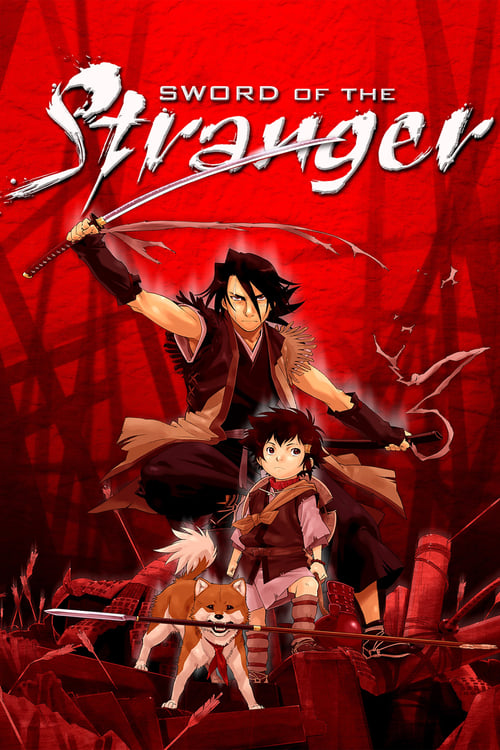
Sword of the Stranger
2007 · Masahiro Ando
When you want pure, beautifully executed action with a warm heart — the samurai movie itch scratched in under two hours. Great for a night when you'd rather feel exhilarated than challenged.
What it's about
In Japan's warring-states era, a boy named Kotaro and his dog are on the run from a squad of elite assassins sent from Ming China, who need the child for a dark imperial purpose. Their path crosses that of a nameless wandering rōnin who has sworn never to draw his blade again. What begins as a grudging bodyguard arrangement becomes a bond — and a collision course with the deadliest swordsman among the pursuers, all of it building toward a snowbound battle at a mountain temple.
The experience
A lean, propulsive chase that alternates quiet, funny stretches of boy-dog-and-ronin bonding with sword fights of startling weight and speed — steel feels heavy, footing matters, and the climax is a sustained rush that leaves your pulse up. It's earnest, bloody, and surprisingly moving.
The craft
Studio Bones built the film around one ambition: swordplay animated with real physical credibility, and the hand-drawn fight choreography — especially the extended mountain-temple finale — remains a benchmark animators still study. The wintry landscapes are gorgeous, and the score swells at exactly the right moments; it rewards the biggest screen and best speakers you have.
Why it matters
Masahiro Ando's directorial debut became a cult touchstone, widely cited as containing some of the finest action animation ever drawn and a proof of what feature anime could do with pure physical choreography.
Snapshot
Sword of the Stranger (Stranger: Mukō Hadan) is a feature-length samurai action film produced by Studio Bones and released in Japan in the autumn of 2007. It marked the feature directorial debut of Masahiro Ando, a veteran animator stepping up to lead a project built around a single, uncompromising ambition: to render swordfighting on screen with a physical credibility that traditional cel-and-digital animation had rarely attempted at this scale. The story is a lean chase narrative — a nameless, sword-sealed rōnin (Nanashi, "No Name") reluctantly protects a hunted boy, Kotaro, and his dog from a cadre of Ming-dynasty assassins who need the child's blood for an imperial elixir of immortality. Around that spare armature the film hangs a set-piece climax, a snowbound melee at a mountain temple, that has become one of the most cited action sequences in modern anime. It is best understood not as a landmark of box-office success but as a craft object: a film whose reputation was made after release, through home video, festival recognition, and the sustained admiration of animators and action-cinema enthusiasts.
Industry & production
The film was a Studio Bones production. Bones, founded in 1998 by former Sunrise staff including Masahiro Maruyama, had by 2007 established a house identity built on high-quality character animation and a willingness to fund original, director-driven work alongside licensed franchises (its catalog by then included Cowboy Bebop: The Movie, the two Fullmetal Alchemist screen properties, RahXephon, and Eureka Seven). Sword of the Stranger fits Bones's pattern of using theatrical features as a showcase for its animation department rather than as guaranteed commercial vehicles.
The project is notable within the industry for its casting strategy, which drew on Japan's talent-agency and idol economy: the lead rōnin was voiced by Tomoya Nagase of the band TOKIO, and the boy Kotaro by Yūri Chinen, then a young member of the Johnny's idol group Hey! Say! JUMP. This kind of stunt-adjacent casting — placing recognizable musicians and idols in principal roles — was a common Japanese marketing practice of the period, intended to broaden a film's appeal beyond core anime audiences.
Commercially, the record is that the film did not perform strongly in Japanese theaters and found its audience and its lasting reputation chiefly through home video and international distribution; it was later released in English-speaking territories on DVD and Blu-ray. I will not cite specific gross figures, as I cannot verify precise box-office numbers, but the characterization of a modest theatrical showing followed by strong post-theatrical and overseas reception is well established in the film's history.
Technology
Sword of the Stranger sits at a mature point in anime's transition from photochemical to digital production. By 2007 Japanese theatrical animation was overwhelmingly produced through digital ink-and-paint and digital compositing while retaining hand-drawn key animation and in-betweens — the "digital cel" workflow. The film exemplifies this hybrid: the drawing itself is traditional, frame-by-frame character animation, while color, layering, lighting effects, and camera moves are assembled digitally in compositing.
The most consequential technological choice is the film's restrained, purposeful use of digital tools in service of hand-drawn action rather than as a substitute for it. Where many action productions of the era leaned on 3DCG for crowds, cavalry, or complex camera trajectories, Sword of the Stranger keeps its combat overwhelmingly in the register of drawn animation, using digital compositing mainly to integrate elements — snow, blood, torchlight, depth — and to enable smooth virtual camera movement through drawn space. The result reads as tactile rather than synthetic, which is central to the film's identity.
Technique
Cinematography
In animation, "cinematography" is a composite of layout, virtual camera design, and the photography/compositing department that finishes the image. The film's visual grammar favors clear spatial legibility: fights are staged so the viewer always understands the geography of a duel — who stands where, which way a blade travels, what the ground and light are doing. The camera is mobile but motivated, tracking and craning with combatants rather than cutting frantically around them, so that momentum is carried by movement within and across shots. Lighting is a recurring expressive tool, from the cold blue-white of the climactic snowfield to the flame-lit interiors of the assassins' encampment. I cannot confidently name the individual photography director, and I will not invent a credit; the department's contribution is nonetheless visible in the consistent integration of drawn elements with atmospheric light and weather.
Editing
The editing philosophy is unusually patient for an action film. Rather than accelerating cutting rates to manufacture excitement, the film often holds on sustained exchanges, letting choreography and animation carry tension, and reserves faster cutting for punctuation. This gives the combat a sense of weight and consequence — blows land, fighters tire, wounds accumulate — and it is a large part of why the action feels "real." I am not able to verify the editor's name from memory and will not fabricate one.
Mise-en-scène / staging
Production design evokes a late feudal-Japanese world without pinning itself to a documented historical date; the setting is a stylized Sengoku-adjacent Japan onto which a foreign incursion — the Ming assassins and their alchemical mission — is grafted. Staging repeatedly contrasts intimacy and scale: the small, human bond between the rōnin, the boy, and the dog set against the machinery of an imperial conspiracy and its armored killers. The climactic temple-and-snow environment is the film's design masterstroke, a single legible arena that concentrates the finale and turns weather itself into a dramatic agent.
Sound
Naoki Satō composed the score, and it is one of the film's defining assets. Satō — a prolific composer for Japanese film, television, and animation — supplies a symphonic idiom that swells at the emotional and martial peaks while leaving the quieter passages relatively bare. The sound design of the combat is equally important: the emphasis on the specific noise of steel, footfall, breath, and impact reinforces the film's insistence on the physicality of violence.
Performance
The vocal performances balance star casting against dramatic restraint. Tomoya Nagase's Nanashi is deliberately laconic — a man who has sealed his sword and, with it, part of himself — so that the performance works through economy rather than display. Yūri Chinen's Kotaro carries the film's emotional throughline, the wary child learning to trust. The antagonist Luo-Lang, a blond Western swordsman who fights among the Ming party purely for the pleasure of a worthy opponent, is written and voiced as a study in aestheticized bloodlust, providing the rōnin's mirror and the finale's true adversary.
Narrative & dramatic mode
The film operates in a classic, almost fable-like mode: the wandering swordsman with a buried past who is redeemed, or at least reawakened, through the duty of protecting a child. Its dramatic engine is the chase — Kotaro is quarry, Nanashi becomes shield — and its emotional engine is the slow thaw of a guarded man. The narrative is spare by design, with relatively little exposition and a willingness to let motive emerge through action. The rōnin's history (his vow never to draw his blade, and the trauma behind it) is metered out rather than explained, so that the moment he finally unsheathes carries the weight of the whole story. This is melodrama in the precise sense — a moral universe where loyalty, cruelty, and sacrifice are legible and consequential — executed with restraint rather than sentimentality.
Genre & cycle
Sword of the Stranger belongs to the chanbara (swordplay) tradition, the samurai-action lineage that runs through Japanese live-action cinema from Kurosawa and the studio-era jidaigeki onward, here transposed into animation. Within anime it participates in a lineage of theatrically ambitious action features and in the broader current of samurai-and-rōnin storytelling that anime has periodically revisited. It is not part of a franchise or a serialized property; it is a standalone original, which is itself notable in a market increasingly dominated by adaptations. Its closest kin are other craft-forward action anime that prize animation quality as the primary attraction, and its "lone protector and hunted child" premise places it in dialogue with a durable archetype that spans Japanese and world cinema alike.
Authorship & method
The film's authorship is best read as a collaboration anchored by an animator-director. Masahiro Ando came to the project from a career as an animator and animation director, with credits that include work on Cowboy Bebop; Sword of the Stranger was his feature directorial debut, and the film's priorities — the primacy of movement, the legibility of action, the trust in drawn animation — reflect that background. His method here is essentially that of an action choreographer working in the medium of animation: he treats the fight not as spectacle to be edited together but as performance to be animated whole.
Naoki Satō (music) is the most clearly identifiable and impactful of the key collaborators, supplying the orchestral score that binds the film's tonal shifts. The screenplay is credited to a writer working from the studio's original concept; my recollection points to Fumihiko Takayama as the credited screenwriter, but I am not fully certain of this attribution and flag it rather than state it as settled fact. For the cinematography (photography direction), editing, and character design, I do not have reliably verifiable individual credits and will not invent them — a genuine gap in what I can attest to, though the collective work of the Bones animation staff, including its key animators on the finale, is the film's real signature.
Movement / national cinema
This is a work of Japanese commercial animation, produced within the Tokyo anime-studio system and expressing that system's particular strengths: a deep bench of hand-drawn character animators, a theatrical-feature tradition that periodically indulges craft ambition over commercial safety, and a national storytelling reservoir of samurai myth. It is not affiliated with any avant-garde or auteur "movement" in the art-cinema sense; its lineage is industrial and popular. At the same time it is legibly national in its material — the jidaigeki setting, the rōnin ethos, the aesthetics of the sword — while reaching outward through its Ming-China antagonists and a Western swordsman, framing feudal Japan as a place touched by foreign ambition.
Era / period
The film is a product of the mid-2000s peak of the "digital cel" era, when Japanese animation had fully absorbed digital compositing while hand-drawn animation remained the expressive core, and before 3DCG had displaced drawn action in mainstream theatrical work. It arrived in a market where original theatrical anime not tied to a franchise faced steep commercial odds, which makes its craft ambition read, in retrospect, as a statement of what the traditional pipeline could still achieve at its height. Its diegetic period is a stylized feudal Japan of the warring-states imagination, deliberately unmoored from a precise historical year.
Themes
The governing theme is the ethics of the drawn sword: violence as something with a cost, both to its victims and to the one who commits it. Nanashi's vow not to unsheathe encodes a moral position — that killing, once done, marks a person — and the film's drama is the tension between that vow and the duty to protect. Around this cluster related concerns: the found-family bond between an unmoored adult, an orphaned child, and a loyal animal; redemption through responsibility for another; and the contrast between honorable purpose and pure, self-delighting bloodlust, embodied in Luo-Lang, who kills not for a cause but for the beauty of the fight. The Ming conspiracy — blood sacrificed for an emperor's immortality — frames a further theme of power that consumes the innocent to perpetuate itself.
Reception, canon & influence
Critically and popularly, Sword of the Stranger is remembered chiefly for the caliber of its animation and its action direction, with the mountain-temple snow battle singled out repeatedly as a high-water mark for animated swordfighting. It earned festival recognition in Japan — it was honored in the animation category at the Japan Media Arts Festival and cited in domestic anime awards around 2007–2008 — a mark of institutional esteem; I state these honors in general terms because I cannot verify the exact prize names and years with certainty and will not manufacture specifics.
Looking backward, the film draws on the live-action chanbara and jidaigeki tradition — the Kurosawa-era grammar of legible, weighty swordplay and the archetype of the wandering rōnin — and on the accumulated craft of the Bones animation house, transposing cinematic action choreography into drawn form. Looking forward, its legacy is less a body of imitators than a benchmark: it is routinely invoked by animators, critics, and fans as a reference point for how hand-drawn action should read — clear, physical, unhurried in its cutting, animated rather than assembled. Masahiro Ando went on to a substantial directorial career in television and film (later projects include Canaan, Hanasaku Iroha, Blast of Tempest, and Sirius the Jaeger), and Sword of the Stranger remains the calling card that established him as an action director of note. Its enduring status is that of a craft touchstone — a film whose influence is measured in the standard it set rather than in the size of the audience it first found.
Reception
A modest theatrical performer in Japan in 2007, it quietly built a reputation abroad through DVD word-of-mouth and sakuga clip culture — today it's routinely name-dropped as the gold standard for 2D sword-fighting animation.
How Sword of the Stranger was received, from release to now →
How to watch Sword of the Stranger: what to notice on a first viewing
- Watch how clearly you can follow each blade's path. The camera tracks and cranes with fighters rather than cutting frantically around them, keeping the geography of a duel, who stands where, always legible. You're never confused about what just happened in a fight, only how it happened.
- Notice how long a sword fight runs before the next cut. The editing holds on sustained exchanges rather than accelerating cutting rate, saving faster cuts for punctuation, so a fighter's fatigue and wounds accumulate visibly. The patience is what makes the violence feel like it actually costs something.
- Listen for the specific sound of steel, footfall, and breath. The combat sound design foregrounds concrete physical noise over music, so a blow, a stumble, and a gasp all register distinctly. The soundtrack is arguing that this violence has real weight, not spectacle.
- Watch Nanashi say as little as possible in every scene. Nagase plays the ronin deliberately laconic, letting economy of speech and movement carry the character rather than any dramatic display. His silence reads as a man keeping something sealed away on purpose.
- Watch how the small trio contrasts with the imperial conspiracy's scale. Staging repeatedly sets the intimate bond of ronin, boy, and dog against the machinery of an empire's armored killers and their alchemical mission. The film keeps the human stakes small even while the plot behind them gets huge.
The whole guide to watching Sword of the Stranger, with the keys for a rewatch →
Influences: the films it descends from and the films it influenced
- Seven Samurai (1954) — Establishes the legible, weight-bearing grammar of screen swordplay — bodies staged in deep space with camera and cutting subordinated to the physical reality of the blow — the very legibility Ando animates rather than assembles.
- Yojimbo (1961) — Codifies the laconic wandering-rōnin archetype and the sudden, terminal single-stroke kill, the beat Ando builds Nanashi's whole combat rhythm and unhurried cutting around.
- The Sword of Doom (1966) — Its snow-and-shadow set-piece dueling and study of a swordsman's ethics-of-violence supply the moral chill and the arena-as-crucible staging echoed in the temple snowfield finale.
- Lone Wolf and Cub: Sword of Vengeance (1972) — The founding template of the found-family chase — a killer bound to a child, pursued across a landscape — which is precisely the narrative engine and melodrama Ando adopts for Nanashi and Kotarō.
- Ninja Scroll (1993) — The benchmark for animated chanbara before Ando — full-limbed, spatially coherent drawn swordfighting with brutal foley weight — that proved hand-drawn action could carry a feature's spectacle.
- Akira (1988) — Sets the standard of frame-dense, fully-animated motion (its light-and-debris detail) that the Bones key animators inherit and translate into the finale's readable, physically continuous choreography.
- Cowboy Bebop (1998) — Ando's own formative credit — its motivated, character-anchored camera and treatment of a fight as animated performance rather than edited montage is the method he carries into his directorial debut.
- Vampire Hunter D: Bloodlust (2001) — Carries forward Kawajiri's fluid single-blade duel choreography — weighted, gravity-obeying swordplay in long unbroken action cuts — into the next animation generation.
- Redline (2009) — Extends the 'animate the action whole' ethos to its limit — kinetic sequences drawn as continuous physical events rather than cut together — the same trust in draftsmanship Ando's finale advertised.
- Canaan (2009) — Ando's follow-up carries forward his action-choreographer method — motivated camera tracking a laconic combatant through spatially legible gunplay set-pieces.
- Sirius the Jaeger (2018) — Ando again foregrounds spatially coherent, physically weighted action animation and slower cutting that lets a fight read as sustained movement, his continuing signature.
- Demon Slayer: Mugen Train (2020) — The current benchmark for sword-combat animation blending digital compositing with hand-drawn motion into legible, physical choreography — the standard Sword of the Stranger is repeatedly cited as having set.
- Dororo (2019) — A jidaigeki of a wandering blade-wielder and a found-family bond, staging its duels with the readable, momentum-driven swordplay that Ando's film re-legitimized for the medium.
- Jujutsu Kaisen 0 (2021) — Bones' ground-level camera that tracks blade choreography across long, continuous unbroken cuts is the direct precedent for JJK 0's virtual-camera sweeps through Yuta and Rika's melee exchanges.
- Princess Mononoke (1997) — A jidaigeki rendered as drawn animation where combat retains bodily consequence and momentum, sharing Ando's insistence on physical legibility over stylized abstraction.
- Samurai Champloo (2004) — Contemporary animated chanbara built on individuated fighting-style choreography and hand-drawn blade fluidity, the same craft priority of animating each duel as distinct performance.
- Afro Samurai (2007) — A same-year animated sword epic staking its identity on set-piece duel spectacle, a direct point of comparison for how drawn swordfighting was being pushed in 2007.
- Blade of the Immortal (2008) — An animated Edo-period sword saga trading on melodramatic found-family stakes and choreographed blade duels, extending the same chanbara-in-drawn-form tradition.
- Gintama: The Very Final (2021) — Sibling in kinetic, physically weighty duel choreography used to ground an otherwise stylized world — the animation register Gintama drops into for its climactic fights.
- Berserk: The Golden Age Arc III - The Advent (2013) — Sibling in swordplay staging: brutal, weighty choreography where the edit lingers on a killing blow, the duration-as-emphasis grammar the trilogy applies to its violence.
Similar films
- Seven Samurai (1954) — influence & lineage
- The Sword of Doom (1966) — influence & lineage
- Yojimbo (1961) — influence & lineage
- Princess Mononoke (1997) — influence & lineage
- Ninja Scroll (1993) — influence & lineage
- Redline (2009) — influence & lineage
- The Boy and the Beast (2015) — shared sensibility
- The Boy and the Heron (2023) — shared sensibility