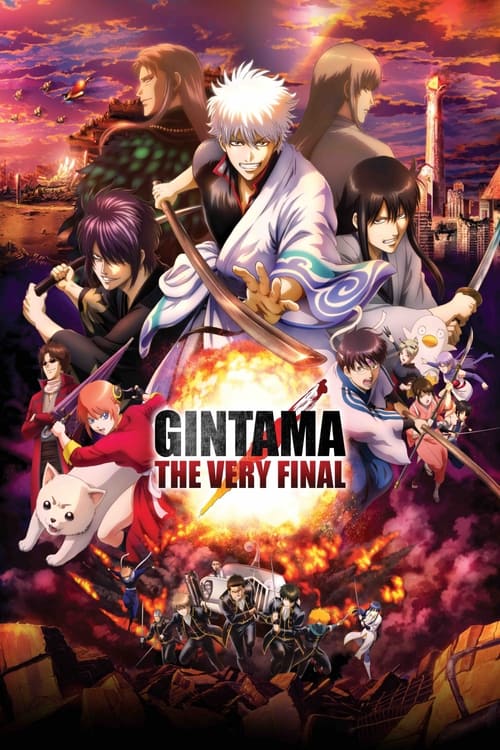
Gintama: The Very Final
2021 · Chizuru Miyawaki
For when you've lived with these characters and want the send-off you've been promised — a night of laughing at dumb jokes and then getting ambushed by real feelings. Newcomers should start with the series; this one assumes devotion and repays it.
What it's about
The grand finale of a fifteen-year saga: in an alternate Edo where aliens ended the age of the samurai, lazy odd-jobs man Gintoki and his found family rally to honor the wishes of their teacher Shoyo and stop the immortal Utsuro from bringing everything down. Nearly everyone the series ever loved — Shinpachi, Kagura, the Shinsengumi, the whole Kabuki District, even old enemies — piles into one last stand while Takasugi fights for his life.
The experience
Pure tonal whiplash, on purpose: crude gags and fourth-wall demolition one minute, sword drama played dead straight the next, and the pivots hit harder because you never see them coming. For longtime fans it plays like a long goodbye — raucous, then suddenly a lump in the throat.
The craft
Chizuru Miyawaki, the franchise's longtime series director and one of the few women helming major anime features, marshals an enormous cast into legible, kinetic action while keeping the parody engine running. The animation swings from deliberately scrappy comedy to full-throttle swordplay, and the sound design leans into both registers — it rewards good speakers when the fights land.
Why it matters
The capstone of one of modern anime's strangest and most beloved franchises, proof that a series built on parody could stick an emotionally serious landing after fifteen years.
The capstone of one of the strangest franchises in modern anime: Hideaki Sorachi's saga of an alternate Edo where aliens ended the age of the samurai, and a lazy silver-haired odd-jobs man with a wooden sword and a sweet tooth keeps the era's spirit alive anyway. Across fifteen years of television, Gintama perfected a tonal whiplash no other series dared — fourth-wall-demolishing parody, gleeful vulgarity, and then, without warning, sword drama of genuine gravity. Chizuru Miyawaki, the longtime series director and one of the few women helming major anime features, closes the Silver Soul arc here, marshaling nearly every character the show ever loved for a last stand over the fate of the teacher who shaped its heroes. Newcomers should start elsewhere; this is a film that assumes devotion and repays it with interest. Fittingly, for a series that 'ended' several times as a running joke, the title itself is the final gag — and, this time, the truth.
Reception
Landed in Japan in January 2021 as a genuine event — a fandom farewell that outdrew everything else in cinemas — and it hasn't needed a reappraisal: it's still regarded as the rare long-running gag series that stuck the landing.
How Gintama: The Very Final was received, from release to now →
Influences: the films it descends from and the films it influenced
- Urusei Yatsura 2: Beautiful Dreamer (1984) — Established the anime-comedy film that turns the gag franchise metafictional and self-referential — collapsing its own frame and mocking its serialized nature — the exact mode Gintama weaponizes into fourth-wall parody.
- Lupin III: The Castle of Cagliostro (1979) — Set the template for the comedy-action franchise film that runs on slapstick ensemble antics for most of its length yet lands a wholly sincere emotional climax — the tonal architecture Gintama's finale reproduces.
- Rurouni Kenshin: Trust & Betrayal (1999) — Modeled the 'swordsman in a dying samurai age' pathos and grave, weighted duel staging that Gintama switches into during its serious arcs, against its alternate-Edo backdrop.
- Excel Saga (1999) — Codified the rapid-fire parody-anime grammar — pop-culture riffs, self-aware narrator jabs, censor-baiting meta gags — that forms Gintama's comedic dialect.
- Cowboy Bebop: Knockin' on Heaven's Door (2001) — Demonstrated how to lift a serialized ensemble into a standalone theatrical feature while preserving the show's episode-to-episode genre-blending and abrupt tonal pivots.
- Sabu and Ichi's Detective Stories (1968) — Early Edo-set buddy-samurai TV serial whose blend of episodic period casework and swordplay laid groundwork for the anime samurai-drama-as-serial format Gintama inherits.
- Digimon Adventure: Last Evolution Kizuna (2020) — Franchise-finale film built to reward grown-up fans' long devotion, staging a deliberate 'goodbye to the ensemble' payoff that only lands if you carried the TV continuity.
- Demon Slayer: Mugen Train (2020) — The direct-continuation Shonen film that functions as a canonical in-story installment requiring TV continuity rather than a standalone side-story — the same continuity dependence as Gintama's finale.
- Dragon Ball Super: Broly (2018) — Long-running Shonen action franchise film that delivers fan-service payoff to established continuity, alternating comic ensemble beats with escalating serious battle spectacle.
- Jujutsu Kaisen 0 (2021) — Shonen Jump franchise feature that balances gag-inflected ensemble banter with a sincere devotion-and-sacrifice climax — the comedy-to-earnest payoff structure Gintama perfected.
- Evangelion: 3.0+1.0 Thrice Upon a Time (2021) — Same-year franchise-finale film that resolves a decades-long serialized property and self-consciously rewards long-term viewer devotion, closing the loop on the show's continuity like Gintama's 'Very Final.'
- One Piece: Stampede (2019) — Serialized-ensemble Shonen film engineered as a devotion payoff — mass-reunion of the franchise's cast staged for fans steeped in television continuity, mirroring Gintama's finale-as-fan-reward design.
- Samurai Champloo (2004) — Shares the anachronistic-Edo craft of fusing rigorous samurai swordplay with deliberately out-of-period modern culture — the same collision that powers Gintama's samurai-meets-sci-fi Edo.
- Sword of the Stranger (2007) — Sibling in kinetic, physically weighty duel choreography used to ground an otherwise stylized world — the animation register Gintama drops into for its climactic fights.
- Tengen Toppa Gurren Lagann (2007) — Sibling in engineered tonal whiplash — swinging from crude ensemble comedy to earnest, devotion-and-sacrifice melodrama within a single scene as a deliberate structural device.
- Lupin III: The Woman Called Fujiko Mine (2012) — A woman director reauthoring a decades-old comedy-action franchise while honoring its serialized continuity — the same authorship move as Miyawaki taking the Gintama helm.
- Gintama: The Final Chapter - Be Forever Yorozuya (2013) — Direct descendant — the actual series-capping film that extends this movie's comedy-to-elegy tonal shift and finality-and-farewell payoff for the same found-family cast.
Similar films
- Jujutsu Kaisen 0 (2021) — influence & lineage
- Evangelion: 3.0+1.0 Thrice Upon a Time (2021) — influence & lineage
- Sword of the Stranger (2007) — influence & lineage
- Gintama: The Final Chapter - Be Forever Yorozuya (2013) — shared sensibility
- Kaguya-sama: Love Is War -The First Kiss That Never Ends- (2022) — shared sensibility
- Demon Slayer: Kimetsu no Yaiba Infinity Castle (2025) — shared sensibility
- Neon Genesis Evangelion: The End of Evangelion (1997) — shared sensibility
- Cosmic Princess Kaguya! (2026) — shared sensibility