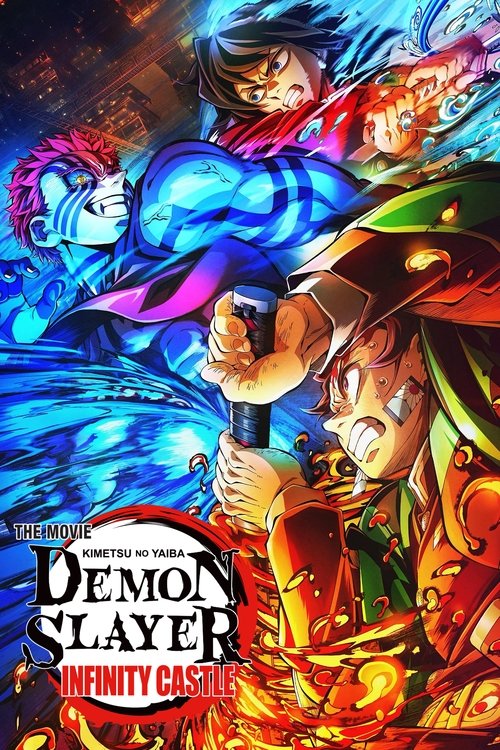
Demon Slayer: Kimetsu no Yaiba Infinity Castle
2025 · Haruo Sotozaki
For when you want pure spectacle that earns its emotions — a maximum-intensity anime event best watched loud and large. Newcomers should start earlier in the series; for the initiated, this is the payoff night.
What it's about
The endgame begins: the entire Demon Slayer Corps is pulled into the Infinity Castle, the shifting, gravity-defying labyrinth of the demon king Muzan Kibutsuji. Tanjiro, his sister Nezuko, and the elite Hashira are scattered through its endless halls and thrown into desperate duels against the Upper Rank demons — the strongest enemies they've ever faced — with no way out but through. It's the first chapter of the war that everything in the series has been building toward.
The experience
Relentless and rapturous — extended, all-out battles rendered with an animation intensity that borders on overwhelming, punctuated by the series' signature gut-punch flashbacks that make you mourn the monsters you just watched fight. It runs hot for its entire length; expect exhilaration and a lump in your throat, often in the same scene.
The craft
Studio ufotable's animation is the event here: the castle itself is a constantly reconfiguring space that lets the fight choreography move in impossible directions, and the fusion of hand-drawn character work with digital camera moves and painted light is the studio at the peak of its craft. This is emphatically a big-screen, big-speakers film — the scale and sound design are half the experience.
Why it matters
The opening act of the franchise's final arc and heir to Mugen Train — the film that rewrote box-office history for anime worldwide — it cemented the theatrical anime event as a global phenomenon rather than a Japanese one.
Snapshot
Demon Slayer: Kimetsu no Yaiba Infinity Castle is the first installment of a planned three-film cycle adapting the concluding "Infinity Castle" arc of Koyoharu Gotouge's manga Kimetsu no Yaiba (2016–2020). Produced by the studio ufotable and directed by Haruo Sotozaki — who has overseen the franchise's animated incarnation since the 2019 television series and the record-setting 2020 feature Mugen Train — the film abandons the road-and-mission structure of earlier chapters for a single, vertiginous location: the shifting labyrinth of the demon king Muzan Kibutsuji, into which the entire Demon Slayer Corps is plunged for the war's final movement. Where Mugen Train was a self-contained episode grafted between television seasons, Infinity Castle is explicitly the opening act of an endgame, a structural choice closer to the split-finale strategy of contemporary blockbuster franchises than to the traditional standalone anime film. It represents the culmination of ufotable's long investment in a compositing-heavy house style, and arrives as one of the most commercially significant theatrical anime releases of the decade, though specific grosses should be checked against current reporting rather than asserted here.
Industry & production
The film is the product of a distinctive production ecology. ufotable, founded in 2000, is unusual among anime studios for keeping a large share of digital compositing, photography, and 3DCG work in-house rather than distributing it across subcontractors, which gives its projects an unusually unified finish. Demon Slayer transformed the studio's commercial profile: the 2019 series and Mugen Train elevated ufotable from a respected mid-tier house — known previously for the Fate franchise adaptations and Tales of game cinematics — into a marquee brand. The franchise sits inside the Japanese "production committee" model, in which publisher (Shueisha), broadcaster, distributor (Aniplex, a Sony subsidiary), and studio share financing and rights; Aniplex's involvement ties the property into Sony's broader global distribution and music apparatus.
The decision to adapt the finale as a theatrical trilogy rather than a television season is itself an industrial statement, betting that the audience assembled by Mugen Train — which demonstrated that a single anime film could dominate a national box office — would return to cinemas repeatedly. This reverses the older norm in which anime films were ancillary to a TV run. Precise budget figures are not part of the reliably documented public record and are not asserted here.
Technology
Infinity Castle is a showcase for ufotable's signature pipeline, which fuses hand-drawn character animation with 3D-modeled environments and heavy digital compositing (the process the industry calls satsuei, or "photography," now largely a digital-effects stage). The Infinity Castle setting is exceptionally suited to this toolkit: an Escher-like non-Euclidean interior of sliding tatami platforms, endless staircases, and reorienting gravity, it is the kind of space that would be prohibitively laborious to stage in pure 2D but that a 3D environment allows the virtual camera to traverse freely. The studio's established method — building sequences in a 3D layout, then integrating 2D characters through layered lighting, particle effects, and color grading — lets the film move its viewpoint through the castle in long, plunging arcs.
The other technological hallmark is the compositing of the Breathing Style combat effects: the stylized water, flame, wind, and lightning motifs that visualize each swordsman's technique are rendered as glowing, semi-abstract overlays fused to the animated figure work. These effects, developed across the TV series, reach an elaborated scale here. As with all such claims, the finer details of the specific software chain are best confirmed against production interviews rather than assumed.
Technique
Cinematography
In animation, "cinematography" describes the designed behavior of a virtual camera and the lighting and lensing of the image. Infinity Castle's defining visual gesture is verticality and disorientation: the camera drops, spirals, and inverts through the castle's impossible architecture, using the freedom of a 3D-composited environment to sustain shots that would be impossible to draw as continuous 2D moves. Depth is emphasized through layered planes and atmospheric haze, and the film leans on strong chiaroscuro — pools of lantern light against deep shadow — consistent with ufotable's practice of treating light as a primary compositing element rather than a flat cel wash.
Editing
The film's cutting is organized around the arc structure of successive duels. Rather than a continuous forward journey, the narrative fragments the Corps across the castle so that the picture can intercut between parallel confrontations, building rhythm by alternating between combat and the flashback interludes that supply each fighter's backstory. This alternation of present-tense violence and past-tense revelation is a structural inheritance from the source manga's serialized pacing, and the editing's task is to hold tension across simultaneous fronts. Precise cutting patterns are a matter for close viewing rather than external documentation.
Mise-en-scène / staging
The castle itself is the dominant mise-en-scène element: a psychological as much as physical space, its perpetual reconfiguration externalizes the sense of a trap closing. Staging exploits the vertical axis — combatants fall, ascend, and fight across reorienting surfaces — and the production design draws on Taishō-era (1912–1926) Japanese visual culture, the period setting of the whole franchise, blending traditional wooden interiors with the surreal geometry of the demon's domain. Character silhouette and color coding (each Hashira's distinctive uniform and weapon) do heavy expository work in crowded compositions.
Sound
The score is credited to Go Shiina and Yuki Kajiura, the composing team associated with the franchise since the series; their idiom mixes orchestral scale, choral textures, and occasional electronic and taiko percussion, and it functions to lift the combat set-pieces into operatic register. Sound design foregrounds the physical impact of sword-clash and the tonal signatures of demonic power. The Japanese voice cast — including Natsuki Hanae as Tanjiro — carries over from the series, preserving vocal continuity across the franchise. Details of the international dub and any franchise theme song should be verified against release records.
Performance
"Performance" in this context is the layered achievement of animators and voice actors. The animation gives its demon antagonists — the Upper Rank demons of Muzan's inner circle — expressive, often grotesque physicality, while the human swordsmen are individuated through fighting styles rendered as choreography. Vocally, the cast is asked to sustain extended emotional registers: the flashback structure repeatedly pivots characters from combat fury to grief and tenderness, and the film's affective power depends on that modulation landing.
Narrative & dramatic mode
The dramatic mode is that of the sustained climactic battle — a form the shōnen action tradition has refined into its own genre of storytelling, in which a large ensemble is distributed across simultaneous duels, each duel functioning as a self-contained emotional short story. Infinity Castle is essentially a war film compressed into a single haunted structure. Its narrative engine is the flashback: combat repeatedly pauses to excavate the history and motivation of both slayer and demon, a device that grants antagonists tragic interiority and reframes each kill as an act of mourning. This dual-perspective sympathy — the recurring revelation that demons were once wronged humans — is the franchise's central dramatic signature, and it distinguishes Demon Slayer from purely triumphalist action. Because the film is a first act, it also operates under the constraint of the non-resolving finale: it must deliver climactic payoffs while withholding ultimate closure, ending mid-war.
Genre & cycle
The film belongs simultaneously to several overlapping categories: theatrical anime, action-fantasy, and the shōnen battle genre codified by decades of serialized manga in Weekly Shōnen Jump, the magazine that published Kimetsu no Yaiba. Its lineage runs through the long tradition of Jump combat epics — Dragon Ball, Naruto, Bleach, Demon Slayer's contemporaries — in which escalating power tiers, named signature techniques, and tournament-or-war structures organize the drama. Within the anime-film cycle specifically, Infinity Castle extends the model Mugen Train proved viable: the high-budget theatrical continuation of a television property, positioned as an event rather than a supplement. It also participates in a broader 2020s trend of releasing franchise finales as multi-part theatrical experiences.
Authorship & method
Authorship here is genuinely distributed. The originating author is Koyoharu Gotouge, whose manga supplies plot, character, and the thematic architecture of empathy-for-the-monster; the studio's adaptations have been notably faithful to that source. The animated work's guiding hand is director Haruo Sotozaki, who has shaped the franchise's screen identity across series and film, and whose method emphasizes the integration of ufotable's compositing craft with emotionally legible character work. The house style is inseparable from ufotable's founder-led culture and its character-designer/chief animation director lineage carried over from the series. On the sound side, composers Go Shiina and Yuki Kajiura are the key authorial collaborators, their score a defining texture of the franchise. The screenplay adaptation is credited to ufotable's writing staff working from Gotouge's manga. Where individual craft credits (editor, specific art directors) matter for scholarly precision, they should be drawn from the film's official credits rather than paraphrased from memory.
Movement / national cinema
Infinity Castle is a work of Japanese commercial animation at the center of the medium's global ascendancy in the 2020s. It belongs not to an art-cinema movement but to the mainstream industrial tradition of anime as Japan's most successful cultural export, and it sits within a specific lineage of the theatrical anime blockbuster that runs from Studio Ghibli's prestige features through the crossover successes of Makoto Shinkai (Your Name, 2016) to the Demon Slayer phenomenon. Its national-cinematic significance is partly economic: Mugen Train's dominance of the Japanese box office marked a moment when domestic animation, rather than imported Hollywood tentpoles, defined the theatrical event. Infinity Castle consolidates that shift.
Era / period
Two "periods" bear on the film. Its diegetic setting is Japan's Taishō era (1912–1926), a moment of rapid modernization on which the franchise's aesthetic — a mingling of traditional dress, folklore, and early-modern industry — depends. Its production era is the early-to-mid 2020s, a period defined for anime by post-pandemic theatrical recovery, streaming-driven global audience expansion, and the maturation of hybrid 2D/3D digital production. The film's very existence as a theatrical-trilogy finale is a product of this second period's economics.
Themes
The film's governing themes descend directly from the manga: the porousness of the line between human and monster; grief as the engine of both heroism and villainy; and the ethic of compassion extended even to those one must kill. The demons of the Infinity Castle are, characteristically, revealed to have been shaped by human suffering, so that combat becomes an argument about the origins of evil in trauma and despair. Set against this is the theme of familial and fraternal bond — the Corps as a chosen family, and Tanjiro's protective devotion to his demon-turned sister Nezuko as the emotional spine. The claustrophobic, gravity-defying castle literalizes a further theme: entrapment within a system of cyclical violence from which escape requires collective sacrifice.
Reception, canon & influence
Critical and popular reception of the Demon Slayer films has generally praised ufotable's technical execution — particularly the fluidity and spectacle of its action animation — while the more familiar critical reservation about shōnen adaptation concerns pacing and the exposition-heavy flashback structure. As the franchise's finale-opener, Infinity Castle was received as a major event of its release year; specific critical scores and precise box-office figures should be confirmed against current reporting rather than stated here.
Influences on the film (backward): the work draws on the deep well of Japanese yōkai folklore and the visual traditions of the ghost and demon tale; on the Weekly Shōnen Jump battle-manga lineage that codified its narrative grammar; and on ufotable's own prior craft, especially the compositing and action language developed across its Fate adaptations and the Demon Slayer series. The Escher-esque impossible architecture of the castle also resonates with a broader tradition of labyrinth and dream-space imagery in fantasy visual culture.
Legacy / what it shaped (forward): the more consequential influence flows through the industry. Mugen Train had already demonstrated that a theatrical anime could dominate a national market, reshaping how studios and committees weigh cinema against television; Infinity Castle extends that lesson to the multi-part finale, a template likely to be emulated by other franchises seeking event-scale theatrical returns. Its high-visibility deployment of hybrid 2D/3D compositing further cements ufotable's house style as an aspirational benchmark within the medium. The full measure of its influence, appropriately for a film this recent, remains to be written.
A Deleuzian reading
A tatami mat slides open and a swordsman falls.
The full Deleuzian reading of Demon Slayer: Kimetsu no Yaiba Infinity Castle →
Reception
No reappraisal needed yet — it arrived in summer 2025 as a full-blown event, smashing Mugen Train's records in Japan and quickly being talked about as the moment anime stopped being a niche at the global box office and became the main event.
How Demon Slayer: Kimetsu no Yaiba Infinity Castle was received, from release to now →
How to watch Demon Slayer: Kimetsu no Yaiba Infinity Castle: what to notice on a first viewing
- Watch where the camera goes when a body falls. It falls too. The virtual camera drops, spirals, and inverts through the castle in long unbroken plunges, and it almost never hangs above looking down at the drop. You lose track of which direction the film considers down, which is the sensation this whole place is built to produce.
- Watch the floors slide open and the staircases end in more staircases. The Infinity Castle rearranges itself continuously. Tatami platforms slide apart, gravity reorients between cuts, and a room appears where a wall stood a second ago. Nothing past the edge of the frame can be located, because it may not have been dealt out yet.
- Watch the pools of lantern light against the deep shadow. ufotable treats light as a compositing element rather than a flat cel wash, so the illumination has weight and the darkness around it has depth. The picture is built out of light and dark contending, which is where the castle gets its non-human feel.
- Watch how each swordsman's technique gets its own color and shape. Water, flame, wind, and lightning are composited as glowing semi-abstract overlays fused to the bodies. Each Hashira is separated out by uniform, weapon, and the look of the attack. Color carries the feeling when the choreography outruns your eye, and it tells you who is fighting in a crowded frame.
- Listen for the choir and the taiko entering under a duel. Shiina and Kajiura mix orchestra, choral texture, and percussion to lift the fights into an operatic register, while the sound design keeps every sword impact physical. The music tells you when a duel has stopped being a fight and turned into a scene about somebody's life.
Influences: the films it descends from and the films it influenced
- The Garden of Sinners (Kara no Kyoukai) (2007) — ufotable's founding project where its digital compositing pipeline and Yuki Kajiura scoring partnership were forged — the chiaroscuro-drenched supernatural urban combat here is the studio DNA Infinity Castle inherits wholesale.
- Fate/stay night: Heaven's Feel III. spring song (2020) — Directly codified ufotable's hybrid 2D-character-on-3D-environment compositing and its sweeping virtual camera swoops through digitally-built space, the exact action language Infinity Castle deploys at scale.
- Demon Slayer: Mugen Train (2020) — The immediate template: proved a theatrical shōnen adaptation could dominate a national box office, and established the film-grade compositing plus emotionally-legible flashback-interlude structure Infinity Castle extends into a multi-part finale.
- Inception (2010) — Weaponized non-Euclidean folding architecture as a literal combat arena, the same conceit as the Infinity Castle's Escher-esque shifting rooms staged as fight space rather than mere set dressing.
- Paprika (2006) — Pioneered morphing dream-space labyrinths where architecture reconfigures between cuts, the impossible-space editing grammar the castle's sliding tatami-and-staircase geometry directly descends from.
- Ninja Scroll (1993) — Established the adult chiaroscuro demon-combat idiom of anime — grotesque yōkai antagonists dispatched in high-contrast shadow — the tonal and lighting register Infinity Castle's duels operate in.
- Akira (1988) — Set the benchmark for high-frame-count fluid hand-drawn kinesis and physically-detailed destruction, the animated-choreography standard ufotable's action is measured against.
- Kwaidan (1964) — Codified the theatrical, painterly Japanese ghost-tale aesthetic — stylized painted skies, folkloric yōkai staged as tableau — the visual tradition feeding the film's Taishō supernatural imagery.
- Dragon Ball Z (1989) — Codified the Weekly Shōnen Jump battle grammar of intercut parallel duels punctuated by mid-fight flashback interludes and escalating power tiers — the narrative editing skeleton Infinity Castle runs on.
- One Piece Film: Red (2022) — Applied the post-Mugen Train playbook — a franchise deploying an event-scale theatrical entry timed to production-committee box-office logic — that Infinity Castle's finale-as-trilogy strategy generalizes.
- Chainsaw Man – The Movie: Reze Arc (2024) — Extends the multi-part theatrical shōnen-finale template Infinity Castle exemplifies, splitting a manga arc into event-cinema installments with film-grade demon/devil combat compositing.
- Haikyu!! The Dumpster Battle (2024) — Adopts the same finale-fragmentation model — converting a serialized climax into standalone theatrical events with heightened virtual-camera choreography — that the Infinity Castle trilogy makes standard practice.
- Jujutsu Kaisen 0 (2021) — MAPPA's parallel bet on Mugen Train's market lesson: a theatrical shōnen battle film built on dark curse/demon combat and dynamic virtual-camera set-pieces, competing in the same event-anime lane.
- The First Slam Dunk (2022) — Advanced the 2D-line-over-3D-model hybrid pipeline with a roaming virtual camera for a theatrical release, the same compositing frontier ufotable pushes in the castle sequences.
- Spider-Man: Into the Spider-Verse (2018) — Married hand-drawn 2D expressivity to 3D-composited space with a deliberately non-photoreal, comic-derived camera — the cross-medium compositing conversation Infinity Castle's manga-fidelity-plus-3D approach belongs to.
- Promare (2019) — Integrated CG environments with a vertiginous, unshackled virtual camera hurtling through stylized action space, a direct peer to the castle's plunging camera moves through composited geometry.
Similar films
- Jujutsu Kaisen 0 (2021) — influence & lineage
- HAIKYU!! The Dumpster Battle (2024) — influence & lineage
- The First Slam Dunk (2022) — influence & lineage
- Akira (1988) — influence & lineage
- Chainsaw Man - The Movie: Reze Arc (2025) — same viewing thread
- Ne Zha 2 (2025) — same viewing thread
- KPop Demon Hunters (2025) — same viewing thread
- Kizumonogatari Part 3: Reiketsu (2017) — shared sensibility
All the films related to Demon Slayer: Kimetsu no Yaiba Infinity Castle →
Watch it with: curated runs of related films
- Sympathy for the Demon — A run of the 2025 animation wave where the line between demon-hunter and demon keeps blurring — outcast heroes carrying monstrous power, and monsters worth rooting for.