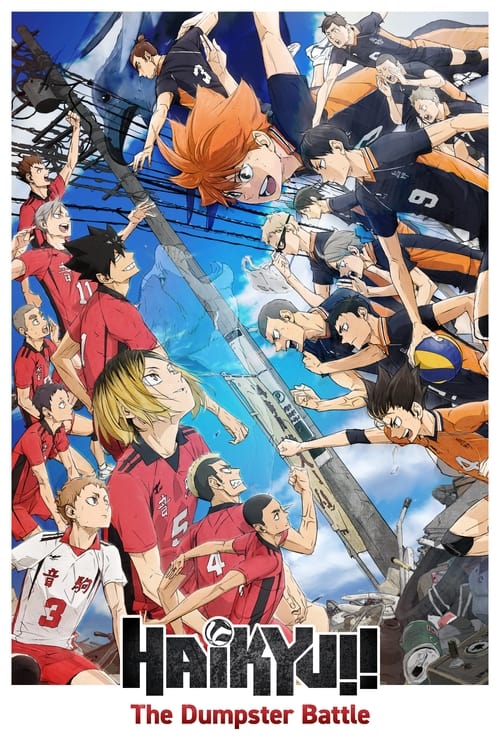
HAIKYU!! The Dumpster Battle
2024 · Susumu Mitsunaka
For when you want pure adrenaline and to stand up cheering at something wholesome — a sports-movie high with zero cynicism. Comfort viewing that still makes your heart pound.
What it's about
Karasuno High's volleyball team finally gets the match it has been chasing for years: a national-tournament showdown with Nekoma, the rival school so intertwined with their own that their games are nicknamed the battle of the garbage dump. At the center are Shoyo Hinata, a short, tireless spiker with impossible jumps, and Tobio Kageyama, the prickly setter who was once his middle-school nemesis — now the two halves of Karasuno's strangest weapon. Standing across the net is Kenma, Nekoma's quiet strategist and Hinata's closest friend outside his own team, which makes every rally personal.
The experience
It plays like a thriller that happens to be a volleyball match — nearly real time, whip-fast rallies, then sudden drops into silence inside a player's head as they read the ball. Even if you've never watched the series, the momentum grabs you; if you have, it's two hours of held breath and payoff.
The craft
Production I.G animates the game with camerawork you'd expect from live-action action cinema: unbroken rally sequences, whip-pans chasing the ball, sound design that cuts to a single heartbeat at the moment of a block. It compresses a rivalry built over four TV seasons into one continuous contest, and it absolutely rewards a big screen and loud speakers — this was made to be an event.
Why it matters
The theatrical capstone of one of the defining sports anime of its generation, and proof that a single match can carry a feature film — part of the wave that made anime films genuine box-office events worldwide.
The theatrical culmination of Haikyu!!, the volleyball series that became one of the defining sports anime of its generation — and a case study in how Japanese animation now treats a single match as an event worthy of a feature. Production I.G, the studio whose sports pedigree runs back decades, compresses the long-promised showdown between scrappy Karasuno and their eternal rivals Nekoma — the 'dumpster battle' of crows versus cats, teased across four television seasons — into one nearly real-time contest. Director Susumu Mitsunaka shoots volleyball like a thriller: whip-pans tracking the ball, rally sequences held without cuts until lungs give out, sudden drops into a player's subjective silence at the moment of a read or a block. What elevates it beyond fan service is its argument — voiced through Kenma, the reluctant genius setter — that games matter because of what they cost the people who refuse to stop playing them. It became one of Japan's biggest box-office hits of 2024, proof that a mid-match line call can land like a plot twist.
Reception
Fans spent a decade waiting for the Karasuno–Nekoma showdown, and when it finally arrived as a movie it was greeted less like a film release than a payoff — it stormed the Japanese box office in early 2024 and became the franchise's biggest earner. The lingering grumble that the finale should have been a TV season, not films, softened once people actually saw it.
How HAIKYU!! The Dumpster Battle was received, from release to now →
Influences: the films it descends from and the films it influenced
- Ping Pong the Animation (2014) — Dramatizes each rally as a psychological duel through split-screen, warped POV and distorted paneling, and anchors it on a reluctant-prodigy player — the animation-craft ancestor of Haikyu's rally-as-thriller framing and its Kenma archetype.
- Ghost in the Shell (1995) — Establishes Production I.G's house method of grounding fantastical motion in rigorously plotted multiplane layouts and architectural space, the studio discipline Haikyu inherits for its court geography.
- Redline (2009) — Hand-drawn hyperkinetic racing that turns whip-pans and full-frame speed smears into pure velocity — the direct debt for Haikyu's whip-pan camera during spikes and serves.
- Akira (1988) — Sets the benchmark for high-detail full-animation motion (light trails, precise weight and follow-through) that Japanese kinetic action, including Haikyu's fluid ball-tracking, still measures against.
- Raging Bull (1980) — Pioneers subjective in-ring sound (muffled crowd, isolated breath, flashbulb pops) and elastic time within a bout — the ancestor of Haikyu's subjective-silence at match peaks.
- The Set-Up (1949) — Unfolds a single boxing night in strict real time toward one fight, the foundational real-time single-bout structure Haikyu adopts for one continuous match.
- Rocky (1976) — Structures an entire feature toward one climactic bout as event, with the underdog-versus-champion staging Haikyu restages as crows-vs-cats.
- High Noon (1952) — Tightens a near-real-time clock toward a single confrontation, the ancestor of Haikyu's real-time-structure fused with thriller-framing suspense.
- Jujutsu Kaisen 0 (2021) — A franchise prequel packaged as a standalone box-office event feature with fluid combat staging — sibling in the anime event-cinema pipeline Haikyu's Dumpster Battle belongs to.
- Demon Slayer: Kimetsu no Yaiba Infinity Castle (2025) — Adopts the same finale-fragmentation model — converting a serialized climax into standalone theatrical events with heightened virtual-camera choreography — that the Infinity Castle trilogy makes standard practice.
- The First Slam Dunk (2022) — Renders a single basketball game as a near-real-time feature with rotoscope-informed CG bodies and drops the crowd to subjective silence at the decisive shot — the exact single-match + subjective-silence template Haikyu extends to volleyball.
- Whiplash (2014) — Cuts to the tempo of performance to turn a rehearsal room into a thriller arena, fusing real-time structure, subjective sound and the cost-of-competition — the live-action mirror of Haikyu's editing rhythm.
- Children of Men (2006) — Sustains unbroken long-takes that hold spatial geography through chaos, the craft kin to Haikyu's long-take rally that refuses to cut through an exchange.
- Demon Slayer: Mugen Train (2020) — The model of a TV-franchise arc released as a theatrical event film with composited virtual-camera moves, sharing Haikyu's franchise-adaptation-as-event-cinema strategy.
- Kuroko's Basketball: Last Game (2017) — A Production I.G stablemate sports title using the same speed-line, reaction-cut and match-clock grammar Haikyu deploys, from the same studio lineage.
- Free! Road to the World – the Dream (2019) — A sports-anime feature built on fluid full-body-in-motion animation and event-film release, extending the same theatrical sports-anime craft Haikyu practices.
Similar films
- The First Slam Dunk (2022) — influence & lineage
- Jujutsu Kaisen 0 (2021) — influence & lineage
- Demon Slayer: Kimetsu no Yaiba Infinity Castle (2025) — shared sensibility
- 100 METERS (2025) — shared sensibility
- Kaguya-sama: Love Is War -The First Kiss That Never Ends- (2022) — shared sensibility
- Look Back (2024) — shared sensibility
- Your Name. (2016) — shared sensibility
- Godzilla Minus One (2023) — shared sensibility