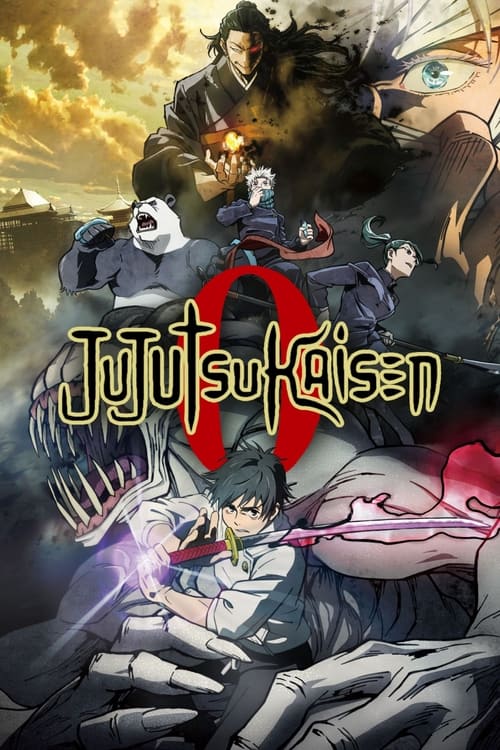
Jujutsu Kaisen 0
2021 · Sunghoo Park
When you want a big-screen anime rush — spectacular fights and a story that earns its tears in under two hours. Works as a standalone gateway even if you've never seen the series it's attached to.
What it's about
Yuta Okkotsu is a withdrawn high schooler haunted in the most literal way: his childhood friend Rika died in front of him and now clings to him as a monstrously powerful curse, mangling anyone who threatens him. Recruited by the irreverent, blindfolded teacher Satoru Gojo into a hidden school for exorcists, Yuta has to learn to control the spirit bound to him — while a charismatic extremist plots a purge that will put the whole school in the crosshairs.
The experience
It runs on the classic shounen engine — training, found family, escalating duels — but with a raw grief at its center that gives the monster fights real emotional stakes. Fast, kinetic, frequently funny, and willing to get genuinely dark and tender by the end.
Performances
Megumi Ogata voices Yuta with a fragile, wounded quality that makes his growth from trembling victim to someone worth rooting for feel earned.
The craft
Studio MAPPA's animation is the draw: fluid, inventively choreographed curse battles where the camera seems to tumble through the action, punctuated by grotesque creature design and sudden bursts of stillness. It rewards a big screen and good sound — the climactic confrontations are staged like concert setpieces.
Why it matters
A massive box-office event in Japan that confirmed theatrical anime as blockbuster business, and the origin story that anchors one of the defining action-anime franchises of its era.
Snapshot
Jujutsu Kaisen 0 is a theatrical anime feature produced by Studio MAPPA and adapted from Gege Akutami's short prequel manga, originally serialized as Tokyo Metropolitan Curse Technical School before being retitled to align with the Jujutsu Kaisen franchise it would ultimately seed. Directed by Sunghoo Park, who had helmed MAPPA's breakout 2020 television adaptation of the parent series, the film functions simultaneously as an origin story internal to its fictional world and as a franchise-consolidating event within the contemporary anime economy. Its protagonist, Yuta Okkotsu, is a traumatized adolescent bound to the vengeful cursed spirit of his dead childhood friend Rika; the narrative tracks his enrollment at Jujutsu High and his collision with the ideological extremist Suguru Geto. Released in Japan in December 2021, the film arrived as anime's theatrical market was being redrawn by the record-shattering success of Demon Slayer: Mugen Train (2020), and it stands as one of the most conspicuous beneficiaries — and drivers — of that moment. It is, in short, a case study in how a modern manga franchise converts television momentum into cinematic scale.
Industry & production
The film is a product of the "production committee" model that governs almost all commercial Japanese animation: financing, licensing, and distribution risk are spread across a consortium typically including the manga's publisher (Shueisha), the broadcaster, the animation studio, music and home-video interests, and distributors. Jujutsu Kaisen 0 was animated by MAPPA, the studio that had, by 2021, become one of the most closely watched — and, in fan discourse, most scrutinized for labor conditions — houses in the industry, owing to its simultaneous slate of high-profile projects. The precise contractual composition of the committee is a matter of corporate record rather than critical analysis, and I will not reconstruct figures I cannot verify.
Commercially, the film was a major success. It opened strongly in Japan during the lucrative year-end window and went on to a substantial domestic run, and its subsequent international release — handled outside Japan by Crunchyroll in partnership with regional distributors — extended its reach into North American and other markets where it also performed well above the historical baseline for anime features. It is frequently cited among the higher-grossing anime films of its era. I am deliberately avoiding specific box-office totals here, because exact figures vary by source and reporting window and I cannot confirm a single authoritative number; the defensible claim is that the film was a significant global commercial event, not a niche release.
Technology
Jujutsu Kaisen 0 was made with the now-standard hybrid digital pipeline of contemporary television-derived anime: hand-drawn 2D character animation composited digitally, supported by 3D CG for select mechanical elements, crowds, and complex spatial constructs, and finished through digital compositing, color, and effects work. The film's most technologically legible signature is its treatment of "cursed energy" — the franchise's magic system — as a compositing and effects problem. Smoke-like curse manifestations, domain-expansion set pieces, and the amorphous body of Rika are rendered through layered digital effects animation that blends drawn linework with particle and glow passes. This is characteristic of MAPPA's house look in the period: a heavy reliance on effects animation and dynamic "camera" moves that would be impossible in cel-era production, enabled by digital multiplaning and virtual camera manipulation. The theatrical context also licensed a higher shot-count of labor-intensive full animation than a television budget permits, and the difference is visible in the density of movement during action sequences.
Technique
Cinematography
Because this is animation, "cinematography" denotes the constructed virtual camera — layout, framing, lens simulation, and movement decisions authored in storyboard and layout rather than captured optically. The film favors an aggressive, kinetic camera during combat, with swooping virtual crane and tracking moves that circle characters mid-strike and rack between foreground and background planes to emphasize depth. This restlessness is contrasted against the quieter registers of Yuta's interiority, where the framing tightens into held close-ups and more static compositions. The action grammar descends recognizably from the television series' visual language, itself indebted to a lineage of effects-forward action animation; the theatrical budget simply raises the ceiling on how sustained and elaborate those moving-camera sequences can be.
Editing
The editing organizes the film around a compact prologue-to-climax structure, alternating expository school-life material with escalating action. Action cutting is fast and impact-driven, using smear frames, speed lines, and brief holds on moments of impact — the anime idiom for conveying force — rather than the continuity coverage of live-action. The film's rhythm accelerates markedly in its final act, a Geto-versus-Yuta confrontation that the edit builds toward as a single sustained crescendo. Transitions frequently exploit the animated frame's freedom to match on graphic elements — curse energy, motion vectors — rather than on strict spatial continuity.
Mise-en-scène / staging
Two contrasting design worlds structure the film: the ordered, institutional space of Jujutsu High, and the eruptive, formless space of curses. Rika, the "special grade" cursed spirit tethered to Yuta, is the film's central staging problem and achievement — a vast, toothy, protean presence whose scale and instability visually externalize Yuta's guilt and unresolved grief. The climactic set piece, staged around a mass "curse" incident, allows the film to open into large-scale spatial spectacle. Character staging leans on the established franchise cast — Gojo as the untouchable, blindfolded mentor; the Jujutsu High students as an ensemble — using their familiar silhouettes and blocking to orient viewers already fluent in the series.
Sound
Sound design foregrounds the tactile physicality of curse combat — low, enveloping tones for curse manifestations against sharp, percussive impacts — and uses silence and ambient restraint to mark Yuta's isolation. The score, composed by Hiroaki Tsutsumi (a member of the franchise's television music team), carries the emotional register between action and grief. The film's end-credits song was provided by King Gnu, the band strongly associated with the franchise's musical identity, extending a branding continuity between series and film. As with most Japanese anime, the performances were recorded as a Japanese-language original, with an English dub produced subsequently for international release.
Performance
Vocal performance is the film's acting medium. Megumi Ogata voices Yuta, bringing a fragile, wavering timidity that hardens over the film's arc — a casting choice legible against Ogata's long history of voicing sensitive, traumatized adolescent boys. Kana Hanazawa voices Rika. The returning franchise cast — including Yuichi Nakamura as Gojo — anchors the film in the television series' established sonic world, while Takahiro Sakurai's Geto supplies the antagonist's soft-spoken menace. The performances are calibrated to swing between naturalistic understatement in the school scenes and heightened, operatic intensity in combat, the standard dynamic range of shōnen action voice acting.
Narrative & dramatic mode
The film operates in the shōnen action-melodrama mode: a coming-of-age structure in which a diffident protagonist is inducted into a hidden world, acquires a found family, and confronts an antagonist who is a dark mirror of himself. Its dramatic engine is grief converted into power — Yuta's inability to release Rika is both his curse and, ultimately, his strength. The screenplay by Hiroshi Seko compresses Akutami's brief source manga into a feature with a clean three-act shape, front-loading world-building for newcomers while trusting series fans to supply franchise context. Thematically the film is more melancholic than the parent series' ensemble adventure register; it is, at its core, a chamber melodrama about love, loss, and the difference between possession and connection, wrapped in large-scale action spectacle.
Genre & cycle
Jujutsu Kaisen 0 sits at the intersection of several genres and cycles: the supernatural/"dark fantasy" action anime, the shōnen battle narrative, and the studio-driven theatrical franchise film. It belongs squarely to the post-2020 wave of anime features that leveraged blockbuster television adaptations into theatrical events — the cycle catalyzed commercially by Demon Slayer: Mugen Train, which demonstrated that a franchise film could function as a mainstream box-office phenomenon rather than a fan-only release. Within the horror-adjacent "curse" subgenre of shōnen, Jujutsu Kaisen draws on a long tradition of Japanese folklore-inflected supernatural action; the film is a prequel entry, a specific franchise form that supplies origin material for characters and stakes elaborated in the ongoing series.
Authorship & method
Authorship in commercial anime is irreducibly collective, and this film is best read as the convergence of several authorial hands atop Gege Akutami's original manga. Sunghoo Park, the director, is a Korean-born animator and director who rose through the Japanese industry and whose direction on the Jujutsu Kaisen television series established the franchise's kinetic action identity; the film consolidates that style at theatrical scale, and it stands as a capstone to his central association with the property before his later departure to found other work. Hiroshi Seko provided the screenplay, adapting the source with the compression a single film demands. Tadashi Hiramatsu served as character designer for the franchise adaptation, translating Akutami's manga art into the animation model sheets that govern on-screen appearance. Hiroaki Tsutsumi contributed to the score within the franchise's established musical team. The "cinematographer" role in anime corresponds to the director of photography/compositing lead who supervises the digital photography and effects finishing; that craft is here executed to the franchise's polished house standard. As with most studio anime, individual editing and layout credits are distributed across a large staff rather than concentrated in a single auteur, and I will not assign specific attributions I cannot verify.
Movement / national cinema
The film is a work of Japanese commercial animation, an industry that constitutes one of the most globally influential national cinemas of the twenty-first century. It belongs not to an art-cinema "movement" but to the mainstream anime industry's contemporary institutional form: manga-to-television-to-film franchise pipelines, production-committee financing, and studio brands as marketing entities. MAPPA's rise is itself part of the story — the studio became, in this period, a marquee name whose involvement signaled a certain scale and visual ambition. The film also exemplifies the increasingly transnational character of that national cinema: a Korean-born director, global simultaneous-release strategies, and an international distribution apparatus (Crunchyroll) that treats anime as a worldwide theatrical category rather than a regional export.
Era / period
Jujutsu Kaisen 0 is a document of the early-2020s inflection point in anime's global commercial history. It was produced and released amid the ongoing disruptions of the COVID-19 period, when theatrical windows were volatile but anime — buoyed by streaming-fueled international fandom — proved unexpectedly resilient at the box office. It arrives after Mugen Train reset expectations for what an anime film could earn, and it reflects the period's intensified industrialization of animation production, including the well-documented public conversation about workload and labor at high-output studios. In franchise terms it is a "0" entry: a prequel timed to capitalize on the television series' first-season popularity and to bridge audiences toward subsequent seasons.
Themes
The film's governing theme is grief and the ethics of attachment. Yuta's bond with Rika literalizes the way unresolved loss can become a haunting — a love that, uncontained, turns monstrous and possessive. The narrative's resolution reframes that bond as a matter of will and release rather than mere power. Running alongside is the franchise's recurring meditation on curses as the residue of human negativity: fear, resentment, and cruelty made manifest. Geto's arc supplies the film's ideological argument — a purity-driven extremism that would cull the non-sorcerer population, positioning him as the dark counter-thesis to the school's more humane, if flawed, institutional order. The film thus stages a familiar shōnen dialectic: personal, intimate grief on one axis and a larger question of who deserves protection and power on the other. Belonging and found family — Yuta's induction into a community that accepts his monstrousness — provide the emotional counterweight to isolation.
Reception, canon & influence
Critically, Jujutsu Kaisen 0 was received as an accomplished, visually spectacular franchise film — praised especially for the fluidity and intensity of its action animation and for the emotional legibility of Yuta's arc — while some critics noted the structural limits of a prequel that must serve both newcomers and existing fans. General consensus positioned it as a strong theatrical extension of the television series rather than a radical departure. I am characterizing the critical reception in broad terms rather than quoting specific reviews, which I cannot reproduce verbatim without risk of error.
Looking backward, the film's influences are legible: Akutami's manga as direct source; the broader lineage of supernatural/curse-driven shōnen and Japanese folk-horror motifs; and the effects-forward action-animation tradition that shapes MAPPA's style. Its commercial strategy is unmistakably indebted to the Mugen Train precedent, which proved the viability of the television-to-blockbuster-film model.
Looking forward, the film's most significant legacy is as a franchise and market event rather than a formal innovation. It reinforced the early-2020s template in which anime films function as global theatrical tentpoles, contributed to Jujutsu Kaisen's consolidation as a leading contemporary franchise, and demonstrated the international box-office ceiling for a prequel feature marketed to a streaming-native fanbase. Within the franchise's own continuity it establishes Yuta as a canonical figure whose significance is developed further in the ongoing series. Its durable influence, then, is industrial and canonical: it is a benchmark for how a modern manga property converts serialized momentum into a worldwide cinematic release.
A Deleuzian reading
A boy stands almost perfectly still.
The full Deleuzian reading of Jujutsu Kaisen 0 →
Reception
A pandemic-era box-office monster in Japan (Crunchyroll's first big theatrical push in the West), it was received as proof that Jujutsu Kaisen was the heir to Demon Slayer's crown — and it's since been recontextualised as director Sunghoo Park's farewell to the franchise, since he left MAPPA and didn't return for Season 2.
How Jujutsu Kaisen 0 was received, from release to now →
How to watch Jujutsu Kaisen 0: what to notice on a first viewing
- Watch the camera swoop in fights, then stop for Yuta. During combat the virtual camera circles and cranes around each strike, but in Yuta's own scenes it holds still on a static close-up instead. The stillness during his scenes makes Yuta read as the pivot of the story, not its main actor.
- Compare the school's straight lines to a curse's shapeless mass. Jujutsu High is built from uniforms, corridors, and classrooms with clear rules, while curse spaces are formless, toothy, and have no fixed shape or floor. The two design worlds show you order sitting directly on top of something the order can't fully contain.
- Watch for a held, blurred frame right at each impact. The action cutting favors smear frames and brief holds on the moment of impact rather than the continuity coverage of live-action fight scenes. The style trades smoothness for punch, letting a single drawn pose carry the force of a hit.
- Listen for silence surrounding Yuta compared to noise around curses. Curse manifestations get low, enveloping tones and sharp percussive impacts, while scenes centered on Yuta lean on quiet and ambient restraint. The contrast in sound marks Yuta as isolated even in a world full of monstrous noise.
- Listen for Yuta's voice grow steadier as the film continues. Megumi Ogata voices Yuta with a fragile, wavering timidity at the start that gradually hardens, audible as pressure building before it becomes resolve. The voice itself tracks Yuta's arc, so you can hear his confidence changing even in quiet scenes.
The whole guide to watching Jujutsu Kaisen 0, with the keys for a rewatch →
Influences: the films it descends from and the films it influenced
- Akira (1988) — Its dense hand-drawn effects animation and impact-frame debris/energy dispersal set the template for MAPPA's curse-energy blasts, where force is rendered as flying particulate and smeared distortion rather than clean beams.
- Ninja Scroll (1993) — Kawajiri's grotesque supernatural bestiary and folk-horror grotesquerie established the deformed, body-horror monster design vocabulary that JJK's curses inherit in their asymmetric, orifice-heavy staging.
- Vampire Hunter D: Bloodlust (2000) — Its gothic, grief-haunted loner protagonist paired with fluid gore-forward swordwork models the fusion of melancholic interiority and kinetic violence that Yuta's arc runs on.
- Sword of the Stranger (2007) — Bones' ground-level camera that tracks blade choreography across long, continuous unbroken cuts is the direct precedent for JJK 0's virtual-camera sweeps through Yuta and Rika's melee exchanges.
- Redline (2009) — Koike's hyper-kinetic, elastic hand-drawn motion with exaggerated smears and impact holds anticipates the frame-rate-modulated 'ones and threes' rhythm MAPPA uses to punch its action beats.
- The End of Evangelion (1997) — Its layered multi-pass compositing that fuses live-action-grade lighting effects with 2D cels laid the groundwork for the 'grief-as-power' set-piece where emotional collapse is visualized through escalating photographic finishing.
- Promare (2019) — Trigger's cel-shaded 2D-on-3DCG hybrid, married to hard graphic-match cuts and geometric impact editing, is the immediate stylistic parent of JJK 0's 2D/3DCG blended combat compositing.
- Demon Slayer: Mugen Train (2020) — It proved the TV-to-theatrical blockbuster industrial template and the ufotable-style effects-forward digital compositing that JJK 0 both commercially and formally follows.
- Gintama: The Very Final (2021) — Shonen Jump franchise feature that balances gag-inflected ensemble banter with a sincere devotion-and-sacrifice climax — the comedy-to-earnest payoff structure Gintama perfected.
- Spy x Family Code: White (2023) — Follows JJK 0's found-family-plus-franchise-film formula, compressing a serialized TV property into a standalone theatrical feature for a streaming-native fanbase.
- Haikyu!! The Dumpster Battle (2024) — A MAPPA stablemate applying the studio's virtual-camera kinetic staging to a franchise TV-to-film continuation, inheriting JJK's house action-photography standard.
- Chainsaw Man – The Movie: Reze Arc (2025) — The most direct studio descendant: MAPPA reapplies the same fluid, effects-heavy curse/devil combat identity and impact-cut editing that Sunghoo Park consolidated on JJK.
- Demon Slayer: Infinity Castle (2025) — Cements the early-2020s anime-tentpole model JJK 0 helped standardize, using large-scale digital compositing and virtual-camera descents to stage a franchise arc as a global theatrical event.
- Into the Spider-Verse (2018) — Shares the comic-panel graphic-match transition device and deliberate 2D-line-over-3D-geometry hybrid render, treating the source medium's page grammar as an editing tool.
- One Piece Film: Red (2022) — Extends the same pop-artist theme-single marketing strategy — Ado's chart singles anchoring the film the way King Gnu's theme anchors JJK 0 — converting a music tie-in into a box-office driver.
- The First Slam Dunk (2022) — Pushes the 2D/3DCG hybrid further with motion-captured virtual-camera movement through the action, sharing JJK 0's use of a free-roaming digital camera to choreograph bodies in space.
- Belle (2021) — A contemporary of JJK 0 deploying full-CG environments composited under hand-drawn character art, negotiating the same 2D/3DCG seam that defines the era's theatrical anime finish.
- Demon Slayer: Kimetsu no Yaiba Infinity Castle (2025) — MAPPA's parallel bet on Mugen Train's market lesson: a theatrical shōnen battle film built on dark curse/demon combat and dynamic virtual-camera set-pieces, competing in the same event-anime lane.
Similar films
- Chainsaw Man - The Movie: Reze Arc (2025) — influence & lineage
- The First Slam Dunk (2022) — influence & lineage
- HAIKYU!! The Dumpster Battle (2024) — influence & lineage
- Ninja Scroll (1993) — influence & lineage
- Sword of the Stranger (2007) — influence & lineage
- Demon Slayer: Kimetsu no Yaiba Infinity Castle (2025) — shared sensibility
- Suzume (2022) — shared sensibility
- Gintama: The Very Final (2021) — shared sensibility