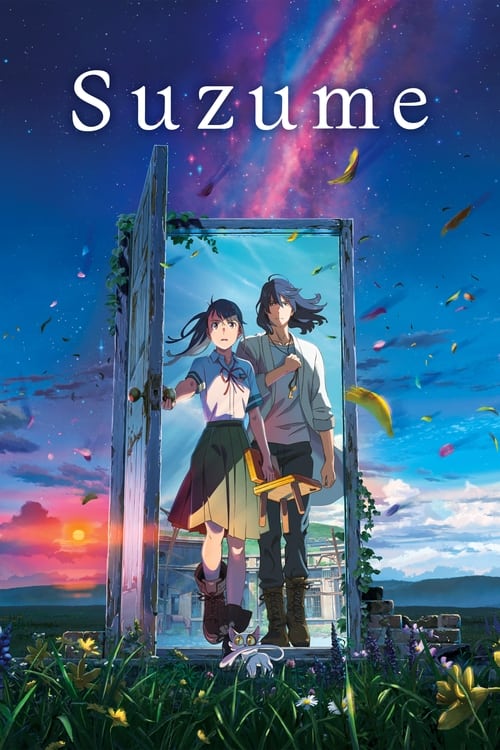
Suzume
2022 · Makoto Shinkai
Suzume completed his disaster-trilogy and cemented the "next Miyazaki" label he keeps rejecting; his global box office made anime's theatrical dominance a mainstream industry conversation.
For when you want to be carried somewhere beautiful — a big-hearted animated journey that's exciting for a family watch but has real weight underneath. Reach for it when you want adventure that ends in a lump in your throat, not when you want something light and disposable.
What it's about
Suzume is seventeen, living quietly with her aunt in a small Kyushu town, when a stranger asks her for directions to some nearby ruins. Following him, she finds a lone door standing in the rubble — and opening it sets loose a force that threatens all of Japan with earthquakes. What follows is a road trip up the length of the country, closing doors left ajar in abandoned places, in the company of a young man whose job it is to seal them and a mischievous talking cat who complicates everything.
The experience
It moves like an adventure and lands like a grief story — big, kinetic set-pieces give way to quiet roadside kindnesses, and the whole thing hums with a warmth that sneaks up on you. Expect to be swept along, then ambushed by feeling in the final stretch.
The craft
Shinkai's studio renders skies, rain-slicked towns, and ruined landscapes with a photographic lushness that begs for the biggest, brightest screen you have. The film's real craft is in its settings: shuttered schools, dead resorts, and depopulated villages drawn with as much love as the living cities, so the supernatural threat feels rooted in real, mourned places. The score and sound design swell exactly when the images do.
Why it matters
The closing chapter of Shinkai's loose disaster trilogy after Your Name. and Weathering with You, it's his most direct reckoning with the 2011 earthquake and tsunami, and it confirmed him as the anime filmmaker whose original features are global theatrical events.
Snapshot
Suzume (originally Suzume no Tojimari, "Suzume's Locking Up") is the seventh feature by Makoto Shinkai and the concluding entry in a loosely conceived trilogy of disaster films that began with Your Name. (2016) and continued through Weathering with You (2019). Produced by CoMix Wave Films and released in Japan by Toho in November 2022, it follows Suzume Iwato, a seventeen-year-old living in Kyushu with her aunt, who encounters a young "Closer," Sōta Munakata, whose task is to seal supernatural doors that stand amid Japan's depopulated ruins. When those doors open they release a colossal worm-like force whose fall to earth triggers earthquakes. The film is at once a road movie that carries Suzume up the length of the archipelago and an elegy for a nation marked by catastrophe — its emotional center is the 2011 Great East Japan Earthquake and tsunami. It premiered internationally in competition at the Berlin International Film Festival in February 2023, a notable placement for a mainstream anime.
Industry & production
Suzume was made within the production system Shinkai has refined across a decade at CoMix Wave Films, a comparatively small studio whose scale is dwarfed by Studio Ghibli or the large television-anime houses. That relative smallness is central to Shinkai's method: he functions as director, sole screenwriter, and — as on his previous features — a hands-on figure in editing and storyboarding, retaining an authorial control unusual in commercial animation. The film was again backed by a Toho-anchored production committee, the standard Japanese financing structure in which distributor, studio, music label, and other partners share cost and risk; Toho's involvement guaranteed the wide theatrical release and marketing muscle that had turned Your Name. into a phenomenon.
Commercially, Suzume was a major success, ranking among the highest-grossing Japanese films of its year and performing strongly overseas, particularly in China, where Shinkai has become one of the most bankable foreign directors. Precise box-office totals vary by source and currency conversion, so specific figures are not asserted here; the salient fact is that the film consolidated Shinkai's standing as the most commercially significant animation director in Japan after the Ghibli generation. Its Berlinale competition slot — the first for a Shinkai film, and a rare instance of a mainstream anime in a major European festival's main competition — signaled an attempt to position his work as festival cinema as well as blockbuster, though the film's reception in that arena was mixed relative to its box-office standing.
Technology
The film was produced with the digital compositing-heavy pipeline that defines contemporary CoMix Wave output, blending hand-drawn character animation with elaborately rendered, photo-referenced backgrounds and extensive digital effects, color, and lighting work. Shinkai's signature is a densely layered image: atmospheric depth built from many composited planes, volumetric light, lens-flare and bloom effects, and skies of extreme saturation and detail. Suzume extends this toward large-scale spectacle — the writhing red "worm" (mimizu) rising over cities, the shifting light of the otherworldly "Ever-After" — that leans on 3D-assisted animation and effects integration. As with his earlier films, the technological aim is not realism as such but a heightened, luminous naturalism in which real Japanese locations are rendered with near-photographic fidelity and then intensified. The precise below-the-line technical credits (photography direction, CG supervision) are less consistently documented in English-language sources, and are not itemized here beyond what can be reliably attributed.
Technique
Cinematography
Anime "cinematography" resides in layout, virtual camera, and the compositing "photography" (satsuei) stage rather than a physical lens, and Shinkai is among the directors most identified with camera-conscious animation. Suzume is built on his characteristic vocabulary: sweeping crane-like moves over landscape, rapid whip-pans and speed lines during the door-sealing set pieces, and an insistent attention to light as a dramatic agent — the gold of late-afternoon sun, the cold blue of the star-filled Ever-After sky, the sickly red glow of the mimizu. The compositions repeatedly frame the human figure as small against vast space (ruined resort towns, the sea, the Tokyo skyline), a scalar contrast that carries the film's theme of individual life set against geological and civilizational catastrophe. Reflective and transparent surfaces — water, glass, rain — recur as motifs, refracting light in the manner that has become a Shinkai trademark.
Editing
Consistent with his practice, Shinkai is closely involved in the film's cutting, and the editing reflects a director shaping rhythm at the storyboard stage rather than discovering it afterward. The film alternates two tempos: propulsive, kinetic sequences around the opening and sealing of doors, cut for velocity and impact; and slower, contemplative passages — travel, conversation, arrival in new towns — that let landscape and mood breathe. The road-movie structure produces an episodic rhythm of departures and arrivals, punctuated by the recurring ritual of the doors. The film's final movement, which returns Suzume to the site of her original loss, slows markedly, using duration and stillness to earn its emotional resolution.
Mise-en-scène / staging
The film's staging is organized around ruins and thresholds. Its doors stand in haikyo — the abandoned schools, amusement parks, and hot-spring towns of a depopulating Japan — and the choice of these settings is itself thematic, mapping the nation's shrinking regions and its accumulated sites of grief. The keystone (kaname-ishi) and the doorway function as concrete spatial anchors around which action is choreographed. A striking staging decision is the transformation of Sōta into a small three-legged child's chair for much of the running time, which forces the film to animate romance, heroism, and pathos through an inanimate object — a bold constraint that shapes blocking and physical comedy alike, and ties to the film's central object, the yellow chair Suzume's mother made her, missing one leg since the disaster.
Sound
Suzume was scored by Radwimps, the rock band led by Yōjirō Noda whose collaboration with Shinkai on Your Name. and Weathering with You has become integral to his authorship, working here alongside composer Kazuma Jinnouchi, who broadened the orchestral and ambient palette. Music is used the way Shinkai has favored since Your Name.: as an emotional throughline, with song sequences that fuse image and score into set pieces. The sound design foregrounds environmental texture — wind, water, the rumble of the earth, the ambient hum of the doors — and treats the mimizu and the earthquake alarms with a weight that would have been unmistakable to Japanese audiences conditioned by real disaster-warning sounds. The ritual greetings itterasshai / okaeri ("go safely" / "welcome home") recur as spoken motifs that the film ultimately invests with its deepest meaning.
Performance
The voice performances anchor the film's tonal balance of adventure and grief. Newcomer Nanoka Hara voices Suzume, giving the protagonist a plainspoken warmth and resilience, while Hokuto Matsumura (of the group SixTONES) voices Sōta, sustaining a romantic and heroic presence largely through voice while the character is a chair. Eri Fukatsu voices Suzume's aunt Tamaki, whose late-film confrontation supplies one of the story's most emotionally exposed sequences. Shinkai's casting mixes trained actors with pop-idol and film talent, a common industry strategy for star appeal that here is generally judged to have served the drama.
Narrative & dramatic mode
The screenplay, by Shinkai alone, fuses several modes: the coming-of-age story, the road movie, the supernatural quest, and the trauma narrative. Its engine is a journey — Suzume travels from Kyushu northeast across Japan, closing doors at successive ruins, in a structure that echoes both the picaresque and the pilgrimage. Beneath the adventure runs a recovery plot: Suzume is an orphan of disaster, and the film gradually reveals that her quest is a movement back toward the day her mother died. The dramatic mode is melodramatic in the classical sense — organized to produce and legitimate strong feeling — but disciplined by a mythic-fantastic apparatus (worms, keystones, an afterworld) that externalizes psychological states. The film's boldest structural gamble is its convergence of the fantastical climax with an intimate scene of a child and her grief, so that saving Japan and consoling one's younger self become the same act.
Genre & cycle
Suzume sits within several overlapping cycles. It is the third of Shinkai's own "disaster trilogy," each film pairing adolescent romance with a national-scale calamity — body-swapping and a comet in Your Name., endless rain and sea-level rise in Weathering with You, earthquakes here. It belongs to the long tradition of Japanese catastrophe fiction, from Godzilla onward, in which natural or supernatural disaster figures collective anxiety; but where the kaiju tradition externalizes threat as monster, Shinkai's late films internalize it as weather, geology, and mourning. It also draws on the road movie and, through its animal trickster Daijin and its threshold-crossings, on folkloric quest narrative. Its most direct genre lineage, though, is the post-3/11 Japanese cultural production that has repeatedly returned to the 2011 disaster — a body of film, animation, and literature to which Suzume is perhaps the most prominent mainstream animated contribution.
Authorship & method
Suzume is unmistakably an auteur work. Shinkai wrote, directed, and shaped the edit, and — as with his previous features — published his own novelization, underlining the degree to which the material is his. His method is recognizable across the whole trilogy: photoreal locations intensified into the numinous; adolescent protagonists; a fusion of pop music and image; and a thematic preoccupation with distance, loss, and the desire to undo catastrophe. His key collaborators recur and are essential to the house style. Character designs are by Masayoshi Tanaka, whose work on Your Name. and Weathering with You established the contemporary look of Shinkai's characters. The score is by Radwimps and Kazuma Jinnouchi. The film was made at CoMix Wave Films with Shinkai's established production team; individual department heads (animation direction, art direction, photography direction) are credited in the film but are less uniformly documented across English-language sources, and are not individually attributed here where the record is thin. What is clear is that Shinkai's authorship is collaborative in execution but singular in conception — a director-writer working with a stable creative circle.
Movement / national cinema
The film is a product of the modern Japanese commercial animation industry, but stands somewhat apart from the two dominant poles of that world — Ghibli's hand-crafted tradition and the franchise-driven television-anime economy. Shinkai emerged in the 2000s from a background in digital, largely solo short-form work (Voices of a Distant Star, 2002), and his cinema retains the imprint of that origin: intensely photographic, digitally composited, and personal in scale even at blockbuster budgets. Critics frequently, and reductively, framed him as a would-be Miyazaki successor; Suzume both invites and resists that comparison, gesturing toward Ghibli-like fantasy and environmental feeling while remaining firmly within Shinkai's own idiom of digital naturalism and pop-scored melodrama. Nationally, the film is inseparable from Japan's twenty-first-century experience of disaster and demographic decline, which it treats not as background but as subject.
Era / period
Released in late 2022, Suzume is a film of the post-3/11 and post-pandemic moment. Eleven years on from the earthquake, tsunami, and Fukushima nuclear accident, Shinkai took the unusual step, for a mass-audience entertainment, of addressing that disaster directly rather than allegorically alone — the journey's endpoint is the devastated Tōhoku coast. The film is equally shaped by contemporary Japanese anxieties about rural depopulation and abandonment, which supply its recurring imagery of ruins. Technologically and industrially it belongs to the era of Shinkai's post–Your Name. superstardom, when his films could command wide global release and festival attention, and when anime's international commercial reach — especially into China — had become a defining feature of the medium's economy.
Themes
The film's governing themes are grief, memory, and the labor of continuing to live after catastrophe. The act of "locking up" is its central metaphor: the Closers seal the doors of abandoned places by first calling up the memory of the lives once lived there, so that mourning and remembrance are literally what hold catastrophe at bay. The keystone and worm draw on Japanese earthquake folklore — the tradition of the namazu, a giant catfish pinned beneath the earth by a god's keystone at Kashima, whose thrashing causes quakes — grounding the fantasy in indigenous myth. Thresholds and doorways figure the boundary between the living and the dead, present and past, home and journey. The greetings itterasshai and okaeri thematize departure and safe return as the ordinary rituals disaster shatters. And in Suzume's meeting with her own younger self, the film advances a consoling but hard-won proposition: that the future, however marked by loss, is worth the living — a message pitched with unusual directness at a generation raised in the shadow of 2011.
Reception, canon & influence
Critical reception was broadly positive and often admiring of the film's ambition and its willingness to confront the 2011 disaster, while a strand of commentary found Shinkai's melodrama and exposition heavy-handed and the trilogy's formula increasingly familiar — a divide sharpened by the film's festival exposure at Berlin, where art-cinema expectations met a mainstream blockbuster. Commercially it was among the year's biggest Japanese films and a strong global performer; specific figures and award tallies vary by source and are not asserted here. Backward, the film's influences are legible: the Japanese catastrophe-film tradition and post-3/11 culture; folkloric earthquake mythology; the road movie; and the broader lineage of Japanese animation, including the environmental and fantastical strains associated with Ghibli, against which Shinkai is continually measured. It also draws on Shinkai's own back catalog, revisiting motifs of distance, weather, and undoing catastrophe. Forward, its most significant effect is consolidative: as the capstone of a hugely successful trilogy, Suzume helped secure Shinkai's position as the defining commercial animation auteur of his generation and reinforced the global theatrical viability of original (non-franchise) anime features — a template of director-driven, music-fused, disaster-themed melodrama whose influence on the next wave of Japanese animation is still unfolding, and on which the historical record remains, necessarily, provisional.
A Deleuzian reading
A door stands by itself in a drowned resort town in Kyushu.
The full Deleuzian reading of Suzume →
Reception
A massive hit in Japan on release (Shinkai's third straight film past the ¥10-billion mark), it was first received as 'more Shinkai formula' — but is increasingly read as the serious capstone of his disaster trilogy, the one where he finally confronted the 2011 earthquake head-on.
How Suzume was received, from release to now →
How to watch Suzume: what to notice on a first viewing
- Notice the doors stand alone in ruins, with nothing behind them. Shinkai plants his free-standing doors in abandoned schools, amusement parks, and hot-spring towns, in the open, so you can already see what is behind them before anyone opens one. Deleuze calls what a doorway normally implies the relative out-of-field, and these doors cancel that promise before the scene even starts.
- Watch how small the human figures look against ruined towns and open sky. Shinkai repeatedly frames people as tiny against vast space, the sea, a ruined resort, a skyline, with sweeping crane-like camera moves over the landscape. The scale contrast sets an individual life against something far larger, geological and civilizational at once.
- Watch for gold light turning sickly red. Light shifts from warm gold sun to a cold blue starlit sky to a sickly red glow whenever the worm-like force nears, with water and glass repeatedly refracting it. Color tells you what kind of danger is near before any dialogue does.
- Listen for go safely and welcome home, said again and again. These two ordinary greetings recur throughout the film, attached to routine departures and arrivals. Everyday rituals become the film's way of holding onto people it might lose.
- Watch how much feeling the voice carries once the male lead becomes a chair. Sōta is transformed into a small three-legged chair for most of the film, so his romance and heroism have to be carried entirely through voice performance and how the chair moves. Turning a person into an object and still asking you to feel for him tests how much a voice alone can do.
The whole guide to watching Suzume, with the keys for a rewatch →
Influences: the films it descends from and the films it influenced
- Your Name. (2016) — Establishes the CoMix Wave house method Suzume refines — Masayoshi Tanaka's character designs fused with photoreal location backgrounds and a Radwimps song-score that structures the montage, plus the disaster-undoing 'catastrophe-reversal' plot engine.
- Weathering with You (2019) — Directly precedes Suzume in the trilogy: the same weather-as-numinous-force rendering, hyperdetailed water/light compositing, and a teen protagonist whose choice inverts civic-scale disaster, carried over as house grammar.
- 5 Centimeters per Second (2007) — Origin of Shinkai's distance-and-longing dual-tempo editing and virtual-camera lyricism, where a musical montage set does the emotional work that dialogue withholds — the road-movie episodic structure of Suzume descends from this.
- The Place Promised in Our Early Days (2004) — Shinkai's first feature to pair a monumental scale-contrast landmark (the tower) with intimate adolescent stakes and the desire to undo a looming catastrophe — the scale-contrast staging Suzume applies to the 'keystone' worm.
- Castle in the Sky (1986) — Template for the wandering-ruins adventure and the transformation-of-the-mundane-into-flight; Suzume's threshold-doors amid overgrown ruins and its ascent set-pieces answer Ghibli's ruin-and-wonder staging.
- Nausicaä of the Valley of the Wind (1984) — Ghibli's founding ecological-catastrophe fantasy, whose folkloric-guardian-versus-natural-cataclysm framework Suzume translates into the Namazu/keystone cosmology binding disaster to myth.
- Spirited Away (2001) — Model for the abandoned-place-as-liminal-portal and a girl crossing thresholds into a spirit world; Suzume's ruined sites as doors-into-the-Ever-After extend this threshold staging.
- Pom Poko (1994) — Ghibli's explicit mobilization of Japanese folklore (tanuki, yokai) as a lens on real land and loss — precedent for Suzume grounding a national catastrophe in namazu earthquake-myth rather than pure invention.
- Godzilla (1954) — Founds the Japanese catastrophe-film tradition of processing collective trauma through a mythic destructive force and civic alarm; Suzume's disaster-alarm soundscape and monstrous 'worm' rising over cities inherit this kaiju grammar.
- Belle (2021) — Continues the post-Shinkai template of the original, music-fused, emotionally maximalist anime feature built for global theatrical release — pop-song set-pieces and virtual-camera spectacle in service of adolescent grief.
- The Boy and the Heron (2023) — Arriving just after Suzume, it returns to the threshold-into-an-other-world-through-a-ruin and processes wartime/personal loss via folkloric passage — the Ghibli lineage against which Suzume was measured, answering back.
- Look Back (2024) — Post-Suzume auteur short-feature that fuses a pop-melancholic score with photoreal interiors and a grief-and-what-if-undoing structure, extending Shinkai's model of music-driven, trauma-centered original anime.
- Shin Godzilla (2016) — The other major post-3/11 disaster allegory of the era — shares the earthquake-quake-alert sound design, evacuation-procedure texture, and treatment of catastrophe as recurring national wound, arrived at from the live-action/tokusatsu side.
- Wolf Children (2012) — Contemporary non-franchise anime auteur working the same grief-and-remembrance melodrama with photoreal rural Japan backgrounds and a road/relocation structure — the closest peer to Shinkai's director-driven theatrical model.
- Mirai (2018) — Extends the same craft of family-trauma processed through fantastical thresholds (the garden-portal) and dual-tempo edits between mundane domestic scenes and mythic passages, a sibling to Suzume's door mechanic.
- A Silent Voice (2016) — Kyoto Animation's trauma-recovery drama sharing Suzume's light-as-motif photography and delicate acting-in-the-edit — using flare, focus and gesture, not exposition, to render adolescent guilt and healing.
- In This Corner of the World (2016) — Contemporary anime that maps national catastrophe onto specific geography and everyday endurance, a memory-of-disaster companion to Suzume's journey across real, named Japanese sites of loss.
- Children of the Sea (2019) — Shares Suzume's digital-naturalism ambition — water and light rendered as numinous cosmic force through heavy compositing — pairing folkloric cosmology with an adolescent's rite of passage.
- 18x2 Beyond Youthful Days (2024) — An episodic road-movie travelogue across Japan's rail lines and abandoned non-places, using transit geography and landscape to externalize the protagonist's interior journey.
Similar films
- In This Corner of the World (2016) — influence & lineage · same viewing thread
- Your Name. (2016) — influence & lineage
- Weathering with You (2019) — influence & lineage
- The Boy and the Heron (2023) — influence & lineage
- Spirited Away (2001) — influence & lineage
- Castle in the Sky (1986) — influence & lineage
- Look Back (2024) — influence & lineage · same viewing thread
- I Want to Eat Your Pancreas (2018) — same viewing thread
All the films related to Suzume →
Watch it with: curated runs of related films
- Anime's Dreaming Adolescents — Watch these together for the ache of being young — first crushes, imaginary worlds, and the small transformations that feel enormous when you're inside them.