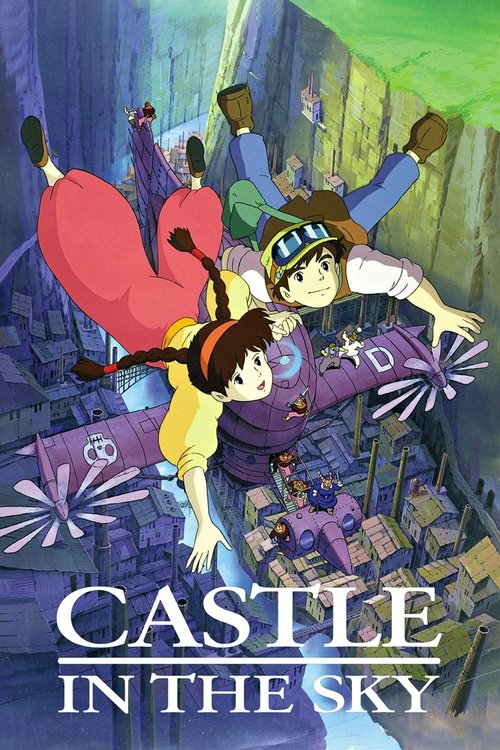
Castle in the Sky
1986 · Hayao Miyazaki
The Boy and the Heron's no-marketing release and second Oscar fueled the eternal "final film" watch, while his resurfaced "an insult to life itself" AI clip made him the patron saint of anti-AI-art sentiment. Ghibli-style AI image generation controversies keep him at the center of a fight he never asked to join.
For when you want to feel like a kid again — comfort viewing with genuine thrills, perfect for a family night or for rediscovering why you love movies. Zero cynicism, all heart.
What it's about
Sheeta, a girl who falls out of the sky wearing a glowing crystal pendant, and Pazu, an orphaned boy from a mining town, race to find Laputa — a legendary floating castle abandoned by an ancient civilization. Chasing them: a rowdy family of sky pirates and a smiling, sinister government agent, all after the secret the crystal holds. It's a pure adventure story of airships, ruins, and two kids who only have each other.
The experience
Rousing and warm-hearted — chases, crashes, and cliffhangers delivered with real momentum, but shot through with wonder and a surprising melancholy about lost worlds. It feels like the best adventure book you read as a kid, brought fully to life.
The craft
The first film from Studio Ghibli, it's hand-drawn animation of astonishing detail: mining towns, fortress interiors, and flying machines imagined with an engineer's love, and skies that make you understand why Miyazaki is obsessed with flight. Joe Hisaishi's score soars right along with it.
Why it matters
As Ghibli's founding production it set the studio's template — aeronautical wonder, anti-militarist conscience, fierce kids — and its influence echoes through decades of animation and adventure storytelling worldwide.
Snapshot
Castle in the Sky (Japanese: Tenkū no Shiro Rapyuta, "Laputa: Castle in the Sky") is the inaugural production of Studio Ghibli, the animation house Hayao Miyazaki and Isao Takahata founded in 1985. Released in Japan in August 1986, it is a rousing steampunk adventure about Sheeta, a girl who carries a glowing crystal pendant, and Pazu, an orphaned mining-town boy, as they flee sky pirates and a militarized government agent named Muska in a race toward Laputa, a legendary floating city abandoned by an ancient civilization. Conceived directly after Miyazaki's Nausicaä of the Valley of the Wind (1984), the film consolidated the visual grammar, thematic obsessions, and studio working methods that would define Ghibli for the next four decades: aeronautical wonder, an anti-militarist conscience, a green suspicion of technological hubris, and a pair of resourceful young protagonists. Its title borrows Laputa from Jonathan Swift's Gulliver's Travels, though Miyazaki repurposes the flying island as a site of tragedy rather than satire. Musically, it marks the beginning of the composer Joe Hisaishi's decades-long collaboration with Miyazaki. It is, in the fullest sense, the film in which Studio Ghibli begins.
Industry & production
The film was produced by Studio Ghibli in association with Tokuma Shoten, the publishing conglomerate that had backed Nausicaä through its subsidiary and that effectively bankrolled Ghibli's earliest years. Nausicaä's commercial and critical success gave Miyazaki and Takahata the leverage to establish a dedicated studio rather than assembling ad hoc production teams; Castle in the Sky was its first project, with Takahata serving as producer and Miyazaki writing and directing. The studio's early ethos — comparatively high budgets, a priority on hand-drawn quality over volume, and full-length theatrical features rather than television work — was set here.
Miyazaki's background is important to the production's character. He had spent years in the television and feature trenches, notably on the Lupin III films (including The Castle of Cagliostro, 1979) and the Future Boy Conan television series (1978), and Castle in the Sky carries the DNA of both: the caper energy and clockwork action of Cagliostro and the boy-and-girl-against-a-corrupt-world structure of Conan. The production employed the labor-intensive cel animation pipeline standard to the era, with Miyazaki personally supervising and extensively re-drawing key animation, a hands-on practice he maintained throughout his career.
The record on the film's precise Japanese box-office performance in 1986 is one where popular accounts vary; I will not assign a specific gross. What is well documented is that the film did not immediately match Nausicaä's reception at the box office yet became one of the most beloved and frequently re-broadcast titles in Japan, its television airings in later decades becoming cultural events in their own right. Internationally, the film had a delayed and complicated distribution history: an early English dub existed for limited exposure, but its major English-language release came only in the late 1990s and early 2000s through Disney's distribution partnership with Tokuma/Ghibli, with a newly recorded English dub featuring a well-known voice cast.
Technology
Castle in the Sky is a traditional cel-animation production, executed with paint on celluloid over hand-painted backgrounds and photographed on an animation stand. It predates Ghibli's later adoption of digital ink-and-paint and computer compositing; its imagery is the product of the fully analog process. Within that framework, the film's ambitions were considerable: sweeping aerial sequences, collapsing architecture, elaborate machinery, and atmospheric effects (clouds, storms, the great cyclonic weather system that hides Laputa) all demanded dense, carefully choreographed drawing.
The film's technological subject is as notable as its technological means. It is among the foundational texts of what the West would later call steampunk, though Miyazaki arrived at the aesthetic through his own lifelong fascination with early aviation, mining engineering, and Victorian-Edwardian industrial design rather than through any genre label. The retro-futurist machinery — flaptered ornithopters, the pirates' flea-like scout craft, airships, mine elevators, and the ambiguous ancient robots of Laputa — reflects a deliberate blend of period industrial romance and imagined ancient technology. The robots in particular, with their moss-grown, melancholy forms, echo Miyazaki's earlier robot design work on a Lupin III television episode he directed, and they became one of the film's enduring visual signatures.
Technique
Cinematography
Because this is hand-drawn animation, "cinematography" describes the film's constructed camera language — its imagined lenses, framing, and movement — rather than photography of a physical world. Miyazaki's staging here is expansive and vertical. He repeatedly exploits extreme changes in scale and altitude: tiny figures against vast skies, the plunging verticals of the mine shafts and the fortress, and the god's-eye reveal of Laputa itself. The film alternates intimate two-shots of Sheeta and Pazu with grand establishing vistas, and it uses the illusion of a mobile camera — sweeping "aerial" moves tracking flying craft — to generate the sensation of flight that is central to the film's appeal. Depth is achieved through multiplane-style layering of foreground and background elements, giving parallax to the aerial and landscape shots.
Editing
The film's cutting, credited within Ghibli's editorial team of the period, serves a classical adventure rhythm: sustained, legible action set-pieces punctuated by quieter passages of rest and wonder. Miyazaki is a master of what has often been described (in relation to his broader body of work) as ma — the deliberate pause or lull between bursts of action, a moment of stillness that lets tension settle and the audience breathe. Castle in the Sky is more relentlessly propulsive than his later films, but the principle is already visible in the breathing spaces between chases: the morning in Pazu's mining town, the quiet interlude in the abandoned mine with the old engineer Uncle Pomme, the pastoral serenity of Laputa's overgrown gardens.
Mise-en-scène / staging
Environmental density is the hallmark. Pazu's mining community, the pirates' cluttered airship galley, and Laputa's ruins are all richly detailed spaces that imply lived history and function. Miyazaki's engineering literacy shows in how machines are staged to be understood — we grasp how the mine elevator, the ornithopters, and the fortress cannon work because they are drawn with mechanical logic. The floating island's design fuses a Swiftian conceit with organic overgrowth: a tree-crowned, root-bound ruin that literalizes the film's argument that nature reclaims and outlasts human ambition.
Sound
The score by Joe Hisaishi is the film's most consequential contribution to the Ghibli house style, inaugurating a partnership that would run through nearly all of Miyazaki's subsequent features. The music ranges from martial and propulsive in the chase sequences to elegiac and pastoral in the Laputa passages; its principal theme became one of the most recognizable pieces of music in Japanese animation. Notably, the international Disney-era release presented a re-recorded, substantially expanded orchestral version of Hisaishi's score, altering the sound balance of the original, which had used sparser instrumentation in places — a point on which the two versions of the film audibly differ.
Performance
Vocal performance in animation shapes character as decisively as drawing does. In the original Japanese, the young leads are voiced to convey earnest determination without saccharine excess, while the pirate matriarch Dola is a comic-heroic force whose gruff warmth anchors the film's tonal shifts. The later English dub recast these roles with a prominent voice cast and, per Disney-era practice, added ad-libbed dialogue in some previously silent moments — a change frequently discussed by critics comparing the two versions.
Narrative & dramatic mode
The film operates in a classical adventure-romance mode: a clear quest structure, a chase escalating across distinct environments (town, mine, sky, fortress, Laputa), and a MacGuffin — the levitation crystal and its "spell of destruction" — that drives every faction's pursuit. Its dramatic engine is a coming-of-age partnership between two children who must choose what kind of power they will wield. The moral architecture is more black-and-white than Miyazaki's later, more ambiguous work: Muska is a comparatively unambiguous villain, and the film's climax turns on a decisive ethical choice — Sheeta and Pazu speaking the crystal's word of ruin to destroy Laputa's weaponizable core rather than let it be commanded. Where the film gains richness is in its refusal of triumphalism: the "victory" is an act of renunciation, letting the castle's destructive potential fall away while its living, natural heart floats free.
Genre & cycle
Castle in the Sky sits at the intersection of the fantasy-adventure, the aviation film, and what would become the steampunk mode. Within Miyazaki's own filmography it belongs to a cycle of works pairing a young girl and boy against a corrupt adult order — a lineage running from Future Boy Conan and Cagliostro through Nausicaä and forward. Within the broader history of Japanese animation, it stands as a landmark of the theatrical anime feature at a moment when television production dominated the industry, asserting the feature film as a vehicle for artisanal, personal filmmaking. It also participates in a long tradition of "lost civilization" and hidden-world adventure fiction stretching back through Verne and Swift.
Authorship & method
This is a comprehensively authored film. Miyazaki wrote the original screenplay, directed, and — characteristically — exercised granular control over storyboards and key animation, working from his own image boards rather than a pre-existing property. His method of drawing the film into being, generating story through visual boards more than a finished script, is central to understanding the work's coherence of vision.
His key collaborators here established the Ghibli core. Isao Takahata, Miyazaki's longtime colleague and co-founder, produced. Joe Hisaishi composed the score, beginning the composer-director partnership that is among the most celebrated in film music. The animation was carried out by a team that included artists who would become mainstays of the studio. Rather than a cinematographer in the live-action sense, the film's look derives from Miyazaki's direction working with art directors and background artists to realize its detailed worlds. The overall impression is of a studio consciously codifying its methods on its first outing.
Movement / national cinema
The film is a foundational document of the modern Japanese animation renaissance and, more specifically, of Studio Ghibli as a distinct authorial brand within it. It emerged from a post-war tradition of Japanese feature animation — the Toei Doga lineage in which both Miyazaki and Takahata had trained — while pushing decisively toward a personal, auteurist cinema. Its sensibility is transnational in its references (Welsh mining valleys are frequently cited as an inspiration for Pazu's town, drawn from Miyazaki's travels; European industrial and folkloric imagery pervades the design) yet unmistakably Japanese in its ethical and ecological concerns and in its relationship to the anime industry it helped elevate.
Era / period
Made in the mid-1980s, the film reflects both the technical possibilities and the anxieties of its moment. It is a product of the pre-digital animation era at the height of hand-drawn craft. Thematically, its preoccupation with a super-weapon capable of civilizational annihilation — Laputa's dormant destructive power — resonates with Cold War nuclear anxiety and, for a Japanese audience, with the specific historical memory of atomic destruction. The image of a technological paradise that is also a doomsday weapon, brought down by a word, is legible against that late-Cold-War backdrop, though the film universalizes rather than historicizes the theme.
Themes
The film's central argument is a warning against the divorce of power from the earth. Laputa's fate — its people's abandonment of the flying city to return to the soil — states the moral directly: technology and dominion without roots in the living world lead to ruin. Muska embodies technocratic domination and the will to command through force; Sheeta and Pazu embody stewardship, labor, and restraint. Related threads run throughout: the dignity of manual work and craft (the mine, the pirates' engine room, Pazu's diligence); flight as both wonder and weapon, an ambivalence that recurs across Miyazaki's career; the resilience and moral seriousness of children set against corrupt or foolish adults; and an ecological faith that nature outlasts and reclaims human hubris, imaged in Laputa's tree-crowned, root-bound survival. The pirate Dola's clan complicates any simple morality, offering a vision of anarchic, familial community as a livable alternative to both state militarism and technocratic tyranny.
Reception, canon & influence
Critically, Castle in the Sky is now firmly canonized as a landmark of animation and a cornerstone of Miyazaki's reputation, routinely cited among his finest adventure films even by critics who rank his later, more introspective works higher. Its standing grew over time, especially internationally once the Disney-era distribution made it widely accessible; contemporaneous English-language criticism was limited by the film's delayed release abroad, so much of its critical canonization is retrospective.
Influences on the film (backward): Jonathan Swift's Gulliver's Travels supplies the floating island and its name; Jules Verne and the tradition of scientific-romance adventure inform its tone; Miyazaki's own earlier work (Future Boy Conan, The Castle of Cagliostro, Nausicaä) supplies its character archetypes and action grammar; and the industrial landscapes of Wales, which Miyazaki is widely reported to have visited and been moved by, shaped the mining-town setting.
Legacy (forward): As the first Ghibli film, it set the template — thematic, aesthetic, and industrial — for one of the most influential bodies of work in animation history. Its steampunk imagery, aerial romance, and ancient-robot iconography reverberate through later anime and games; the melancholy garden-tending robot became a widely referenced image. The Hisaishi-Miyazaki collaboration it launched became one of cinema's signature partnerships. In Japan its television broadcasts turned it into a shared cultural ritual, famously associated with mass simultaneous audience participation around its climactic word of destruction — a phenomenon that testifies to how deeply the film embedded itself in popular memory. More broadly, it helped establish the theatrical anime feature as a vehicle for serious, personal, artisanal filmmaking, an influence felt across the medium ever since.
A Deleuzian reading
A robot stands in a garden near the end of this film.
The full Deleuzian reading of Castle in the Sky →
Reception
A modest box-office performer in Japan in 1986, it quietly became one of the country's most beloved animated films — decades of TV airings and polls have lifted it into the Ghibli top tier worldwide.
How Castle in the Sky was received, from release to now →
How to watch Castle in the Sky: what to notice on a first viewing
- Notice how often tiny figures are dwarfed by huge skies or shafts. Miyazaki keeps cutting between vast establishing vistas and intimate two-shots of Sheeta and Pazu, alternating scale and altitude throughout the chase. This shifting scale builds the wonder of flight and the sense of a world too large to control.
- Listen for the score turning from marching drums to slow strings. Hisaishi's music tightens into propulsion during chases and opens into pastoral melody in Laputa's ruins, marking a shift in the film's rhythm. The music performs the same alternation between action and rest that shapes the whole film.
- Watch how the mine elevator and ornithopters are drawn to work. Miyazaki stages every machine, from cannon to wings, so its mechanism stays legible on screen instead of becoming abstract spectacle. Seeing how machines work makes you believe them, keeping the action readable even at top speed.
- Notice the quiet mornings and gardens between each chase scene. Town mornings, the mine with Uncle Pomme, and Laputa's overgrown gardens interrupt the pursuit again and again, giving the film room to settle. These lulls make the action that follows hit harder rather than slowing the film down.
- Track the glowing pendant as it passes between characters' hands. Sheeta's crystal moves from her neck to Pazu's grip to Muska's reach, always wanted, always driving the next chase. The pendant is the single object every faction wants, driving each chase forward.
The whole guide to watching Castle in the Sky, with the keys for a rewatch →
Influences: the films it descends from and the films it influenced
- The Great Adventure of Horus, Prince of the Sun (1968) — Established the Takahata-Miyazaki layout-driven staging and 'ma' emotional pauses — Miyazaki's key-animation and scene design here seeded the deliberate held beats and community-labor detail Laputa uses to space its action.
- Future Boy Conan (1978) — Supplies the boy-hero/mysterious-girl action couple and the elastic, physics-defying pursuit choreography (dangling, leaping, catching) that Pazu and Sheeta directly reprise.
- The Castle of Cagliostro (1979) — Perfected the vertical clock-tower/rooftop scramble chase — a sustained climb-and-fall spatial gag reused wholesale in Laputa's collapsing-fortress climax.
- Nausicaä of the Valley of the Wind (1984) — Set Miyazaki's image-board-first world-building method plus the gliding-flight animation and anti-militarist/ecological-hubris framework Laputa inherits intact.
- Superman: The Mechanical Monsters (1941) — Its riveted, blank-faced flying robots are the direct design source for Laputa's robot soldiers — the same rounded torso, articulated arms, and impassive single-eyed head.
- Snow White and the Seven Dwarfs (1937) — Pioneered the multiplane camera whose stacked depth-and-atmosphere layering Miyazaki adapts for Laputa's vertical scale, hazy cloud strata, and receding backgrounds.
- Metropolis (1927) — Model for the stratified vertical city and mechanized-labor iconography behind Laputa's tiered mining town and the ancient machine-civilization architecture.
- The King and the Mockingbird (1980) — Its melancholy, protective giant robot is a near-direct homage to Grimault's towering automaton, and its floating tiered city extends the architectural-fantasy verticality.
- The Eccentrics (1974) — Makes the homemade flying machine the central emblem of freedom and love against militarized order — the same 'flight-as-freedom' iconography powering the fable.
- My Neighbor Totoro (1988) — Extends the Hisaishi-Miyazaki scoring partnership launched here and pushes the 'ma' pause pacing — quiet dead-time between events — into a full aesthetic.
- Nadia: The Secret of Blue Water (1990) — Grew from Miyazaki's own shelved 'Around the World Under the Sea' pitch, replicating the glowing crystal-pendant MacGuffin, sky/sea super-fortress, and mechanic-boy/orphan-girl pairing.
- Porco Rosso (1992) — Carries forward the 'mechanical logic' animation of aircraft — rendering weight, torque, propeller drag, and takeoff physics as believable engineering rather than magic.
- The Iron Giant (1999) — Builds a whole film on Laputa's benevolent war-robot conceit — an ancient weaponized machine that chooses not to kill — a pacifist inversion Bird drew from Miyazaki.
- Last Exile (2003) — An aerial steampunk anime built on Laputa's sky-ship romance, staging vertical-scale dogfights and analog flying-machine draftsmanship as its core spectacle.
- Howl's Moving Castle (2004) — Applies Laputa's 'mechanical logic' staging to an articulated walking machine, animating the castle's lurching gait and shifting mass as coherent (if fantastical) engineering.
- WALL-E (2008) — Lifts Laputa's lonely garden-tending robot image directly into its protagonist — a solitary machine nurturing plant life amid ruins — an homage Stanton openly credited to Miyazaki.
- Up (2009) — Miyazaki's aerial lost-world adventure — flight as simultaneous literal transport and emotional liberation for characters carrying unresolved grief, leading toward a vertical mythological destination — is the most direct formal antecedent to the balloon-house conceit and Paradise Falls as third-act reward.
- Suzume (2022) — Template for the wandering-ruins adventure and the transformation-of-the-mundane-into-flight; Suzume's threshold-doors amid overgrown ruins and its ascent set-pieces answer Ghibli's ruin-and-wonder staging.
- Kiki's Delivery Service (1989) — Cemented the Hisaishi leitmotif-scoring partnership and the sustained aerial set-piece; Kiki carries over the same composer-driven emotional cueing and airborne spatial staging.
- Whisper of the Heart (1995) — Its soaring aerial-flight aesthetic and romantic-idealist storyboarding are the lineage of Miyazaki's flying-Baron dream sequence grafted into Whisper's realism.
- Arco (2025) — Codifies the humane, wonder-driven retro-futurism — a child's flight through anachronistic sky-machines — that Arco's rainbow-flight fable descends from tonally and in world-design.
- Princess Mononoke (1997) — Deepens Laputa's anti-militarism and ecological-hubris themes, staging technological/industrial power (Eboshi's ironworks) against nature in the same moral register.
- Steamboy (2004) — Extends the pre-digital, hyper-detailed steam-machinery draftsmanship — valves, pistons, gauges rendered with engineering precision — into its own Victorian steampunk feature.
- Warriors of the Wind (1984) — Ghibli's first official film directly extends Nausicaä's craft: Hisaishi's soaring leitmotif scoring, floating-flight-as-rapture set pieces, and hand-drawn ornithopter mechanics refined from the Mehve.
Similar films
- My Neighbor Totoro (1988) — influence & lineage · same viewing thread · often watched together
- Princess Mononoke (1997) — influence & lineage · same viewing thread · often watched together
- Porco Rosso (1992) — influence & lineage · same viewing thread · often watched together
- The Castle of Cagliostro (1979) — influence & lineage · same viewing thread
- Howl's Moving Castle (2004) — influence & lineage · same viewing thread
- Spirited Away (2001) — same viewing thread · often watched together
- Kiki's Delivery Service (1989) — same viewing thread · often watched together
- Ponyo (2008) — same viewing thread · often watched together
All the films related to Castle in the Sky →
Watch it with: curated runs of related films
- The Studio Ghibli Canon — A run through the whole hand-drawn shelf of Miyazaki and Takahata — start with the childhood-wonder crowd-pleasers and drift toward the studio's quieter, adult, more elegiac corners.