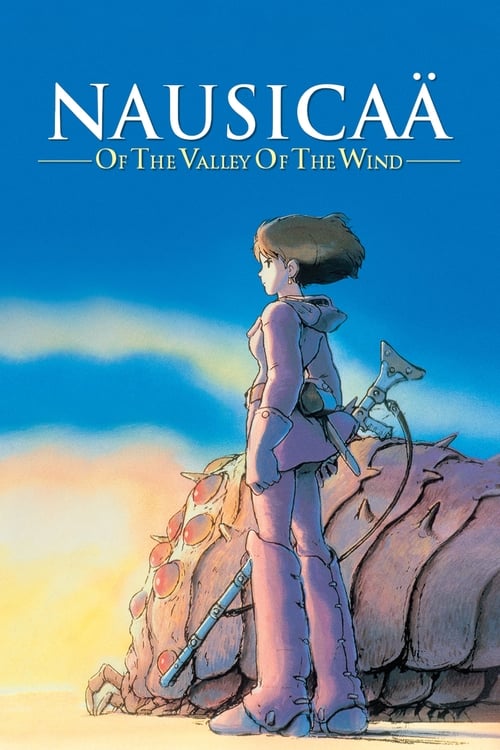
Warriors of the Wind
1984 · Hayao Miyazaki
The Boy and the Heron's no-marketing release and second Oscar fueled the eternal "final film" watch, while his resurfaced "an insult to life itself" AI clip made him the patron saint of anti-AI-art sentiment. Ghibli-style AI image generation controversies keep him at the center of a fight he never asked to join.
For when you want epic-scale wonder — a big imaginative world to fall into, thrilling but warm-hearted enough to share with kids or watch on a rainy Sunday. Comfort viewing with a conscience.
What it's about
A thousand years after industrial civilization poisoned the earth, a toxic jungle guarded by giant insects is swallowing what's left of humanity. In one of the last clean corners of the world, a wind-riding princess refuses to treat the jungle as an enemy — even as warring kingdoms drag her small valley into their fight over the planet's future. It's an adventure about a girl trying to stop a war on two fronts: human against human, and human against nature.
The experience
Sweeping and strange and full of awe — the flying sequences are pure exhilaration, the insect swarms genuinely eerie, and underneath the adventure runs a real moral seriousness that sneaks up on you. It moves fast but leaves you thinking about who the monsters actually are.
The craft
Miyazaki adapted his own sprawling manga, and the hand-drawn world-building — the drifting spores, the vast insect designs, the physics of flight — still astonishes. Joe Hisaishi's score, his first for Miyazaki, launched one of cinema's great composer-director partnerships. Worth the biggest screen and best speakers you can find. Note: this 1984 English version, retitled by its US distributor, cut some twenty minutes from Miyazaki's film; the full-length version circulates as 'Nausicaä of the Valley of the Wind.'
Why it matters
Its success directly financed the founding of Studio Ghibli a year later, and it contains in embryo nearly everything Miyazaki would spend four decades elaborating — the fierce girl heroine, the refusal of tidy villains, nature owed reverence rather than victory.
Before Studio Ghibli existed, there was this: Hayao Miyazaki's 1984 ecological epic, adapted from his own sprawling manga, whose box-office success directly financed the studio's founding a year later. A thousand years after industrial civilization poisoned the earth, a princess who glides on the wind refuses to see the toxic jungle and its giant insects as enemies — a premise that contains, in embryo, nearly everything Miyazaki would spend four decades elaborating: the fierce girl heroine, the refusal of tidy villains, flight as moral rapture, nature as something owed reverence rather than victory. Joe Hisaishi's first score for Miyazaki began cinema's most durable composer-director partnership since Herrmann and Hitchcock. The film's American fate became legend: New World Pictures hacked out twenty-two minutes, renamed it 'Warriors of the Wind,' and sold it as kiddie sci-fi — a mutilation so galling that Ghibli adopted its famous no-cuts policy for all future foreign releases. The ohmu, with their cathedral shells and shifting eyes, remain among animation's great creations.
A Deleuzian reading
A girl stands on a wing.
The full Deleuzian reading of Warriors of the Wind →
Reception
Butchered for its 1985 US release by New World Pictures — roughly 20 minutes cut, characters renamed, the ecological heart gutted, all marketed as a kids' sci-fi romp. Once the only English version available, it's now a disowned curio, fully eclipsed by the restored, uncut Nausicaä dub Disney released in 2005.
How Warriors of the Wind was received, from release to now →
Influences: the films it descends from and the films it influenced
- Future Boy Conan (1978) — Miyazaki's own TV series established his post-apocalyptic vertical staging — kids clambering over ruined mega-structures and gliding on the wind — that Nausicaä lifts wholesale into the Ohmu-and-glider action grammar.
- The Castle of Cagliostro (1979) — His debut feature codified the weight-and-momentum animation of characters running along rooftops and clinging to sheer walls, the physical-comedy timing later reused for Nausicaä's Mehve-glider chases.
- Panda! Go, Panda! (1972) — Takahata directing and Miyazaki designing forged their curious-child-in-a-benevolent-natural-world staging, the pastoral tenderness toward large creatures that becomes Nausicaä's rapport with the Ohmu.
- Horus: Prince of the Sun (1968) — Toei's landmark where Miyazaki keyframed crowd and nature scenes; its village-under-ecological-threat epic structure and moral seriousness in animation are the template Nausicaä scales up.
- Gulliver's Travels Beyond the Moon (1965) — Miyazaki's first credited animation work, where he reportedly reanimated the ending; its outer-space allegory of liberation seeds his lifelong instinct to bend commercial anime toward humanist parable.
- Star Wars (1977) — Its used-future texture — grimy machinery, lived-in ruins — informs Nausicaä's insistence on hand-drawn mechanical wear and the tactile decay of the Sea of Corruption's tanks and gunships.
- Dune (novel-to-screen sensibility) (1984) — Shares the giant-desert-organism ecology and messianic-girl-in-a-poisoned-biosphere worldbuilding, a sibling reworking of Herbert's living-ecosystem-as-antagonist into moving images the same year.
- Castle in the Sky (1986) — Ghibli's first official film directly extends Nausicaä's craft: Hisaishi's soaring leitmotif scoring, floating-flight-as-rapture set pieces, and hand-drawn ornithopter mechanics refined from the Mehve.
- Princess Mononoke (1997) — The mature restatement of Nausicaä's thesis — a girl mediating between vengeful nature-spirits and industrial humanity — with the Shishigami's toxic bloom echoing the Ohmu-swarm's golden-tendril climax.
- My Neighbor Totoro (1988) — Carries forward Nausicaä's reverence-for-nature staging into the domestic register, keeping the wind-in-the-grass, breath-in-the-forest ambient animation as an emotional device rather than plot.
- Grave of the Fireflies (1988) — The sibling Ghibli film financed by Nausicaä's success that pushes the studio's pacifism into unflinching wartime tragedy, extending the anti-militarist conviction Nausicaä dramatizes via the Tolmekian war machine.
- Akira (1988) — A sibling apex of hand-drawn animation ambition — thousands of cels, no-shortcut fluidity, and biomechanical apocalypse — matching Nausicaä's refusal to cut corners in depicting mass destruction.
Similar films
- Princess Mononoke (1997) — influence & lineage · same viewing thread
- My Neighbor Totoro (1988) — influence & lineage · same viewing thread
- Castle in the Sky (1986) — influence & lineage · same viewing thread
- The Castle of Cagliostro (1979) — influence & lineage · same viewing thread
- Grave of the Fireflies (1988) — influence & lineage
- Spirited Away (2001) — same viewing thread
- The Wind Rises (2013) — same viewing thread
- Kiki's Delivery Service (1989) — same viewing thread
All the films related to Warriors of the Wind →
Watch it with: curated runs of related films
- The Studio Ghibli Canon — A run through the whole hand-drawn shelf of Miyazaki and Takahata — start with the childhood-wonder crowd-pleasers and drift toward the studio's quieter, adult, more elegiac corners.