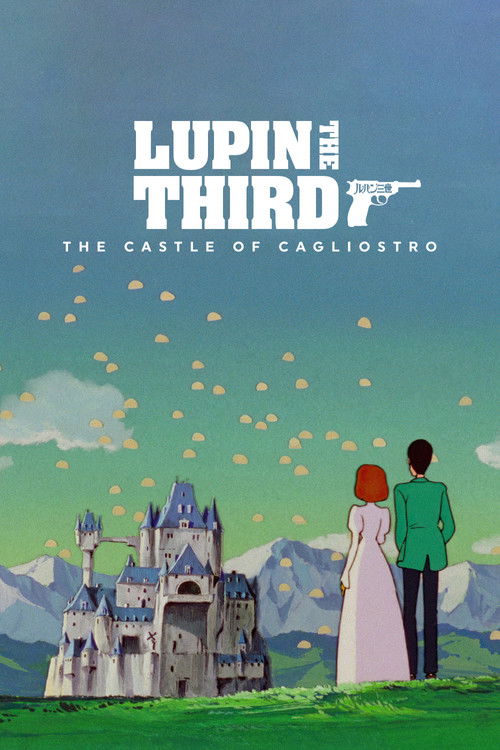
The Castle of Cagliostro
1979 · Hayao Miyazaki
The Boy and the Heron's no-marketing release and second Oscar fueled the eternal "final film" watch, while his resurfaced "an insult to life itself" AI clip made him the patron saint of anti-AI-art sentiment. Ghibli-style AI image generation controversies keep him at the center of a fight he never asked to join.
For when you want uncomplicated delight — a caper to grin through with family, friends, or just a good mood you'd like to keep. Total comfort viewing that never feels lazy.
What it's about
Gentleman thief Lupin the Third pulls off a casino heist only to discover the loot is expertly forged, so he traces the counterfeits to a tiny European principality and its ancient castle. Inside he finds a scheming count, a centuries-old secret, and an imprisoned young woman who needs rescuing — and the job shifts from robbery to something closer to knight-errantry. Car chases, rooftop leaps, and a clock tower all get their due.
The experience
Pure buoyant fun — fast, funny, and warm, with action that moves like acrobatics and never a dead minute. It has the lightness of a Saturday-matinee adventure made by someone who takes joy seriously.
The craft
This is Hayao Miyazaki's feature debut, and the hand-drawn action is legendary among animators: clean draftsmanship, physical comedy timed like silent-era slapstick, and a castle designed as a giant vertical machine of gears, aqueducts, and hidden passages. The famous car chase alone rewards a big screen.
Why it matters
The film that launched Miyazaki's directing career and a touchstone for generations of animators and action filmmakers — its chase and rescue set pieces have been studied and borrowed ever since.
Snapshot
The Castle of Cagliostro (Rupan Sansei: Kariosutoro no Shiro) is Hayao Miyazaki's feature directorial debut, a caper-adventure built around the established gentleman-thief franchise Lupin III. Working from Monkey Punch's raffish, sexually cynical manga property, Miyazaki reconfigured its lead into something closer to a chivalric rogue and staged a chase-and-rescue plot around a tiny fictional European principality whose economy runs on counterfeit currency and whose castle hides a centuries-old secret. Made quickly by a director who had already spent more than a decade in television and feature animation, the film is a compact demonstration of a sensibility—clean draftsmanship, kinetic physical comedy, an ethical center, and a fascination with hidden mechanisms and vertical architecture—that would define his later work at Studio Ghibli. It was not a strong commercial performer on release, but it accrued a durable critical reputation, particularly among animators, as one of the medium's most fluid action films.
Industry & production
The film was produced by TMS Entertainment (Tokyo Movie Shinsha) and released by Toho in December 1979. It arrived as a franchise product: Lupin III already existed as Monkey Punch's manga (from 1967) and as two television series, the second of which was airing at the time and would run for years. A theatrical Lupin feature, The Mystery of Mamo, had preceded it in 1978. Cagliostro was thus a sequel-of-sorts within an ongoing multimedia property rather than an original creation, and Miyazaki inherited an ensemble—Lupin, the marksman Jigen, the swordsman Goemon, the femme fatale Fujiko, and the dogged Inspector Zenigata—whose voices and personalities were already fixed in the public mind through television.
Miyazaki came to the assignment with unusual authority for a first-time feature director. He had co-directed episodes of the first Lupin III TV series in the early 1970s (with Isao Takahata), so he knew the characters intimately. The production is generally described as rapid—turned around in a matter of months—which is consistent with the economical, television-trained methods Miyazaki and his collaborators brought from earlier studios such as Toei Doga, A Pro, and Nippon Animation. Precise budget and box-office figures for the initial run are not something I can state with confidence; the reliable claim is the qualitative one repeated across the historical record: the film underperformed relative to expectations at release and found its audience later through re-screenings, television, and home video.
Technology
This is fully hand-drawn, cel-based traditional animation, photographed on an animation stand with the standard multiplane and camera techniques of late-1970s Japanese production. There is no digital imaging here; depth, atmosphere, and the illusion of camera movement are achieved through layered cels, painted backgrounds, held-and-moving artwork, and optical effects executed photographically. The technological interest of Cagliostro lies less in any novel apparatus than in how efficiently conventional means are marshaled: the film wrings a sensation of speed and three-dimensional space from resolutely analog tools. Within the fiction, technology is also a subject—the castle is a machine of trapdoors, retracting bridges, hidden gears, and a clock tower whose mechanism becomes the climax's stage—reflecting Miyazaki's lifelong delight in visible, comprehensible mechanical systems.
Technique
Cinematography
Because there is no photographic camera in the conventional sense, "cinematography" here means the design of framing, virtual lens behavior, and staged camera movement through drawn imagery. The film is celebrated for its dynamic sense of space. The famous opening car chase is the touchstone: Lupin's small Fiat careens along cliffside switchbacks in a sequence that reads with startling clarity despite constant changes of scale, direction, and elevation. Miyazaki's staging keeps the geography legible—the viewer always understands where the vehicles are relative to the road and the drop—so that the comedy and suspense land. Elsewhere the film exploits verticality: the castle is shot to emphasize height, plunging drops, and the dizzying climb of the clock tower, with "camera" positions that swoop and crane in ways live-action of the period could scarcely afford.
Editing
The cutting is brisk and functional in the service of action and gag timing. Miyazaki, trained in television animation where economy is paramount, structures set-pieces so that each shot advances a physical situation—a leap, a catch, a near-miss—rather than lingering. The rhythm accelerates through the chase and rooftop sequences and slows for the quieter interludes between Lupin and the imprisoned Clarisse, giving the film a clear dynamic contour. Continuity of screen direction is maintained rigorously through the most chaotic movement, which is precisely why the action remains coherent.
Mise-en-scène / staging
This is the film's signal strength. The imaginary state of Cagliostro is a total designed world: a European-storybook duchy of red-roofed towns, a Roman-aqueduct-and-medieval castle, and a lake concealing ruins. Miyazaki's staging is architectural—he thinks in terms of levels, thresholds, and traversal, sending characters up drainpipes, across battlements, and down into subterranean vaults. The physical comedy is blocked with silent-film precision (the debt to Chaplin, Keaton, and Lupin the First's Franco-comic lineage is often noted), and objects—rings, a signet, counterfeit plates, the clock's gears—are placed so that the plot's mechanics and the building's mechanics rhyme.
Sound
The score is by Yuji Ohno, the composer long associated with the Lupin III franchise, whose jazz-inflected idiom gives the film its cool, propulsive texture. The theme song "Honō no Takaramono" ("Fire Treasure"), performed by Bobby, accompanies the emotional coda. Sound design supports the physical comedy—engines, ricochets, mechanical clanks—in the broad, punctuating style of the tradition. I'm not able to verify specific mixing or recording details beyond these established credits.
Performance
As voice performance, the film rests on the franchise's regular Japanese cast, anchored by Yasuo Yamada as Lupin, whose loose, wry delivery established the character's screen voice for a generation. The ensemble—Jigen, Goemon, Fujiko, and Zenigata—carries the familiar interplay audiences knew from television. "Performance" in animation is also the work of the animators: the acting is in the drawing—Lupin's rubber-limbed athleticism and sudden stillness, Clarisse's guarded softness, Zenigata's bluster—and the film's expressive economy in gesture and face is a large part of its enduring appeal.
Narrative & dramatic mode
The film operates in the mode of the romantic adventure-caper with strong fairy-tale underpinning. Its engine is a heist that mutates into a rescue: Lupin, chasing the source of flawless counterfeit "goat bills," is drawn into liberating Clarisse, the last of the Cagliostro line, from a forced marriage to the usurping Count. The structure is classical and clean—inciting chase, infiltration, reversal, capture, climactic confrontation in the clock tower, resolution—with the treasure hunt and the damsel-rescue braided together. Tonally it balances slapstick comedy, suspense, and a strain of melancholy chivalry: Lupin's attachment to Clarisse is rendered as wistful and renunciatory rather than acquisitive. Zenigata functions as both antagonist and, ultimately, ally-in-spirit, and the ending famously offers a gallant closing exchange in which what Lupin has "stolen" is figured as Clarisse's heart. It is a self-contained tale that requires no prior knowledge of the franchise, which is part of why it travels so well.
Genre & cycle
Cagliostro sits at the intersection of the heist/caper film, the adventure-romance, and the animated action-comedy, all inflected by the Lupin III franchise's particular blend of espionage-parody and picaresque. Within the anime feature cycle of the late 1970s it belongs to the early wave of theatrical films spun from popular TV properties. Genre-wise it deliberately pulls the property away from the manga's harder-edged, adult, sex-and-crime register toward a family-friendly, storybook adventure—closer to the European bande dessinée tradition of Tintin-like clean-line adventure and to classic Hollywood/European swashbucklers than to Monkey Punch's cynicism. This tonal recalibration is the film's most consequential generic choice and a recurring point of discussion (and occasional purist objection) in the franchise's history.
Authorship & method
The dominant authorial signature is Miyazaki's, and Cagliostro is routinely read as a seed catalog for Ghibli. Its recurring preoccupations are already fully present: a resourceful, dignified young woman at the moral center; flight, height, and falling; elaborate functional architecture and machinery; a European-fantastical setting; suspicion of tyrannical power hoarding wealth; and physical comedy grounded in real weight and momentum. Miyazaki co-wrote the screenplay (with Haruya Yamazaki credited on the script), so authorship extends from concept through staging to the drawing itself, given his hands-on animation background.
Among key collaborators: composer Yuji Ohno supplies the franchise's defining jazz identity and shapes the film's cool tonality. The animation direction/character work draws on the established franchise designs while Miyazaki reshapes them expressively. The film also stands in the long creative dialogue between Miyazaki and Isao Takahata, his frequent collaborator and the co-director of Miyazaki's earliest Lupin III television work, whose partnership formed the crucible in which this style developed—though Takahata is not a credited author of Cagliostro itself. I won't assign specific individual credits beyond these where the record in front of me is not firm; the safe and central attribution is that this is Miyazaki's film in conception and execution.
Movement / national cinema
The film is a product of the postwar Japanese commercial animation industry—the studio-and-television system descended from Toei Doga and Osamu Tezuka's Mushi Pro, in which Miyazaki and Takahata trained. It predates the "Studio Ghibli era" and the international "anime boom" of the late 1980s and 1990s, but in retrospect it reads as a bridge between the workmanlike TV-anime tradition and the auteurist, high-craft feature animation Miyazaki would later institutionalize. It is not part of any manifesto-driven movement; its "movement" affiliation is better described as the beginning of a personal school—the Miyazaki/Ghibli house style—rooted in Japanese production practice but consciously in dialogue with European illustration and classic international cinema.
Era / period
1979 places the film at the end of the 1970s, before home video, cable, and international distribution transformed anime's reach. Theatrical anime features were still largely franchise extensions of TV hits, and the medium had limited critical prestige in the West. Cagliostro is therefore a late-analog, pre-boom artifact whose reputation was built slowly and retrospectively. Its period character shows in its craft economy and in its confidence that a mass audience would follow a clearly staged adventure without spectacle for its own sake.
Themes
Several themes recur and prefigure Miyazaki's mature work. Greed versus grace: the Count hoards counterfeit wealth and a literal buried treasure, while Lupin, the professional thief, ultimately declines material reward. Freedom and captivity: Clarisse is imprisoned in a tower, and the film's moral action is her liberation—not into a marriage with the hero, but into self-determination. Chivalry and renunciation: Lupin's romantic longing is honored precisely by his letting go. The hidden mechanism / buried past: the castle literally conceals history, and the climax reveals a submerged Roman city, aligning the film's love of machinery with an archaeology of truth beneath corrupt power. Authority and its limits: Zenigata embodies dogged, incorruptible duty in tension with, but not opposed to, Lupin's outlaw decency. These concerns—dignity, ecology-of-the-past, resistance to tyranny, the moral seriousness of a young heroine—are the through-lines to Miyazaki's later cinema.
Reception, canon & influence
On release the film is generally reported to have been a commercial disappointment and to have received modest immediate attention; I can't cite specific contemporary reviews or figures with confidence, so I'll flag that the initial-reception record, as I can vouch for it, is thin. What is well established is the arc afterward: Cagliostro grew into a canonical work, celebrated as a benchmark of animated action direction and as the origin point of Miyazaki's feature authorship. It became a staple reference among animators and filmmakers internationally.
Influences on the film (backward): the Lupin III manga and TV series that supplied its characters and world; the European clear-line adventure-comic tradition and swashbuckler cinema that inform its tone and setting; and the physical-comedy grammar of silent film. Miyazaki's own earlier television work on the property is the most direct precursor.
Legacy (forward): the film's DNA runs straight into Studio Ghibli, founded in 1984, and into Miyazaki's subsequent features, which elaborate its themes and its staging of flight and architecture. Its opening chase and clock-tower climax are frequently invoked as models of legible, physics-grounded action. It is also widely noted—though attributions of direct influence should be treated cautiously—that later animators and filmmakers, in Japan and abroad, have cited it as formative; the most commonly repeated anecdote concerns its high regard among Pixar's filmmakers, and the clock-tower finale is often discussed alongside comparable sequences in later animation. Where such influence claims cannot be firmly sourced, they are best stated as reputation rather than fact. What is not in dispute is the film's standing: a debut that already contained a complete artistic worldview, and the hinge on which one of animation's major authorships turned.
A Deleuzian reading
A small car on a mountain road, and a drop where the guardrail should be.
The full Deleuzian reading of The Castle of Cagliostro →
Reception
A modest box-office performer for a Lupin III entry in 1979, it was slowly rehabilitated through Japanese TV airings and Miyazaki's later fame into a perennial favorite — now routinely called the best Lupin film and an essential piece of pre-Ghibli history.
How The Castle of Cagliostro was received, from release to now →
How to watch The Castle of Cagliostro: what to notice on a first viewing
- Watch the opening chase for how legible it stays. Despite constant shifts in scale, direction, and elevation along the cliffside road, the staging keeps the car's position relative to the road and the drop clear at every single moment. You can only feel a fall as dangerous if the film has told you exactly how far down it goes.
- Watch characters climb drainpipes, battlements, and vaults. Miyazaki's staging is architectural, thinking in levels and thresholds, sending characters up drainpipes, across battlements, and down into subterranean vaults throughout the film. The castle's own layout keeps generating new places for the plot to physically happen.
- Listen for jazz driving even the quietest scenes. Yuji Ohno's jazz-inflected score gives the film a cool, propulsive texture that carries through both the frantic chases and the calmer, quieter interludes alike. The music never really changes register, which keeps the film's tone light even during the danger.
- Watch the counterfeit bills that kick off the plot. Lupin's haul from the opening robbery is worthless, perfectly forged banknotes, and following that single clue is what leads him to a whole hidden duchy. One small object opens onto an entire situation you could not have seen from where the story starts.
The whole guide to watching The Castle of Cagliostro, with the keys for a rewatch →
Influences: the films it descends from and the films it influenced
- Lupin III (TV series, Part I) (1971) — Miyazaki and Takahata's own uncredited/co-directed reworking of the property's back half established the character rhythms, kinetic car chases, and comic timing Cagliostro refines into feature form.
- Future Boy Conan (1978) — Miyazaki's TV directorial run immediately prior codified his physics-grounded leaps, falls, and vertical-space chase choreography that Cagliostro elevates in the tower climax.
- The Adventures of Tintin (Hergé's ligne claire) (1929) — The clear-line Franco-Belgian adventure-comic aesthetic — clean contours, legible European-fantastical architecture, globe-trotting caper tone — directly shapes the film's design language and mood.
- Sherlock Jr. (1924) — Keaton's silent physical-comedy grammar of the whole body reacting to real momentum, gags built on architecture and gravity, informs Lupin's slapstick chase staging.
- To Catch a Thief (1955) — The suave gentleman-thief heist-caper template, rooftop pursuits, and glamorous continental setting supply the swashbuckling tonal register Cagliostro adopts.
- The Snow Queen (1957) — Miyazaki's rescue-quest with a resourceful girl at its heart continues the Gerda template of active sincerity that he credited The Snow Queen with restoring his faith in.
- Nausicaä of the Valley of the Wind (1984) — Miyazaki's next feature extends Cagliostro's flight-and-falling staging and its tyrannical-power-hoarding-wealth theme into a fuller ecological register.
- Castle in the Sky (1986) — The clock-tower climax's vertical-space and functional-machinery mise-en-scène becomes Laputa's entire architecture of ascent, ruin, and gravity-bound action.
- Kiki's Delivery Service (1989) — Reprises Cagliostro's European-fantastical town design and its dignified young-woman-at-the-moral-center protagonist as the emotional core.
- Porco Rosso (1992) — Most direct heir to Cagliostro's suave adventurer tone, Adriatic-Europe setting, and comic-romantic caper structure grounded in weighty flight physics.
- The Great Mouse Detective (1986) — Its Big Ben clock-tower gear-and-cog climax is widely discussed as descending from Cagliostro's mechanism-driven, physics-legible tower finale.
- The Iron Giant (1999) — Bird's insistence on real weight, momentum, and clearly staged action from an animator's hand echoes Cagliostro's physics-grounded movement principles.
- The Incredibles (2004) — Extends Cagliostro's legible spatial action and vertical-chase staging — the Pixar circle's oft-cited debt to Miyazaki's clear geography of motion.
- Spirited Away (2001) — The elaborate functional-architecture-as-set (the bathhouse) and the resourceful girl navigating a labyrinth of hoarded wealth are Cagliostro's mise-en-scène preoccupations fully matured.
- Ratatouille (2007) — Continues the Pixar lineage of camera-legible chase geography through complex architecture that filmmakers there trace to Cagliostro's staging.
- Howl's Moving Castle (2004) — Miyazaki's debut feature that codifies the storybook-European castle as an animate mechanical playground of hidden gears and gravity-defying action staging.
- The Cat Returns (2002) — The Baron's rescue is Miyazaki's Lupin chase choreography in miniature: dapper gentleman-thief poise, running along parapets and rooftops, and an escape from a tower that structurally disassembles beneath the pursued as they climb.
- Horus, Prince of the Sun (1968) — Miyazaki's layout and animation work under Takahata forged the weighted, momentum-driven character movement and the dignified resourceful heroine that Cagliostro deploys wholesale.
- Lupin III: The Fuma Conspiracy (1987) — A franchise entry consciously chasing Cagliostro's legible action choreography and clean chase editing as the model to imitate.
- Whisper of the Heart (1995) — A Ghibli work storyboarded/scripted by Miyazaki that reuses Cagliostro's clean European-townscape architectural mise-en-scène and coming-of-age heroine.
- Warriors of the Wind (1984) — His debut feature codified the weight-and-momentum animation of characters running along rooftops and clinging to sheer walls, the physical-comedy timing later reused for Nausicaä's Mehve-glider chases.
Similar films
- Castle in the Sky (1986) — influence & lineage · same viewing thread
- Porco Rosso (1992) — influence & lineage · same viewing thread
- Spirited Away (2001) — influence & lineage · same viewing thread
- Kiki's Delivery Service (1989) — influence & lineage · same viewing thread
- Ratatouille (2007) — influence & lineage
- Howl's Moving Castle (2004) — same viewing thread
- My Neighbor Totoro (1988) — same viewing thread
- Princess Mononoke (1997) — same viewing thread
All the films related to The Castle of Cagliostro →
Watch it with: curated runs of related films
- The Studio Ghibli Canon — A run through the whole hand-drawn shelf of Miyazaki and Takahata — start with the childhood-wonder crowd-pleasers and drift toward the studio's quieter, adult, more elegiac corners.