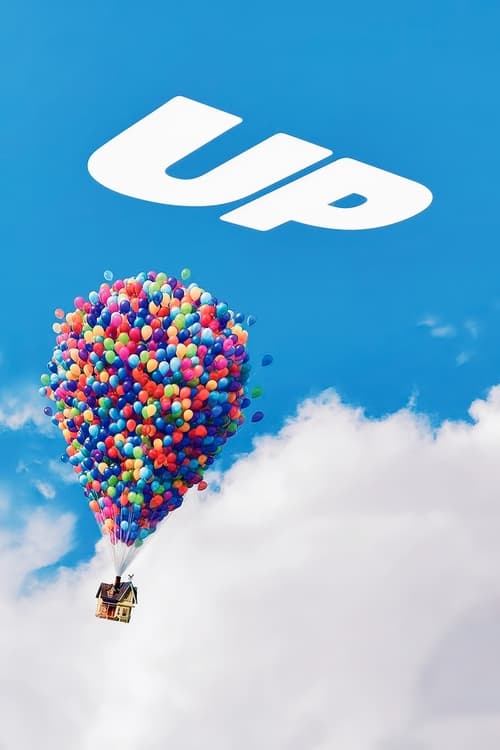
Up
2009 · Pete Docter
For a family movie night, or any evening when you need a good cry followed by a good laugh — comfort viewing that earns its emotions honestly. Reach for it when you want to feel hopeful about starting over.
What it's about
Carl Fredricksen, a 78-year-old widower, ties thousands of helium balloons to his house and floats away toward the South American wilderness he and his late wife always dreamed of seeing. He discovers a stowaway on his porch — Russell, a relentlessly chipper 8-year-old Wilderness Explorer — and the unlikely pair's journey turns up talking dogs, a rare giant bird, and adventures neither of them planned.
The experience
It opens with a wordless few minutes about a whole marriage that will wreck you, then lifts into a bright, funny, big-hearted adventure. You'll laugh a lot, cry at least once, and leave lighter than you arrived.
Performances
Ed Asner's gruff, grieving voice work makes Carl a genuinely three-dimensional curmudgeon, one of the most affecting lead turns in animated film.
The craft
Pixar at full power: a balloon canopy that glows like stained glass, cliffscapes inspired by Venezuelan tepuis, and Michael Giacchino's waltzing, Oscar-winning score, whose main theme carries the entire emotional arc. The famous opening montage is a masterclass in visual storytelling — not a word spoken, everything felt.
Why it matters
It won Oscars for Best Animated Feature and Best Original Score, opened the Cannes Film Festival, and earned a Best Picture nomination — proof at the height of Pixar's creative peak that animation could handle grief and aging head-on.
Snapshot
A 78-year-old balloon salesman lashes ten thousand helium balloons to his house and floats to the Venezuelan highlands to fulfill a lifelong promise to his dead wife. Pixar Animation Studios' tenth feature is simultaneously its most audacious formal gambit and its most direct emotional statement: in its wordless opening montage of roughly four minutes, it accomplishes what most films labor an entire runtime to achieve, then spends the remaining hour and a half exploring what comes after grief. Up won the Academy Awards for Best Animated Feature and Best Original Score, became the first animated film and the first 3D film to open the Cannes Film Festival (May 2009), and received a Best Picture nomination when the Academy expanded its field to ten. It is regarded as one of the defining achievements of Pixar's long creative peak and a landmark in American animation's claim to serious dramatic art.
Industry & production
Pete Docter had directed Monsters, Inc. (2001) for Pixar before developing Up across several years of internal development. Bob Peterson, a longtime Pixar story artist and voice actor, serves as co-director and co-writer. The screenplay was written by Docter and Peterson, with Tom McCarthy — the independent filmmaker behind The Station Agent (2003) and later the Oscar-winning Spotlight (2015) — contributing to the story's structural architecture, particularly its grounded human register.
The film was produced under Pixar's established creative model: extended development (story reels, iterative storyboarding) before any significant technical production, with John Lasseter as executive producer. Pixar's "brain trust" — the internal peer-review group of directors and senior creatives — shaped the project through repeated story screenings. The core dramatic idea, of a man who retreats from the world and then is forcibly returned to it, grew from Docter's own stated interest in the appeal of escape and the question of what, precisely, we are fleeing. An early iteration involved floating islands and exiled royalty; the refinement toward an intimate domestic drama preceding the adventure was a central story development decision.
Up was distributed by Walt Disney Pictures, marking the ongoing Pixar–Disney relationship (Disney had acquired Pixar in 2006). Its production budget has been reported at approximately $175 million, and its worldwide gross exceeded $730 million, making it a substantial commercial success that also commanded unusually strong critical prestige for an animated studio release.
Technology
Pixar's technical teams broke significant new ground on Up in several domains. The film's central visual spectacle — a house lifted by a dense cluster of nearly ten thousand individually animated balloons — demanded new simulation software. Each balloon behaves according to its own physics: it inflates, tugs against its string, collides with neighbors, and responds to wind. Pixar engineers developed proprietary simulation systems to handle the balloon mass as a dynamic volume rather than a rigid attached object, and the rendering load for scenes with the balloon cluster was among the most computationally intensive in the studio's output at the time.
Cloth and hair simulation, already advanced by The Incredibles and Ratatouille, were pushed further to handle Russell's Wilderness Explorer uniform, Carl's suit, and Dug the dog's fur. The South American tepui landscape — modeled in part on the Roraima plateau region of Venezuela, the inspiration for the fictional Paradise Falls — required environment artists to develop new approaches to large-scale matte painting integrated with three-dimensional geometry, preserving a painterly, slightly expressionistic quality in the backgrounds that echoes classical adventure illustration.
Up was released in RealD 3D and Digital IMAX 3D, part of the accelerating shift toward stereoscopic exhibition that characterized the period. Pixar's approach to 3D was notably restrained: the depth plane was used to enhance the sense of environment and scale, particularly in the aerial sequences, rather than for overt gimmickry. The camera rarely throws objects toward the viewer; the third dimension amplifies immersion rather than spectacle.
Technique
Cinematography
The film's directors of photography for animation were Patrick Lin and Jean-Claude Kalache. Pixar's approach to virtual cinematography in Up is unusually deliberate in its expressive grammar. In the early domestic sequences — Carl and Ellie's life together, and Carl's alone following her death — the virtual camera maintains relatively tight, slightly constrained framings. Lenses are less wide; camera movement is modest. As Carl's house rises and the landscape opens, the cinematography shifts register: wider angles, more vertical movement, framings that emphasize the smallness of the house against the vast sky. The tepui sequence returns to more intimate staging for its dramatic confrontations. This arc — constriction to expansion to intimacy — is legible as a structural choice aligned with Carl's psychological journey.
The color design reinforces the same grammar. Carl's suburban life is rendered in duller, more earthbound tones; Paradise Falls is saturated with the lurid greens and tropical abundance of an imagined adventure landscape; the golden hour light of the film's closing sequences signals resolution. Character design follows a similar logic: Carl is largely rectilinear — boxy suit, square jaw, rectangular glasses — while Russell is composed of circles and soft volumes, and the tropical setting introduces more organic, irregular forms.
Editing
Kevin Nolting edited Up, as he had edited Finding Nemo (2003). The film's most celebrated editorial achievement is the opening "Married Life" montage, a sequence spanning Carl and Ellie's life from courtship to Ellie's death in approximately four minutes. Nolting and Docter structure the montage in distinct emotional chapters: courtship and marriage; the realization that they cannot have children (communicated entirely through visual shorthand, without dialogue); their shared savings-jar dream of traveling to Paradise Falls; the accumulation of life's interruptions and expenses that drain the jar; Ellie's decline and death. The editing rhythm modulates throughout — quick, playful cuts in the courtship; a sustained stillness in the grief passage. The montage operates almost entirely without dialogue or conventional exposition, relying on Michael Giacchino's score to supply emotional continuity. It is widely cited in contemporary screenwriting pedagogy as an exemplar of visual storytelling economy.
Mise-en-scène / staging
Docter and Peterson deploy staging with theatrical precision. Carl's house, intact and anachronistic amid the sterile glass towers of development that surround it, functions as a stage set for stubbornness; the visual joke — small Victorian structure encircled by construction cranes — is also the film's first argument about attachment to the past. The staging of key dramatic revelations follows classical patterns: Charles Muntz, the disgraced explorer who functions as the film's antagonist, is introduced in archival footage before his full appearance, so his corruption reads as a fall from a known ideal. The recurring motif of Ellie's adventure book — and the "Things I Want to Do" pages Carl cannot bring himself to look at — is carefully staged so that its final revelation (Ellie has filled the empty pages with photographs of their life together) lands as a genuine dramatic reversal.
Sound
Sound designer Barney Jones and the Pixar audio team built a layered acoustic world in which the balloon cluster has a distinctive presence — the rubbery, collective whisper of shifting latex — that persists throughout the aerial sequences and registers subliminally as both wonder and precariousness. The absence of music in certain passages (notably in the quiet aftermath of Ellie's death) is as deliberate as its presence. Dug's voice-collar device, which translates canine thought into deadpan spoken English, is calibrated for comedic punctuation: Bob Peterson's voice performance for Dug — guileless, literal, easily distracted by squirrels — is largely a sound design and voice performance achievement working in tandem.
Performance
Up is a voice-performance film of unusual emotional range. Edward Asner's Carl is gruff without being caricature; Asner brings a basso gravitas and a specifically working-class American quality to a character who could easily have become a comic curmudgeon. The performance deepens appreciably after the midpoint, when Carl's grief is externalized. Christopher Plummer's Charles Muntz is elegantly threatening: Plummer modulates between the warmth of the character's golden-age celebrity and the coiled menace of his decades of obsession. Jordan Nagai, a non-professional child actor, provides Russell with an earnestness that avoids both saccharine performance and irritating precocity. Bob Peterson voices Dug and Alpha; the tonal contrast between Dug's hapless sincerity and Alpha's artificially lowered malfunctioning collar is a sustained comic achievement.
Narrative & dramatic mode
Up operates in a compound dramatic mode that is unusual even within Pixar's output. The opening act is domestic drama verging on elegy; the central adventure section borrows the conventions of the lost-world serial and the buddy road narrative; the climax draws on the action set piece. The film's formal gambit is to stage the deepest emotional work before the adventure begins, so that the adventure functions as a long coda to an already-completed mourning. What Carl is doing when he flies to Paradise Falls is not escaping grief but carrying it; the dramatic question is whether he can set it down.
This structure inverts the conventional animated-film arc in which the protagonist's wound is progressively revealed and resolved across the runtime. Carl's wound is fully established and felt by minute five. The rest of the film concerns his reluctant re-engagement with the living — Russell, Dug, the bird Kevin — and the recognition that Ellie's deepest wish was not the destination but the life they had already shared. The adventure book revelation is the film's emotional resolution: not a triumphant arrival at Paradise Falls but a reframing of what the adventure always was.
Genre & cycle
Up belongs to the lost-world adventure cycle derived from Sir Arthur Conan Doyle's The Lost World (1912) and its serial-fiction descendants: a remote plateau inaccessible to modernity, prehistoric fauna, a disgraced or obsessive explorer. Docter and Peterson are explicit in their homage to this tradition; Muntz directly echoes the figure of the discredited scientific adventurer, and the film's production design — the blimp Spirit of Adventure, the Art Deco trophies and memorabilia in Muntz's floating headquarters — is a loving recreation of the pre-war adventure aesthetic.
At the same time, Up is part of the late-2000s cycle of Pixar films — WALL-E (2008), Ratatouille (2007), The Incredibles (2004) — that aggressively expanded the thematic and tonal range of mainstream American animation. Each of these films uses genre conventions as a delivery mechanism for more serious material: consumerism, ambition, identity, mortality. Within Pixar's own development, Up follows WALL-E's near-silent opening as an experiment in how much tonal weight and narrative information an animated studio film can carry without conventional dialogue exposition.
Authorship & method
Pete Docter is the most consistent auteurist presence in Pixar's director stable. His four features as director — Monsters, Inc., Up, Inside Out (2015), Soul (2020) — form a coherent body of work organized around a single preoccupation: the interior emotional life made externally visible, and the way that transformation, fear, or grief are experienced from the inside. Up is the least literally realized of these (it does not enter Carl's psychology as a physical space, as Inside Out does) but it is the most structurally radical, in that it accomplishes its emotional program before its plot properly begins.
Tom McCarthy's contribution to the screenplay is worth noting: his independent films are marked by a patience with non-dramatic duration and a preference for character behavior over plot mechanics. His influence on Up's early domestic sequences — their accumulation of small detail and routine — is plausible, though the specific division of creative labor in any Pixar production is difficult to establish from the outside record.
Michael Giacchino's score is inseparable from the film's achievement. "Married Life," the waltz theme that anchors the opening montage, modulates through major and minor registers, through buoyancy and melancholy, within a short span; Giacchino has described composing it in a matter of days under significant time pressure, and it remains among the most emotionally efficient pieces of film scoring in recent American cinema. The Academy Award for Best Original Score was the first of Giacchino's major awards recognition, though his work for Pixar — particularly the The Incredibles score — had already established his importance to the studio's sound.
Kevin Nolting's editorial relationship with Docter across multiple Pixar features represents an authorial continuity comparable to the Spielberg–Kahn or Leone–Morrione partnerships in classical Hollywood terms.
Movement / national cinema
Up is a product of American studio animation at its most institutionally refined. Pixar, headquartered in Emeryville, California, operates within the Disney industrial system while maintaining an unusual degree of creative autonomy. The studio's visual and narrative aesthetic in this period draws on the full history of American animation — the Disney classical canon, Warner Bros. comedy timing, the theatrical character animation of Don Bluth's era — while consciously positioning itself against the perceived limitations of that tradition through tonal and thematic ambition.
It would be tendentious to claim a specifically national character for Up beyond its industry context, but its protagonist's profile — the working-class American, self-reliant, emotionally inarticulate, defined by the promises he has and has not kept — connects to a specific American dramatic archetype running from Eugene O'Neill through Arthur Miller to the ordinary-man films of Frank Capra and Delbert Mann. Docter has not cited these connections directly in the available record, and the claim should be taken as formal observation rather than documented influence.
Era / period
Up belongs to the period from roughly 2001 to 2015 that constitutes Pixar's sustained critical peak, and to the specific sub-period, 2007–2010, when the studio released Ratatouille, WALL-E, Up, and Toy Story 3 in rapid succession — a run without precedent in the studio's history for consistent critical esteem. This period coincides with the consolidation of digital 3D cinema as the industry's dominant theatrical format and with the rapid commercial growth of animated family films as a major box-office category. Up opened in a market shaped by DreamWorks Animation's competing franchise model (Shrek, Madagascar) and by the general assumption that animated films succeed on franchise recognition and comic-relief density. Its commercial and critical success on premises almost opposite to those assumptions had industry-wide implications.
Cannes 2009's selection of Up as the opening film of the Competition — unusual both for animation and for 3D cinema — signaled a European critical acknowledgment of American studio animation's claim to cinematic seriousness that had been building since Toy Story (1995) but had not previously been institutionally ratified at that level.
Themes
Grief and arrested time. Carl's situation at the film's opening is that of a man frozen at the moment of loss. His house is not merely a home but a reliquary; his refusal to sell it is a refusal to continue time. The film's central dramatic work is coaxing him back into temporality — into a life that continues rather than memorializes.
The adventure of the ordinary. Up conducts a sustained interrogation of the word "adventure." Muntz's quest — the canonical adventure in geographic and masculine terms — is revealed as pathological, a destruction of everything human in pursuit of a single proof. Carl's adventure, reframed by Ellie's annotated album, turns out to have been the texture of a shared life. The film's ethical argument is that the ordinary, lived with full attention, is the highest adventure available.
Aging and urgency. Carl is 78, an unusual protagonist age for any popular film. The film treats his age neither sentimentally nor as a disability but as a source of dramatic pressure: he has fewer days to keep his promise, and the physical demands of the journey are real. The casting of Edward Asner, then 79 during production, grounds the performance in a quality of age that could not be approximated by a younger actor.
Letting go. The parallel between Carl's inability to release his attachment to Ellie and Muntz's inability to release his need for vindication structures the film's moral argument. Muntz is what Carl would become if he refused return; the destruction of Carl's house — damaged, deflated, set down on the tepui peak — is the film's central image of necessary release.
Reception, canon & influence
Up was received with near-unanimous critical acclaim on release. The opening montage was identified immediately as the film's defining achievement and as an exceptional example of cinematic visual storytelling, and this assessment has remained stable in the critical record. The film holds a very high score on aggregation sites, though specific figures from the review record shift; it is consistently cited in critical retrospectives of the 2000s decade in cinema.
Influences on the film (backward): The lost-world adventure tradition, from Doyle through the Hollywood serial era, is the clearest generic antecedent. The figure of the eccentric elderly protagonist floating above the world has been connected — though not by Docter in documented interviews — to Hayao Miyazaki's treatment of age and flight, particularly Castle in the Sky (1986) and Howl's Moving Castle (2004). The Capraesque ordinary-American protagonist is a structural inheritance. The film's montage technique draws on silent cinema's establishment of visual storytelling without dialogue, and Docter has cited early Disney shorts in interviews as formative influences on character expression.
Legacy and forward influence: Up substantially altered the terms of critical and industrial discourse about animated film. Its opening montage has become a canonical example taught in film schools and screenwriting programs as an argument for the primacy of visual over verbal storytelling. The film's willingness to stage grief, aging, and the miscarriage of reproductive ambition in a family animation without hedging or comic deflation created a new sense of what the genre could accommodate. Docter's subsequent work at Pixar, particularly Inside Out and Soul, directly extends the project of Up: each uses a high-concept fantastical premise to make psychological or philosophical interiority visible and navigable. The influence of Up's emotional directness can be traced through subsequent animated features from multiple studios that became more willing to address death, loss, and adult emotional experience without sentimentalizing them, though attributing this specifically to Up's influence rather than to a broader cultural shift in the genre's audience expectations requires caution.
A Deleuzian reading
A glass jar with PARADISE FALLS painted across it.
The full Deleuzian reading of Up →
Reception
An instant hit in 2009 — rapturous reviews, huge box office, and a Best Picture nomination — and if anything its reputation has only sharpened: the opening 'Married Life' montage is now routinely called one of the greatest sequences Pixar ever made, sometimes overshadowing the film around it.
How Up was received, from release to now →
Influences: the films it descends from and the films it influenced
- City Lights (1931) — The 'Married Life' montage directly inherits Chaplin's technique of compressing a relationship's full emotional arc through music-driven silent images, substituting gestural and spatial recurrence for dialogue — love, loss, and time encoded without a word spoken.
- Bambi (1942) — Bambi's staging of a parent's death as an offscreen acoustic event — heard but never depicted — is the formal model for Up's grammar of grief-through-absence, establishing that theatrical animation could make irreversible loss its emotional core without showing it directly.
- The Lost World (1925) — Doyle's plateau with its vertical terrain, mythological fauna, and the convention that such a destination is unreachable except through extraordinary sacrifice establishes the genre cartography of Paradise Falls — the lost world as the spatial payoff that retrospectively justifies the hero's terrestrial wound.
- Grave of the Fireflies (1988) — Takahata established the categorical precedent that theatrical animation could make adult grief and irreversible loss its primary subject without comedic deflection, providing the genre permission structure within which Up's opening montage operates as formal argument rather than tonal aberration.
- Castle in the Sky (1986) — Miyazaki's aerial lost-world adventure — flight as simultaneous literal transport and emotional liberation for characters carrying unresolved grief, leading toward a vertical mythological destination — is the most direct formal antecedent to the balloon-house conceit and Paradise Falls as third-act reward.
- My Neighbor Totoro (1988) — Miyazaki's technique of loading domestic objects with emotional weight as legible stand-ins for unspoken psychological states — the umbrella at the bus stop, the soot spirits in the hallway — is the direct model for Up's adventure book and house as externalized mourning objects whose dramatic function exceeds their narrative function.
- Howl's Moving Castle (2004) — Sophie's visual aging by grief and obligation — rendered through posture, gait, and voice casting rather than exposition — directly anticipates Carl Fredricksen's design logic, where physical appearance externalizes interior emotional state and aging becomes a readable surface rather than a biographical fact.
- The Iron Giant (1999) — Bird established, within American studio animation, the formal grammar of staging genuine emotional loss without comedic deflection or resurrection — the Giant's sacrifice held in strategic silence and a sustained wide frame — that Docter extends in Up's treatment of Ellie's death and Carl's subsequent paralysis.
- WALL-E (2008) — Developed in parallel at Pixar, WALL-E demonstrates the studio's shared willingness to sustain a dialogue-free opening act built entirely from action, sound design, and musical rhythm — the adjacent institutional experiment that legitimizes Up's opening montage as Pixar house grammar rather than idiosyncratic authorial risk.
- Toy Story 2 (1999) — The wordless 'Married Life' montage is the direct heir of Jessie's flashback technique — score plus image compressing an entire life into minutes of melodrama.
- Monsters, Inc. (2001) — Docter reprises the mismatched-duo dynamic and the front-loaded emotional premise, pairing a gruff isolate with an irrepressible child stand-in (Russell echoes Boo).
- Inside Out (2015) — Docter's direct extension of Up's project: where Up externalizes grief through fantastical journey and object symbolism, Inside Out literalizes the interior emotional architecture as a physical space the camera can enter, completing the method of making psychological interiority navigable that Up initiates through external symbolic geography.
- Coco (2017) — The most direct industrial response to Up's precedent within Pixar — staging a grandparent's permanent death as the film's central felt loss and refusing to treat mortality as abstract threat rather than specific grief — applying Up's grammar of loss-without-sentimentality to a culturally specific ritual framework.
- Soul (2020) — The third iteration of Docter's Up method: a fantastical liminal space externalizing philosophical interiority, now interrogating what constitutes a meaningful life rather than grief specifically, using the same structural device of establishing existential wound before the plot's inciting action begins.
- A Man Called Ove (2015) — The compressed, near-wordless marriage-and-loss montage that stakes a rigid old man's anger in specific grief before the present-day comedy is allowed to begin.
- A Man Called Otto (2022) — Models the wordless married-life-to-widowhood montage that lets a grieving old man's backstory play as a parallel bright-lit timeline against his desaturated present — Otto's two-register flashback logic in miniature.
- Inside Out 2 (2024) — The wordless 'Married Life' montage established Docter's compression of an emotional arc through purely edited image-and-score, the technique behind the sequel's belief-system and memory montages.
- Toy Story 5 (2026) — 'Married Life' proved the front-loaded wordless montage could carry a feature's entire emotional debt, scored as a single continuous waltz with cuts landing on musical phrase — the load-bearing device the new film brackets its story with at both ends.
- Searching (2018) — Explicitly cited template for the wordless opening montage that compresses a marriage and a loss into minutes; Searching transposes its beat structure onto folder dates, calendar entries and OS-version drift.
- Mary and Max (2009) — Elliot's contemporaneous claymation feature uses recurring figurine objects (the Noblets) as externalized psychological states with the same structural logic as Up's adventure book, staging adult grief and social isolation in family-adjacent animation without the genre-obligatory tonal relief that both films refuse.
- The Red Turtle (2016) — Dudok de Wit applies Up's opening-montage strategy — wordless compression of a complete human life through recurring visual motifs and musical modulation rather than dialogue — to a full feature-length running time, demonstrating the formal scalability of the technique that Up deploys in its first eight minutes.
- Toy Story 3 (2010) — The 'Married Life' montage's wordless confrontation with mortality is the sibling gesture to TS3's hand-holding incinerator scene, both trusting silence over dialogue.
- The Incredibles (2004) — Giacchino weds a melodic, motif-driven orchestral score to genuinely adult domestic-emotional stakes inside CG animation — the emotional-maturity ambition the Incredibles legitimized.
- Hunt for the Wilderpeople (2016) — The grumpy-old-man/eager-boy wilderness odd couple structured so that adventure metabolizes grief — the same bereavement-under-the-comedy engine driving Hec and Ricky.
Similar films
- Inside Out (2015) — influence & lineage · same viewing thread
- WALL·E (2008) — influence & lineage · same viewing thread
- Mary and Max (2009) — influence & lineage · same viewing thread
- Coco (2017) — influence & lineage
- My Neighbor Totoro (1988) — influence & lineage
- Finding Nemo (2003) — same viewing thread
- Lilo & Stitch (2002) — same viewing thread
- Monsters, Inc. (2001) — same viewing thread
Watch it with: curated runs of related films
- Animation That Aches — A run of animated films that take loneliness, grief, and memory as seriously as any live-action drama — watch them in a row and the cartoon surface stops mattering.