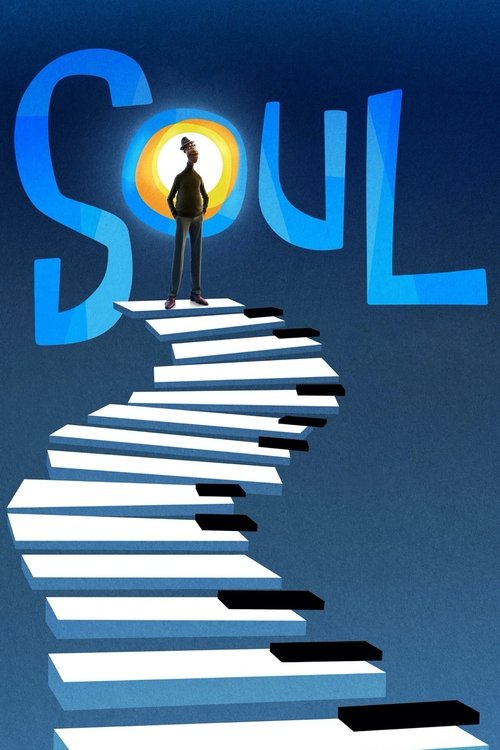
Soul
2020 · Pete Docter
For when you want a film to chew on for days — or when you're feeling stuck, burnt out, or unsure what you're doing with your life. Gentle enough for kids, but really aimed at adults.
What it's about
A middle-school band teacher and jazz pianist finally lands the gig of his life — then an accident knocks his soul out of his body and into the Great Before, a pastel cosmos where unborn souls acquire their personalities. Desperate to get back for his big break, he's paired with 22, a cynical soul who has never seen the point of living, and the two argue their way toward what actually makes a life worth it.
The experience
Funny and cosmic in equal measure, it glides between a lovingly detailed New York and a dreamlike beyond — and then, quietly, it gets you. Expect to laugh for an hour and be ambushed by something profound in the home stretch.
Performances
Jamie Foxx brings warmth and wounded ambition to Joe, Pixar's first Black lead, while Tina Fey makes 22's cosmic sarcasm both hilarious and quietly sad.
The craft
Two sound worlds define it: Jon Batiste's jazz, animated finger by finger at the piano, against a shimmering ambient score by Trent Reznor and Atticus Ross for the soul realms. The New York scenes — barbershops, subway platforms, a half-lit basement jazz club — are rendered with such specificity you can practically smell them. Good speakers are non-negotiable.
Why it matters
An Oscar winner for animated feature and score, it marked Pixar at its most philosophically ambitious and gave the studio its first Black protagonist — a film that landed mid-pandemic exactly when audiences were re-asking its central question.
Pete Docter, Pixar's resident metaphysician after Up and Inside Out, aims here at the biggest target yet: not what happens after life, but what makes one worth living. A middle-school band teacher and jazz pianist on the verge of his big break is knocked out of his body and into the Great Before, where unborn souls acquire their personalities — and where the film stages a gentle argument against the tyranny of Purpose itself. Co-director and co-writer Kemp Powers helped make Joe Gardner Pixar's first Black protagonist, and the studio renders his New York with loving specificity: barbershops, tailor shops, the half-lit glow of a basement jazz club, with Jon Batiste's piano performances animated finger by finger. The cosmic realms, by contrast, ripple to an ambient score by Trent Reznor and Atticus Ross — two sound worlds for two planes of existence. Released to homes in the bleak pandemic winter of 2020, its meditation on savoring ordinary days landed with accidental force. The film's boldest stroke may be its climactic quietness: a montage of small remembered things — pizza crust, subway light, a falling seed — offered as an answer to everything.
A Deleuzian reading
A seed drifts down through the air and lands in an open palm.
The full Deleuzian reading of Soul →
Reception
A pandemic casualty turned quiet triumph: dumped straight to Disney+ on Christmas Day 2020 with no US theatrical run, it still won two Oscars and is now widely seen as the crown jewel of Pixar's 'streaming era' — the one everyone agrees deserved a big screen (a belated 2024 theatrical release tried, too late, to fix that).
How Soul was received, from release to now →
Influences: the films it descends from and the films it influenced
- Inside Out (2015) — Docter's method of literalizing abstract interior states as navigable, character-populated realms is the direct design template for the Great Before and the You Seminar.
- Up (2009) — Establishes Docter's wordless-montage handling of mortality inside a family film; Soul's 'savoring ordinary days' epiphany is the same meaning-of-life resolution reached through quiet rather than spectacle.
- Monsters, Inc. (2001) — Docter's rule-bound parallel dimension with bureaucratic gatekeepers, turnstiles and clerks is the structural blueprint for the You Seminar's counselors and soul-accounting.
- A Matter of Life and Death (1946) — The celestial bureaucracy, the escalator/stairway to the beyond, and the clerical soul-counter (Terry) descend from Powell-Pressburger's afterlife administration rendered in contrasting color palettes.
- Here Comes Mr. Jordan (1941) — Supplies the 'soul taken early by an afterlife clerical error, then sent back' plot mechanism that drives Joe's fight to return to his body.
- Defending Your Life (1991) — Frames the afterlife as a comic institutional way-station where a completed life is tallied and judged before moving on — the tonal model for the Seminar's genial bureaucracy.
- Wings of Desire (1987) — The disembodied soul's-eye yearning for physical sensation, cashed out in small earthly pleasures, is the precedent for Soul's climax of falling-leaf, pizza-slice ordinary-life transcendence.
- Fantasia (1940) — Pioneers the synesthetic marriage of animation to a musical performance — the aesthetic license Soul takes when it dissolves Joe's piano playing into the abstract 'zone.'
- Ratatouille (2007) — Pixar's other film built around animating a single transcendent sensory moment (the Proustian tasting flashback), the craft Soul redeploys for its subway-ride 'spark' revelation.
- Round Midnight (1986) — Set the standard of collaborating with a real jazz player (Dexter Gordon) for performance authenticity; Pixar recorded Jon Batiste and matched the animation to his actual hands and phrasing.
- All That Jazz (1979) — A musician's reckoning with death staged as a stylized show-business afterlife, an early template for scoring a life-review through the artist's own idiom.
- The Princess and the Frog (2009) — Reference-animates a jazz pianist's hands from live musician footage in TPatF's period-authenticity spirit, then knowingly re-enters its central liability — a Black protagonist who spends most of the runtime out of his own body — as the film's declared subject.
- Toy Story 5 (2026) — The Great Before solved 2D-inside-3D: line-drawn Jerrys with no volume, lit by nothing, moving through a dimensional space with real depth cues — the rendering and staging problem the film's flat interface elements and chalk imagination space repeat.
- Whiplash (2014) — Shares the commitment to jazz-performance fidelity as dramatic engine, where the technical truth of the playing — not just the notes — carries the scene.
- La La Land (2016) — A jazz-purist protagonist whose devotion-versus-livelihood conflict mirrors Joe's; both stage the musician's dream against the mundane gig economy.
- The Social Network (2010) — Origin of the Trent Reznor & Atticus Ross ambient-electronic scoring method that Soul splits off as the ethereal Seminar music, counterpointed against Batiste's acoustic jazz.
- Coco (2017) — Pixar's companion death-realm film organized around music and a return-to-the-living deadline, sharing the studio's craft of designing a rule-governed afterlife world.
- Spirited Away (2001) — A protagonist trapped in a spirit world governed by contracts, thresholds and gatekeepers who must earn passage back — kindred rule-bound metaphysical world-building.
- After Life (1999) — Renders the threshold between life and death as a processing facility staffed by counselors who help a soul locate its defining 'spark,' directly echoing After Life's memory-selection bureaucracy.
- Luca (2021) — Part of Pixar's turn to personal, stylized, streaming-first features — a Disney+ debut cohort with Luca that reshaped how these films reached audiences.
- Inside Out 2 (2024) — Extends the externalized-abstraction production design to metaphysics, designing the 'Great Before' as a soft, rule-governed conceptual space where intangibles are given shape and staff.
- Eternity (2025) — Stages an administrative pre/after-life (the You Seminar and Great Beyond) as softly designed, restrained metaphysical bureaucracy that weighs the worth of a lived life against an idealized one.
- Hoppers (2026) — Pixar's own consciousness-transfer solution: a lead voice performance carried inside an animal body, with the animation team keying the animal's natural locomotion against imported human gesture so the mismatch reads as comedy before it reads as pathos.
Similar films
- Coco (2017) — influence & lineage
- Inside Out (2015) — influence & lineage
- Ratatouille (2007) — influence & lineage
- Monsters, Inc. (2001) — influence & lineage
- Up (2009) — influence & lineage
- Spider-Man: Into the Spider-Verse (2018) — shared sensibility
- Everything Everywhere All at Once (2022) — shared sensibility
- Finding Nemo (2003) — shared sensibility