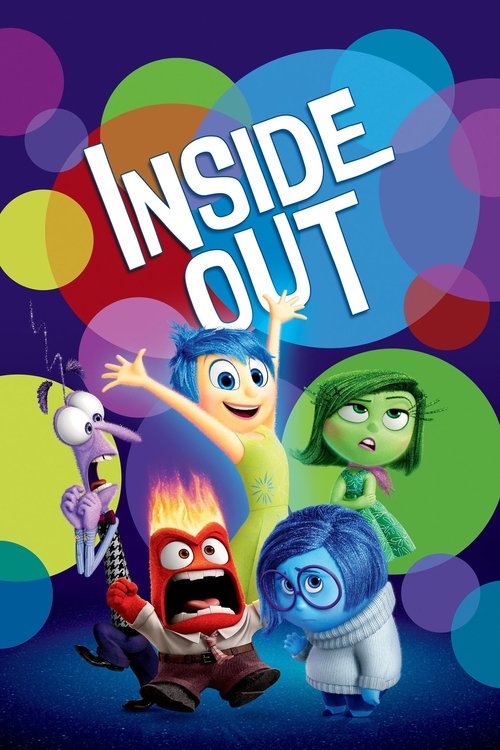
Inside Out
2015 · Pete Docter
For when you want to laugh and cry in the same ninety minutes — a family movie night that works just as hard on the grown-ups, or when you need a film that makes feeling bad feel okay.
What it's about
Eleven-year-old Riley is uprooted from Minnesota to San Francisco, and the move is narrated from inside her head, where five personified emotions — Joy, Sadness, Fear, Anger and Disgust — run a control room. When Joy and Sadness are accidentally swept out of Headquarters along with Riley's core memories, they have to trek back across the strange geography of her mind while the girl they steer visibly struggles to cope. It's a family comedy on the outside and a road movie through a child's psyche on the inside.
The experience
Fast, funny and inventive for long stretches, then quietly devastating when it counts — this is the Pixar film most likely to ambush adults with real tears. It earns its emotion by argument, not manipulation: you leave genuinely rethinking what sadness is for.
Performances
Amy Poehler's relentless, brittle optimism as Joy carries the film, and Phyllis Smith makes Sadness — a droopy blue mope, on paper — its unlikely soul. Richard Kind does heartbreaking work in a supporting voice role.
The craft
The imagination on screen is unusually disciplined: the mind is built as a coherent system with rules — memory orbs, personality islands, a literal train of thought — and every gag and payoff obeys them. Michael Giacchino's score threads the whole thing together, and the candy-bright interior world against muted, foggy San Francisco is a color scheme doing real storytelling work.
Why it matters
An instant entry in the argument over Pixar's best film, it won the Animation Oscar and seeped into everyday life — teachers, therapists and parents still use its five emotions as a shared vocabulary for talking to kids about feelings.
Snapshot
Pixar's fifteenth feature is a psychomachia staged as a buddy road movie. Eleven-year-old Riley Andersen is uprooted from Minnesota to San Francisco; inside her head, five personified emotions — Joy, Sadness, Fear, Anger, Disgust — operate a console in a room called Headquarters. When Joy and Sadness are flushed out of the control room along with a cluster of "core memories," the film splits into two simultaneous tracks: a girl outwardly failing to cope, and two cartoon figures trekking across the allegorical geography of her mind to get back. The conceit is old — medieval personification allegory, the morality play, the newspaper strip about little men who run a body — but the execution is unusually rigorous. Inside Out commits to its metaphor as a system with rules, then uses those rules to make an argument most children's films will not make: that sadness is functional, that unhappiness is not a malfunction to be routed around, and that growing up means the end of uncomplicated feeling. It won the Academy Award for Best Animated Feature and was nominated for Best Original Screenplay — a rare crossover for animation — and grossed well over $800 million worldwide against a reported budget in the $175 million range.
Industry & production
The film arrived at a moment of institutional anxiety. After Toy Story 3 (2010), Pixar's output skewed toward sequels and prequels — Cars 2, Monsters University — and 2014 passed without a Pixar release for the first time since 2005, following the collapse of The Good Dinosaur's original version. Inside Out was widely received, inside and outside the company, as a demonstration that the studio's original-story engine still worked.
Docter began developing the idea around 2009–2010, in the aftermath of Up. The stated origin is personal: he watched his own daughter Elie — who had voiced the young Ellie in Up — become quieter and more withdrawn as she approached adolescence, and wondered what was happening inside. Production ran roughly five years, with Jonas Rivera producing and Ronnie del Carmen co-directing and sharing original story credit. The screenplay is credited to Docter, Meg LeFauve, and Josh Cooley.
The development record is unusually well documented because Pixar publicized its own difficulties. The most consequential structural change: for a long stretch, Joy's companion on the journey was Fear, not Sadness — a pairing that produced comedy but no thesis. Reassigning the role to Sadness converted a picaresque into an argument, because it forced Joy to spend the film in the company of the emotion she was actively trying to suppress. Other elements arrived late, including the full shape of Bing Bong's arc. This is characteristic of Pixar's "Braintrust" method — iterative, high-attrition story reels reviewed by peer directors — and Inside Out is one of the clearer cases where the method produced not just polish but a change in meaning.
The other notable production decision was external consultation. Docter and his team worked with psychologists Dacher Keltner (UC Berkeley) and Paul Ekman, whose research on basic, cross-culturally recognizable emotions supplied the cast list. Ekman's canonical set runs to six or seven; the film cut it to five, dropping surprise as functionally redundant with fear. That compression is an aesthetic decision dressed as a scientific one, and the filmmakers have said as much.
Technology
Inside Out was made during Pixar's transition from its long-standing REYES rendering architecture toward physically based path tracing in RenderMan's RIS framework, a shift usually dated to the mid-2010s and generally described as complete by Finding Dory (2016). Inside Out sits on the near side of that change, and the public record does not cleanly settle how the work was divided between pipelines shot by shot; it is safer to say the film was made in the middle of the transition than to assign it to either side.
The film's genuinely novel technical problem was the emotions themselves. Rather than the smooth, solid surfaces of earlier Pixar characters, the five leads were conceived as clouds of luminous particles — a shimmering, granular skin that reads as energy rather than flesh, closer to felt or static than to plastic. This created two hard constraints. First, the particle layer had to preserve silhouette and expression: the characters remain legible as performers despite having no continuous surface. Second, Joy is a practical light source. She emits illumination that falls on floors, walls, and other characters, which means her position in a shot has consequences for the lighting of everything around her — a rendering dependency that had to be solved rather than faked. Animators worked with simplified proxies, with the full particle treatment resolved downstream, which is standard practice but was more consequential here than usual.
Pixar's proprietary animation system Presto handled character work; the mind-world environments — Long Term Memory's endless shelving, the Memory Dump, Imagination Land — are essentially procedural set-building problems, generating vast repeating structures that still need to feel authored rather than tiled.
Technique
Cinematography
Pixar splits the cinematographer's role in two: Patrick Lin as director of photography for camera, Kim White for lighting. The film's controlling idea is that the two worlds are shot differently. Riley's San Francisco is photographed with restraint — longer lenses, shallower focus, a slightly documentary looseness in framing, muted and cool in the new apartment, warm and golden in the Minnesota flashbacks. Headquarters and the mind are shot theatrically: broader lenses, more symmetrical staging, higher key, saturated. The console room is composed almost as a proscenium, with the window onto Riley's field of vision functioning as a screen-within-the-screen — the emotions are an audience watching a movie they can also steer.
White's lighting carries the argument. Joy's emitted light is the film's dominant source in Headquarters, and its gradual displacement — by the blue of Sadness, by the literal darkening of Headquarters after Riley shuts down — tracks the drama without dialogue. The most cited passage is the Abstract Thought chamber, where the characters are progressively deconstructed: from volumetric bodies to cubist assemblages, then to flat planes, then to line drawings. It is a compressed history of modernist abstraction — Picasso to Miró and Matisse — played as a gag, and it works because the film has already established that its rendering conventions are rules rather than defaults.
Editing
Kevin Nolting, who also cut Up, is working with two problems: an opening that must compress eleven years of a life into minutes, and a body that must sustain parallel action in two ontologically different spaces. The prologue solves the first with a montage keyed to the accumulation of memory orbs — the film teaching its own visual grammar while advancing time. The second is handled by making the cut itself causal: an action in the mind produces an effect in the world, or vice versa, so that crossing between tracks reads as consequence rather than intercutting.
The dinner-table sequence is the cleanest demonstration and the film's best joke — a rapid rotation through three sets of consoles, Riley's, her mother's, her father's, each with its own crew, décor, and institutional culture. It is exposition, characterization, and a comic set piece delivered in a single editorial figure. Elsewhere the cutting is patient: Bing Bong's dissolution in the Memory Dump is given time, held rather than punctuated, and the film's climax — a memory turning from gold to blue as Sadness touches it — is staged as a slow reversal rather than a cut.
Mise-en-scène / staging
Production design by Ralph Eggleston, whose color scripts govern the film's emotional throughline as much as the screenplay does. The mind's regions are designed as bureaucratic parodies: Dream Productions is a studio backlot complete with soundstages and a diva actress; Long Term Memory is a Borgesian archive with a maintenance crew who cull what is no longer used; Imagination Land is a theme park; the Train of Thought is a train. The joke is consistent — the interior life is administered, unionized, and slightly under-resourced.
Character design follows the same literalizing logic. The emotions were built from objects: Joy from a star, Sadness from a teardrop, Anger from a brick, Fear from a raw nerve, Disgust from broccoli. Each anchors a color — gold, blue, red, purple, green — which then propagates into the memory orbs, the lighting, and the film's overall palette. The color-coded orb is the film's central prop and its central idea: memory as an object that can be handled, sorted, damaged, and, crucially, changed.
Sound
Michael Giacchino's score is built around a piano-led theme of deceptive simplicity — waltz-adjacent, celeste-tinted, associated with Joy and with the Minnesota material — that is repeatedly recontextualized until its final statement carries the film's whole argument about complicated feeling. Giacchino had by this point become Pixar's most-used composer after his work on The Incredibles, Ratatouille, and Up.
Sound design credited to Ren Klyce — better known for his work with David Fincher — gives the two worlds distinct acoustic signatures: the mind is reverberant, machine-hummed, faintly institutional, while Riley's world is close and naturalistic. The emotions' particle bodies have a soft, granular sonic presence. The film's most effective sound decision is negative: in Riley's worst moments, the score and the mind-world noise drop away almost entirely.
Performance
Amy Poehler's Joy is improv-trained comic urgency — fast, managerial, and increasingly desperate, and the performance is calibrated so that her relentlessness curdles into something the audience recognizes as a problem before Joy does. Phyllis Smith's Sadness works in the opposite register: a low, unhurried deadpan carried over from The Office, which turns the character's inertia into comedy without making her contemptible. Lewis Black, Bill Hader, and Mindy Kaling largely deploy established personae. Richard Kind's Bing Bong is the film's most conventionally sentimental performance and its most load-bearing; his final line, asking Joy to take Riley to the moon for him, is the emotional pivot of the picture. Kaitlyn Dias, as Riley, plays an ordinary child ordinarily, which is harder than it sounds in a film surrounded by broad comic voices. Pixar's standard practice of recording actors individually means the ensemble rhythm is assembled in the edit.
Narrative & dramatic mode
The film runs a dual-track structure in which each track is a commentary on the other. Externally: a competent, well-loved child fails at a move, withdraws from her parents, and attempts to run away. Internally: a quest narrative with a mismatched pair, a ticking clock, a dying companion, and a return. Neither track is complete alone. The interior journey is a metaphor for the exterior events, but the film refuses to let it be only a metaphor — the mind-world has physics, stakes, and mortality of its own, which is why Bing Bong's death lands.
The dramatic mode is allegory in the strict sense, and it inherits allegory's characteristic risk: a system so legible that the characters become positions rather than people. Inside Out mitigates this by making the system fallible. Joy is wrong. Her governing theory of Riley — keep her happy, quarantine the blue — is presented sympathetically and then dismantled, and the film's turn arrives when Joy watches a memory she has always read as pure happiness and sees that it began in sadness. The reversal is structural, not rhetorical: the film changes the meaning of an image it already showed us.
Genre & cycle
Formally a family animated adventure; structurally a two-hander road movie in the Toy Story mold, with a mismatched pair separated from home and forced into mutual dependence. The mind-world sequences borrow from the fantasy-quest travelogue — The Wizard of Oz is the obvious skeleton, complete with a companion who does not come back.
Within Pixar's own cycles, it belongs to the studio's "high-concept interiority" line, which begins arguably with Monsters, Inc. — a workplace comedy built on a fully specified fictional economy — and continues in Docter's Soul (2020), which extends Inside Out's method into metaphysics proper. It also belongs to a broader 2010s cycle of mainstream American entertainment engaging therapeutic vocabulary directly rather than by implication.
Authorship & method
Docter is the most systematizing of Pixar's directors: his films begin with a world-rule and derive story from it. Monsters, Inc. posits screams as an energy commodity; Up posits grief as a house that must be physically carried; Inside Out posits emotion as staff. The method's strength is coherence — the metaphor never breaks — and its risk is schematism, which Docter counters by locating the emotional payload in a secondary character (Ellie in Up, Bing Bong here) whose loss is not required by the system.
Key collaborators: co-director and story originator Ronnie del Carmen; writers Meg LeFauve and Josh Cooley (Cooley later directed Toy Story 4); producer Jonas Rivera; production designer Ralph Eggleston, whose color work is inseparable from the film's argument; editor Kevin Nolting; DPs Patrick Lin (camera) and Kim White (lighting); composer Michael Giacchino. Docter became Pixar's chief creative officer in 2018.
Movement / national cinema
American computer animation in its studio-auteur phase: Pixar's Emeryville operation functioning less like a director-driven art cinema than like a classical Hollywood unit with a strong house style and a peer-review system. The film also sits inside Pixar's long dialogue with Japanese animation — Docter has been closely associated with the studio's stewardship of Studio Ghibli's English-language releases, and the willingness of Inside Out to sit with a child's unhappiness without externalizing it as a villain is closer to Ghibli practice than to the Disney Renaissance template. There is no antagonist in the film. That is a structural choice with a lineage.
Era / period
2015 is deep into the Disney consolidation — Marvel, Lucasfilm, Pixar all in-house — and animation had become a reliable tentpole business rather than a seasonal one. The commercial logic of the moment favored franchise extension, which makes an original, psychologically abstract feature a conspicuous bet. Culturally, the film lands amid mainstreaming discourse around emotional literacy, mindfulness, and children's mental health, and its rapid uptake by schools and clinicians has as much to do with that timing as with the film itself.
Themes
The organizing argument is that sadness is adaptive — that it signals loss to others and elicits care, and that a psyche managed exclusively for happiness is brittle. The film also proposes that memory is reconstructive rather than archival: the same event can be recolored by the emotion that touches it, which is what permits the ending. Adjacent to both is a quieter theme about forgetting. Bing Bong does not die of anything; he is simply no longer used, and the film's most affecting sequence is an argument that growing up is a process of attrition you do not consent to.
Its critique of enforced positivity is sharper than it is usually credited for. Joy's project is not villainy but a common parental and cultural instruction — be happy — and the film treats that instruction as a mistake with consequences.
Reception, canon & influence
Inside Out premiered out of competition at Cannes in May 2015 and opened in North America that June to reviews at the top of Pixar's range, with particular praise for the conceptual ambition and for the Bing Bong sequence. It won the Academy Award for Best Animated Feature, the corresponding BAFTA and Golden Globe, and swept the Annie Awards; its Best Original Screenplay nomination placed it in a very small group of animated features recognized in a general craft category. Keltner and Ekman published a public account of what the film got right and wrong about affective science, which both certified and complicated its scientific reputation.
Dissent clustered on the model rather than the execution. The five-emotion console is a simplification that the film's own consultants qualify; the "little men at the controls" architecture is closer to homunculus theory than to anything current cognitive science holds; and some critics found the framing individualist, locating Riley's distress almost entirely inside her head rather than in the family and economic circumstances that produced the move. The film's international performance was strong overall but reportedly uneven in some markets, and commentary at the time speculated that a picture built almost entirely from culturally specific comic personae and English-language wordplay travels less easily than an adventure.
Backward, the film's ancestry is dense and mostly acknowledged: medieval psychomachia and the morality play; the British comic strip The Numskulls, whose crew operates a human body from inside the skull; Disney's own wartime short Reason and Emotion (1943), which literally puts personified faculties at a control console in a man's head; the sitcom Herman's Head; the EPCOT attraction Cranium Command; Osmosis Jones. Structurally it owes The Wizard of Oz and Pixar's own Toy Story.
Forward, its influence runs in three directions. Within Pixar, it licensed a run of conceptually abstract originals culminating in Docter's Soul. Outside cinema, it entered classrooms and clinical practice as an emotional-literacy text to a degree few features achieve — its vocabulary of "core memories" passed into ordinary speech, including as internet idiom largely detached from the film. And commercially, Inside Out 2 (2024, dir. Kelsey Mann), which adds Anxiety, Envy, Embarrassment, and Ennui to the console for Riley's adolescence, became the highest-grossing animated film of all time by worldwide gross — a sequel that vindicated the original's premise as durable IP while, inevitably, converting an argument about the necessity of unhappiness into a franchise.
Reception
Greeted at Cannes 2015 as Pixar's triumphant return to form after the Cars 2-era slump, and a decade on that verdict has only hardened — it's now routinely called the studio's last consensus masterpiece, with the 2024 sequel's box-office rampage sending everyone back to reaffirm the original.
How Inside Out was received, from release to now →
How to watch Inside Out: what to notice on a first viewing
- Watch the light Joy throws onto floors, walls and other characters. Kim White builds Joy as an actual lamp. Where Poehler's character stands, the room warms. When she leaves a space, the gold leaves with her and blue creeps in. The lighting tells you who is running the room before anyone says so.
- Notice how Riley's San Francisco is framed loosely, her mind symmetrically. Patrick Lin shoots the house and school with longer lenses, shallow focus and a slightly handheld looseness. Headquarters gets wide lenses, centered staging, high key, full saturation. Two ways of shooting keep two stories separate, so you always know which one you are in.
- Listen for the hum and echo inside Headquarters, gone in Riley's apartment. Ren Klyce gives the mind reverb and a low machine drone, like an under-funded office building. Riley's world is close, dry and ordinary. The emotions' bodies carry a soft granular fizz. Your ears can tell inside from outside with your eyes shut, which is how the film keeps its rules clear.
- Listen to Phyllis Smith's slow flat voice against Amy Poehler's fast one. Smith drags every line downward, unhurried and deadpan. Poehler pushes, manages, interrupts. The gap is funny first, then starts to feel like a problem with Joy rather than Sadness. The comedy of the mismatch is also the argument: relentless cheer is the thing that stops working.
- Watch the glowing colored balls: gold, blue, red, purple, green. Each orb takes the color of whichever emotion last handled it. Eggleston pushes those five colors out into the shelves, the walls, the whole palette. The orbs can be sorted, dropped and recolored. The film makes the past into an object you can pick up, which means it can also be changed.
The whole guide to watching Inside Out, with the keys for a rewatch →
Influences: the films it descends from and the films it influenced
- The Wizard of Oz (1939) — Supplies both the two-palette lens scheme — desaturated home world against a hyper-chromatic interior one, which Eggleston's color script re-runs as drab Minnesota vs. emissive Headquarters — and the episodic companion-quest chassis in which a displaced girl must traverse a rule-bound fantasy geography to get back to the room she started in.
- Reason and Emotion (1943) — Disney's own wartime short is the literal precedent for the console staging: personified faculties seated at a driver's cockpit inside a skull, cutting between who holds the controls and the resulting behavior of the body they pilot.
- A Matter of Life and Death (1946) — Establishes the dual-track contract Docter runs on — a bureaucratic other-world literally arguing over a person while surgeons operate on their brain — including the inverted stock/palette rule that assigns each world its own photographic register rather than treating the interior as mere fantasy inset.
- Fight Club (1999) — Ren Klyce's method here — giving the psychic interior a dry, close, unnaturally intimate acoustic signature against the reverberant shared world — is the same sound-design grammar he brings to Headquarters vs. the Mind World, where room tone rather than score tells you which layer you're in.
- Being John Malkovich (1999) — The homunculus-at-the-wheel gag in its modern form: occupants inside a head who steer the body from a viewing seat, and whose comedy comes from two of them fighting for the controls — Joy and Sadness at the console is that bit, systematized into a workplace.
- Toy Story (1995) — The structural template Pixar hands Docter wholesale: two mismatched functionaries are ejected from the child's room, must cross hostile territory against a moving-day deadline, and the arrogant lead must end by carrying the rival he tried to sideline — Joy/Sadness re-runs Woody/Buzz beat for beat.
- Monsters, Inc. (2001) — Docter's world-rule method in its first full form — emotion as an extracted industrial commodity — plus the door-vault's conveyor architecture, which returns as the racked-and-tubed logistics of Long Term Memory and the vacuuming Mind Workers.
- Osmosis Jones (2001) — Body-as-municipality with an editorial contract Inside Out inherits intact: every gag or crisis among the interior personnel is cut against the exterior human's involuntary behavior, so causality runs inside-out and the laugh lands on the join.
- Eternal Sunshine of the Spotless Mind (2004) — Stages memory as physical, walkable set-pieces that visibly decay and are dismantled by hired erasure technicians while the protagonist runs through them clutching a companion — the Memory Dump, the crumbling Islands of Personality, and the fading of Bing Bong are that apparatus rebuilt for a child.
- Ratatouille (2007) — Two direct devices: the literal pilot-in-the-hair steering another creature's limbs, and the burst of non-representational shape-and-color animation used to render an interior sensation — the synesthesia riff that Abstract Thought and the emissive memory orbs expand into a whole visual system.
- Up (2009) — Docter's counter to schematism: park the emotional payload in a secondary figure the premise doesn't require, and make grief a physical object that must be hauled across the map — Ellie's house of balloons becomes the core memory orb Joy carries, and Bing Bong occupies Ellie's structural slot.
- Toy Story 3 (2010) — Extends the studio's imperial-decade craft of dramatizing growing-up-as-loss (Bing Bong's fade) — the farewell-and-maturation emotional signature TS3 crystallized for Pixar.
- Soul (2020) — The explicit extension: naturalistic New York shot with real-lens imperfection against a plane of line-and-wash abstract beings whose surfaces descend directly from the Abstract Thought room and the particle-skin emotion shader, with Klyce again splitting the two worlds acoustically.
- Turning Red (2022) — Takes the functional-Sadness argument as its whole architecture — the disruptive affect is a creature to be negotiated with, not evicted — and gives it the same interior second world (the bamboo astral plane) where the family ritual is literally staged.
- Elemental (2023) — Its volumetric flame and water leads are the direct technical heirs of the emotions' particulate skin: Pixar's pipeline for characters whose surface is an animated energy field rather than a shaded shell, with performance readable through emissive glow.
- Inside Out 2 (2024) — Extends the console roster into adolescence and upgrades the Islands of Personality into a braided rope of belief strands — replacing a static set of monuments with a continuously rewoven object, so identity change can be animated as a process instead of a collapse.
- IF (2024) — Builds a feature out of Bing Bong's premise — a population of imaginary friends who dim and dissolve as their children stop believing — using the hybrid live-action/animated register to make the forgetting a compositing event rather than a line of dialogue.
- Orion and the Dark (2024) — Charlie Kaufman's script rebuilds the console as a night crew of personified night-functions (Sleep, Quiet, Unexplained Noises) working shifts on a child, and adds a nested-narration dual track so the allegory is being authored by the anxious character it describes.
- Everything Everywhere All at Once (2022) — The structural model of constructing genre-fantasy world-building infrastructure as delivery mechanism for a sincere, emotionally devastating parent-child argument—entertainment armature bearing genuine emotional weight—is the direct affective architecture EEAAO inherits and scales to a live-action register.
- Coco (2017) — Runs the same two-world lens scheme and a memory-economy world-rule — the dead persist only while remembered and physically dissolve when they aren't — so remembering becomes a staged mechanical event rather than a sentiment, exactly as orb-fade does here.
- Finding Dory (2016) — Companion Pixar 'mind' film using associative flashback as load-bearing structure and dramatic irony about a protagonist's cognition — the audience grasping inner mechanics the character cannot.
Similar films
- Inside Out 2 (2024) — influence & lineage · same viewing thread
- Up (2009) — influence & lineage · same viewing thread
- Monsters, Inc. (2001) — influence & lineage · same viewing thread
- Toy Story (1995) — influence & lineage
- Soul (2020) — influence & lineage
- Coco (2017) — influence & lineage
- Eternal Sunshine of the Spotless Mind (2004) — influence & lineage
- Finding Nemo (2003) — same viewing thread
All the films related to Inside Out →
Watch it with: curated runs of related films
- Animation That Aches — A run of animated films that take loneliness, grief, and memory as seriously as any live-action drama — watch them in a row and the cartoon surface stops mattering.