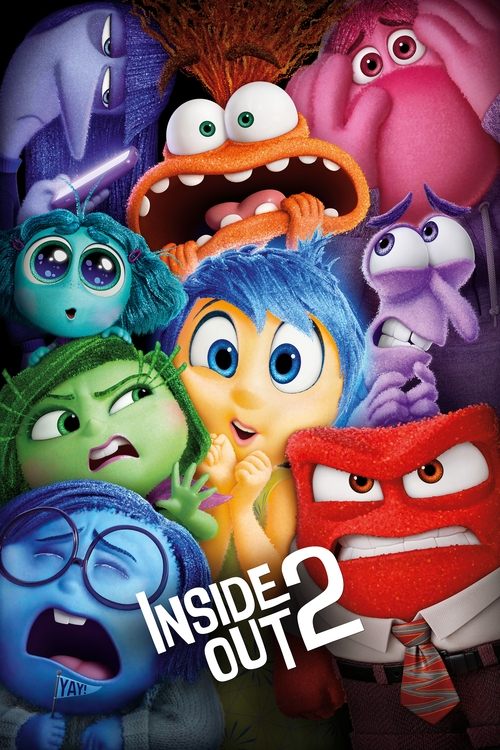
Inside Out 2
2024 · Kelsey Mann
For a family night that gives the adults as much to chew on as the kids, or for when you need a warm, wise movie about why your brain won't leave you alone. Comfort viewing that sneaks in a little therapy.
What it's about
Riley turns thirteen, and overnight the emotional headquarters in her head gets demolished for renovation: Anxiety arrives with moving boxes, trailing Envy, Embarrassment, and Ennui. While Riley spends a make-or-break weekend at hockey camp trying to impress the older girls, Joy, Sadness, and the original crew fight to keep her sense of self intact as the new management takes over.
The experience
Funny, bright, and fast on the surface, with a current of real recognition underneath — anyone who has ever spiraled at 2 a.m. will see themselves rendered in orange. It builds to moments that are genuinely moving without turning heavy.
Performances
Maya Hawke's Anxiety is the standout — jittery, well-meaning, and weirdly lovable — playing perfectly against Amy Poehler's relentless sunshine as Joy.
The craft
Pixar's visual imagination runs loose again: abstract ideas like a panic spiral or a buried memory become literal, candy-colored architecture you can watch characters climb through. The character animation wrings comedy from posture alone, and the film's design of a teenage mind is dense with blink-and-miss-it gags.
Why it matters
The top-grossing film of 2024 worldwide and by wide reporting the biggest animated release ever, it single-handedly reversed a rough stretch for theatrical animation — and put anxiety, the emotion, at the center of a mainstream conversation.
Snapshot
Inside Out 2 is Pixar Animation Studios' sequel to Pete Docter's Inside Out (2015), returning to the interior world of Riley Andersen's mind at the moment she crosses into adolescence. Where the first film dramatized the tug-of-war between Joy and Sadness in the psyche of an eleven-year-old, the sequel stages a hostile takeover: the arrival of Anxiety and a cohort of new, "grown-up" emotions—Envy, Ennui, Embarrassment—as thirteen-year-old Riley attends a weekend hockey camp and tries to secure a place among older players. It marked the feature directorial debut of Kelsey Mann, a Pixar veteran best known for story work, and became a commercial phenomenon: it was the top-grossing film of 2024 worldwide and, by wide reporting, the highest-grossing animated film ever released, a result that decisively reversed several years of anxiety about Pixar's theatrical viability. Critically, it was received as a warm, emotionally intelligent crowd-pleaser—more conventional in structure than its predecessor, but singled out repeatedly for its depiction of anxiety and, in particular, a climactic panic-attack sequence.
Industry & production
The film was produced by Pixar and released through Walt Disney Studios in June 2024. It was produced by Mark Nielsen, with Pete Docter—by then Pixar's Chief Creative Officer—overseeing as an executive presence rather than director. The project's institutional stakes were unusually high. Pixar had spent the pandemic years watching three consecutive features (Soul, Luca, Turning Red) diverted to Disney+ rather than theaters, and its subsequent theatrical returns (Lightyear in 2022, Elemental in 2023) had underperformed relative to the studio's historic standard, with Elemental recovering only through a long tail of word of mouth. Against that backdrop, a sequel to one of Pixar's most beloved and most awarded originals functioned as a deliberate consolidation of proven material. The gambit succeeded on a scale that exceeded even internal expectations; the film's grosses restored confidence in Pixar's core model and in the theatrical appetite for family animation broadly. Reporting around the release also connected the film to a period of restructuring at Pixar, including workforce reductions—context worth flagging as the industry backdrop, though the specifics of internal decision-making are outside the verifiable public record and should not be overstated.
Technology
Inside Out 2 was made with Pixar's proprietary pipeline built around the USD (Universal Scene Description) framework and rendered with RenderMan, the studio's own physically based renderer. The production's central technical problem was one of design more than raw computation: the interior "Mind World" is a fantasia of abstracted architecture, glowing memory spheres, conveyor systems, and non-naturalistic light, and the sequel had to expand that world—adding new zones such as the "Sense of Self" and the vault of suppressed feelings—while keeping it legible and continuous with the 2015 film. Pixar's tools for volumetrics, subsurface scattering, and stylized illumination allowed the emotion characters to read as luminous, semi-translucent beings whose surfaces suggest static or particle energy rather than skin. The film continues Pixar's long-running practice of caricatured, non-photoreal character design for the emotions set against more grounded rendering for the "real world" of Riley's body, camp, and family. Beyond these established pipeline capabilities, granular claims about bespoke software written specifically for this production are not well documented in the public record, and I will not invent them.
Technique
Cinematography
As with all Pixar features, "cinematography" here means virtual cinematography—camera placement, lensing, and lighting designed within CG space, and typically split at Pixar between a director of photography for camera and one for lighting. The film's visual grammar distinguishes two registers. Riley's exterior world is shot with relative restraint: steady framings, naturalistic depth of field, the observational coverage of a live-action family drama. The Mind World, by contrast, is expansive and mobile, with sweeping crane-like moves through vast interior spaces and dramatic, saturated key lighting that codes emotional states in color. Anxiety's takeover is rendered partly through light and palette—an encroaching orange that suffuses Headquarters. I am not able to confirm the specific names of the film's directors of photography from memory with confidence, and rather than misattribute credit I flag that here; the craft descriptions above hold regardless.
Editing
The editing carries the film's dual-track structure, cross-cutting between the literal action of Riley at hockey camp and the allegorical action inside her head, so that a social misstep in the real world lands simultaneously as a mechanical crisis in the Mind World. The escalating rhythm of the third act—building to the panic-attack sequence—depends on cutting that tightens as Anxiety's control spirals. The specific editor's credit is not something I can verify with certainty, and I decline to guess a name.
Mise-en-scène / staging
The production design is the film's most expressive instrument. The Mind World is an authored landscape whose geography externalizes psychology: Headquarters as control room, the memory shelves, and the new "Belief System"—a vault where strands of memory braid into the glowing tree of Riley's Sense of Self, the literalized image of who she believes herself to be. Anxiety's staging is pointed: she commandeers Headquarters and installs a sweatshop-like "imagination" bullpen of workers generating catastrophic future scenarios, a comic-industrial image of the anxious mind projecting worst cases. Character staging leans on the ensemble contrast between the original five emotions—now a settled, slightly middle-aged team—and the jittery, angular newcomers, with Anxiety's frazzled orange silhouette and darting movement designed to disrupt the composed geometry the older emotions occupy.
Sound
The score is by Andrea Datzman, who took over the franchise's music from Michael Giacchino, composer of the original film; Inside Out 2 represents a marquee solo feature-scoring credit for her within Pixar. The music tracks the film's emotional architecture, shifting from the warm, wistful thematic material associated with the established emotions toward more agitated, propulsive writing as Anxiety ascends. Sound design contributes materially to the anxiety motif—the accelerating, overwhelming aural build of the panic-attack sequence is one of the film's most discussed effects, using density and rhythm of sound to simulate a physiological state rather than merely illustrate it.
Performance
The voice cast blends returning and recast performers. Amy Poehler returns as Joy, Phyllis Smith as Sadness, and Lewis Black as Anger. Two of the original five were recast: Tony Hale takes over Fear from Bill Hader, and Liza Lapira takes over Disgust from Mindy Kaling. The new emotions are led by Maya Hawke as Anxiety—the performance the film is built around, calibrated between manic helpfulness and genuine menace—with Ayo Edebiri as Envy, Adèle Exarchopoulos as Ennui, Paul Walter Hauser as Embarrassment, and June Squibb as Nostalgia. Riley is voiced by Kensington Tallman, recast from the original film's Kaitlyn Dias to suit the character's older age. Pixar performance is a collaboration between vocal track and animation; the emotions' readability depends on animators translating vocal timing into caricatured physical acting, and Hawke's vocal restlessness is matched to Anxiety's twitchy, hyper-kinetic design.
Narrative & dramatic mode
The film operates in Pixar's signature mode of the externalized psychological allegory: an abstract inner process given literal characters, geography, and stakes. Its dramatic engine is a classic displacement structure—the protagonist we follow most closely (Joy) loses control of the world she governs to an antagonist (Anxiety) who is not evil but misguided, convinced she is protecting Riley. The screenplay, credited to Meg LeFauve (a writer on the original Inside Out) and Dave Holstein, runs two synchronized plots: Riley's realistic coming-of-age drama at camp, and the mythic quest inside her mind as the old emotions try to recover the discarded Sense of Self. Crucially, the film complicates the first movie's tidy resolution. Where Inside Out argued that Sadness has a necessary place beside Joy, the sequel argues against any single emotion—including Joy—curating a person's self-image, landing instead on a more mature acceptance of contradiction: a self made of "I'm a good person and I'm not."
Genre & cycle
Inside Out 2 sits at the intersection of the animated family film, the coming-of-age story, and the high-concept "conceptual allegory" that has become a Pixar house genre (alongside Soul and, in a different key, Turning Red). As a sequel it belongs to the studio's franchise cycle, and it is instructive to place it there: Pixar's sequels have ranged from the widely admired (Toy Story 3) to the commercially safe. Inside Out 2 is a sequel that leans into familiarity—reusing the original's premise, cast, and emotional beats—while advancing the concept just far enough (new emotions, a new developmental stage) to justify itself. Its adolescent subject also connects it to a broader 2020s cluster of animated films foregrounding puberty and mental health, of which Turning Red (2022) is Pixar's own nearest neighbor.
Authorship & method
The film is Kelsey Mann's feature directorial debut. Mann came up through Pixar's story department and brought a story-first sensibility rather than an established auteur signature, working within a studio culture where the director leads but development is famously collaborative and iterative (the Braintrust review process). His key collaborators define the work as much as he does: screenwriters Meg LeFauve and Dave Holstein; producer Mark Nielsen; composer Andrea Datzman; and the returning conceptual authorship of Pete Docter, whose original film supplies the world, rules, and tone the sequel inherits. In this sense Inside Out 2 is best read as institutional authorship—a Pixar film in the fullest sense, executed by a first-time director working inside a strongly established creative framework—rather than a personal vision. Detailed accounts of Mann's specific methods on the production are relatively thin in the public record, and I won't manufacture them.
Movement / national cinema
The film is a product of American computer-generated feature animation and, more specifically, of Pixar's Northern California studio tradition—the lineage running from Toy Story (1995) through the studio's establishment of CG animation as a prestige narrative form. That tradition is defined by technical leadership in rendering and simulation married to a screenwriting culture inherited from classical Hollywood emotional storytelling. As Disney-distributed Pixar product, it also belongs to the dominant American animation industry that competes with DreamWorks, Illumination, and the international imports of Studio Ghibli and others; its worldwide gross underscores the continued global reach of the Hollywood animated tentpole.
Era / period
Inside Out 2 is a post-pandemic film in both subject and circumstance. Circumstantially, it arrived as the theatrical recovery from COVID-19 disruption was still uncertain for family films, and after Pixar's own detour into Disney+ releases had blurred the studio's theatrical identity; its success was read as evidence that audiences would still turn out in force for the right animated event. Thematically, it is very much a film of the 2020s "mental health" moment—its central dramatization of anxiety as a distinct, nameable, manageable force in an adolescent mind spoke directly to a cultural conversation about teenage mental health, and much of the film's reception treated it as a useful tool for talking to young people about anxiety.
Themes
The film's governing theme is the construction of the self in adolescence—how a coherent identity ("Sense of Self") is assembled from memory and belief, and how puberty destabilizes it. Its central psychological argument is about anxiety specifically: that anxiety originates as protection, an attempt to plan for and control an uncertain future, but becomes destructive when it seizes total control and drowns out the fuller chorus of feeling. Around this sit related concerns: the loss of childhood's emotional simplicity; the social pressures of belonging and status among peers; nostalgia and the pull of the past (literalized in the character Nostalgia); and, most resonantly, the acceptance that a healthy self is not a curated flattering story but a contradictory whole that holds both good and bad. The panic-attack sequence is the thematic climax made visceral—the point at which the film stops explaining anxiety and instead makes the audience feel it before offering the relief of Joy's return and a more capacious, shared model of the self.
Reception, canon & influence
Critically, Inside Out 2 was received warmly, with broad praise for its emotional acuity, the invention of Anxiety as a character, and above all the panic-attack sequence, frequently cited as among Pixar's most affecting and formally daring passages. The most common reservation was structural: reviewers noted that the sequel plays it safer than the 2015 original, reprising a proven formula rather than breaking new conceptual ground, and that its novelty lies in refinement rather than reinvention. Commercially it was a landmark—the year's biggest film worldwide and, by wide reporting, the highest-grossing animated film ever—a result that reset expectations for Pixar and for theatrical animation after several lean years.
Looking backward, the film's influences are clear. Most directly it inherits everything from Pete Docter's Inside Out (2015). Behind that lies a long tradition of personified inner faculties: the medieval allegorical psychomachia, the British comics lineage of "The Numskulls," television's Herman's Head, and the general cultural habit of imagining the mind as a control room staffed by little operators. It also draws on Pixar's own accumulated craft in externalizing abstractions.
Looking forward, the film's most tangible legacy so far is industrial: it reaffirmed the commercial power of the Pixar theatrical event and the viability of the studio's franchise strategy, influencing the calculus behind subsequent Pixar and Disney release planning. Culturally, its clear, sympathetic dramatization of anxiety entered the popular vocabulary for discussing adolescent mental health, and the film has been widely adopted as a conversation-starter in that context. As it is a recent release, claims about its longer-term influence on filmmaking craft remain necessarily provisional, and I flag that the fuller arc of its legacy is still being written.
A Deleuzian reading
There's a room in this film where people sit at desks and draw.
The full Deleuzian reading of Inside Out 2 →
Reception
It arrived as Pixar's big comeback story — the film that 'saved' the 2024 box office and became the highest-grossing animated movie ever at the time — and has since settled into a gentler reputation: a beloved crowd-pleaser that cinephiles rank a clear notch below the 2015 original.
How Inside Out 2 was received, from release to now →
How to watch Inside Out 2: what to notice on a first viewing
- Watch the console in Headquarters and who is touching it. Every Headquarters scene sets up the same machine: a window that takes the world in, a board that sends behavior back out, and a crew arguing in the space between them. The room is a picture of the pause between seeing something and doing something about it.
- Watch orange seep into Headquarters and spread across the walls. Anxiety's takeover is staged as color. An encroaching orange fills the control room and keeps going, and the feeling of the place travels with the hue instead of being described by anyone. You can read how much control she holds from the temperature of the light alone.
- Watch a moment at hockey camp land inside her head. The film cross-cuts two plots. A social misstep on the ice arrives at the same instant as a mechanical crisis in the Mind World, and the cutting tightens as the weekend goes on. Cause and effect get shown twice, so the machinery behind a thirteen-year-old's behavior is always visible.
- Watch the workers drawing disasters in Anxiety's bullpen. She takes the room and immediately opens a factory. Desks, quotas, sketch after sketch of everything that could go wrong at camp, stacked and handed off. None of it will actually happen. The anxious mind here is not confused about the future. It is overproducing it on an industrial floor.
- Listen for Maya Hawke's voice speeding up and doubling back. Hawke pitches Anxiety between manic helpfulness and real menace, never finishing a thought at the speed she started it. The animators match that to a twitchy, angular body that will not settle. Voice and design run the same rhythm, which is how she breaks up the composed geometry the older emotions stand in.
The whole guide to watching Inside Out 2, with the keys for a rewatch →
Influences: the films it descends from and the films it influenced
- Inside Out (2015) — Supplies the entire externalized-mind grammar the sequel reprises: a Headquarters control-room set staffed by color-coded personified emotions who drive behavior via a physical console.
- Monsters, Inc. (2001) — Docter's method of literalizing an intangible abstraction (an emotional/energy economy) into a fully functioning industrial world with its own labor, machinery, and rules — the design logic Inside Out extends to the mind.
- Up (2009) — The wordless 'Married Life' montage established Docter's compression of an emotional arc through purely edited image-and-score, the technique behind the sequel's belief-system and memory montages.
- Osmosis Jones (2001) — Renders bodily function as a populated municipal city run by anthropomorphized agents — the direct precedent for staging an interior process as a workplace staffed by personified operators.
- Herman's Head (1991) — Stages the mind as an ensemble of four personified faculties arguing in a single control-room set that overrides the protagonist's choices — the dramaturgical template Inside Out formalized into cinema.
- Fantastic Voyage (1966) — Production design that renders the interior of a body as a navigable environment with its own weather, terrain, and hazards, establishing the 'inner-space-as-landscape' convention.
- The Cabinet of Dr. Caligari (1920) — German Expressionism's externalization of a disturbed mind through distorted, painted sets — the root of psychology-as-production-design that Pixar reskins with color-coded lighting.
- Being John Malkovich (1999) — Literalizes consciousness as a physical architecture one can enter and traverse, treating the interior of a mind as a location with doors, passages, and rules.
- Eternal Sunshine of the Spotless Mind (2004) — Dramatizes memory and forgetting through practically collapsing and dissolving sets — the staging grammar behind Pixar's long-term-memory shelves and the 'memory dump.'
- Requiem for a Dream (2000) — Fuses rapid associative cross-cutting to escalating, rhythmic sound design to render a physiological spiral from the inside — the editing-and-sound DNA of the panic-attack sequence.
- Vertigo (1958) — The dolly-zoom: a single optical maneuver that externalizes an internal panic state as a bodily sensation, echoed in the panic sequence's aspect-ratio shift and spatial distortions.
- The Phantom Tollbooth (1970) — Animates abstract faculties — words, numbers, the Doldrums — as personified characters inhabiting an allegorical landscape, the conceptual-allegory mode Pixar inherits.
- Soul (2020) — Extends the externalized-abstraction production design to metaphysics, designing the 'Great Before' as a soft, rule-governed conceptual space where intangibles are given shape and staff.
- Turning Red (2022) — Externalizes adolescent emotional dysregulation into a literal physical transformation, sharing the 2020s coming-of-age-as-mental-health register and metaphor-made-visible strategy.
- Elemental (2023) — Personifies abstractions (the elements) as characters while pushing the same volumetric subsurface-scattering and translucency rendering pipeline used to give emotions their glowing, semi-transparent bodies.
Similar films
- Inside Out (2015) — influence & lineage · same viewing thread
- Monsters, Inc. (2001) — influence & lineage · same viewing thread
- Up (2009) — influence & lineage · same viewing thread
- Toy Story 5 (2026) — same viewing thread
- Toy Story 3 (2010) — same viewing thread
- Memoir of a Snail (2024) — same viewing thread
- Toy Story (1995) — same viewing thread
- The Wild Robot (2024) — same viewing thread
All the films related to Inside Out 2 →
Watch it with: curated runs of related films
- Pixar and the Fear of Being Replaced — Watch these together for Pixar's quiet obsession with obsolescence — the toy outgrown, the newer model, the town the highway forgot.
- Animation That Aches — A run of animated films that take loneliness, grief, and memory as seriously as any live-action drama — watch them in a row and the cartoon surface stops mattering.