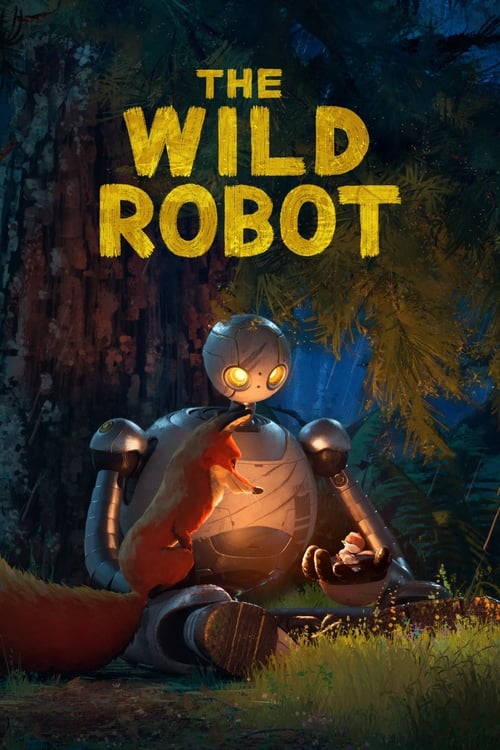
The Wild Robot
2024 · Chris Sanders
For a family movie night when you want everyone genuinely moved, not just occupied — or for when you need a good cry wrapped in something warm. Pure comfort with real emotional weight.
What it's about
A service robot named Roz washes ashore after a shipwreck on an island with no humans — only animals who see her as a monster. To survive, she learns their languages and their ways, and when she accidentally ends up responsible for an orphaned gosling, her programming collides with something it was never designed for: raising a child. Adapted from Peter Brown's beloved children's novels.
The experience
Gorgeous, funny, and disarmingly emotional — it moves fast enough for kids but keeps landing feelings squarely on the adults in the room. Expect to laugh at the animals and then get ambushed by the motherhood story; tissues are not optional.
Performances
Lupita Nyong'o voices Roz with a delicate arc from customer-service chirp to something warmer and stranger — a genuinely great vocal performance that carries the film's whole emotional journey.
The craft
DreamWorks abandoned its polished house style for painterly, hand-worked surfaces — brushstroke textures and impressionist light that director Chris Sanders described as 'a Monet painting in a Miyazaki forest.' With Kris Bowers' sweeping orchestral score, it's one of the rare animated films that truly demands the biggest screen and best speakers you can find.
Why it matters
It marked a turn back toward painterly, artist-driven animation at a major American studio and confirmed Chris Sanders — the sensibility behind some of modern animation's most beloved creature stories — as one of the form's great directors of tenderness.
Chris Sanders — the sensibility behind Lilo & Stitch and How to Train Your Dragon, animation's great chronicler of feral creatures learning tenderness — adapted Peter Brown's beloved novels into DreamWorks' most artistically ambitious film in years. A service robot washes ashore on an island without humans and must learn the languages of geese, possums, and bears; what begins as a survival mechanism becomes, unmistakably, motherhood. The story's emotional directness is matched by a radical visual choice: the studio abandoned its polished house style for painterly, hand-worked surfaces, brushstroke textures and impressionist light that Sanders described as 'a Monet painting in a Miyazaki forest.' Lupita Nyong'o voices Roz with a delicate arc from customer-service chirp to something warmer and stranger, and Kris Bowers' orchestral score does heavy emotional lifting without embarrassment. In an era when American studio animation had settled into algorithmic safety, this was a reminder of what the medium's craftspeople can do when handed a story about wildness — and allowed some of their own.
A Deleuzian reading
A machine washes up on a beach and offers to help.
The full Deleuzian reading of The Wild Robot →
Reception
No reappraisal needed — it landed in autumn 2024 as an instant crowd-and-critic darling, the rare animated film adults admitted crying at. The only shift since: its awards-season loss turned it from 'sure thing' to 'the one that got robbed,' depending on who you ask.
How The Wild Robot was received, from release to now →
Influences: the films it descends from and the films it influenced
- Lilo & Stitch (2002) — Sanders' own earlier film establishes his watercolor-washed backgrounds and the feral-creature-tamed-by-tenderness template — Stitch's 'genetic weapon softened into family' is Roz's arc rehearsed in 2D.
- How to Train Your Dragon (2010) — Sanders co-directed the wordless trust-building duet between human and creature, and imported Roger Deakins's naturalistic lighting consultancy — the silent Roz-and-Brightbill bonding is Hiccup-and-Toothless refined.
- Bambi (1942) — Tyrus Wong's atmospheric, impressionist background paintings and the off-screen death of the mother supply both the painterly forest and the maternal-loss beat the film reprises.
- My Neighbor Totoro (1988) — Miyazaki's soft-edged watercolor nature, unhurried 'ma' pacing, and benevolent wilderness are the explicit 'Monet in a Miyazaki forest' target of the film's lighting design.
- Nausicaä of the Valley of the Wind (1984) — Sets the nature-versus-technology grammar — machinery and ecosystem entangled — and the heroine who bridges the two, the conflict Roz literalizes as a machine embedded in a living wood.
- Princess Mononoke (1997) — Hand-painted teeming ecosystems and the collision of industrial technology with a sentient forest model the film's dense wildlife staging and its tech-in-the-wild tension.
- The Iron Giant (1999) — The archetype of a machine built as a weapon that chooses gentleness and self-sacrifice — 'you are who you choose to be' — is the moral engine of Roz overriding her programming.
- WALL-E (2008) — A near-dialogue-free first act in which a robot develops tenderness, shot with Roger Deakins's photographic lighting consult — the mute-machine-learns-to-love craft Sanders extends.
- Watership Down (1978) — Impressionistic, painterly rendering of the natural world married to unsentimental animal predation and death — the tonal license for the film's real-stakes wilderness.
- Klaus (2019) — Pioneered a bespoke volumetric-lighting tool that painted hand-drawn-style light and shadow onto CG, launching the painterly-CGI revival that Wild Robot's brushstroke pipeline continues.
- Puss in Boots: The Last Wish (2022) — DreamWorks' immediate in-house precursor whose stepped-frame, brushstroke 'storybook' look and hand-painted textures directly enabled Wild Robot's impressionist rendering pipeline.
- How to Train Your Dragon 2 (2014) — HTTYD co-creator Sanders reunites naturalistic light, wordless creature performance, and John Powell's orchestral scoring in a painterly frame that treats parenthood and loss with the same earned emotional weight.
- Hoppers (2026) — Put a machine in a forest and made learning animal speech the plot's central technical and dramatic problem; Hoppers inverts the same device — an animal-shaped machine carrying a human — which makes it legible as a deliberate answer rather than a coincidence.
- The Red Turtle (2016) — A Ghibli co-production telling a wordless survival-to-belonging fable on a wild island in watercolor minimalism — the same dialogue-light interspecies-family register.
- Spider-Man: Into the Spider-Verse (2018) — Broke from photoreal rendering toward stepped frames and visible illustrative marks, legitimizing the non-photoreal, hand-worked CG aesthetic Wild Robot pushes toward oil-painting.
- Wolfwalkers (2020) — Cartoon Saloon's hand-drawn painterly wildness treats the forest as a living, mark-made character and centers a feral child — the same painterly-revival ethos in 2D.
- Big Hero 6 (2014) — Baymax establishes the nurturing-robot-as-reluctant-caregiver figure — a machine whose programd function becomes tenderness — the character logic Roz inherits.
- Flow (2024) — A contemporaneous, fully dialogue-free animal-survival fable in which solitary creatures form an improvised interspecies family amid indifferent nature — the same wordless survival-to-belonging craft.
- The Boy and the Heron (2023) — Sustains the hand-painted Ghibli surface — grief, motherhood, and a boy crossing into a wild otherworld — that Wild Robot deliberately emulates through CG rather than ink and paint.
Similar films
- Lilo & Stitch (2002) — influence & lineage · same viewing thread
- Flow (2024) — influence & lineage · same viewing thread
- How to Train Your Dragon (2010) — influence & lineage
- The Boy and the Heron (2023) — influence & lineage
- Big Hero 6 (2014) — influence & lineage
- Wolfwalkers (2020) — influence & lineage
- WALL·E (2008) — influence & lineage · same viewing thread
- Robot Dreams (2023) — same viewing thread
All the films related to The Wild Robot →
Watch it with: curated runs of related films
- Animation That Aches — A run of animated films that take loneliness, grief, and memory as seriously as any live-action drama — watch them in a row and the cartoon surface stops mattering.