Klaus
2019 · Sergio Pablos
For a cozy night in when you want the good kind of Christmas movie — the one that earns its warmth instead of assuming it. Pure comfort, great with kids or without them.
What it's about
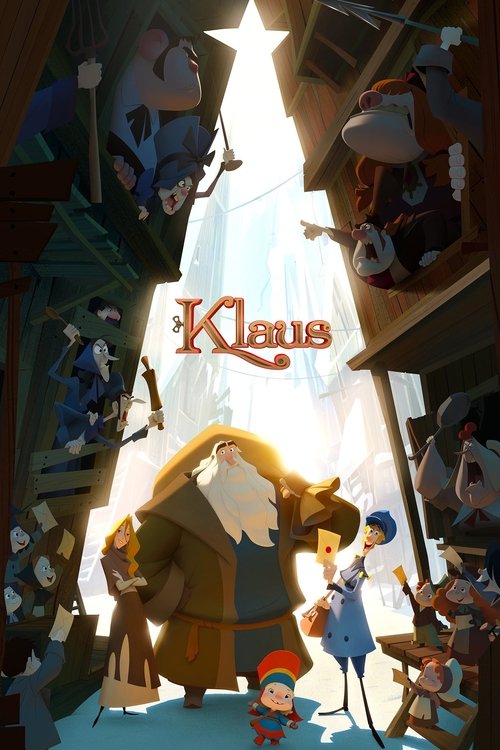
A spoiled postman is exiled to a frozen island town so consumed by an ancient feud that nobody sends letters at all. Desperate to hit his delivery quota and get home, he stumbles into a partnership with a reclusive woodsman whose cabin is full of handmade toys — and their scheme to move mail starts quietly rewiring the whole miserable town. It's a Santa Claus origin story built from scratch, with sled chases, scheming clan matriarchs, and one very determined little girl who wants to be a teacher.
The experience
Warm without being sugary — it's genuinely funny, a little wicked around the edges, and then sneaks up on you with real emotion in the final stretch. The pace is brisk and the whole thing glows; expect to get misty when you least expect it.
Performances
Jason Schwartzman voices the postman Jesper with perfect entitled-brat energy that makes his slow thaw land, and J.K. Simmons gives Klaus a gruff, wounded gravity well beyond the usual jolly-Santa register.
The craft
Hand-drawn animation lit like nothing else: SPA Studios developed software that wraps 2D drawings in volumetric light and shadow, so every frame has the depth of a painting while keeping the warmth of the pencil line. The snowbound town at dusk, lantern light on drifts, a workshop full of firelit toys — it's a gorgeous film that rewards a big, dark screen.
Why it matters
Made by the man who dreamed up Despicable Me, it proved hand-drawn features could still stun in a CG-dominated industry, earned an Oscar nomination as Netflix's first animated feature, and instantly joined the modern Christmas canon.
Sergio Pablos had already helped invent one modern franchise — he devised the concept for Despicable Me — before returning to Madrid to attempt something far riskier: a hand-drawn feature in an industry that had declared the form dead. His answer to the Santa Claus origin story follows a spoiled postman exiled to a feuding town in the frozen north, where an accidental partnership with a hermit woodsman begins to thaw generations of spite. The breakthrough is technical and visible in every frame: SPA Studios lit its 2D drawings with software that wraps them in volumetric light and shadow, giving flat animation the depth of paint without surrendering the warmth of the pencil line. The screenplay's central conceit — that one genuine act of goodwill mechanically triggers another — gives the sentiment an almost clockwork elegance. Netflix released it as the platform's first original animated feature; it took the BAFTA, earned an Oscar nomination, and its crew list reads as a roll call of veteran hand-drawn artists given one more chance at the craft they trained for.
A Deleuzian reading
A face turns toward a lamp and the shadow slides across it.
The full Deleuzian reading of Klaus →
Reception
Dropped quietly on Netflix in November 2019 and became a word-of-mouth phenomenon almost overnight — within a couple of Decembers it went from 'that new Netflix cartoon' to permanent fixture on the annual Christmas rewatch rotation and a rallying flag for the hand-drawn animation revival.
How Klaus was received, from release to now →
Influences: the films it descends from and the films it influenced
- Bambi (1942) — Its multiplane-camera staging and layered watercolor forests are the origin of Klaus's painterly depth — the sense of atmospheric distance built by stacking illustrated planes rather than modeling 3D space.
- Sleeping Beauty (1959) — Eyvind Earle's flat-yet-graphic, hard-edged background stylization is the art-direction lineage behind Klaus's angular, designed shapes that reject soft Disney rounding for a bold illustrative silhouette.
- The Little Mermaid (1989) — The Disney Renaissance hand-drawn pipeline trained exactly the generation of veteran 2D animators (character acting via drawn line, not rig) that Sergio Pablos recruited to give Klaus its performance craft.
- Tarzan (1999) — Pablos animated on it and absorbed its 'Deep Canvas' system for painting 2D characters into dimensional environments — the direct conceptual seed of Klaus's volumetric-lighting attempt to give hand-drawn forms 3D-feeling light.
- The Iron Giant (1999) — Bird's model of grounding hand-drawn character warmth with restrained, invisible CG assistance is the hybrid-craft precedent for Klaus layering a digital lighting engine onto traditional 2D drawings.
- The Thief and the Cobbler (1993) — Williams's cult of meticulous, fully-rendered hand-drawn detail and complex drawn perspective is the maximalist 2D-craft tradition Klaus consciously revives against the CG default.
- The Snowman (1982) — Its soft crayon-textured hand-drawn surfaces married to a wordless winter-warmth Christmas tone prefigure Klaus's use of drawn texture and frozen-north palette to carry sentiment.
- Balto (1995) — Shares the drawn frozen-north staging vocabulary — sled runs, snowbound isolation, aurora skies — that Klaus stages its Smeerensburg geography and depth cues around.
- Despicable Me (2010) — Pablos originated its concept before founding SPA Studios; its comic-timing character-design DNA (broad silhouettes, gag staging) is the authorship bridge from his commercial CG work to Klaus.
- Song of the Sea (2014) — A contemporary hand-drawn feature that treats light and folkloric northern landscape as painterly design — the same revival-era commitment to 2D atmosphere that Klaus pushes with its lighting tool.
- Treasure Planet (2002) — Extends 2D/CG fusion the other direction — applying volumetric CG lighting and texturing to hand-drawn characters — proving the traditional-medium-plus-modern-tech thesis Treasure Planet argued for but couldn't commercially sustain.
- How to Train Your Dragon (2010) — Its hand-painted-look pipeline with hard directional firelight and cast shadow advances the same project HTTYD began — bringing live-action cinematographic lighting logic into stylized animation.
- Wolfwalkers (2020) — Extends Klaus's argument a year later, pushing hand-drawn line with painterly light and depth so far that it too competed for the Oscar — carrying the 2D-revival banner Klaus reopened.
- Puss in Boots: The Last Wish (2022) — Adopts the illustrative, brushstroke-visible, stepped-framerate 'painting come alive' look that Klaus and Spider-Verse legitimized, faking 2D painterliness inside a CG pipeline.
- The Wild Robot (2024) — Its impressionist, painted-light environments citing 'a Monet in the woods' descend from the Klaus-era permission to prize painterly, illustrated depth and volumetric light over clean render realism.
- The Secret of Kells (2009) — Cartoon Saloon's proof that a stylized, flat-graphic 2D feature could win awards against CG is the parallel hand-drawn-revival argument Klaus makes, both prioritizing designed illustration over volume.
- Ernest & Celestine (2012) — Its watercolor-textured, hand-drawn European feature look and gentle two-hander redemption warmth run in parallel to Klaus's craft of foregrounding painterly surface over slick rendering.
- Spider-Man: Into the Spider-Verse (2018) — The other 2018–19 landmark rejecting photoreal CG for illustrative, comic-book lighting and line — a sibling front in the same movement to put painterly non-photoreal light on stylized forms.
- Tangled (2010) — Fakes painterly volumetric lighting onto 2D characters, sharing Tangled's core mission of marrying hand-drawn warmth with rendered dimensional depth.
- Spider-Man: Across the Spider-Verse (2023) — Reintroduced volumetric painted lighting and shadow onto hand-drawn 2D so flat animation gains dimensional form, the inverse-direction experiment (depth into 2D) that parallels Spider-Verse's illustration-into-3D.
- Nimona (2023) — Netflix's flagship feature-animation gamble, engineering volumetric hand-drawn-look lighting to prove streaming-era 2D viability — part of the same platform-rescue animation economy that saved Nimona.
- The Little Prince (2015) — An artisanal-looking, non-franchise animated feature that reached audiences through streaming (Netflix), the same mid-2010s distribution shift that defined the film's US non-release and Netflix pickup.
Similar films
- Puss in Boots: The Last Wish (2022) — influence & lineage
- Song of the Sea (2014) — influence & lineage
- The Secret of Kells (2009) — influence & lineage
- Ernest & Celestine (2012) — influence & lineage
- The Wild Robot (2024) — influence & lineage
- Guillermo del Toro's Pinocchio (2022) — shared sensibility
- The Nightmare Before Christmas (1993) — shared sensibility
- The Son of a Thousand Men (2025) — shared sensibility