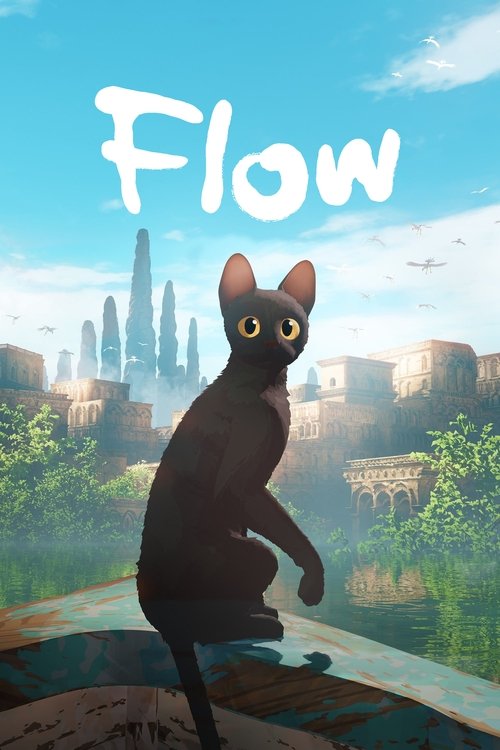
Flow
2024 · Gints Zilbalodis
For when you want something genuinely different — a calm, wordless spell of a film to watch closely and feel deeply, alone or with children, when talky movies feel like too much.
What it's about
A great flood swallows the world, and a solitary black cat scrambles aboard a drifting sailboat to survive. The boat fills with other refugees — a capybara, a lemur, a dog, a tall stubborn bird — none of whom speak, because no one in this film does. There are no humans and no words: just animals, behaving like animals, learning to share a small boat on an endless sea.
The experience
Quiet, tense, and unexpectedly moving — you lean in because there's no dialogue to carry you, and the film rewards that attention with moments of real suspense and grace. It's gentle enough for kids and somber enough to stay with adults for days.
The craft
Made by a tiny Latvian team in free open-source software, and it looks like nothing else in animation — a floating camera that glides through flooded ruins in long unbroken moves, water that feels alive, and a sound design of real animal voices and weather doing all the storytelling. Watch it loud and undistracted; the sound is half the film.
Why it matters
It won the Academy Award for Best Animated Feature — a first for Latvia — and became instant proof that a small independent team can beat the big studios at their own game.
Snapshot
Flow (Latvian: Straume) is a wordless animated feature directed by the Latvian filmmaker Gints Zilbalodis, following a solitary black cat that survives a cataclysmic flood by boarding a small boat and forming a fragile, improvised community with a capybara, a lemur, a golden retriever, and a secretarybird. The film carries no human characters and no anthropomorphized speech: the animals behave, more or less, like animals, and meaning is generated entirely through action, gesture, environment, and sound. Produced as a Latvian–French–Belgian co-production and built in the free open-source software Blender, it premiered in the Un Certain Regard section at Cannes in May 2024 and went on to an exceptional awards run, culminating in the Academy Award for Best Animated Feature and the Golden Globe in the same category — the first Latvian film to win an Academy Award, and a rare instance of a small-nation, independently produced animation triumphing over the American studio majors. Roughly 85 minutes long, it is a compact, immersive parable about survival, cooperation, and adaptation to a transformed world.
Industry & production
Flow was produced by Dream Well Studio (Latvia), Sacrebleu Productions (France), and Take Five (Belgium), with Matīss Kaža among the lead producers and also credited as co-writer. It was made on a budget that, by the standards of theatrical animated features, was extraordinarily modest — a fraction of what a Hollywood studio spends — a fact repeatedly emphasized in the film's reception as evidence that ambitious, world-class animation no longer requires a proprietary pipeline or a nine-figure spend. That economy was itself a production strategy: by building in Blender and keeping the core creative team small, Zilbalodis retained an unusual degree of authorial control for a feature at this scale.
The film's industrial significance lies in this contrast. It arrived at a moment when the dominant model for prestige animation — Pixar, DreamWorks, Illumination, and the streamer-financed features — was defined by large teams, dialogue-driven scripts, and star voice casts. Flow offered a counter-model rooted in the European auteur tradition and in the amateur-to-professional trajectory of open-source tooling. Its festival path reinforced this: after Cannes it played Annecy, the world's most important animation festival, where it was warmly received, before accumulating awards through the autumn and winter season. Its double Academy Award recognition — nominated for both Best Animated Feature and, as Latvia's official submission, Best International Feature — underscored that the film was read simultaneously as animation and as national art cinema, a dual identity that few animated films achieve.
Technology
The defining technological fact of Flow is that it was created in Blender, the free, open-source 3D creation suite, rather than in the proprietary software (Maya, Houdini, RenderMan and their kin) that underpins most studio animation. Zilbalodis and his team leaned into real-time and near-real-time rendering approaches associated with Blender's EEVEE engine, which allowed the small crew to iterate quickly and to treat the virtual camera almost like a live-action camera moving through a physical set. This workflow is central to the film's aesthetic identity: the fluid, searching camera movements that characterize Flow are a direct consequence of a pipeline in which the environment is a fully realized 3D world the camera can navigate freely, closer to how a camera operator moves through a video game level than to the shot-by-shot construction of traditional animation.
Crucially, the film does not chase photorealism. The water simulations, fur, and lighting are convincing and atmospheric but retain a legible, slightly stylized hand — surfaces read as painterly rather than as rendered-to-perfection CGI. This was a deliberate accommodation of the tools and the budget, and it became a virtue: the imperfection reads as texture and warmth rather than as limitation. Flow thus functions as a landmark case study in what open-source software makes possible for independent animation, and it has been widely cited within the Blender community as a proof of concept for feature work.
Technique
Cinematography
The most immediately distinctive element of Flow is its camera. Zilbalodis favors long, continuous, gliding movements that follow the cat and its companions through space with an almost documentary attentiveness, frequently withholding cuts to sustain immersion. The camera dips underwater, sweeps up into the air with the secretarybird, and threads through submerged architecture and forest canopy in unbroken arcs. The vocabulary is that of a third-person camera in an open-world video game — a lineage Zilbalodis has openly embraced — placed slightly behind and around the protagonist so that the viewer discovers the world at the animal's eye level and pace. This produces a strong sense of embodied presence and spatial continuity, and it is the film's signature.
Editing
Consistent with its cinematography, Flow is edited for flow, favoring longer takes and smooth spatial transitions over rapid cutting. The film's rhythm is set by movement — the drift of the boat, the surge of water, the flight of the bird — rather than by conventional shot/reverse-shot coverage, which would in any case be alien to a film without dialogue. Sequences build tension through duration and through the gradual revelation of environment. The editing's discipline is in restraint: it trusts the sustained image and the moving camera to carry emotional and narrative information that a more heavily cut film would spell out.
Mise-en-scène / staging
The staging is environmental storytelling in the purest sense. With no dialogue and no captions, every plot point — the rising water, the abandoned structures, the traces of a vanished human or larger civilization, the shifting alliances among the animals — must be communicated through what is placed in the frame and how the creatures move through it. The flooded world is dense with implication: colossal statues, drowned buildings, and the debris of an absent order suggest a mythic, post-human landscape without ever explaining it. The boat itself becomes a stage, a confined space where the drama of a reluctant, interspecies community is played out through proximity, body language, and the negotiation of shared space.
Sound
Because Flow has no spoken language, its soundscape does enormous narrative and emotional work. Animal vocalizations are naturalistic rather than cartoonish, and the sound design of water — lapping, roaring, dripping, submerging — is a constant, almost tactile presence. The score, composed by Zilbalodis with the percussionist Rihards Zaļupe, is integral rather than decorative, swelling and receding with the action and often carrying the emotional register that dialogue would supply in a conventional film. Music, ambient sound, and the animals' cries together form the film's entire "voice."
Performance
There are no human performances and no voice cast. The "acting" in Flow is entirely animation performance: the believability of the cat's wariness, the capybara's placidity, the lemur's acquisitiveness, the dog's eagerness, and the secretarybird's dignity. Zilbalodis and his animators grounded these characterizations in observed animal behavior rather than in anthropomorphic mugging, so that emotion is read through posture, hesitation, and small physical choices. The film's power depends on the audience projecting feeling onto creatures that never violate their species' physical logic — a difficult, restrained mode of character animation.
Narrative & dramatic mode
Flow operates in a wordless, fable-like register. Its narrative is linear and elemental — flood, flight, refuge, journey, survival — and it unfolds without exposition, backstory, or verbal explanation. The dramatic mode is closer to silent cinema and to the nature-observation tradition than to dialogue-driven animation: the film asks the viewer to infer, to watch, and to feel rather than to be told. Conflict is external (the flood, predators, the hostile environment) and internal to the group (the difficulty of cooperation among creatures who would not naturally trust one another). The absence of language universalizes the story and pushes it toward parable; the cat's arc, from solitary self-reliance to membership in a community, is the emotional spine.
Genre & cycle
Nominally an adventure–animation–family–fantasy film, Flow sits at the intersection of several traditions: the animal-survival narrative (a lineage that includes Watership Down and, in animation, films of anthropomorphic peril), the wordless art-animation feature, and the ecological/post-apocalyptic fable. Its most obvious contemporary companion is Michaël Dudok de Wit's The Red Turtle (2016), another dialogue-free, ecologically minded art-animation feature made within the European co-production system. But Flow diverges from the hand-drawn or painterly 2D of that lineage by rendering its world in fluid 3D, aligning it with a newer cycle of independent, tool-democratized computer animation. It also participates in a broader turn toward climate-inflected storytelling, its imagery of a drowned world resonating with contemporary ecological anxiety without ever stating a message.
Authorship & method
Flow is a strongly authored film, and understanding it requires understanding Zilbalodis's trajectory. His first feature, Away (2019), was an almost unprecedented solo effort: he directed, animated, wrote, and scored the entire film essentially alone, and it won the Contrechamp Award at Annecy. Flow represents a deliberate scaling-up from that solitary method into genuine collaboration, while preserving the same core sensibility — the fluid camera, the wordless storytelling, the fusion of art film and adventure.
The key collaborators are legible in the credits. Matīss Kaža served as co-writer and producer, helping to shape the narrative and to build the co-production that made the film possible. The score was composed by Zilbalodis together with Rihards Zaļupe, whose percussion gives the music its propulsive, elemental quality. Zilbalodis himself remained the central creative authority across direction, camera, and editing, making Flow an author's film in the European sense even as it was executed by a team. The method — build a complete 3D world in Blender, then "shoot" it with a freely moving virtual camera — is the connective tissue between his solo debut and this larger production.
Movement / national cinema
Flow is, above all, a milestone for Latvian and Baltic cinema. Latvia's film culture is small and historically constrained by resources, and the country had never before won — or, in the animated category, seriously contended for — an Academy Award. The film's success placed Latvia on the global animation map and demonstrated that a national cinema without a large industrial base could produce internationally dominant work by combining local talent, European co-production financing, and open-source technology. It belongs equally to a pan-European art-animation movement — the milieu of Annecy, of Sacrebleu Productions, of The Red Turtle — that values authorship, ecological and humanist themes, and formal experiment over franchise storytelling.
Era / period
Flow is a product of the mid-2020s, a moment defined by two convergent forces. First, the maturation of free and open-source creative tools, above all Blender, to a point where they could rival proprietary studio pipelines — a democratization that Flow exemplifies and accelerated. Second, a cultural climate saturated with ecological unease, in which images of flooding and a post-human world carry immediate contemporary charge. The film also arrived amid an industry conversation about the sustainability and homogeneity of big-studio animation, and it was received in part as a corrective — proof that the era's most acclaimed animated feature could come from outside the major studios entirely.
Themes
The film's central themes are survival, adaptation, and cooperation across difference. The cat, initially self-sufficient and solitary, must learn to depend on and coexist with creatures unlike itself; the boat becomes a microcosm of a community forged by necessity rather than affinity. Water is the governing image — destructive and transformative, a force that erases an old order and demands new ways of living. The drowned statues and structures gesture toward the disappearance of a prior civilization (whether human or otherwise is left unstated), lending the film a mythic, elegiac undertone. Above these runs an ecological allegory that the film never verbalizes: a world remade by rising water, in which survival depends on solidarity. The wordlessness keeps all of this open, resisting a single didactic reading.
Reception, canon & influence
Critically, Flow was among the most acclaimed films of its year, widely praised for its immersive camera, emotional restraint, and the humane intelligence of its animal characterizations. Its awards record is the clearest measure of its standing: after its Cannes Un Certain Regard premiere and its Annecy run, it won the Golden Globe for Best Animated Feature and then the Academy Award for Best Animated Feature, while also earning a Best International Feature nomination as Latvia's submission — a historic first for the country. This trajectory moved it, almost immediately, into the canon of significant twenty-first-century animation and into the smaller canon of major wordless features.
Looking backward, the influences on Flow include the wordless, ecological art-animation of The Red Turtle; the animal-survival tradition; the humanist adventure spirit of Studio Ghibli and Hayao Miyazaki, to whom Zilbalodis's work is often compared; and, distinctively, the spatial grammar of open-world video games, which shapes its roaming third-person camera. Zilbalodis's own Away is the most direct antecedent, establishing the method and sensibility that Flow refines.
Looking forward, the film's most concrete legacy is likely to be industrial and technological: as a high-profile demonstration that a Blender-built, modestly financed, small-team feature can win the industry's top honors, it has become a rallying reference for independent and open-source animators and a challenge to the assumption that world-class animation requires studio-scale resources. Its influence on aesthetics — the sustained, gliding virtual camera and the confidence to tell a feature-length story without a single word — is already visible as a model that other independent animators cite. Because the film is recent, claims about its long-term influence remain provisional; what is already clear is that Flow durably expanded the sense of what independent animation, and a small national cinema, can achieve.
A Deleuzian reading
The camera walks the cat down to the waterline and then does something a camera has no business doing.
The full Deleuzian reading of Flow →
Reception
An underdog from the start — a dialogue-free Latvian indie made in free software that premiered quietly in Cannes's Un Certain Regard, then snowballed through the 2024–25 awards season into an Oscar win over Pixar. Less a reappraisal than a real-time little-engine-that-could story the internet rooted for.
How Flow was received, from release to now →
How to watch Flow: what to notice on a first viewing
- Watch the camera dip under the water and come back up. Zilbalodis moves a virtual camera through a finished world rather than building each shot to fit a frame. It goes under the surface, rides the boat, lifts with the bird. The space behind the frame really exists in the file, so the camera can go anywhere. You feel a place, not a set of pictures.
- Listen for water underneath every scene. Lapping, dripping, roaring, submerging. Animal cries stay naturalistic, never cartoon voices. The percussion score by Zilbalodis and Zaļupe rises and falls with the action instead of decorating it. With no dialogue, sound carries the whole story. The mix tells you where you are and how close the danger is.
- Notice where the camera sits relative to the cat. It rides slightly behind and beside her, at her height, the way a third-person game camera follows a player. Most of the time you are watching an animal watching. You learn the world at the cat's pace and eye level, so you find things out exactly when she does.
- Look at the statues and buildings standing in the water. Colossal carved figures, flooded rooms, the debris of an order that is gone. The film never explains who made them or where the water came from. The unexplained world presses on every frame. You keep inferring a history the film will not hand you.
- Watch how the cat holds her body when she is scared. The animators stay with observed animal behavior. No mugging, no cartoon faces. Wariness is a crouch and a tail. The lemur's greed is the way it holds objects. Feeling comes out of posture alone. You do the reading, which is how the animals stay animals and still move you.
The whole guide to watching Flow, with the keys for a rewatch →
Influences: the films it descends from and the films it influenced
- Away (2019) — Zilbalodis's solo debut established the exact method Flow refines — build a complete 3D world in Blender, then 'shoot' it with a freely roaming virtual camera and score it in-house.
- The Red Turtle (2016) — A dialogue-free ecological survival fable that carries all emotion through gesture, weather, and animal presence — the model for feature-length wordless art-animation Flow inherits.
- Watership Down (1978) — Treats animals with genuine mortal stakes and observed field behavior rather than cute anthropomorphism, the naturalistic characterization Flow extends by removing speech entirely.
- The Plague Dogs (1982) — Unsparing animal-survival realism staged at ground level from the creatures' physical vantage, refusing reassurance — the tonal restraint Flow adopts in its flood-world.
- Bambi (1942) — Near-wordless animal-POV naturalism whose forest-fire and flood set-pieces stage environmental catastrophe entirely from an animal's eye level, a template for Flow's rising-water peril.
- Nausicaä of the Valley of the Wind (1984) — Humanist eco-fable built on gliding flight camera and long wordless action passages, the Ghibli adventure sensibility Zilbalodis is repeatedly compared to.
- Journey (2012) — A wordless game whose roaming third-person camera and cooperation between mute strangers is the open-world spatial grammar Flow borrows for its virtual camera and its raft of mismatched animals.
- Sintel (2010) — A Blender Foundation open-movie proof that an open-source pipeline can produce cinematic 3D, the industrial precedent Flow vindicates by winning the Oscar on the same toolset.
- Rango (2011) — Carries Rango's virtual-camera principle furthest: the camera is treated as a physical object with mass and an operator, drifting, over-shooting pans and losing its subject, so that framing becomes a record of someone holding a rig rather than a placed viewpoint.
- Boy & the World (2014) — A feature with no dialogue at all, built on near-solo authorship and carrying meaning through non-verbal vocalization, camera movement and a leitmotif score — the clearest recent exercise of the permission Boy & the World won for the wordless, small-team animated feature.
- Gravity (2013) — Choreographs a freely floating virtual camera through fully CG space in extended unbroken takes, the same 'shoot a built 3D world with a liberated lens' logic Flow runs on a Blender budget.
- Children of Men (2006) — Threads sustained gliding long-takes through dense environmental storytelling so the world is read in continuous space rather than cut exposition — Flow's editing ethos in live action.
- 1917 (2019) — Constructs an apparently continuous gliding traversal of terrain as immersive spatial grammar, the same commitment to unbroken movement-through-place that governs Flow's camera.
- Robot Dreams (2023) — A festival-canon wordless animated feature that conveys an entire emotional arc through observed behavior alone, Flow's closest contemporary in the small canon of dialogue-free features.
- The Wild Robot (2024) — Contemporaneous ecological animal-survival tale of cooperation across species, using painterly naturalism and creature behavior — the studio-scale counterpart to Flow's indie method.
- Marona's Fantastic Tale (2019) — European art-animation told from an animal's subjective point of view, sharing Flow's commitment to rendering the world through a non-human gaze.
- Wolfwalkers (2020) — Auteur European art-animation that stages an environmental fable through a non-human perspective and roaming movement, a sibling in the wave Flow belongs to.
- Ernest & Celestine (2012) — Builds its story on cooperation between natural enemies who must trust each other to survive, the cross-difference bond Flow reworks among predator and prey on a raft.
- Hoppers (2026) — Sustained a floating, animal-height virtual camera through water simulation with no dialogue at all, forcing narrative onto animal behavior and fur-water interaction — the maximalist version of the wordless-observation passages Hoppers uses between its speech scenes.
- How to Train Your Dragon: The Hidden World (2019) — Takes the wordless-animal-pantomime premise to its limit — a feature with no dialogue at all, characters legible only through observed feline and canine behavior, carried by a continuously roaming virtual camera that behaves like a handheld operator following an animal.
Similar films
- The Wild Robot (2024) — influence & lineage · same viewing thread
- Robot Dreams (2023) — influence & lineage · same viewing thread
- The Plague Dogs (1982) — influence & lineage · same viewing thread
- Memoir of a Snail (2024) — same viewing thread
- Boy & the World (2014) — same viewing thread
- In Waves (2026) — same viewing thread
- Finding Nemo (2003) — same viewing thread
- Isle of Dogs (2018) — same viewing thread
All the films related to Flow →
Watch it with: curated runs of related films
- Animation That Aches — A run of animated films that take loneliness, grief, and memory as seriously as any live-action drama — watch them in a row and the cartoon surface stops mattering.