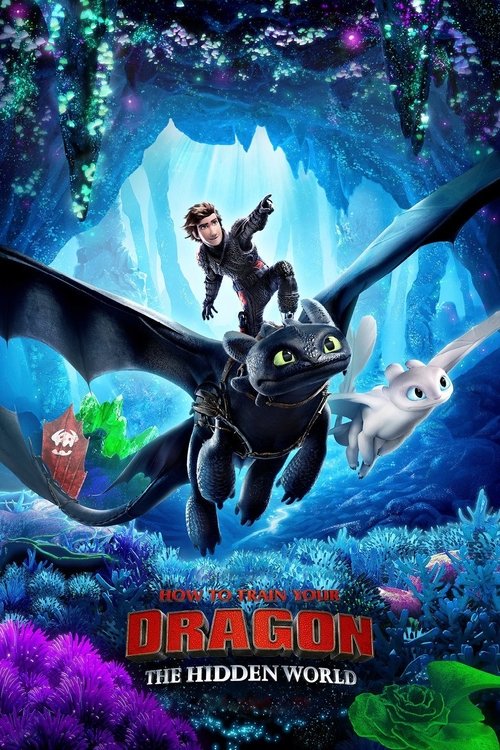
How to Train Your Dragon: The Hidden World
2019 · Dean DeBlois
For a family movie night when you want genuine adventure and don't mind crying a little — the rare kids' film that takes growing up and letting go seriously.
What it's about
Hiccup, now chief of Berk, has turned his village into a crowded haven for rescued dragons — so crowded it's drawing the wrong kind of attention. A ruthless hunter who has made a career of killing Night Furies sets his sights on Toothless, just as Toothless meets a wild female of his own kind and starts to feel a pull away from his rider. The search for a legendary hidden world safe for dragons forces Hiccup to weigh what leadership, and love, actually require.
The experience
Sweeping and openhearted, with real melancholy under the swashbuckling — it's a farewell film, and it feels like one. The flying sequences are pure exhilaration; the quieter passages between boy and dragon land with a lump in the throat.
The craft
Some of the most sumptuous lighting and atmosphere ever put in a mainstream animated feature — bioluminescent caverns, storm-lit seas, a courtship flight through clouds that begs for the biggest screen you can find. John Powell's soaring score, the trilogy's not-so-secret weapon, gets its richest workout here.
Why it matters
A rare thing: a blockbuster animated trilogy that planned its ending and stuck the landing, closing one of DreamWorks' most beloved series and cementing it as the studio's emotional high-water mark.
Snapshot
The third and final film of Dean DeBlois's How to Train Your Dragon trilogy is a closure machine. Its plot is a set of subtractions: Hiccup, now chief of a Berk so overrun with rescued dragons that it is visibly sinking under them, is hunted by a dragon-killer who has made a career of exterminating Night Furies; Toothless meets a female of his own kind and begins, in stages, to belong to her rather than to his rider; and the film's terminus is not a victory but a renunciation, in which the human characters send every dragon they love into a subterranean world and close the door behind them.
That ending is the film's reason for existing. DeBlois built the trilogy toward an etiological myth — an account of why there are no dragons now — and The Hidden World is structured backward from it. This gives the picture an elegiac register unusual in mainstream American animation, where franchise installments are more typically engines for continuation than for foreclosure. It also produces the film's central formal gamble: the entire romantic plot between Toothless and the Light Fury is conducted without a word of dialogue, in animal pantomime, for large stretches of the running time. A studio family film released at the scale this one was released at does not usually stake fifteen or twenty minutes of screen time on wordless courtship behavior observed from a distance.
The result was received as a handsome, moving, slightly slack conclusion — an assessment that has largely held. Its more durable significance is arguably technical and industrial: it emerged from DreamWorks Animation's absorption into NBCUniversal, it appears to have been the studio's first feature rendered on the in-house path tracer MoonRay, and it closed a photorealist chapter in DreamWorks' history that the studio would shortly and decisively abandon.
Industry & production
The Hidden World was produced by DreamWorks Animation in Glendale and released by Universal Pictures on 22 February 2019 in North America, with a number of international territories opening earlier in the year. It is the first film of the trilogy not distributed by Paramount, and that change of hands is the most legible trace of a corporate upheaval that ran straight through the production.
The film was announced years before it appeared and slipped repeatedly — a 2016 date became 2017, then 2018, then 2019. Two events account for most of that drift. In 2015 DreamWorks Animation undertook a severe restructuring, cutting its staff substantially, shuttering its Northern California facility, and reducing its annual release slate; in 2016, NBCUniversal acquired the company outright. A trilogy-capping film in active development is an awkward object to carry across a downsizing and an acquisition, and the delays should be read as the schedule absorbing that turbulence rather than as creative trouble. Bonnie Arnold, who produced both prior films, produced this one with Brad Lewis.
The cast returns nearly intact: Jay Baruchel as Hiccup, America Ferrera as Astrid, Cate Blanchett as Valka, Craig Ferguson as Gobber, Jonah Hill, Kristen Wiig, Kit Harington, and Gerard Butler as Stoick in flashback. Justin Rupple replaces T.J. Miller as Tuffnut. F. Murray Abraham joins as Grimmel the Grisly, the film's antagonist — a lean, courtly, almost bureaucratic hunter, deliberately designed against the bulk and bluster of Drago Bludvist in the second film.
Commercially the picture performed strongly, with worldwide receipts widely reported above half a billion dollars, though somewhat below the second film's total. I would treat any precise figure with caution: box-office reporting varies by source and by whether one counts re-releases, and this dossier is not the place to launder an approximate number into a fact. It was nominated for the Academy Award for Best Animated Feature, as both predecessors had been; none of the three won.
Technology
The film's most consequential technical fact is its renderer. DreamWorks had been developing MoonRay, a proprietary Monte Carlo path tracer, and The Hidden World is generally identified as the first DreamWorks feature to make full use of it. The studio subsequently released MoonRay as open-source software in 2023, which makes this film an unusual case: a piece of production infrastructure built for a specific set of images later became public property for the wider industry.
The distinction matters aesthetically, not just as trivia. Path tracing simulates light transport globally — bounce, scatter, and transmission are computed rather than approximated with rigged fills and cheats. The picture is built almost entirely around effects that reward this. The Hidden World itself is a vast bioluminescent cavern in which the light sources are the creatures and the crystalline geology, meaning that virtually every surface is lit by indirect, colored, moving illumination rather than by a key. Rendering that convincingly with older raster-and-fake-bounce approaches would have required an enormous amount of hand-authored cheating; a path tracer takes it as the ordinary case.
The Light Fury poses a second and stranger problem. Her scales are iridescent — the color shifts with viewing angle rather than being a fixed property of the material — and she can superheat them to become effectively invisible, refracting the environment around her. That is a shader problem of some delicacy: the audience must be able to read her presence as a shimmer without losing her, and the effect has to survive fast aerial motion. The film's solution is legible on screen as a kind of heat-mirage displacement rather than a clean transparency, which keeps her body implied throughout.
Alongside the renderer, the production continued to use the animation and lighting toolchain DreamWorks had introduced with the second film — a rebuilt system giving animators direct, more sculptural manipulation of characters at high fidelity rather than pushing rig controls at low resolution. That toolchain is a precondition for the film's animal performance work, which depends on very small facial and postural increments.
Technique
Cinematography
Roger Deakins served as visual consultant across all three films, as he has on a number of animated features, and The Hidden World is the entry where that consultancy is most conspicuous. The film is composed in scope, with an unusual willingness to hold wide, let figures be small, and use silhouette against sky as a primary expressive device. Its lighting logic is naturalistic to a degree that borders on austere for family animation: sources are motivated, contrast is allowed to go deep, and faces are frequently underlit or backlit rather than filled to legibility. Deakins had won his first Academy Award for Blade Runner 2049 barely a year before this film's release, and the trilogy's characteristic look — hard skies, low sun, atmosphere as a visible medium — is continuous with that live-action practice.
The camera also behaves, insistently, like a physical instrument. Flight sequences are staged with the vocabulary of aerial cinematography: long lenses that compress and lose the subject, whip-pans that fail to keep up, lens flare, rack focus, the suggestion of an operator chasing something faster than the rig. This is a rhetorical choice rather than a technical necessity — a virtual camera can be perfect — and it is what gives the flying its documentary charge.
Credit specifics deserve a caveat. CG features divide the cinematographer's function across lighting and layout/camera departments, and the resulting credits are inconsistently recorded across databases and press materials. Gil Zimmerman is associated with the lighting-DP role across the trilogy; I would treat fine-grained per-film attributions in this area as provisional rather than settled.
Editing
John K. Carr, who also cut the second film, is credited as editor. The film's cutting carries an unusual structural burden: it must sustain two parallel plots in different registers — a verbal, political one on Berk and a wordless, behavioral one between two dragons — and keep them rhyming rather than competing. The courtship sequences are cut long and patiently, with sustained two-shots and observational holds that resist the reaction-shot rhythm typical of the genre; the Berk material is cut faster and more conventionally. The intercutting is where the film does its thematic argument, placing Hiccup's negotiations with his own future beside Toothless's, so that each reads as commentary on the other.
The film's most-discussed weakness — a certain slackness in the middle stretch, an antagonist plot that idles — is fundamentally a structural rather than a scene-level problem. Grimmel is efficient as a threat and thin as a presence, and the cutting cannot manufacture urgency that the screenplay has not supplied.
Mise-en-scène / staging
Two designed spaces organize the film. The first is Berk itself, restaged as visibly overcrowded — dragons on every roof, in every doorway, in the water — so that the argument for departure is made environmentally before anyone articulates it. The second is the Hidden World, a cathedral-scaled subterranean ecosystem lit from within, staged for awe and for scale disparity: humans and their dragons are dwarfed by both the geology and by the creatures already living there. The design tells us plainly that this is not a place people belong.
Pierre-Olivier Vincent's production design (he served in that capacity across the trilogy) maintains the series' Norse-adjacent vernacular — carved timber, longhouses, weathered rope and iron — while pushing the natural world toward the sublime. The design of Grimmel is worth noting: pale, refined, dressed in a hunter's discipline rather than a warlord's armor, with his Deathgripper dragons kept chemically subdued. He is staged as a poisoner and a manager, an antagonist of process.
Sound
John Powell returns as composer, completing one of the more coherent scoring projects in modern American animation. The trilogy's thematic material — the soaring flight theme, the tender "forbidden friendship" figure — is treated here as memory: cues arrive in the third film already carrying nine years of association, and Powell exploits that by quoting themes in reduced, valedictory orchestrations rather than restating them triumphally. The instrumental palette remains Celtic-inflected — pipes, whistle, bodhrán, choir — set against a large orchestra. Jónsi, the Icelandic singer of Sigur Rós who contributed songs to both prior films, performs "Together From Afar" over the end credits, closing that thread as well.
The sound design carries the courtship plot almost single-handed. With no dialogue available, the film must communicate emotional state through vocalization — chirrs, clicks, growls, the Night Fury's plasma discharge — and through the ambient signature of environments. The Hidden World's soundscape is dense, wet, and reverberant, coded as a living organism rather than a cave.
Performance
The animation performance divides sharply. The human voice performances are naturalistic and comic in the established DreamWorks register; Baruchel's Hiccup remains built on hesitancy and self-deprecation, which is precisely the raw material the film needs for a leader who does not want authority, and Abraham gives Grimmel a dry, cultivated menace that is more interesting than the writing supporting it.
The animal performance is the film's real achievement, and it is a matter of animation rather than voice. Simon Otto, head of character animation across the trilogy, and his team stage the Toothless–Light Fury material as observed animal behavior — display, retreat, mimicry, misfired gestures — with a clear debt to natural-history filmmaking and, specifically, to the courtship displays of birds. The comedy in these scenes is behavioral: Toothless attempts a display, executes it badly, and the audience reads embarrassment without a single anthropomorphic facial cheat. It is a sustained demonstration that a mass-market animated film can carry a romance in pantomime.
Narrative & dramatic mode
The film operates in an elegiac mode organized around renunciation. Its dramatic question is not whether Hiccup can defeat Grimmel — that outcome is never seriously in doubt — but whether he can relinquish the relationship that has defined him since the first film. The screenplay therefore stages a series of graduated losses: Toothless's attention, then his dependence (his prosthetic tail is replaced with an autonomous one), then his presence.
Structurally the film runs on a doubling. Hiccup and Astrid's engagement and Toothless's courtship are the same plot at different levels of articulation, and the film's climax requires both couples to be constituted separately. That doubling also carries the argument: the film's ethical position is that love which requires possession is not stewardship, and that the correct expression of Hiccup's bond is to end it.
The narration frame — Hiccup speaking retrospectively, bookending the picture — converts the whole trilogy into a legend being told after the fact, which is what licenses the epilogue: years later, Hiccup, Astrid, and their children sail to the boundary of the Hidden World and are met, briefly, by Toothless and his offspring. The scene deliberately does not undo the separation. This is a fairly severe piece of dramaturgy for a family film, and it is the reason the ending has retained the reputation it has.
Genre & cycle
The film belongs to the "boy and his creature" tradition — The Yearling, The Black Stallion, E.T., Free Willy — whose structural obligation is the release of the animal at the end. The Hidden World is unusually explicit about inheriting that obligation, and it extends the release from a single creature to an entire species, converting the genre's private sacrifice into a civilizational one.
It also sits inside a specific late-2010s cycle: the deliberate completion of animated franchises as trilogies with valedictory endings. Toy Story 3 (2010) established the template; Kung Fu Panda 3 (2016) and this film followed. What distinguishes The Hidden World within that cycle is that it forecloses its own world rather than passing it on — there is no successor generation of dragon riders, because there are no dragons.
A third generic frame is the Western's civilization-and-wilderness structure, transposed. Berk's problem is that its frontier has closed; the dragons must go beyond settlement or be destroyed by it. The film's ending is functionally the same gesture as the departing gunfighter, applied to an entire ecology.
Authorship & method
DeBlois is the trilogy's authorial center and the reason it coheres. He co-directed the first film with Chris Sanders — the pair had previously made Lilo & Stitch (2002), which is recognizably the same idea in a different key: a lonely child, a dangerous non-human companion, a found family. He then wrote and directed the second and third films alone, and has consistently described conceiving the material as a three-part arc, with the aging-up of the characters and the eventual disappearance of dragons planned rather than improvised.
That plan is also a reconciliation with the source. Cressida Cowell's book series, which the films depart from almost completely in plot and character design, concludes with dragons withdrawing from the human world and an aged Hiccup narrating the loss. The films' finale converges on the books' finale even as the intervening material diverges — an unusual relationship between adaptation and original, in which fidelity is reserved for the ending alone.
The key collaborators are stable across all three films and constitute the real authorship: Powell on score, Deakins as visual consultant, Vincent on production design, Otto on character animation, Arnold producing, Carr cutting the last two. Franchise animation is not often granted this continuity of crew, and the trilogy's consistency of tone and look is largely attributable to it.
Movement / national cinema
This is a Hollywood studio film in its financing, distribution, and industrial logic, and it is not usefully assigned to a movement. It is worth noting, though, how transnational its creative sensibility is: DeBlois is Canadian, Powell British, Deakins British, Jónsi Icelandic, and the imagined world is a composite North Atlantic — Norse settlement architecture, Scottish and Irish musical idiom, Hebridean and Icelandic landscape. The trilogy is one of the more successful instances of American studio animation constructing a coherent regional imaginary rather than a generic fantasy.
Within American animation more narrowly, the film represents the high-water mark of DreamWorks' photorealist tendency — the strand that pursued live-action lighting logic, physically plausible materials, and camera behavior borrowed from cinematography — as against the studio's comedic-cartoon tradition.
Era / period
The Hidden World arrives at the close of the 2010s, in the middle of the industry's consolidation phase. DreamWorks Animation, once the principal independent challenger to Disney in feature animation, had by 2019 been absorbed into NBCUniversal; the Disney–Fox merger completed weeks after this film's release; Disney+ launched later the same year. The film is thus a late artifact of a competitive landscape that was in the act of disappearing.
It is also positioned just before a decisive aesthetic turn. Within a few years, DreamWorks would pivot hard toward stylization and painterly, lower-frame-rate, illustration-derived looks in The Bad Guys and Puss in Boots: The Last Wish (both 2022), following the influence of Spider-Man: Into the Spider-Verse, which opened only two months before The Hidden World. Seen from the other side of that shift, this film reads as the closing statement of an approach — maximum physical plausibility, live-action-derived photography — that the industry then largely set aside for mainstream animation. That framing is a critical reading rather than a documented studio decision, and should be taken as such.
Themes
The governing theme is stewardship as opposed to possession. The film argues that Hiccup's authority — over Berk, over Toothless — is legitimate only insofar as he is willing to give it up, and it tests this by making every good outcome contingent on a relinquishment. Its treatment of leadership is correspondingly unromantic: Hiccup's chieftainship is depicted as continuous with his father's failure and his own inadequacy, and the film's resolution is not that he becomes a great chief but that he makes a decision that costs him everything he wants.
Second is the incompatibility of wildness and domesticity. Berk's dragon utopia is presented sympathetically and then shown to be untenable: overcrowded, unsustainable, and an advertisement to hunters. The Light Fury is the argument in creature form — she is skittish around humans throughout, and never becomes a rideable companion. The film declines to let its own premise be reconciled.
Third is an ecological withdrawal narrative with a genuinely melancholy conclusion: the natural world's survival requires its removal from human reach. This is a darker proposition than the conservationist coexistence usually offered in family cinema, and it is not softened. The epilogue's brief reunion is explicitly a visit across a boundary, not a restoration.
Underneath all of these runs a coming-of-age structure completed by loss. The trilogy has aged its protagonist from adolescent to married chief across three films, and its final gesture is the one that adulthood is conventionally defined by: the surrender of the thing that made childhood extraordinary.
Reception, canon & influence
Critical reception was broadly positive, with a consistent shape to the reviews: near-unanimous praise for the animation, lighting, and flight sequences; strong praise for the wordless courtship material and for the ending's emotional weight; and recurrent reservations about a thin antagonist and a slack midsection. Critics widely treated it as a satisfying conclusion rather than the trilogy's strongest individual film, with the 2010 original and the darker second film both retaining partisans. It received an Academy Award nomination for Best Animated Feature and recognition at the Annie Awards; I would rather not itemize specific Annie categories than risk misattributing them.
The influences running into the film are legible. Cowell's books supply the premise and the ending. DeBlois and Sanders' Lilo & Stitch supplies the emotional architecture. Miyazaki is a persistent presence — the reconciliation of human society with a wounded natural order in Nausicaä of the Valley of the Wind and Princess Mononoke, and the ecstatic treatment of flight throughout his work — and DeBlois has acknowledged that debt in interviews. Deakins's live-action practice is the direct source of the photographic scheme. And natural-history filmmaking, particularly the long tradition of televised courtship-display sequences, is the model for the film's most distinctive passages.
Forward influence runs along three lines. Technically, MoonRay — proved out on this production and open-sourced in 2023 — is the most concrete legacy, a renderer developed for these images that became available to the industry at large. Aesthetically, the trilogy's demonstration that a mass-market animated feature could sustain long non-verbal creature performance has been widely absorbed, and its Deakins-derived approach to virtual cinematography is now near-standard practice in high-end animated features even as the surface styles have moved away from photorealism. Commercially and culturally, the property proved durable enough that DeBlois himself directed a live-action remake of the first film, released by Universal in 2025 with Gerard Butler returning as Stoick — an unusual case of a director remaking his own animated work in live action, and a sign that the trilogy's conclusion functioned as a canonical text rather than an endpoint.
The film's more interesting canonical position may be as a boundary marker. It is the last major statement of one animation aesthetic and one studio configuration, made by a creative team that stayed together across nine years to finish an argument they had started — a continuity that the industry, in its current shape, does not often permit.
Reception
Landed in 2019 to warm reviews and an Oscar nod but with a faint 'weakest of the trilogy' shrug; since then the trilogy has been canonized as DreamWorks' crown jewel, and the finale's reputation has only climbed as fans salute a blockbuster franchise that actually chose to end.
How How to Train Your Dragon: The Hidden World was received, from release to now →
How to watch How to Train Your Dragon: The Hidden World: what to notice on a first viewing
- Watch Toothless try to impress the white dragon without a sound. Simon Otto's animators stage display, retreat, mimicry, and badly executed moves, built from bird courtship in natural-history film. No dialogue. No cartoon face doing the work. You read the embarrassment off posture alone. A big studio family film hands its whole love story to animal behavior and trusts you to read it.
- Watch the camera lose Toothless during a fast flight. The flight scenes use long lenses that compress and drift off the subject, whip-pans that fall behind, lens flare, hunting rack focus. A virtual camera could be perfect. This one behaves like an operator. The imperfection is deliberate. Making the camera struggle to keep up is what gives the flying its documentary charge.
- Notice how often a face is backlit and half dark. Deakins consulted on all three films and this is where it shows most. Sources are motivated, contrast runs deep, and faces are not filled in for legibility. Figures often read as silhouettes against hard sky. The lighting refuses the bright, even look family animation usually takes for granted. Darkness is allowed to sit on the characters.
- Count the dragons on the roofs and in the water at Berk. Every doorway, roofline, and stretch of harbor is packed with rescued dragons. Nobody has said there is a problem yet. The production design says it in the background of each establishing shot. The film makes its case environmentally before anyone speaks it. Look at the crowding and you already know Berk cannot hold.
- Listen for the trilogy's flying music returning in a quieter arrangement. Powell has scored all three films. Here he quotes the familiar flight and friendship material in reduced, valedictory orchestrations instead of restating it big. Pipes, whistle, bodhran, and choir sit against the orchestra. Music that arrives already carrying nine years of association does work no new tune could. The scaling down is the feeling.
Influences: the films it descends from and the films it influenced
- Lilo & Stitch (2002) — DeBlois and Sanders' template for staging a dangerous non-human companion as a behaving animal rather than a talking sidekick — Stitch's affection is played entirely in ear-set, spine curl and eyeline, the same pantomime grammar that carries Toothless and the Light Fury's wordless courtship.
- How to Train Your Dragon (2010) — Establishes the film's two founding methods: Deakins' consultancy imposing motivated single-source lighting and real lens behavior on a CG feature, and the 'Forbidden Friendship' sequence's observational holds — long, cut-sparse takes in which a creature approaches, retreats and re-approaches with no dialogue to carry the beat.
- How to Train Your Dragon 2 (2014) — Introduces the simulated aerial camera that the third film systematizes — a virtual rig constrained to plausible helicopter/wingsuit physics with lag, roll overshoot and lens breathing — and seeds the Powell themes ('Where No One Goes', the Stoick material) that the finale recalls in fragmented, unresolved form.
- Nausicaä of the Valley of the Wind (1984) — The source of the trilogy's ecstatic flight vocabulary: gliding shot from a rider's shoulder with the horizon rolling under the frame, wind rendered as visible texture, and flight treated as an extended non-narrative sequence whose pleasure is its own justification.
- Princess Mononoke (1997) — Model for the renunciation ending as etiological myth — the wounded natural order withdraws rather than being defeated, and the film closes on a settlement in which human and non-human worlds are permanently separated, staged as loss rather than triumph.
- Bambi (1942) — The founding case of animators working from live-animal reference on the lot to derive weight, gait and startle response — the observed-animal-behavior discipline behind Toothless's cat-horse locomotion and the Light Fury's prey-animal caution.
- The Black Stallion (1979) — The live-action precedent for sustaining a wordless human-animal courtship across a full reel — the beach sequence's patient observational cutting, natural light and refusal to score over the silence is the structural model for the Hidden World's mating-display passages.
- E.T. the Extra-Terrestrial (1982) — Sets the parting-with-the-creature ending as a choreography of hands and eyelines held past comfort, with the score doing the articulating the dialogue refuses — the exact beat structure of Hiccup releasing Toothless at the fissure.
- The Assassination of Jesse James by the Coward Robert Ford (2007) — Deakins' practice here — practicals and sky as the only justified sources, deep falloff into unfilled shadow, faces read by silhouette — is the photographic scheme he transposed into the Hidden World's lighting rigs, where every key is traceable to a diegetic source.
- Skyfall (2012) — Deakins' Shanghai high-rise fight is the scope-silhouette shot the film repeatedly quotes: figures reduced to black shapes against a single saturated luminous plane, with all information carried by contour and negative space in the widescreen frame.
- Winged Migration (2001) — Pioneered the flying-alongside camera — a rig moving in formation with the animal, matching its speed so the subject appears static while the world streams past — the shot design the film's virtual camera reproduces in the Fury flight duets.
- The Lord of the Rings: The Return of the King (2003) — Precedent for the trilogy-closing valedictory coda: a long post-climax movement of separate farewells plus a time-jump epilogue with retrospective narration reframing the whole as a passed age — the structure of the Hidden World's dual-timeline ending.
- Puss in Boots: The Last Wish (2022) — Built on MoonRay, the path tracer proved out on this production; it inherits the renderer's global-illumination pipeline and then deliberately breaks the photoreal surface it was designed for — stepped framerate and painted specular — showing the tool outliving the aesthetic that justified it.
- The Wild Robot (2024) — Sanders extends the trilogy's bet that a mass-market feature can run long stretches on non-verbal creature performance, and reuses its lighting logic — a single naturalistic key from a low sun, animals staged in silhouette against it — under a painterly surface.
- How to Train Your Dragon (2025) — DeBlois re-shoots his own animated staging in live action, with the flight sequences' virtual camera language now executed by physical rigs and Powell rescoring his own themes — a direct transfer of animated blocking into photographic production.
- The Bad Guys (2022) — Same MoonRay lighting pipeline and the same Deakins-derived virtual camera discipline — motivated sources, physical lens limits, no impossible moves — applied to a graphic 2D-inflected style, isolating the cinematography method from the render style.
- Flow (2024) — Takes the wordless-animal-pantomime premise to its limit — a feature with no dialogue at all, characters legible only through observed feline and canine behavior, carried by a continuously roaming virtual camera that behaves like a handheld operator following an animal.
- Avatar: The Way of Water (2022) — Parallel solution to the same problem — bonding-with-a-flying/swimming-creature sequences built on a simulated camera obeying real optics and operator inertia, with the creature's assent conveyed through breath, eye contact and body pressure rather than speech.
Similar films
- How to Train Your Dragon (2010) — influence & lineage · same viewing thread
- How to Train Your Dragon (2025) — influence & lineage · same viewing thread
- Puss in Boots: The Last Wish (2022) — influence & lineage · same viewing thread
- How to Train Your Dragon 2 (2014) — influence & lineage
- Lilo & Stitch (2002) — influence & lineage
- Avatar: The Way of Water (2022) — influence & lineage
- The Wild Robot (2024) — influence & lineage
- Kung Fu Panda 2 (2011) — same viewing thread
All the films related to How to Train Your Dragon: The Hidden World →
Watch it with: curated runs of related films
- The DreamWorks Fable — A run of DreamWorks' own canon — the studio that answered Disney with ogres, pandas, Vikings and swashbuckling cats — half fairy-tale satire, half genuine heart.