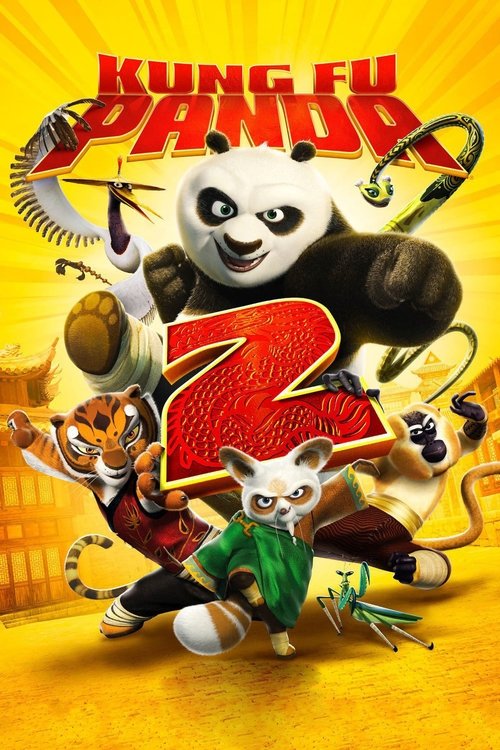
Kung Fu Panda 2
2011 · Jennifer Yuh Nelson
For family movie night when you want spectacle with soul, or when you're in the mood for an animated film that takes its emotions as seriously as its punchlines.
What it's about
Po the panda is living his dream as the Dragon Warrior when a new threat emerges: Lord Shen, an exiled peacock prince who has built a weapon that could end kung fu itself. As Po and the Furious Five race across China to stop him, Po is ambushed by fragments of a past he doesn't remember — and realizes he can't win the fight ahead without facing where he actually came from.
The experience
A fast, funny action-comedy with a surprisingly heavy heart — the slapstick and set pieces come rapid-fire, but the film keeps circling back to grief and identity with real sincerity. Kids get a romp; adults get something that stings a little.
Performances
Gary Oldman's voice work as Lord Shen is a genuine standout — silky, wounded, and menacing — opposite Jack Black's endlessly likable Po.
The craft
Jennifer Yuh Nelson stages the action with the eye of a story artist: fluid martial-arts choreography, bold reds and golds, and stylized 2D interludes for Po's memories that are among the most beautiful passages in studio animation of its era. It rewards the biggest, loudest screen you have.
Why it matters
Widely cited as the first animated feature from a major American studio directed solely by a woman, it pushed the franchise — and mainstream family animation — toward darker, more emotionally ambitious storytelling.
Snapshot
Kung Fu Panda 2 is the second installment of DreamWorks Animation's flagship martial-arts comedy franchise, and a film whose ambitions ran conspicuously ahead of the "bigger sequel" brief it was handed. Where the 2008 original was an underdog wish-fulfillment comedy, the sequel is a trauma narrative dressed as a family blockbuster: Po (Jack Black), now installed as the Dragon Warrior, must recover the buried memory of his origins—the massacre of his species—in order to defeat the peacock Lord Shen (Gary Oldman), who has industrialized war by inventing the cannon. The film is notable in production history as the feature directorial debut of Jennifer Yuh Nelson, the head of story on the first film, and is widely cited as the first animated feature from a major American studio to be directed solely by a woman. It arrived at the crest of the post-Avatar stereoscopic-3D boom and is remembered for the polish of its digital "cinematography," its fusion of CG with hand-drawn 2D interludes, and a surprisingly somber emotional register for its genre.
Industry & production
The film was produced by DreamWorks Animation, then a publicly traded studio operating independently of a parent conglomerate, with theatrical distribution handled by Paramount Pictures under the two companies' distribution agreement of that era. It was overseen by producer Melissa Cobb, who shepherded the franchise, and written by the returning screenwriting team of Jonathan Aibel and Glenn Berger. The original Kung Fu Panda (2008) had been a major commercial success and an Academy Award nominee for Best Animated Feature, establishing a franchise DreamWorks was eager to extend; a sequel was a corporate certainty well before its creative shape was settled.
The production sits squarely within DreamWorks' late-2000s house strategy: proprietary CG pipelines, star-driven voice casts, and premium 3D pricing. Kung Fu Panda 2 was designed and released in stereoscopic 3D at a moment when studios were converting nearly every tentpole to the format. Guillermo del Toro was attached to the studio during this period as a creative consultant and lent that role to the film, part of DreamWorks' attempt to raise the narrative sophistication of its output. Commercially the film performed strongly worldwide—grossing well over half a billion dollars, with the bulk of its receipts coming from international markets, China prominent among them—though it is generally understood to have earned somewhat less than the first film domestically. Precise figures should be checked against a box-office database rather than trusted to memory.
Technology
Kung Fu Panda 2 was produced on DreamWorks Animation's proprietary CG toolset of the period, the pipeline that had matured across Madagascar, Kung Fu Panda, and How to Train Your Dragon. Its most consequential technological context is stereoscopic 3D: the film was authored for the format rather than converted after the fact, and its staging—deep foreground-to-background compositions, objects thrust toward the lens—reflects that native design. The production also leaned on the studio's advances in lighting, fur and feather simulation, cloth, and volumetric effects, all stressed by a story full of smoke, fireworks, fire, water, and the reflective metal of Shen's cannons.
Technically the film's signature gambit is its integration of stylized traditional 2D animation into a CG feature. The prologue recounting the fall of the pandas, and later memory sequences, are rendered in a flat, painterly, quasi–shadow-puppet idiom drawn from Chinese visual art rather than in the volumetric CG of the main narrative. This is a deliberate technological and aesthetic seam—hand-drawn craft embedded within a computer-generated film—used to mark the register of myth and memory as distinct from the present-tense action.
Technique
Cinematography
The film's virtual camerawork is among its most admired features and is frequently described as unusually "live-action" in sensibility for a CG animation of its moment. Sequences are built around dramatic lensing choices—shallow focus, sweeping crane-like moves, silhouette and backlight—that borrow the grammar of wide-screen action cinema. This is consistent with DreamWorks' practice on the franchise and its neighbor How to Train Your Dragon of consulting live-action cinematographers to inform lighting and staging; the cinematographer Roger Deakins is well documented as a visual consultant on those DreamWorks productions of the period, and the lineage of that collaboration is visible in the film's naturalistic light. (The exact consulting credits for this specific installment are worth verifying against the film's official credits.) The palette is bolder and more operatic than the first film's, saturated reds and firelight against slate-gray city stone.
Editing
The editing carries an unusually wide tonal range for a family film, cutting between broad slapstick, kinetic martial-arts set pieces, and passages of near-silent grief. The action is assembled for legibility—longer held beats and clean spatial geography inside the choreography—rather than the fragmented cutting typical of contemporaneous live-action action cinema, a choice that lets the animated choreography read. The rhythmic contrast between the busy present-day sequences and the slow, hushed 2D memory inserts is a primary editorial strategy.
Mise-en-scène / staging
Production design, led by Raymond Zibach (who had designed the first film), grounds the picture in a stylized imperial China: the vertical stone architecture of Gongmen City, the peacock iconography of Shen's tower, misty mountain valleys, and the panda-country landscapes of the finale. Staging exploits scale relentlessly—Po dwarfed by cannons, tiny figures against vast skies—and organizes color and silhouette around the film's oppositions: the warm, rounded panda world against Shen's cold whites, metallics, and knife-edged forms. The peacock's plumage is used as a recurring compositional motif, at once beautiful and menacing.
Sound
The score is credited to Hans Zimmer and John Powell, the composing partnership that had scored the first film, and it weaves Chinese instrumentation and pentatonic color into a large orchestral idiom. Sound design foregrounds the film's central technological threat: the concussive report of the cannon, the hiss and crackle of gunpowder and fireworks, set against the softer textures of the panda village. The contrast between organic sound and the mechanized violence of Shen's weapon is one of the film's clearest thematic tools.
Performance
Vocal performance anchors the film. Jack Black modulates Po between comic bluster and genuine woundedness, and the screenplay gives him more interior register than the original did. Gary Oldman's Shen is a precise, wounded-aristocrat villain, brittle and vengeful rather than merely wicked. Dustin Hoffman returns as Shifu, and the returning ensemble—Angelina Jolie (Tigress), Jackie Chan, Seth Rogen, Lucy Liu, David Cross as the Furious Five, and James Hong as Po's adoptive father, Mr. Ping—fills out the world. Michelle Yeoh joins as the Soothsayer, a casting choice that quietly ties the film to the martial-arts cinema it venerates.
Narrative & dramatic mode
Structurally the film is a hero's-journey adventure whose true engine is a recovered-memory drama. The external plot—stop Shen's weapon before it destroys kung fu—runs parallel to an internal one: Po must confront the truth that he was orphaned in a genocide, and reconcile his adoptive identity (raised by a goose noodle-maker) with his biological origins. "Finding inner peace" operates as both the martial technique Po must master and the psychological work the story demands of him. The dramatic mode is thus more melodramatic and openly emotional than the comic first film, folding loss, adoption, and post-traumatic memory into a PG entertainment. The 2D interludes function as the narrative's unconscious, surfacing the past the present cannot yet speak.
Genre & cycle
The film belongs simultaneously to the American computer-animated family blockbuster and to the martial-arts genre it lovingly pastiches. Its DNA runs back through Hong Kong wuxia and kung fu cinema—Shaw Brothers choreography, the wire-work and mythic landscapes of King Hu and their inheritance in Crouching Tiger, Hidden Dragon, and the physical comedy of Jackie Chan. Within the animation cycle, it is a product of the late-2000s/early-2010s vogue for CG sequels and franchise-building at DreamWorks, and of the industry-wide 3D conversion moment. It also participates in a smaller cycle of animated films reaching for genuine emotional weight and darker stakes, a tendency associated with Pixar's prestige that DreamWorks was consciously pursuing in this period.
Authorship & method
The dossier's central authorship story is Jennifer Yuh Nelson. Korean-American, she rose through DreamWorks as a story artist, storyboarded the acclaimed dream sequence of the first film, and served as its head of story before being elevated to direct the sequel—her feature debut, and a landmark as the first solo-directed animated feature from a major U.S. studio helmed by a woman. Her background in story and boarding is legible in the film's emphasis on graphic staging, silhouette, and the seamless integration of the 2D memory passages, which reflect a storyteller's rather than a technician's instincts.
Her key collaborators include screenwriters Jonathan Aibel and Glenn Berger, who calibrated the tonal balance of comedy and grief; production designer Raymond Zibach, whose imperial-China world-building gives the film its look; and composers Hans Zimmer and John Powell, whose East-meets-orchestral score carries much of the emotion. Guillermo del Toro's involvement as a creative consultant belongs to this account as an external authorial pressure toward darker, more mythic material. The film's editor and full craft credits should be confirmed against the picture's official credits before naming individuals, as the public record on some below-the-line roles is thinner than on the marquee names.
Movement / national cinema
This is unambiguously a Hollywood/American studio production, but one whose subject and style are an extended act of homage to Chinese landscape, art, and martial-arts cinema. It is not a work of Chinese national cinema; it is an American reading of Chinese aesthetics, filtered through the DreamWorks pipeline. That said, its warm reception in the Chinese market and its careful sourcing of visual motifs from Chinese painting and architecture make it a notable case study in the transnational animation economy of the 2010s, in which American studios increasingly designed tentpoles with global—and specifically Chinese—audiences in mind.
Era / period
The film is a document of the 2011 animation landscape: the height of the post-Avatar stereoscopic 3D wave, DreamWorks Animation operating as an independent public company chasing Pixar's prestige, and the industrialization of the animated franchise. Its very plot—an artisanal martial-arts world menaced by the invention of gunpowder artillery—reads almost allegorically against its own moment, a film about tradition confronting a disruptive new technology, made by a studio betting everything on new technology. Its release also sits within a broader cultural conversation about representation behind the camera, given its director.
Themes
The film's dominant theme is the reconciliation of the self with a traumatic past—inner peace not as passivity but as the acceptance of what cannot be changed. Adoption and chosen family run beneath this: Po's arc affirms that the goose who raised him is his true father even as he learns the truth of his birth, a genuinely tender treatment of a subject animation rarely handles so directly. Around these sit the film's meditations on violence and progress—Shen's cannon as the birth of modern, mechanized, mass killing set against the embodied, disciplined art of kung fu—and on vengeance versus healing, with Shen and Po as mirror figures, each defined by the same wound met with opposite responses.
Reception, canon & influence
Critically the film was received warmly, generally regarded as equal to or better than the original, with particular praise for its visual beauty, its emotional ambition, and the sophistication of its virtual cinematography; some reviewers noted that its darker themes pushed at the edges of its family rating. It earned an Academy Award nomination for Best Animated Feature (the prize that year went to Rango), and Jennifer Yuh Nelson's achievement drew significant attention as a milestone for women directors in animation.
Looking backward, the film's influences are the martial-arts cinema of Hong Kong and greater China, the compositional traditions of Chinese landscape painting and shadow-puppetry, and the DreamWorks house style refined on How to Train Your Dragon, including that film's live-action-informed approach to virtual cinematography. Looking forward, it consolidated Kung Fu Panda as one of DreamWorks' durable franchises, leading to Kung Fu Panda 3 (2016)—which Yuh Nelson co-directed—television spin-offs, and a fourth feature in 2024. More broadly, it stands as an early, prominent example of an animated blockbuster taking on trauma, grief, and identity with real seriousness, and its director's career became a frequently cited reference point in ongoing discussions of authorship and representation in mainstream animation. Its precise commercial standing—including claims that it ranked among the highest-grossing films directed by a woman at the time—should be verified against box-office records rather than asserted from memory.
Reception
A solid hit in 2011 that's since been quietly canonized as the peak of the franchise — over the years the consensus has hardened that the sequel is where Kung Fu Panda got genuinely great, darker and more ambitious than anyone expected from a DreamWorks follow-up.
How Kung Fu Panda 2 was received, from release to now →
Influences: the films it descends from and the films it influenced
- Kung Fu Panda (2008) — Direct predecessor that set the template Yuh Nelson inherited as head of story—a virtual camera treating CG space like a live-action set, plus the Zimmer/Powell East-meets-orchestral scoring grammar the sequel deepens.
- How to Train Your Dragon (2010) — Established the DreamWorks 'live-action-informed' virtual cinematography (with Roger Deakins consulting) of long lenses, shallow focus, and lens flare that KFP2 adopts wholesale for its shot design.
- Crouching Tiger, Hidden Dragon (2000) — Yuen Woo-ping's weightless wire-fu—treetop duels and gravity-defying pursuit—supplies the choreographic vocabulary KFP2 pastiches in its rooftop and river chases.
- Once Upon a Time in China (1991) — Tsui/Yuen's rhythmic wushu blocking and Wong Fei-hung heroic-lineage staging model the film's ensemble martial choreography and its 'master and students' formation fighting.
- Drunken Master (1978) — Jackie Chan's comedic-acrobatic kung fu—turning clumsiness and props into fight beats—is the direct source of Po's clownish, improvisational physical comedy in combat.
- Enter the Dragon (1973) — Bruce Lee's one-against-many staging, holding a wide frame so each strike reads cleanly, informs KFP2's commitment to legible action editing over chaotic cutting.
- The Adventures of Prince Achmed (1926) — Reiniger's silhouette/shadow-puppet animation is the visual ancestor of KFP2's flat, shadow-play memory sequences and the film's recurring use of silhouette staging drawn from Chinese shadow theater.
- Pan's Labyrinth (2006) — Del Toro, KFP2's creative consultant, brought his method of mythic, unsettling fairy-tale design and a child's trauma treated with genuine dread, pushing the villain Shen and the darker register past family-film convention.
- How to Train Your Dragon 2 (2014) — Extends the shared DreamWorks lineage of live-action-informed virtual cinematography and John Powell's soaring thematic scoring that KFP2 helped consolidate as house style.
- Kung Fu Panda 3 (2016) — Yuh Nelson's own continuation extends KFP2's 2D-into-CG stylistic shifts into full spirit-realm painterly sequences and repeats its scale-contrast staging of Po against cosmic landscapes.
- Puss in Boots: The Last Wish (2022) — Advances the 2D-CG hybrid look with stepped 'on-twos' animation and comic impact-frame flourishes, applying that stylization to exactly the kind of storybook martial-arts action KFP2 pioneered at the studio.
- Spider-Man: Into the Spider-Verse (2018) — Pushes the 2D-drawn-over-CG hybrid and graphic, panel-legible action staging—line work, halftone, held silhouettes—into a new mainstream benchmark that KFP2's memory sequences anticipated.
- Rise of the Guardians (2012) — In-house precedent for the withheld-origin structure — trauma parcelled out in fragments and finally delivered in a memory sequence rendered in a visibly different medium and palette from the film around it, which is exactly how Jack's drowning flashback is staged.
- Hero (2002) — Zhang's painterly, color-coded chapters and figures dwarfed against vast monochrome landscapes are echoed in KFP2's scale-contrast compositions and its stylized 2D memory palettes.
- Kill Bill: Vol. 1 (2003) — The Production I.G 2D-anime villain-origin flashback embedded in a live-action revenge film is the same device KFP2 uses: hand-drawn 2D memory passages carrying the traumatic backstory inside a CG world.
- Mulan (1998) — An American studio's homage to Chinese art that pioneered ink-wash negative-space backgrounds and calligraphic staging—the same aesthetic translation KFP2 performs into stereoscopic CG.
- Samurai Jack (2001) — Tartakovsky's graphic, boarded-first action design—bold silhouettes, negative space, held-frame minimalism—parallels the storyboard-artist instincts Yuh Nelson brings to KFP2's silhouette combat.
Similar films
- Kung Fu Panda (2008) — influence & lineage · same viewing thread
- Puss in Boots: The Last Wish (2022) — influence & lineage · same viewing thread
- How to Train Your Dragon (2010) — influence & lineage · same viewing thread
- How to Train Your Dragon 2 (2014) — influence & lineage
- Crouching Tiger, Hidden Dragon (2000) — influence & lineage
- Mulan (1998) — influence & lineage
- Pan's Labyrinth (2006) — influence & lineage
- How to Train Your Dragon: The Hidden World (2019) — same viewing thread
All the films related to Kung Fu Panda 2 →
Watch it with: curated runs of related films
- The DreamWorks Fable — A run of DreamWorks' own canon — the studio that answered Disney with ogres, pandas, Vikings and swashbuckling cats — half fairy-tale satire, half genuine heart.