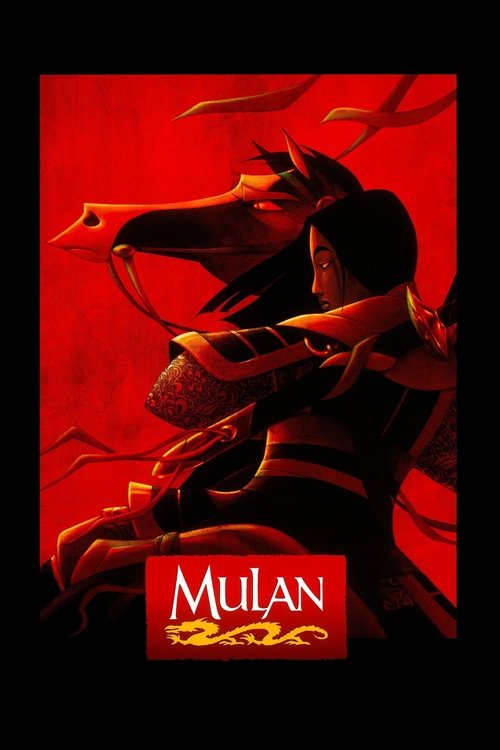
Mulan
1998 · Tony Bancroft
For a family movie night when you want adventure with actual stakes, or when you need an underdog story about proving everyone wrong. Pure comfort viewing that still has a spine.
What it's about
When the Huns pour over the Great Wall and Imperial China drafts one man from every family, a young woman cuts her hair, takes her ailing father's armor, and rides off to join the army in his place. If anyone discovers she's a woman, the penalty is death — so she has to survive brutal training, a war, and the daily performance of being someone she's not, with only a pint-sized guardian dragon and a lucky cricket in her corner. Underneath the musical numbers it's a story about a daughter who doesn't fit the mold her world offers, and what she does about it.
The experience
Warm and funny in the barracks, then genuinely sweeping when the war arrives — the mountain battle has real scale and dread for a family film. It moves fast, lands its jokes, and still finds room for quiet ache in the scenes between Mulan and her father.
Performances
Ming-Na Wen gives Mulan a dry, doubting intelligence rare in a Disney heroine, with Lea Salonga supplying her soaring singing voice; Eddie Murphy's motor-mouthed Mushu is one of the great sidekick voice performances, riffing at full speed without ever swamping the story.
The craft
The film pares back Disney's usual visual busyness in favor of negative space and washes of color borrowed from Chinese landscape painting — the avalanche and the Hun army cresting a snowfield are stunners built from thousands of moving figures. The songs are compact and purposeful, and 'I'll Make a Man Out of You' is a training montage that became an anthem.
Why it matters
One of the last high points of the Disney Renaissance and a landmark for an East Asian lead in a major American animated film — it became a generational touchstone and the seed of a franchise, including a live-action remake decades later.
Snapshot
Mulan is Walt Disney Feature Animation's thirty-sixth animated feature and one of the last major entries in the studio's "Renaissance" cycle. Adapted from the classical Chinese "Ballad of Mulan," it recounts the story of Fa Mulan, a young woman who takes her aging father's place in the imperial army by disguising herself as a man. Though the film carries the familiar Renaissance-era machinery — a comic sidekick, an "I Want" song, a Broadway-inflected score — it is notably austere in its visual conception, drawing on Chinese landscape painting to a degree unusual for the studio. Co-directed by Tony Bancroft and Barry Cook (the credit here names only Bancroft, but the two shared directing duties), it was produced principally at Disney's Florida animation studio and is remembered both as a commercial and critical success and as a flashpoint for ongoing debates about cross-cultural representation in Hollywood animation.
Industry & production
Mulan was developed and produced across Disney's animation operations in the mid-1990s, with the bulk of production handled by the smaller satellite studio at Disney-MGM Studios in Orlando, Florida — a facility that had previously supported feature work but had not carried a marquee release of this scale on its own. Positioning a "B-unit" studio as the lead on a major title was itself a notable institutional bet, and the film became the Florida studio's signature achievement.
The project originated partly from a Disney interest in a "girl's" story with strong dramatic stakes, and it drew on source research into the Mulan legend; the story credit acknowledges Robert D. San Souci, whose work on the material helped bring it into the pipeline. The screenplay accumulated multiple credited hands — including Rita Hsiao, Philip LaZebnik, Chris Sanders (also head of story), Raymond Singer, and Eugenia Bostwick-Singer — a plurality typical of Disney's story-by-committee development. The film arrived in 1998, in the closing stretch of the Renaissance run that began with The Little Mermaid (1989), and after the more turbulent receptions of The Hunchback of Notre Dame (1996) and Hercules (1997). It performed strongly at the box office and was received as a return to form; precise budget and gross figures are widely reported but I will not commit to specific numbers here.
Technology
Mulan was produced using Disney's Computer Animation Production System (CAPS), the digital ink-and-paint and compositing platform, co-developed with Pixar, that had underpinned every Disney feature since its partial use on The Little Mermaid and full deployment on The Rescuers Down Under (1990). CAPS allowed hand-drawn animation to be scanned, digitally colored, and composited with multiplane depth, effects layers, and computer-generated elements.
The film's most-discussed technical achievement is its handling of massed armies. To render the Hun cavalry charging down the mountain — thousands of figures moving as a horde — the production developed crowd-simulation software (reported under the name "Attila," with a companion tool sometimes cited as "Dynasty") that generated and animated large numbers of individuated figures far beyond what hand animation could feasibly draw. This CGI crowd work was integrated with 2D character animation and effects, and the avalanche sequence combined simulated snow and particle effects with traditional animation. As with much of Disney's work in this period, the ambition was to fold computer-generated tools invisibly into a hand-drawn aesthetic rather than to foreground them.
Technique
Cinematography
Because this is a traditionally animated film, "cinematography" lives in layout, staging, and the virtual camera. Mulan's most distinctive choice is its embrace of negative space and wide, uncluttered compositions borrowed from Chinese landoug... Chinese landscape painting: single figures set against expanses of empty sky or paper-toned ground, horizons pushed to extremes, and a restraint in detail that reads as deliberately calligraphic. The film alternates this intimacy with sweeping scale — long shots of the imperial city, of columns of troops, of the mountain pass — and it uses the crowd technology to earn genuinely epic vistas. Camera moves tend toward the graceful and legible rather than the frenetic, in keeping with the painterly source.
Editing
Michael Kelly is credited as editor. The cutting follows the disciplined Disney feature rhythm of the era: economical scene-setting, songs staged as self-contained set-pieces, and clear escalation from domestic prologue through training montage to battlefield climax. The training sequence built around "I'll Make a Man Out of You" is a model of montage compression, and the avalanche battle is edited for mounting scale and a decisive single stroke of ingenuity. Comic beats with the sidekick Mushu are interpolated to modulate tone between the film's heavier passages.
Mise-en-scène / staging
Production design was led by Hans Bacher, with art direction associated with Ric Sluiter, and the design program is the film's most coherent artistic statement. Backgrounds favor watercolor washes, simplified forms, and a limited, keyed palette; interiors and exteriors alike are stripped of extraneous ornament so that silhouette and gesture carry meaning. Character design leans on clean, brush-like lines. Staging repeatedly isolates Mulan within large empty frames to dramatize solitude and self-division — most pointedly in the "Reflection" sequence, where her face in a polished surface externalizes the film's identity theme. The overall look was a conscious departure from the denser, more Baroque design of the immediately preceding Renaissance films.
Sound
Jerry Goldsmith composed the orchestral score, one of the last great symphonic assignments of his late career and a significant "prestige" hire for an animated feature. His music integrates Chinese instrumental color with a full Hollywood orchestra and supplies the film's martial and emotional weight. The songs were written by Matthew Wilder (music) and David Zippel (lyrics): "Honor to Us All," the identity ballad "Reflection," the training anthem "I'll Make a Man Out of You," and the comic "A Girl Worth Fighting For." Sound design supports the scale of the battle sequences and the physical comedy alike. A pop version of "Reflection" performed by Christina Aguilera was released to promote the film and is widely credited with helping launch her recording career.
Performance
The vocal ensemble splits several roles between speaking and singing performers, a common Disney practice. Ming-Na Wen voices the speaking Mulan and Lea Salonga (already Disney's singing voice for Jasmine in Aladdin) provides Mulan's singing. Eddie Murphy voices the dragon Mushu in a fast, improvisational comic register that anticipates his later work as Donkey in Shrek. B.D. Wong speaks Captain Li Shang with Donny Osmond singing the role; Miguel Ferrer voices the villain Shan Yu; Pat Morita voices the Emperor; and the cast draws heavily on Asian and Asian-American performers, including George Takei, James Hong, Soon-Tek Oh (as Mulan's father, Fa Zhou), Gedde Watanabe, and others — a casting emphasis that was itself notable for a major American studio picture of the period. Harvey Fierstein appears among the soldiers. The performances balance the film's dramatic core against its broad comedy.
Narrative & dramatic mode
The film's dramatic mode is the coming-of-age identity quest folded into an adventure-epic. Its engine is disguise and the gap between social role and inner self: Mulan fails to perform the expected feminine role in the matchmaker prologue, then adopts a masculine role in the army, and the story's tension lies in the constant risk of exposure and the deferred question of who she "really" is. This is dramatized structurally — the "Reflection" ballad states the theme; the training montage enacts transformation; the mid-film reveal of her sex triggers the crisis; and the climax lets her succeed as herself, using wit rather than brute strength. The narrative is more overtly concerned with self-actualization and familial duty than with romance, and it treats war and the threat of execution with a seriousness that gives its comic apparatus something real to offset.
Genre & cycle
Mulan sits at the intersection of the animated musical, the family adventure, and the war/action epic. Within Disney's own output it belongs to the Renaissance cycle's late phase, sharing that cycle's grammar — comic sidekick, showstopper songs, a heroine's yearning ballad — while pushing toward a more action-driven, martial register than the fairy-tale romances that defined the cycle's early hits. It is frequently grouped with the studio's 1990s efforts to broaden its heroines beyond the princess-and-prince template, alongside Pocahontas (1995); Mulan is a warrior rather than royalty, and the film foregrounds martial achievement and self-definition over marriage.
Authorship & method
Directorial authorship is genuinely shared between Tony Bancroft and Barry Cook, both Disney veterans; Bancroft came up through character animation and Cook through effects and directing, and the pairing reflects Disney's collaborative feature model rather than a single auteur vision. The most consequential authorial signatures beyond the directors are Hans Bacher's production design, which set the film's painterly identity; Chris Sanders's contribution as head of story (Sanders would go on to co-direct Lilo & Stitch and later How to Train Your Dragon and The Wild Robot); and Jerry Goldsmith's score. The songwriting team of Matthew Wilder and David Zippel and editor Michael Kelly round out the key craft credits. The method is characteristically Disney: extensive story development by committee, design-driven pre-production, and a large animation crew centered on the Florida studio, with lead animators assigned per character.
Movement / national cinema
Mulan is a product of the American studio-animation tradition, specifically the Disney Renaissance — the roughly decade-long resurgence, launched by The Little Mermaid and sustained through the Howard Ashman/Alan Menken musical model, that restored Disney animation to commercial and cultural dominance. It is not a work of Chinese national cinema, and much of its later critical discussion turns precisely on the distance between its American authorship and its Chinese source material and setting. The film participates in Hollywood's 1990s interest in adapting non-Western legends for global family audiences, and its aesthetic borrowing from Chinese painting represents a genuine, if outsider, engagement with that visual tradition.
Era / period
The film is doubly periodized: as a text it is set in an unspecified dynastic imperial China menaced by northern invaders (the film's "Huns," a loose Hollywood analog to the historical Xiongnu of the ballad's world), and as an artifact it belongs firmly to the late 1990s. That production moment matters: Mulan appeared as Disney's traditional 2D division was near its commercial peak but already facing the coming ascendancy of computer animation, with Pixar's Toy Story (1995) having reset audience expectations. It is thus a late-classical work — a highly refined example of hand-drawn feature animation produced just before the medium's commercial decline at the major studios.
Themes
The film's central theme is identity: the reconciliation of an authentic self with the roles a society assigns by gender. Mulan's arc dramatizes duty and love within the family — her enlistment is an act of filial devotion to her father — set against a rigid social order that measures a woman's worth by marriageability and "honor." Related motifs include the tension between conformity and individuality, the redefinition of courage and strength (Mulan wins through intelligence and adaptability, not by out-muscling men), and the idea that true honor is internal rather than performed for the community. The film has been read extensively through feminist lenses as a story of female agency, and also critiqued for the ways it resolves that agency within conventional structures. Its treatment of war, sacrifice, and the fear of death lends the material an unusual gravity for a family film.
Reception, canon & influence
Critically, Mulan was well received on release and widely regarded as a rebound for Disney animation after the cooler responses to Hunchback and Hercules, with particular praise for its heroine, its visual design, and Jerry Goldsmith's score. It earned awards recognition, including Annie Awards and an Academy Award nomination associated with its music, and its songs — especially "Reflection" and "I'll Make a Man Out of You" — have had a long cultural afterlife. Reception within China itself was more mixed, with some viewers finding the film's version of the legend and its characterizations (notably the comic dragon Mushu) unfaithful to the source; this cross-cultural gap has been a recurring subject in scholarship on the film.
Influences on the film (backward): the primary source is the classical "Ballad of Mulan," a centuries-old Chinese poem, filtered through prior retellings and San Souci's story work. Aesthetically, the film draws on Chinese ink-and-wash landscape painting and calligraphic line. Structurally and musically it inherits the Ashman-Menken Broadway model that shaped the whole Renaissance cycle, and it sits within Disney's own house tradition of the comic-sidekick musical.
Legacy (forward): Mulan generated a direct-to-video sequel, Mulan II (2005), and Mulan was incorporated into the Disney Princess franchise despite not being royalty — an anomaly often noted in discussion of that brand. Most significantly, it became the basis for Disney's 2020 live-action remake, whose changed creative choices (the removal of the songs and of Mushu, among others) and whose production controversies reopened many of the representation debates the original had raised. The 1998 film also holds a durable place in conversations about gender, disguise, and cross-cultural adaptation in animation, and it remains a touchstone example of the Disney Renaissance's later, more action-driven ambitions and of hand-drawn feature animation near the end of its commercial dominance.
Reception
A solid hit in 1998 as Disney's Renaissance was winding down, it's climbed steadily since — and the 2020 live-action remake's chilly reception (no Mushu, no songs) triggered a full-scale reappraisal that cemented the animated original as the definitive Mulan.
How Mulan was received, from release to now →
How to watch Mulan: what to notice on a first viewing
- Notice how often Mulan stands alone against a huge empty sky. Bancroft and Bacher repeatedly place a single small figure against wide, uncluttered backgrounds borrowed from Chinese landscape painting. This staging keeps her isolation and self-division visible without a word of dialogue.
- Listen for Chinese instrumental color woven into Goldsmith's orchestral score. Goldsmith blends traditional Chinese instruments with a full Hollywood orchestra, shifting between them as scenes move between home and battlefield. The mix of sound worlds tracks Mulan's movement between two versions of duty.
- Watch how fast the training montage compresses days into quick cuts. The 'I'll Make a Man Out of You' sequence tightens its editing rhythm as Mulan's skills visibly improve shot by shot. The montage makes her transformation from failure to soldier feel earned in minutes.
- Listen for the switch between Mulan's speaking voice and her singing voice. Ming-Na Wen speaks every line while Lea Salonga sings every song, a split voice built into the character from the start. The seam between the two performers marks the divide between Mulan's public self and inner voice.
The whole guide to watching Mulan, with the keys for a rewatch →
Influences: the films it descends from and the films it influenced
- Bambi (1942) — Tyrus Wong's Song-dynasty-inspired backgrounds—atmospheric, sparse, built from negative space and suggestion rather than detail—are the direct precedent for Hans Bacher's ink-and-wash landscape design in Mulan.
- Sleeping Beauty (1959) — Eyvind Earle's flat, calligraphic, graphically stylized backgrounds pioneered the 'design-first' pre-production Disney revived for Mulan, where a controlling painterly identity was locked before animation.
- Snow White and the Seven Dwarfs (1937) — Established the committee-driven feature pipeline—story-department development plus lead animators assigned per character—that structured Mulan's Florida-studio production.
- The Little Mermaid (1989) — Codified the Ashman-Menken integrated 'I-want' ballad; 'Reflection' occupies the same structural slot as 'Part of Your World,' stating the heroine's interior conflict before the plot engages.
- Beauty and the Beast (1991) — Its CAPS-enabled CGI ballroom proved digital ink-and-paint could composite 3D camera moves into 2D; Mulan reuses that CAPS toolchain for the Hun cavalry charge and mass battle staging.
- Aladdin (1992) — Set the comic-sidekick template (Genie→Mushu) and the split speaking/singing voice model—Lea Salonga sang Jasmine here and Mulan's vocals, dubbing over a separate speaking actress.
- The Lion King (1994) — Its wildebeest-stampede crowd-simulation software was evolved to generate Mulan's avalanche and the surging Hun army, the film's most computationally ambitious set piece.
- The Hunchback of Notre Dame (1996) — Its crowd-simulation system for the Feast of Fools throngs directly seeded the technology used to populate Mulan's massed battlefield and city-square sequences.
- Mulan II (2005) — The direct-to-video sequel from Disney's Australian unit, extending the characters and comic-sidekick musical formula on a reduced-budget production pipeline.
- Lilo & Stitch (2002) — Directed by Mulan's head of story Chris Sanders, carrying his character-driven storytelling forward and reviving watercolor backgrounds as a painterly counter to CGI slickness.
- How to Train Your Dragon (2010) — Sanders again translates Mulan's craft—expressive character animation and a mismatched hero/creature bond—into a large-scale action-fantasy, now in CG.
- The Wild Robot (2024) — Sanders' painterly 'illustration in motion' aesthetic, with impressionistic negative-space landscapes, is the CG-era continuation of the hand-brushed identity he helped shape on Mulan.
- Mulan (2020) — The live-action remake reworks the 1998 film's staging and iconography while stripping the songs and Mushu, directly re-litigating its adaptation and representation choices.
- Raya and the Last Dragon (2021) — Disney's later Asian-set warrior-heroine feature inherits Mulan's model of a non-royal fighting woman anchoring an action-forward epic within the Princess brand.
- Pocahontas (1995) — The Renaissance's other stylized-landscape heroine picture, foregrounding a non-royal woman's agency through painterly nature backgrounds and calligraphic wind-and-leaf effects animation.
- Hercules (1997) — Gerald Scarfe's bold, line-driven graphic design pushed the same 'strong controlling visual signature over naturalism' approach Bacher applied to Mulan the following year.
- Tarzan (1999) — Deep Canvas extended Mulan's painterly ambitions by letting a 3D camera travel through hand-painted 2D environments, the next step in reconciling brushwork with cinematic movement.
- The Prince of Egypt (1998) — Sibling in monumental crowd craft: released the same year, its Huns-charge sequence used the same particle/crowd-simulation software approach to render armies as swarming masses that Prince of Egypt uses for the exodus multitudes.
- Kung Fu Panda 2 (2011) — An American studio's homage to Chinese art that pioneered ink-wash negative-space backgrounds and calligraphic staging—the same aesthetic translation KFP2 performs into stereoscopic CG.
Similar films
- The Lion King (1994) — influence & lineage · same viewing thread
- Beauty and the Beast (1991) — influence & lineage · same viewing thread
- Aladdin (1992) — influence & lineage · same viewing thread
- Hercules (1997) — influence & lineage · same viewing thread
- How to Train Your Dragon (2010) — influence & lineage
- Tangled (2010) — same viewing thread
- Kung Fu Panda (2008) — shared sensibility
- Moana (2016) — shared sensibility
All the films related to Mulan →
Watch it with: curated runs of related films
- Disney's Animated Golden Ages — Watch these together to trace Disney's storybook house style across three eras — the 1940 concert experiment, the hand-drawn renaissance, and the CG revival — and hear how each generation quotes the last.