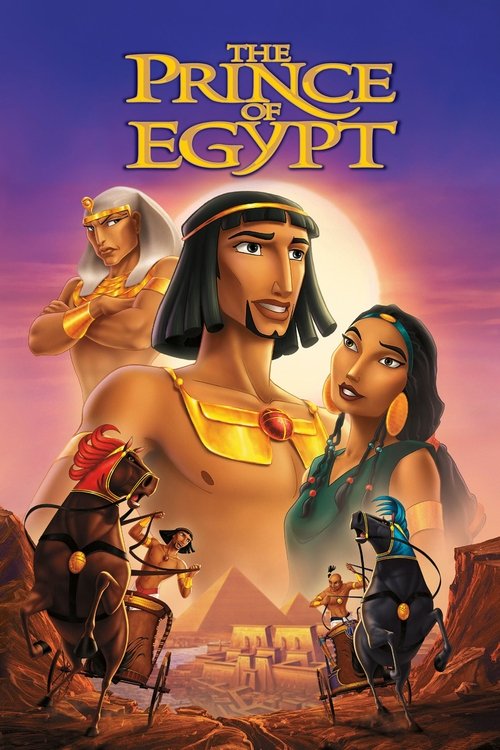
The Prince of Egypt
1998 · Simon Wells
For when you want to feel swept up by something grand — a family film with real gravity, equally right for a nostalgic rewatch or introducing kids to what animation can do at full scale. Comfort viewing with an epic's weight.
What it's about
Two brothers raised as princes of Egypt — one the heir, one adopted — are torn apart when Moses learns who he really is and what he's called to do. DreamWorks' telling of the Exodus story plays it as fraternal tragedy first and miracle second: the plagues, the burning bush, and the parting of the sea all land harder because the man on the other side of them is family.
The experience
Genuinely awe-inspiring — this is animation reaching for the epic register, and hitting it. It's sincere in a way big-studio animation rarely risks, emotionally heavy for a family film, with musical numbers that raise the hair on your arms.
Performances
The voice cast plays it straight as drama rather than cartoon — Ralph Fiennes gives Rameses a wounded pride that makes the brothers' rift genuinely tragic.
The craft
DreamWorks' first hand-drawn feature, with Gustave Doré engravings and David Lean's desert vistas as stated visual references — hand-drawn figures dwarfed by digitally assisted spectacle in the burning bush, the plagues, and the parting of the sea, which remain among the medium's great setpieces. Hans Zimmer's score and Stephen Schwartz's songs, including 'When You Believe,' demand good speakers.
Why it matters
Jeffrey Katzenberg's declaration that animation could be made for grown-ups, launched in direct challenge to his former studio — it proved a non-Disney house could produce a hand-drawn epic of this ambition, and its setpieces are still a benchmark.
DreamWorks Animation's first hand-drawn feature was Jeffrey Katzenberg's declaration of war on his former studio: if Disney wouldn't make grown-up animation, he would — and he opened with Exodus. Co-directed by Brenda Chapman (soon to become the first woman to direct a major American animated feature outright, with Brave), Simon Wells, and Steve Hickner, it reframes scripture as a fraternal tragedy — two brothers raised as princes, pulled apart by identity and duty — and plays it with a sincerity mainstream animation rarely risks. The visual ambition was explicit: Gustave Doré's engravings and David Lean's desert vistas were the stated references, and sequences like the burning bush, the plagues, and the parting of the sea remain among the medium's great setpieces, hand-drawn figures dwarfed by digitally-assisted immensity. Hans Zimmer's score and Stephen Schwartz's songs — 'When You Believe' took the Oscar — carry a story consulted on by hundreds of theologians across three faiths. Val Kilmer voices Moses, and, in a quiet stroke of casting-as-theology, God as well: the divine voice a man might mistake for his own.
A Deleuzian reading
A man stands at the edge of the water holding a stick.
The full Deleuzian reading of The Prince of Egypt →
Reception
A hit in 1998 that still felt like an underdog next to Disney — but it's since been fully canonized, routinely topping 'best non-Disney animation' lists and fueling the eternal 'DreamWorks peaked here' take.
How The Prince of Egypt was received, from release to now →
Influences: the films it descends from and the films it influenced
- The Ten Commandments (1956) — Direct live-action ancestor: its Exodus staging — the parting of the Red Sea as a set-piece climax, Moses raising his staff before massed crowds — is the compositional template Prince of Egypt re-choreographs shot-for-beat in animation.
- Lawrence of Arabia (1962) — Named influence: Lean's use of the desert as an epic emptiness, tiny figures dwarfed by vast horizon lines and heat-haze scale, is directly quoted in the film's widescreen desert vistas and monumental sense of distance.
- Fantasia (1940) — Ancestor in music-driven animation: the 'Night on Bald Mountain' precedent of animating to a symphonic score with abstract, awe-inducing imagery underwrites Prince of Egypt's plague and burning-bush sequences built as music-image spectacle rather than gag-driven cartooning.
- Bambi (1942) — Ancestor in painterly hand-drawn naturalism: its atmospheric backgrounds and restrained, non-comic animal/character weight established the 'serious' watercolor-realist register that Prince of Egypt adopts to sell dramatic gravity in a medium built for comedy.
- The Doré Bible Illustrations (1866) — Cited visual source: Doré's engraved biblical tableaux — dramatic chiaroscuro, crowded monumental architecture, God's light breaking through cloud — are the direct art-direction reference for the film's lighting and epic staging.
- The Road to El Dorado (2000) — Descendant: DreamWorks' immediate follow-on in hand-drawn epic mode, reusing the same digital-assisted-2D pipeline, sweeping camera moves through monumental ancient architecture, and Zimmer/Elton John song-scored spectacle.
- Spirit: Stallion of the Cimarron (2002) — Descendant: DreamWorks' hand-drawn, dialogue-light epic built on 2D-over-3D landscape animation and a Zimmer/song-driven emotional score — the studio explicitly extending Prince of Egypt's 'serious painterly epic' formula.
- Sinbad: Legend of the Seven Seas (2003) — Descendant: DreamWorks' last traditional-animation epic, carrying forward the seamless traditional/CGI-blended set pieces (storms, sea monsters) that Prince of Egypt pioneered in its plagues and Red Sea.
- Brave (2012) — Descendant via authorship: Chapman's directorial voice — grand landscape framing, a relationship reconciled through duty and identity, and mythic solemnity within a family drama — carries the Prince of Egypt sensibility into Pixar's 3D.
- The Prince of Egypt (musical stage adaptation) (2017) — Descendant: Stephen Schwartz's stage remounting extends the film's own song-and-choral craft (the Oscar-winning 'When You Believe,' liturgical chorus) into theatrical form, treating the animated score as a canonical text.
- Exodus: Gods and Kings (2014) — Descendant/sibling in Moses staging: Scott's live-action retelling wrestles with the same fraternal-rivalry framing (Moses/Ramses raised as brothers) and CGI-driven plague-and-parting spectacle that Prince of Egypt had already rendered as its dramatic spine.
- Joseph: King of Dreams (2000) — Descendant: DreamWorks' direct-to-video companion piece, an explicit spin-off using the same Old-Testament source, painterly desert palette, and dream-sequence animation experiments seeded by Prince of Egypt.
- Beauty and the Beast (1991) — Sibling in the Disney Renaissance craft that Katzenberg helped forge: the CAPS digital-ink-and-paint pipeline and 3D-camera-move-over-2D technique (the ballroom shot) is the same digital-assisted-animation method scaled up for Prince of Egypt's chariot race and temple flythroughs.
- The Lion King (1994) — Sibling and blueprint: Katzenberg's own 'mature,' mortality-driven animated epic with a fraternal-betrayal core (Scar/Mufasa) and a Hans Zimmer symphonic score set the template Prince of Egypt deliberately extends into overt tragedy.
- Mulan (1998) — Sibling in monumental crowd craft: released the same year, its Huns-charge sequence used the same particle/crowd-simulation software approach to render armies as swarming masses that Prince of Egypt uses for the exodus multitudes.
- The Hunchback of Notre Dame (1996) — Sibling in 'mature animation': it pushed Disney toward religious weight, adult moral stakes, and cathedral-scale architectural rendering — the same appetite for solemn theological spectacle Prince of Egypt commits to fully.
- Antz (1998) — Sibling as DreamWorks Animation's debut alongside Prince of Egypt: it embodies the studio's founding pitch — adult-skewing, star-voiced, non-Disney animation — that Prince of Egypt was the hand-drawn half of.
- Azur & Asmar: The Princes' Quest (2006) — Its mirror-fable of two boys nursed as brothers who become rivals across a cultural divide is the same narrative device Azur builds on, with the milk-mother bond driving the reconciliation.
- Hercules (1997) — Rival ancient-world animated musical released a year later, built on the same gambit of gospel-choral pop numbers ('When You Believe') scoring an antiquity epic, with matching CG-hybrid spectacle.
Similar films
- The Lion King (1994) — influence & lineage
- Fantasia (1940) — influence & lineage
- Mulan (1998) — influence & lineage
- Spirit: Stallion of the Cimarron (2002) — influence & lineage
- Beauty and the Beast (1991) — influence & lineage
- Spirited Away (2001) — shared sensibility
- How to Train Your Dragon (2010) — shared sensibility
- The Little Prince (2015) — shared sensibility