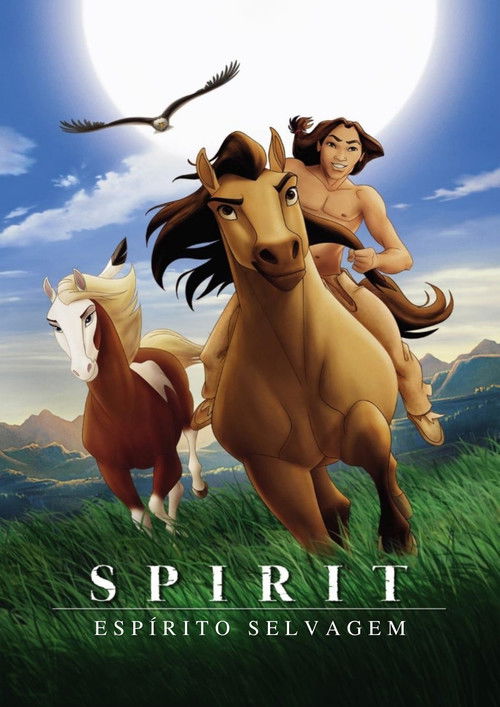
Spirit: Stallion of the Cimarron
2002 · Kelly Asbury
For a family movie night, or for anyone who grew up on it and wants that surge of freedom-and-homecoming feeling again; pure-hearted comfort viewing with actual sweep.
What it's about
A wild mustang stallion, born free on the American frontier, is captured during the era of the cavalry and the transcontinental railroad — and refuses, absolutely, to be broken. The film follows his fight to get back to his herd and his homeland, and the wary bond he forms with a Lakota man along the way. The bold move: the horses never talk.
The experience
Sweeping and sincere, with real momentum — chases, escapes, open-country vistas — and an emotional directness that works on kids and sneaks up on adults. Expect a lump in the throat more than once.
Performances
Matt Damon's first-person narration gives the stallion an inner voice without ever putting words in his mouth on screen — a restrained piece of voice work that lets the animation do the acting.
The craft
Traditional hand-drawn animation at nearly its last great moment, carrying the entire emotional load through movement, eyes, and body language since the animals never speak. Hans Zimmer's near-continuous score and Bryan Adams's songs function as the horses' dialogue, which makes good speakers genuinely worth it. The landscape animation — canyons, rivers, plains — is built for a big screen.
Why it matters
One of the final major American features to bet on traditional animation as computer animation took over, and its dialogue-free animal storytelling has kept it a touchstone — enough to spawn a franchise revival years later.
Snapshot
Spirit: Stallion of the Cimarron is a traditionally animated feature produced by DreamWorks Animation and released in 2002, directed by Kelly Asbury and Lorna Cook from a screenplay by John Fusco. It tells, largely without spoken dialogue for its animal characters, the story of a wild Kiger Mustang stallion captured during the era of westward expansion and the transcontinental railroad, who resists domestication and struggles to return to his herd. The film's defining formal gamble is that its central characters — horses — never talk; their inner life is carried by animation, vocalization, a first-person narration voiced by Matt Damon, and a near-continuous song-and-score bed by Hans Zimmer with original songs performed by Bryan Adams. Arriving at the hinge point when computer animation was displacing hand-drawn features, Spirit stands as one of the last major American studio productions to foreground 2D character animation, and as an unusually earnest attempt to fuse the animated musical with the revisionist Western. Its reputation has shifted over time from a respectful-but-modest theatrical reception toward durable affection, especially among younger and equestrian audiences.
Industry & production
The film was a DreamWorks Animation production of the studio's Glendale-based traditional-animation unit, overseen at the executive level by Jeffrey Katzenberg, who had built DreamWorks' animation division after his departure from Disney and who took a strong personal interest in this project. It emerged from the same 2D pipeline that had produced The Prince of Egypt (1998) and The Road to El Dorado (2000), and it was developed as a prestige, emotionally serious entry rather than a comedy.
Its release places it at a precarious industrial moment. DreamWorks' own Shrek (2001) had just demonstrated the commercial dominance of CG animation, and across the industry the hand-drawn feature was losing ground. Spirit consequently reads in hindsight as a late flowering of a form already in decline; DreamWorks would release only one more principally traditionally animated feature, Sinbad: Legend of the Seven Seas (2003), before committing fully to computer animation. Commercially, Spirit is generally described as a modest performer — it recouped against a substantial budget but fell well short of the studio's CG blockbusters. I am not confident of exact budget and gross figures and will not assert them; the consistent characterization in the record is "moderate success, not a breakout."
Technology
Spirit is a signal example of what the animation industry called the "tradigital" approach: hand-drawn 2D character animation composited with three-dimensional computer-generated elements. The horses and human figures are animated in the classical drawn tradition, while environments, mechanical objects, and complex set pieces — the locomotive and train, the cavalry fort, sweeping camera moves across canyon landscapes — make heavy use of CGI. The intent was to preserve the expressive, hand-crafted line of drawn animation for the emotive protagonists while exploiting the computer's strengths for scale, perspective, and repeatable rigid forms.
To ground the horse animation in real anatomy, the production undertook extensive study of live horses, including bringing horses to the studio for the animators to observe and draw. The stated aim was to render equine movement and musculature convincingly while stylizing the faces just enough to read human-legible emotion without lapsing into cartoon anthropomorphism. This tension — realistic body, expressive face, no speech — is the film's core technical problem, and much of its production effort was directed at solving it.
Technique
Cinematography
As an animated film, Spirit has no photographed cinematography; its "camera" is a constructed layout and virtual-camera system. The visual language deliberately invokes the classical Hollywood Western: wide vistas, buttes and canyons, silhouetted riders against enormous skies, and sunset palettes that recall the Monument Valley iconography of John Ford. CGI environments enabled dynamic camera moves — sweeping craning shots and tracking runs alongside the galloping stallion — that would have been laborious in pure 2D, and the film uses these for its kinetic chase and escape sequences. The compositional grammar consistently frames the horse against open landscape to dramatize freedom, and against bars, ropes, fences, and enclosing architecture to dramatize captivity.
Editing
The editing (credited, per the film's record, to Nick Fletcher) alternates between two registers: lyrical, music-led montage passages carried by the songs, and tightly cut action set pieces — the breaking-yard sequence, the train runaway, the climactic canyon leap. Because the protagonists do not speak, the cutting cannot lean on dialogue rhythm; instead it is paced to music and to physical action, giving the film an almost operatic or music-video structure in its emotional peaks. This is a defining structural feature rather than an incidental one.
Mise-en-scène / staging
Staging does the narrative heavy lifting precisely because dialogue is withheld from the animal leads. Meaning is built through blocking, gesture, and spatial relationships: the assertion of dominance or trust between horses, the wary choreography between Spirit and the human Colonel, the developing bond with the mare Rain and the Lakota man Little Creek. Production design (led by Kathy Altieri) organizes the world into opposed spaces — the open range versus the cavalry fort, the natural versus the mechanical (the railroad as an intrusion of industrial modernity) — so that the settings themselves carry the film's thematic argument about wildness and domination.
Sound
Sound is arguably the film's most important expressive channel. With the horses mute of language, the soundtrack — Hans Zimmer's orchestral score and Bryan Adams's songs — functions as the characters' voice, externalizing feeling that would elsewhere be spoken. Equine vocalizations, environmental sound, and the mechanical noise of the train and fort are foregrounded. The songs are frequently first-person, effectively lending Spirit a "singing voice" he never uses in dialogue, a convention borrowed from the animated musical and adapted to a non-speaking protagonist.
Performance
Performance divides into two modes. The human characters (notably James Cromwell as the Colonel and Daniel Studi as Little Creek) are voiced conventionally. The animal leads are "performed" chiefly by animators rather than actors — the acting is in the drawing. Matt Damon supplies a sparse first-person narration for Spirit, used to bridge understanding without turning the horse into a talking character; the narration is deliberately limited so that it supplements rather than replaces the visual performance. The lead animation of Spirit was a showcase for the studio's senior character animators, and the film is often discussed as an animator's picture for the quality of its equine acting.
Narrative & dramatic mode
The film's dramatic mode is a coming-of-age and captivity-and-return narrative told from a non-human point of view. Structurally it is a series of confinements and escapes: capture by the cavalry, resistance to breaking, alliance with Little Creek, romance with Rain, forced labor on the railroad, and final flight home. The withholding of animal speech pushes it toward a quasi-silent, pantomime-plus-music dramaturgy closer to ballet or opera than to the dialogue-driven animated comedy dominant in the period. The narration and songs supply interiority; the plot supplies a clear, almost mythic arc of freedom lost and regained. It is earnest and largely comedy-free, a tonal choice that distinguished it sharply from the contemporaneous Shrek-style irony.
Genre & cycle
Spirit sits at the intersection of several traditions. It is an animated musical, deploying songs as emotional narration. It is a Western, and specifically a revisionist one: the U.S. Cavalry and the railroad are framed as forces of domination, while the Lakota character is portrayed sympathetically — a stance continuous with the post-Dances with Wolves (1990) Western cycle and with screenwriter John Fusco's own career-long engagement with Native American subject matter. And it belongs to the lineage of animal-perspective stories — Black Beauty, The Black Stallion, Bambi, Watership Down — that dramatize the natural world's encounter with human power from the animal's vantage. One might reasonably call it an "eco-Western" or a frontier fable. Within the animation cycle of its moment, it is a late-period traditional 2D feature made as the industry pivoted to CG.
Authorship & method
The film is credited to co-directors Kelly Asbury and Lorna Cook. Asbury came up through the Disney art and story departments (contributing in art and story roles on films of the Disney Renaissance and on The Nightmare Before Christmas) before this, his first feature direction; he would go on to co-direct Shrek 2 (2004) and direct Gnomeo & Juliet (2011) and The Smurfs films. Cook's background was as a story artist. The pairing of a strong story-and-art sensibility fits a film that carries so much meaning through staging and image rather than dialogue.
Screenwriter John Fusco is central to the film's identity. Known for Young Guns (1988), Thunderheart (1992), and later Hidalgo (2004), Fusco has a sustained interest in the American West and in Native American history and is himself a horseman; his involvement is generally credited with the film's attempt at authenticity in its frontier and Lakota material and with its sympathetic ideological framing.
The music is by Hans Zimmer, with original songs written and performed by Bryan Adams (co-written and produced with his longtime collaborator Robert John "Mutt" Lange, per the songwriting record) — an unusual choice to give a family animated feature the voice of an adult rock artist, and one that shapes the film's distinctive sound. Editing is credited to Nick Fletcher and production design to Kathy Altieri, both DreamWorks stalwarts. The decision to keep the horses silent — the film's foundational creative choice — is widely attributed to studio leadership's conviction that speaking horses would break the intended realism, though I would flag the precise attribution of that decision as the kind of production lore that the record reports variably.
Movement / national cinema
This is a work of the American commercial studio-animation tradition, produced within the Hollywood system by DreamWorks. It is not affiliated with any art-cinema movement. Its most meaningful "movement" context is industrial and historical: it belongs to the twilight of American hand-drawn feature animation, a tradition rooted in Disney's classical era and carried briefly by DreamWorks and others before computer animation became the industry default. Thematically it participates in an American national mythology — the frontier, the closing of the West, manifest destiny — which it revisits critically from the perspective of the dominated (the wild horse, the Native American) rather than the conqueror.
Era / period
Two "periods" matter. The film's setting is the American West of the mid-to-late nineteenth century, the era of the U.S. Cavalry, westward settlement, and the transcontinental railroad, which the film uses as its emblem of encroaching industrial civilization. The film's moment of production — 2001–2002 — is equally significant: it was made at the exact transition when Shrek had proven CG's commercial supremacy and the hand-drawn feature was entering its final industry decline. Spirit is thus doubly a film about an ending — narratively about the closing of the wild frontier, and industrially a late artifact of a closing animation era.
Themes
The film's governing theme is freedom versus captivity: the wild horse's refusal to be broken becomes an argument about the value of the untamed and the violence of domination. Related threads run through it: the encroachment of industrial modernity on the natural world (the railroad as an almost antagonistic force); a critique of frontier conquest and colonial expansion, softened for a family audience but legible in the sympathetic Lakota portrayal and the unsympathetic cavalry; the bond between human and animal built on mutual respect rather than mastery (Little Creek and Spirit); and, formally as much as thematically, the idea that emotional truth can be communicated without words — the film is in a sense a thesis about wordless expression. There is also a strong current of homecoming and belonging, the drive to return to one's herd and native landscape.
Reception, canon & influence
Critical reception at release was broadly respectful but mixed-to-modest. Reviewers frequently praised the animation quality, the sincerity, and the ambition of the non-speaking conceit while some found the earnest tone and the wall-to-wall Bryan Adams songs heavy-handed. The film received an Academy Award nomination for Best Animated Feature — an award in only its second year — in a field that also included Ice Age, Lilo & Stitch, and Treasure Planet, with the prize going to Hayao Miyazaki's Spirited Away. That nomination marks its principal formal canonization.
Influences on the film (backward): it draws on the classical Hollywood Western's landscape iconography (Ford), on the revisionist, Native-sympathetic Western cycle following Dances with Wolves, on the tradition of serious animal-perspective narratives (The Black Stallion, Black Beauty, Bambi), and on the Disney-lineage animated musical, which it adapts by routing song through a mute protagonist. Screenwriter Fusco's own body of Western work is a direct authorial influence.
Legacy (forward): Spirit's cultural afterlife has outgrown its theatrical footprint, sustained by home video and by a devoted following among children and horse enthusiasts. It generated a franchise expansion under DreamWorks — most visibly the television and film properties built around the Spirit Riding Free brand in the later 2010s, which reoriented the material toward a young-girl-and-her-horse adventure format and reached a substantial new audience, alongside a 2021 theatrical spin-off. Industrially, it is remembered as one of the last significant American studio features to lead with hand-drawn character animation, and as an ambitious, somewhat singular experiment in dialogue-free animal storytelling — a film more often admired for the purity of its central conceit than imitated, since few subsequent studio features attempted so austere a formal wager. The detailed internal production history remains comparatively thinly documented in scholarly sources, and claims about specific decision-making should be treated with corresponding caution.
A Deleuzian reading
A rope pulls tight and a horse's head comes up.
The full Deleuzian reading of Spirit: Stallion of the Cimarron →
Reception
A box-office disappointment with mixed reviews in 2002 (it lost the Best Animated Feature Oscar to Spirited Away), it's since been lovingly reclaimed by the generation who grew up on it — now a certified nostalgia classic and the crown jewel of 'horse girl cinema'.
How Spirit: Stallion of the Cimarron was received, from release to now →
Influences: the films it descends from and the films it influenced
- The Searchers (1956) — Supplies both the Monument Valley framing grammar the film quotes and the captivity-and-return narrative armature, with the frontier landscape shot as a moral space.
- Bambi (1942) — Establishes the studio practice of studying live animals as 'actors' for naturalistic quadruped locomotion and animal-POV drama built on gesture rather than speech.
- Fantasia (1940) — Model for extended music-led montage in which sequences are cut and staged entirely to a score with no dialogue driving the action.
- The Black Stallion (1979) — Pioneers the long wordless horse-and-landscape passage that carries emotional narrative purely through cinematography, animal movement, and score.
- Black Beauty (1994) — Provides the first-person equine narration and episodic captivity-and-return structure, telling a horse's life from inside its own voice-over.
- Dances with Wolves (1990) — Codifies the Native-sympathetic revisionist Western framing that Fusco routes into the film's Lakota material and cavalry-as-antagonist staging.
- Young Guns (1988) — Screenwriter John Fusco's frontier authorship and horseman's research sensibility, the direct authorial through-line into Spirit's West.
- Beauty and the Beast (1991) — Introduces the craning CGI virtual camera sweeping over 2D hand-drawn characters — the tradigital device Spirit uses for its canyon and stampede staging.
- The Lion King (1994) — Hans Zimmer's pop-orchestral-plus-choir template for a 'serious' animal animated feature, and the CG-herd/2D-character integration of its stampede.
- Tarzan (1999) — Deep Canvas virtual-camera moves through painted 3D space, plus the use of an adult pop artist's (Phil Collins) non-diegetic songs as emotional narration instead of character musical numbers.
- The Prince of Egypt (1998) — The DreamWorks 2D-feature pipeline that fuses CG cameras, crowds, and effects with hand-drawn characters for an epic scale Spirit inherits directly.
- Rango (2011) — Animated revisionist Western that explicitly quotes Ford and Leone landscape grammar and Monument-Valley staging as a formal system.
- How to Train Your Dragon (2010) — Builds its central bond on a non-speaking creature whose entire performance is carried through pantomime body-acting and eye animation, the wordless-animal-actor craft Spirit wagered on.
- The Red Turtle (2016) — Carries a full animated feature with no dialogue at all, sustaining narrative through image, gesture, and score — the austere wordless conceit taken to its limit.
- Klaus (2019) — Revives feature hand-drawn character animation by marrying it to volumetric CG lighting and camera, continuing the tradigital 2D craft Spirit exemplified near the medium's studio sunset.
- Spirit Untamed (2021) — Direct franchise extension that reworks the property into CG for the Spirit Riding Free girl-and-her-horse format, inheriting the mute-horse premise and freedom-versus-captivity theme.
- The Road to El Dorado (2000) — Asbury's own prior feature, likewise scoring narrative through an adult pop songwriter's (Elton John) non-diegetic songs rather than diegetic singing.
- Brother Bear (2003) — Contemporary 2D animal-POV wilderness fable scored by an adult pop artist (Phil Collins), extending the song-as-emotional-voice-over strategy over a transformation-and-return arc.
- Treasure Planet (2002) — DreamWorks' contemporaneous tradigital experiment layering hand-drawn animals over CG canyons and camera moves — the same 2002 bet that hybrid 2D could survive, sharing Treasure Planet's integration goals.
Similar films
- How to Train Your Dragon (2010) — influence & lineage · same viewing thread
- The Black Stallion (1979) — influence & lineage
- Dances with Wolves (1990) — influence & lineage
- Fantasia (1940) — influence & lineage
- How to Train Your Dragon: The Hidden World (2019) — same viewing thread
- Brokeback Mountain (2005) — shared sensibility
- Spirited Away (2001) — shared sensibility
- The Rider (2018) — shared sensibility
All the films related to Spirit: Stallion of the Cimarron →
Watch it with: curated runs of related films
- The DreamWorks Fable — A run of DreamWorks' own canon — the studio that answered Disney with ogres, pandas, Vikings and swashbuckling cats — half fairy-tale satire, half genuine heart.