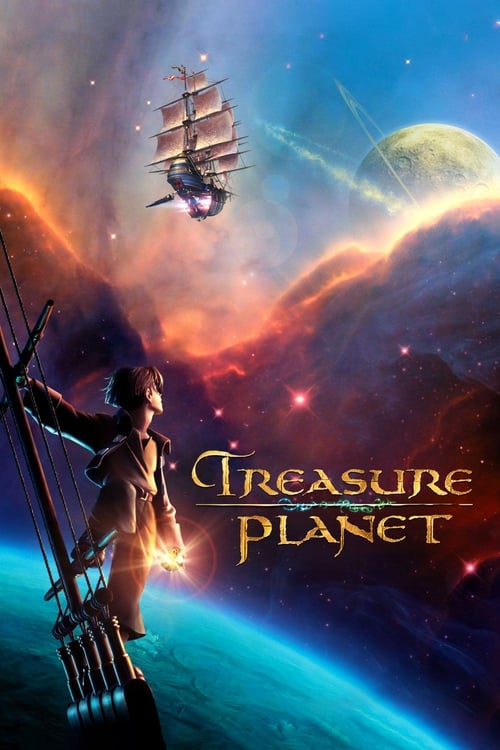
Treasure Planet
2002 · Ron Clements
For a family movie night or a nostalgic solo rewatch — when you want earnest adventure with real feeling underneath, the kind of underdog film you end up rooting for on both sides of the screen.
What it's about
Jim Hawkins, a restless teenager in trouble, comes into possession of a map to the legendary 'loot of a thousand worlds' and ships out on a space galleon to find it. Aboard, the cyborg cook John Silver takes him under his wing — teaching him to sail solar winds and weather supernovas — while a mutiny quietly brews below decks. It's Treasure Island refitted with rocket sails, and its real engine is the father-son bond between a boy who needs one and a pirate who shouldn't care.
The experience
Big-hearted, swashbuckling, and sincerely emotional — the adventure moves fast, but the film keeps circling back to the ache between Jim and Silver. It plays like classic Disney adventure with a melancholy streak the studio rarely allowed itself.
The craft
Directors Ron Clements and John Musker built the look on a '70/30 rule' — seventy percent traditional painterly warmth, thirty percent science-fiction machinery — sending hand-drawn characters sailing through vast CG spaces. John Silver himself embodies the technique: his flesh-and-blood half animated by hand by Glen Keane, his mechanical half rendered digitally. It's gorgeous on a big screen.
Why it matters
A passion project Clements and Musker pitched to Disney for over fifteen years, released into the twilight of hand-drawn animation; it underperformed badly at the time and has since been reclaimed as one of the studio's great cult favorites.
Ron Clements and John Musker pitched 'Treasure Island in space' to Disney three times starting in 1985 — before The Little Mermaid, before Aladdin — and only their track record from those hits finally bought it a green light. The result is the strange, sincere outlier of Disney's uneasy post-renaissance years: Stevenson's novel refitted with solar sails and etherium seas, its emotional engine the surrogate father-son bond between a sullen teenage Jim Hawkins and the cyborg cook John Silver. The studio's '70/30 rule' governed the look — 70 percent traditional warmth, 30 percent science-fiction machinery — with hand-drawn characters sailing through deep-canvas CG spaces of real grandeur. Silver himself is the thesis in miniature: Glen Keane animated his flesh-and-blood half by hand while a separate team rendered his mechanical arm digitally, the two halves fused in every frame. It lost Disney a fortune — one of the costliest flops in the studio's history — and helped rationalize the abandonment of 2D animation. The generation that saw it young has spent two decades arguing, persuasively, that the ledger got it wrong.
Reception
One of Disney's most notorious box-office bombs in 2002 — the studio took a huge write-off within weeks of release — yet the millennials who caught it on DVD grew up to canonize it, and it's now a fixture of 'underrated Disney' reappraisal lists.
How Treasure Planet was received, from release to now →
Influences: the films it descends from and the films it influenced
- Treasure Island (1950) — Robert Newton's growling, one-legged Long John Silver set the definitive performance template that Treasure Planet's Silver is animated and voiced against — the seductive-mentor-as-antagonist blocking descends directly from Newton.
- The Great Mouse Detective (1986) — Musker and Clements' own first experiment compositing wireframe-rendered CG (the Big Ben clockwork gears) beneath hand-drawn characters — the small-scale prototype of the 2D/CG integration Treasure Planet industrializes.
- The Rescuers Down Under (1990) — First fully CAPS digital feature, whose swooping CG-assisted camera flights over Australia pioneered the virtual roving camera that Deep Canvas later frees for Treasure Planet's spaceport push-ins.
- Beauty and the Beast (1991) — The CG ballroom — a fully modeled 3D environment tracked under 2D characters with a moving camera — established the hybrid staging grammar Treasure Planet scales to whole worlds.
- Aladdin (1992) — Musker/Clements' magic-carpet chases fused a CG-modeled carpet with hand-animated tassels, and Robin Williams' improv-driven Genie proved the voice-actor-leads-the-drawing method that shapes Brian Murray's Silver.
- Hercules (1997) — The multi-headed Hydra was a CG creature animated to a hand-drawn appeal and cartoon timing — the hand-CG fusion of a 'living' machine that Treasure Planet applies to B.E.N. and the solar-sailing rigs.
- Tarzan (1999) — Deep Canvas — Eric Daniels' technique of painting in 3D space so 2D characters move through a fully dimensional camera-navigable environment — was invented here and is the exact tool Treasure Planet is built around; Glen Keane's weight-and-force animation on Tarzan carries into his Silver.
- Brother Bear (2003) — One of Disney's final Deep Canvas / CAPS 2D features, extending the character-effects-integration workflow immediately after Treasure Planet as the traditional pipeline wound down.
- Home on the Range (2004) — The literal 'end of 2D' Treasure Planet's box-office failure hastened — Disney's last hand-drawn feature before shuttering the traditional unit, the elegy Treasure Planet foreshadowed made real.
- The Princess and the Frog (2009) — Musker and Clements' own return to hand-drawn animation after Treasure Planet, reviving the 2D pipeline they had helped push to its CG-hybrid limit.
- Klaus (2019) — Extends 2D/CG fusion the other direction — applying volumetric CG lighting and texturing to hand-drawn characters — proving the traditional-medium-plus-modern-tech thesis Treasure Planet argued for but couldn't commercially sustain.
- Moana (2016) — The directors' first full commitment to hybrid staging — 2D-drawn principals composited into Deep Canvas CG environments — plus the voyage structure of a young navigator, a duplicitous charismatic mentor and a wordless morphing sidekick that Moana rebuilds with the polarity reversed (CG principals, drawn insert).
- The Iron Giant (1999) — Renders a CG-modeled title character to match a hand-drawn cast so seamlessly the seams vanish — the same 'CG element convincingly living inside a 2D world' problem Treasure Planet solves for its cyborg and ships.
- Titan A.E. (2000) — Places hand-drawn characters against CG spacecraft and nebulae for a 2D/3D space adventure — the direct sibling attempt at the tradigital cosmic-frontier look Treasure Planet chases.
- Atlantis: The Lost Empire (2001) — Disney's other widescreen 2D pulp-adventure of the era, leaning on Deep Canvas and heavy CG vehicles designed to the same 'plausible-mechanical-first' logic as Treasure Planet's 70-30 rule.
- Lilo & Stitch (2002) — Same-year Disney 2D feature whose character-effects work (water, alien morphing) and watercolor backgrounds represent the parallel hand-craft track Treasure Planet abandoned for CG environments.
- Spirit: Stallion of the Cimarron (2002) — DreamWorks' contemporaneous tradigital experiment layering hand-drawn animals over CG canyons and camera moves — the same 2002 bet that hybrid 2D could survive, sharing Treasure Planet's integration goals.
- Sinbad: Legend of the Seven Seas (2003) — Hand-drawn seafarers voyaging on CG-modeled ships and oceans — a direct sibling in fusing 2D character acting with 3D nautical hardware, the maritime-in-space conceit Treasure Planet literalizes.
Similar films
- Lilo & Stitch (2002) — influence & lineage
- Guardians of the Galaxy Vol. 2 (2017) — same viewing thread
- How to Train Your Dragon (2025) — same viewing thread
- Life of Pi (2012) — same viewing thread
- Avatar: The Way of Water (2022) — same viewing thread
- Moana (2016) — shared sensibility
- Pirates of the Caribbean: The Curse of the Black Pearl (2003) — shared sensibility
- How to Train Your Dragon (2010) — shared sensibility
All the films related to Treasure Planet →
Watch it with: curated runs of related films
- Worlds Worth Getting Lost In — A run of maximalist, effects-driven pictures that each conjure a whole world from scratch — watch them when you want to be swept somewhere on the biggest screen you can find.