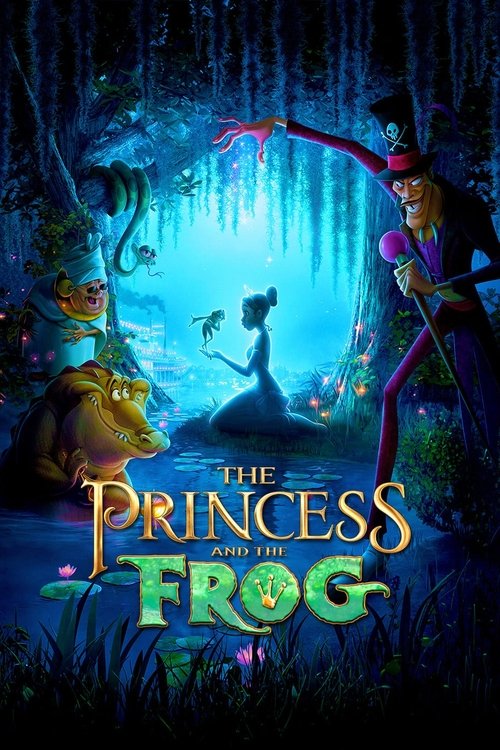
The Princess and the Frog
2009 · Ron Clements
For a cozy night in when you want classic Disney comfort — songs, romance, a good villain — with enough soul and swing to charm the adults in the room.
What it's about
In Jazz Age New Orleans, Tiana is a waitress working double shifts to save for the restaurant she and her late father dreamed of — until a kiss meant to break a feckless prince's curse turns her into a frog too. The two hop off through the bayou to undo the voodoo, pursued by a debt-collecting Shadow Man, with a trumpet-playing alligator and a lovestruck firefly along for the ride.
The experience
Warm, funny and full of music, with a jolt of genuine menace whenever the Shadow Man's magic slides in. It moves like a jazz number — brassy and quick — but its heart is an old-fashioned fairy tale about wanting something and working for it.
Performances
Anika Noni Rose gives Tiana real backbone and warmth in the voice booth, and Keith David's velvet menace as Dr. Facilier makes him one of the great modern Disney villains.
The craft
This was Disney's deliberate resurrection of hand-drawn animation, from the directors of The Little Mermaid and Aladdin, and the craft shows — watercolor bayous, an Art Deco dream sequence, and a Randy Newman songbook steeped in jazz, gospel and zydeco. It's a love letter to a medium, and it glows on a good screen.
Why it matters
It introduced Disney's first Black princess, a genuine cultural milestone, and stands as the studio's last full-throated bet on traditional hand-drawn feature animation.
Snapshot
The Princess and the Frog is a film with two jobs, and it is honest about both. It is a Jazz Age fairy tale set in a mythologized New Orleans, in which a working waitress named Tiana kisses a feckless prince and gets turned into a frog for her trouble; and it is Walt Disney Animation Studios' attempt to resurrect hand-drawn feature animation five years after the studio had effectively buried it. Directed by Ron Clements and John Musker — the partnership behind The Little Mermaid (1989) and Aladdin (1992) — with songs and score by Randy Newman, it restores the Disney Renaissance musical grammar almost point for point while inserting into that grammar the studio's first Black heroine and a protagonist whose "I want" song is about a lease, a down payment, and double shifts. The film was warmly received, earned three Academy Award nominations, and made money without making enough of it; within two years the hand-drawn unit it had been built to revive was gone again. Its afterlife has been unusually long and unusually contested, running from academic arguments about postracial representation to the 2024 retheming of Disney's Splash Mountain attraction as Tiana's Bayou Adventure.
Industry & production
The production history is inseparable from a corporate reversal. After Home on the Range (2004) underperformed, Disney closed its Florida animation facility, dispersed its traditional animators, and declared the 2D feature commercially dead — a judgment that looked defensible in a market where Pixar, DreamWorks, and Blue Sky had made computer animation the default. The 2006 acquisition of Pixar installed Ed Catmull and John Lasseter over Walt Disney Animation Studios, and Lasseter, who had been trained in the hand-drawn tradition, reopened the question almost immediately. Clements and Musker, who had been at the studio since the early 1980s and had left the building after Treasure Planet (2002), were brought back to make a hand-drawn musical.
That meant rebuilding a craft base that had been deliberately dismantled: recalling scattered animators, reconstituting a pencil-and-paper workflow, and re-establishing a digital ink-and-paint pipeline that no longer existed in-house. The film credits Peter Del Vecho as producer and Lasseter as executive producer. The screenplay is credited to Clements, Musker, and Rob Edwards, from a story developed by Clements, Musker, Greg Erb, and Jason Oremland, with the Brothers Grimm's "The Frog King" and E. D. Baker's 2002 novel The Frog Princess as acknowledged sources.
Development was also, unusually for Disney, publicly revised under criticism. Early materials described a film called The Frog Princess whose heroine was a chambermaid named Maddy — a name too close to "mammy," attached to a job too close to servitude — and the character was reworked into Tiana, an aspiring restaurateur. Other objections stuck without being resolved: that the heroine spends most of her own film as an amphibian, that Prince Naveen hails from an invented country (Maldonia) and is racially unplaceable, and that a story set in 1920s Louisiana treats segregation as weather rather than subject. Disney sought outside counsel during development, and Oprah Winfrey — cast as Tiana's mother, Eudora — was publicly associated with that consultation.
Commercially the film was a qualified success and a strategic disappointment. It opened in limited release in late November 2009 before going wide in December, where it ran into Avatar and the year-end family field; it took roughly $100 million domestically and something in the region of $270 million worldwide against a reported budget of about $105 million. Disney read the domestic number as a branding problem rather than a craft problem, and the reading had consequences: the studio's next fairy tale, in production as Rapunzel, was renamed Tangled and marketed as a buddy adventure, on the theory that "princess" was repelling half the potential audience.
Technology
The Princess and the Frog is a hand-drawn film made with a rebuilt digital spine. Disney's proprietary CAPS system — the Disney/Pixar-developed digital ink-and-paint and compositing platform that had carried the studio from The Rescuers Down Under through Home on the Range — had been retired along with the department that used it. For this production the studio moved to Toon Boom's Harmony for digital ink and paint and compositing, a shift that quietly ended two decades of in-house tooling and aligned Disney with the commercial software the rest of the 2D industry was using.
Animation itself was drawn largely on paper, a decision framed by the filmmakers as a craft argument as much as a technical one: the pencil line, with its variable pressure and its accumulated smear of the animator's hand, was the thing being revived. Computer graphics were used selectively and were meant to disappear — vehicles, the streetcar, architectural perspective, crowd and parade elements, and some water and particle effects were built or assisted in CG and then treated to sit inside the drawn world rather than in front of it. The bayou made this hard: hand-drawn water is among the most labor-intensive effects work in the medium, and the film's swamp is full of it.
One technological choice was conspicuous by omission. The film was released flat, in a December when stereoscopic 3D was the industry's central obsession and Avatar was redefining what a premium ticket meant. Being the one major animated release without a surcharge-bearing format was a real competitive handicap, and it is part of why the film's grosses are difficult to read as a clean referendum on hand-drawn animation.
Technique
Cinematography
In an animated feature the equivalent of cinematography is distributed across layout, art direction, color, and effects. Ian Gooding's art direction organizes the film around three chromatic territories: the burnished golds, ambers, and warm browns of Tiana's New Orleans and her imagined restaurant; the saturated, humid greens and blue-blacks of the bayou; and the acid violets, sulfurous greens, and inky silhouettes of Dr. Facilier's magic. Transitions between them do narrative work — the film gets colder and stranger as it moves away from the city and warmer as Tiana's dream reorganizes itself around people rather than property.
Two sequences stand apart as designed set pieces. "Almost There" abandons the film's rendered depth for a flattened, graphic Art Deco idiom of hard silhouettes, restricted palette, and stylized figures that reads as a Jazz Age poster brought to life and evokes the visual language of Harlem Renaissance painting. "Friends on the Other Side" builds a proscenium of tarot cards, hieroglyphic masks, and independently acting shadows, staged with the theatrical frontality of a 1930s cartoon musical number. Elsewhere the camera is more mobile than classical Disney, using CG-assisted perspective moves through the French Quarter and over the Mardi Gras parade, but the film is careful not to let virtual camerawork advertise itself.
Editing
Jeff Draheim edited. As with all studio animation, the decisive cutting happened years before the finished frames existed, in story reels and animatics where sequences were timed, tested, and discarded on the strength of boards. The finished film runs about 97 minutes and is cut tight — brisk enough that the middle act, which has to carry Tiana, Naveen, Louis the trumpet-playing alligator, and Ray the firefly through the swamp, keeps moving by handing off between comic numbers rather than lingering. The most conspicuous editorial decision is a withheld one: Ray's death is allowed to land in real time, with a funeral and a silence, before the film permits its consoling image of a second star beside Evangeline.
Mise-en-scène / staging
The film's staging logic is the musical's. Numbers are blocked as performances — for an audience inside the film where possible (Louis on the riverboat, Facilier's street-corner sell), with the surrounding world reorganizing itself into choreography. New Orleans is built as a set of legible zones: the French Quarter's balconied density, the Garden District's white-columned wealth where the La Bouffs live, the working restaurant kitchen, the derelict sugar mill Tiana intends to buy. The bayou is staged as its own society, with the Cajun firefly clan and Mama Odie's tree-boat.
The dominant motif is the shadow. Facilier's shadow acts independently of him, running errands, laughing on its own beat, and finally the shadows collect their debt and drag him into a tombstone-mask that shuts like a mouth. It is one of the more genuinely frightening images in the Disney canon and the film's cleanest piece of visual thinking: a man who trades in other people's silhouettes gets taken by his own.
Sound
Randy Newman's contribution is the film's connective tissue. Rather than a single house style, the score and songs move through a survey of Louisiana and adjacent American musics: Dixieland and traditional jazz ("When We're Human"), a driving Jazz Age Broadway number ("Almost There"), Cab Calloway–adjacent hoodoo showmanship ("Friends on the Other Side"), a Cajun waltz ("Ma Belle Evangeline"), zydeco ("Gonna Take You There"), and gospel ("Dig a Little Deeper"). Dr. John sings "Down in New Orleans" over the opening, an authenticating gesture that puts a genuine New Orleans voice at the film's threshold; Ne-Yo's "Never Knew I Needed" closes it in a contemporary R&B register. Diegetic music is everywhere — Louis's trumpet, the restaurant, the parade — so that the shift into song feels less like a break than a thickening.
Performance
Anika Noni Rose, a Tony winner for Caroline, or Change, gives Tiana a hardness the Disney heroine template had not much accommodated: clipped, tired, funny, and capable of sounding genuinely irritated. She sings her own numbers, and the theatrical training shows in the phrasing of "Almost There." Keith David's Facilier is the film's best vocal performance — silk over gravel, a salesman's warmth that never quite drops. Bruno Campos plays Naveen's charm as slightly stupid rather than merely roguish, which is what makes the reversal work. Jim Cummings gives Ray a Cajun lilt that risks caricature and mostly earns its pathos; Michael-Leon Wooley's bass supplies Louis's bulk; Jenifer Lewis's Mama Odie and John Goodman's Big Daddy La Bouff are broad in the register the film wants. The supervising animators included Mark Henn on Tiana, Bruce W. Smith on Dr. Facilier, Andreas Deja on Mama Odie, Eric Goldberg on Louis, and Randy Haycock on Naveen — a roster that reads as a deliberate assembly of the studio's surviving hand-drawn expertise. Facilier's loose-limbed, dance-driven acting sits in a lineage of stage showmen from Calloway onward; the specific studio references cited in interviews are less consistently documented than the influence is obvious.
Narrative & dramatic mode
The film's structural joke is a broken fairy-tale mechanism: the kiss fails. Tiana is not a princess, the spell does not lift, and the film's second act is a comic road movie through the swamp with two amphibians who dislike each other. This is a shrewd device, because it converts a wish-fulfillment premise into a labor premise — the characters must work their way back to their own bodies.
Underneath it runs an orthodox want/need structure. Tiana wants the restaurant, inherited as a promise from her late father James; what she needs, in the film's formulation, is to understand the restaurant as a place where people gather rather than a property she owns. The clearest articulation is Mama Odie's "Dig a Little Deeper," and the test is the climax, where Facilier offers Tiana the restaurant outright, in full detail, and she refuses. That refusal is the film's real dramatic peak; the Mardi Gras chase is decoration around it.
Facilier operates on contract logic — deals, debts, "friends" who are creditors — which gives the film a Faustian spine unusual in the princess cycle. And the death of Ray is a genuine structural risk: comic sidekicks in Disney features are conventionally indestructible, and killing one shifts the last reel into a register the formula does not normally permit.
Genre & cycle
The film sits at the hinge of two cycles. Backward, it is the last full-dress instance of the Renaissance-era Disney musical fairy tale: the "I want" song, the villain song, the animal sidekicks, the mentor figure, the transformation curse, the wedding. Forward, it belongs to the run of films now grouped as the Disney Revival — Bolt (2008), Tangled (2010), Wreck-It Ralph (2012), Frozen (2013) — in which the studio recovered commercial and critical standing under Lasseter and Catmull. It is the only one of them drawn by hand.
It also draws on cycles outside Disney: the animal-buddy road comedy, the Jazz Age Americana picture, and the long screen tradition of New Orleans as a place of music, appetite, and permeable supernaturalism.
Authorship & method
Clements and Musker's authorship is legible in method more than in signature style. Their films — The Great Mouse Detective, The Little Mermaid, Aladdin, Hercules, Treasure Planet, later Moana — are built as musicals with strong comic seconds and a taste for graphic stylization inside otherwise rendered worlds. They write as well as direct, and here they share screenplay credit with Rob Edwards.
The decisive collaborator is Newman, whose Americana instincts and family roots in Hollywood scoring made him a natural for a film that needed period pastiche played straight rather than ironically. Gooding's art direction supplies the film's coherence of color and period, and Draheim's cutting keeps a story-reel-driven production moving. The animation itself is authored at the character level by supervising animators in the classical Disney manner, and the film functions partly as a showcase for that seniority — Deja, Henn, and Goldberg were by 2009 among the last major figures of the studio's hand-drawn line, and Smith was one of the few Black supervising animators in Disney feature history.
Movement / national cinema
This is American commercial studio animation at a moment of internal crisis, and it is best read against the international picture. Hand-drawn feature animation had not died globally — Studio Ghibli, French and Irish independent production, and television animation across Asia continued to sustain it — but it had died as American theatrical practice. The Princess and the Frog was an attempt to prove that the loss had been a marketing failure rather than an aesthetic one. Its regional dimension matters too: the film is a piece of Louisiana imaginary produced four years after Hurricane Katrina, released to a city and a national audience for whom New Orleans was a live subject. The film does not address the disaster, but its affection for the city's music, food, and street life carried an obvious extra-textual charge in 2009.
Era / period
The film is set in the 1920s and released into a very specific 2009: the first year of the Obama presidency, the trough of the financial crisis, and the height of digital-3D fever. Each of those left marks. Tiana's bootstrap ethic — two jobs, a coffee can of savings, deferred pleasure — reads differently against a recession, and was praised and criticized on exactly those terms, as either a corrective to passive princesses or an endorsement of individual striving in a story that carefully avoids naming the structural barriers its heroine faces. The film's arrival as Disney's first Black princess was widely framed through the language of a postracial moment, a framing that much subsequent scholarship has treated as the film's central problem rather than its achievement.
Themes
Work and dreaming are the film's declared subject: the tension between the father's dictum that wishing must be joined to effort and Charlotte's fairy-tale literalism about wishing on stars. Food and communion run underneath it — gumbo as the recurring image of a thing made from many parts and shared, and the restaurant as a civic space rather than a possession. Transformation is treated as loss of legibility rather than of self; the frogs remain entirely themselves and simply cannot be recognized.
Race and class are present as pressure rather than argument. Tiana's exchange with the realtors, who tell her that a woman of her background would be better off elsewhere, is the film's one direct acknowledgment of the barrier the entire plot is organized around, and the film moves past it quickly. Her friendship with Charlotte crosses lines the film declines to name. And religion is carefully triangulated: Facilier's transactional dark magic is set against Mama Odie's benign hoodoo, a distinction that satisfied few — some viewers objected to any depiction of voodoo, others to the film's flattening of an actual religious tradition into fairy-tale materials.
Reception, canon & influence
Critical reception was broadly positive. Reviewers welcomed the return of the hand-drawn line, praised Newman's songs, Rose's performance, and Facilier as the strongest Disney villain in years, and consistently noted the film's craft. The recurring complaints were structural: too long spent as frogs, a crowded sidekick bench, and a fidelity to the Renaissance formula that read to some as nostalgia rather than renewal. The film received three Academy Award nominations — Best Animated Feature and two Best Original Song nods, for "Almost There" and "Down in New Orleans" — and lost Animated Feature to Up.
Its influences run backward through the Grimm tale and Baker's novel, through Disney's own Renaissance output, through the graphic stylization the studio had used since Sleeping Beauty, through the 1930s cartoon-musical tradition of Fleischer-era rubber-limbed showmanship, and through Harlem Renaissance and Art Deco design. Its relation to Song of the South (1946) is unspoken but structural: this is Disney's Louisiana, made under the shadow of the studio's most disavowed film.
Forward, its influence is threefold. Institutionally, it failed at the thing it was built to do — Disney's next hand-drawn feature, Winnie the Pooh (2011), was its last theatrical one to date, and the studio's fairy tales moved permanently to CG. Commercially, its perceived underperformance directly shaped the retitling and repositioning of Tangled and the gender-neutral marketing strategy that followed through Frozen. Culturally, it has outlasted both: Tiana became a permanent fixture of the Disney Princess franchise, the arguments the film provoked about representation, setting, and who gets to be human on screen fed directly into the more consultative development processes behind Moana (2016), Encanto (2021), and Pixar's Soul (2020), and in 2024 Disney replaced Splash Mountain — an attraction built on Song of the South — with Tiana's Bayou Adventure, effectively installing Tiana over the studio's own buried history. A Tiana series for Disney+ was announced in 2020 and has had a well-publicized but unsettled development path; the public record on its current status is thin enough that any firm account would be speculation.
The film's standing has risen accordingly. It is now read less as the last gasp of a dead technique than as a transitional work that got its craft right, its politics half-right, and its timing wrong — and whose central figure has proved far more durable than the production apparatus that made her.
Reception
In 2009 it was the 'disappointment' that opened against Avatar and made Disney so nervous about the word 'princess' that Rapunzel became Tangled — now it's warmly reclaimed, with Tiana beloved enough to get Splash Mountain rebuilt as Tiana's Bayou Adventure.
How The Princess and the Frog was received, from release to now →
How to watch The Princess and the Frog: what to notice on a first viewing
- Notice the color shift as the film leaves the city. New Orleans is warm gold and amber, the bayou turns humid green and blue-black, and Dr. Facilier's magic arrives in acid violet and sulfurous green. Each world gets its own palette. You can tell which world you're in, and how safe it is, from color alone.
- Watch Facilier's shadow move on its own. The shadow runs errands, gestures, and laughs on its own timing, completely apart from Facilier's own body, from the moment he is introduced. A man who trades in other people's silhouettes has clearly already given his own away.
- Spot one song looking completely different from the rest. During 'Almost There,' the film drops its usual rendered depth for flat silhouettes and a restricted Art Deco palette, like a vintage poster brought to life. The film changes its whole visual language for one dream, which tells you how much that dream matters to her.
- Listen for music playing inside the story before anyone sings. Louis's trumpet, a street band, the restaurant radio: music is already part of the world in nearly every scene, so the songs feel like an extension of the setting, not an interruption. You're never jolted into a musical number, because the film has already been humming one under the dialogue.
- Watch how tired and irritated Tiana sounds early on. Rose plays Tiana clipped and genuinely impatient in her early scenes, working double shifts, rather than dreamy or serene the way earlier Disney heroines often sound. Her exhaustion is the character, established before the plot gives her a single magical problem to solve.
The whole guide to watching The Princess and the Frog, with the keys for a rewatch →
Influences: the films it descends from and the films it influenced
- Minnie the Moocher (1932) — Cab Calloway's rotoscoped dance and call-and-response scat drive a phantasmal underworld built of morphing shapes — the Fleischer device of a Black bandleader-as-showman carrying a sequence through performance and shadow-play rather than plot, which Facilier's 'Friends on the Other Side' reproduces almost move for move.
- Snow White and the Seven Dwarfs (1937) — Establishes the two-register cast TPatF reuses — a heroine animated with rotoscope-derived naturalism playing against rubber-limbed comic seconds — and the true-love's-kiss resolution that Clements stages faithfully and then deliberately fails.
- Dumbo (1941) — 'Pink Elephants on Parade' invents the Disney non-narrative morph number: a flat, restricted-key hallucination cut loose from story logic and timed to the song rather than to action — the exact construction principle of Facilier's voodoo-mask sequence.
- Song of the South (1946) — Supplies Disney's Deep South animated idiom — rubber-limbed Br'er trickster staging inside a folk-tale frame narrated by a Black elder — which TPatF inherits wholesale in Ray, Mama Odie and the bayou set pieces while stripping out the live-action plantation framing that made it unreleasable.
- Peter Pan (1953) — Animates a detached shadow as an independent character on its own cel layer, requiring separate assignment from the body it belongs to; Facilier's shadow extends that specific technical problem from a gag into a villain's henchman with its own performance arc.
- Sleeping Beauty (1959) — Eyvind Earle's flattening of pictorial depth into vertical designed planes held to a restricted color key is the studio precedent TPatF redirects at Art Deco, giving 'Almost There' its poster-flat gold-and-black register inside an otherwise rendered film.
- The Little Mermaid (1989) — The Clements/Musker–Ashman template: the 'I Want' ballad as a solo aria staged with a rising camera, and the villain's Faustian contract number 'Poor Unfortunate Souls' whose signature-and-scroll beat 'Friends on the Other Side' restages with tarot cards and a handshake.
- Beauty and the Beast (1991) — The CAPS ballroom — a CG-modeled environment moved through by a hand-drawn camera — is the origin of the CG-assisted layout TPatF uses routinely for its Mardi Gras and bayou moves, now invisible rather than showcased.
- Aladdin (1992) — Eric Goldberg's Genie establishes the Hirschfeld-derived caricature line and jazz-timed metamorphosis that Goldberg carries directly into Louis the alligator, along with the crowded comic-sidekick bench reviewers flagged in both films.
- Hercules (1997) — Their method of dropping a hard external graphic style (Gerald Scarfe) into an otherwise rendered world, plus a chorus that comments on the action while remaining diegetic singers — the structural model for TPatF's Deco inserts and its saturated on-screen bands.
- Tarzan (1999) — Deep Canvas — painting hand-drawn texture onto 3D geometry so a 2D character can be tracked through a continuous dimensional camera move — is the pipeline ancestor of TPatF's CG-assisted layout.
- Treasure Planet (2002) — Musker and Clements' own return to hand-drawn animation after Treasure Planet, reviving the 2D pipeline they had helped push to its CG-hybrid limit.
- Tangled (2010) — Built as the direct commercial answer to TPatF: Glen Keane's non-photorealistic painterly shading ports the hand-drawn line into CG, the Menken/Broadway song structure is kept intact, and the title is stripped of 'Princess' — the retitling strategy TPatF's reception triggered.
- Winnie the Pooh (2011) — Reassembles TPatF's supervising-animator bench on the same Toon Boom Harmony pipeline for what remains Disney's last theatrical hand-drawn feature — the coda that made TPatF's revival a terminus rather than a restart.
- Frozen (2013) — Takes TPatF's failed-transformation kiss — the true-love's-kiss that is performed correctly and simply doesn't work — and promotes it from a second-act complication to the film's structural hinge, while completing the gender-neutral marketing line TPatF's underperformance set in motion.
- Moana (2016) — Clements and Musker preserve the hand-drawn line as an inset — Eric Goldberg animating Maui's tattoos in 2D inside a CG feature — and repeat TPatF's location music-survey method with Opetaia Foa'i, this time inside a formal cultural-consultation structure.
- Soul (2020) — Reference-animates a jazz pianist's hands from live musician footage in TPatF's period-authenticity spirit, then knowingly re-enters its central liability — a Black protagonist who spends most of the runtime out of his own body — as the film's declared subject.
- Encanto (2021) — Applies TPatF's survey method — research the regional idiom first, then write pastiche to it rather than scoring over it — to Colombian music, with the same diegetic saturation and the same proscenium-performance staging for its show-stopping character number.
- The Secret of Kells (2009) — Released the same year and nominated in the same Animated Feature category, it makes the parallel case for flat, deliberately graphic hand-drawn 2D built in a digital ink-and-paint pipeline as a live contemporary technique rather than heritage revival.
Similar films
- Tangled (2010) — influence & lineage · same viewing thread
- Beauty and the Beast (1991) — influence & lineage · same viewing thread
- Aladdin (1992) — influence & lineage · same viewing thread
- Hercules (1997) — influence & lineage · same viewing thread
- Moana (2016) — influence & lineage
- Soul (2020) — influence & lineage
- The Lion King (1994) — same viewing thread
- Beauty and the Beast (2017) — shared sensibility
All the films related to The Princess and the Frog →
Watch it with: curated runs of related films
- Disney's Animated Golden Ages — Watch these together to trace Disney's storybook house style across three eras — the 1940 concert experiment, the hand-drawn renaissance, and the CG revival — and hear how each generation quotes the last.