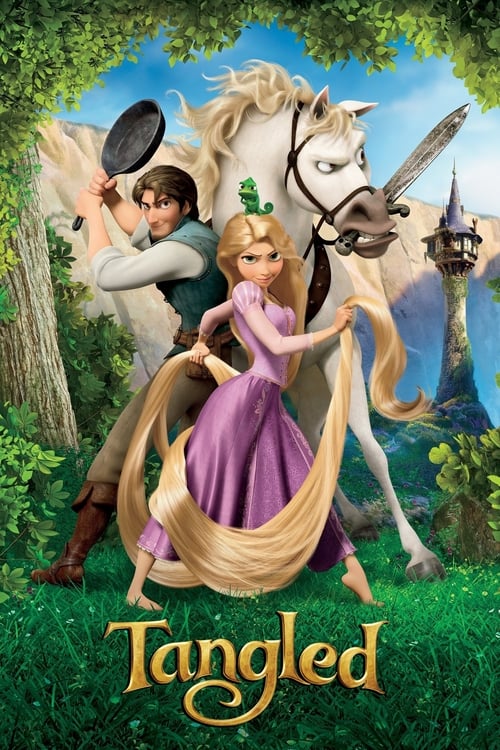
Tangled
2010 · Nathan Greno
For a cozy night in when you want to fall in love and laugh — a full-comfort family pick that adults don't have to grade on a curve. Reach for it when you need guaranteed warmth.
What it's about
Rapunzel has seventy feet of magical hair, an eighteenth birthday coming, and a lifetime spent locked in a tower by a smothering mother who insists the world is too dangerous for her. When a charming wanted thief named Flynn Rider stumbles into her hiding place, she blackmails him into escorting her to see the floating lanterns she's watched from her window every year. Cue a kingdom-wide chase involving thugs, a very judgmental horse, and a frying pan.
The experience
Fast, funny, and glowing — screwball banter between two leads who genuinely spark, with songs that sneak up on you and a lantern sequence that earns its reputation as one of the most purely beautiful things Disney has made. Underneath the comedy there's a surprisingly sharp portrait of emotional manipulation, which gives the sweetness a spine.
Performances
Donna Murphy's Mother Gothel is the standout — a Broadway-caliber vocal turn that makes passive-aggressive 'love' genuinely chilling under all the charm — while Mandy Moore and Zachary Levi give the leads real screwball chemistry.
The craft
Disney's fiftieth animated feature spent a decade chasing one obsession: making computer animation glow like a hand-painted storybook, with animator Glen Keane pushing CGI toward the gestural warmth of the studio's golden-age style. Alan Menken's songs bridge classic Disney and modern pop. The lantern night is worth the biggest, brightest screen you can find.
Why it matters
It quietly rebooted the Disney princess formula — banter-driven, self-aware, romance as negotiation between equals — and set the template the studio's megahits of the following decade ran on.
Disney's fiftieth animated feature and, at the time, the most expensive animated film ever made — a decade-long production whose central technical obsession was making computer animation glow like a hand-painted storybook. Rapunzel, locked in a tower by a mother whose manipulation is the film's real villainy, bargains her way out with a wanted thief, and the ensuing escapade quietly rebooted the Disney princess formula: screwball banter, a heroine with a frying pan, romance as negotiation between equals. Legendary animator Glen Keane, who originated the project, pushed the studio toward what he called 'the best of both worlds' — CGI dimensionality with the gestural warmth of the 1950s Fontaine Fox–era house style, using non-photorealistic rendering to approximate brushwork. Alan Menken's score bridges the Renaissance era he defined and the revival to come; the film's success paved the road to Frozen. Its signature image endures on its own terms: thousands of lanterns rising over dark water, a sequence the animators spent years perfecting and which remains one of the medium's purest renderings of longing.
Reception
A solid hit and well-reviewed in 2010, Tangled was quickly overshadowed by Frozen three years later — but the internet has since flipped the script, and it's now routinely reappraised as the stealth best film of the Disney Revival.
How Tangled was received, from release to now →
Influences: the films it descends from and the films it influenced
- Snow White and the Seven Dwarfs (1937) — Established the feature-length Disney-princess form and multiplane depth staging that Tangled re-engineers in painterly CG.
- Sleeping Beauty (1959) — Eyvind Earle's flat, tapestry-like storybook backgrounds are the explicit art-direction model Tangled chased when it invented a 'painterly' rendering pipeline to soften photoreal CG.
- The Little Mermaid (1989) — Set the Menken/Ashman Broadway-musical princess template, and gave Glen Keane his career-defining supervising-animator role on Ariel that he carries into Rapunzel.
- Beauty and the Beast (1991) — Menken's orchestral-theatrical scoring plus the ballroom's pioneering CG-under-hand-drawn compositing seed the CG/hand-drawn hybrid look Tangled scales to a whole film; Keane animated the Beast.
- Aladdin (1992) — Fast screwball banter and the roguish-thief-courts-royalty dynamic are the direct comic-romantic engine Flynn Rider and Rapunzel replay as 'romance-as-negotiation.'
- Tarzan (1999) — Glen Keane's 'Deep Canvas' painting-into-3D technique is the technical ancestor of Tangled's non-photorealistic painterly rendering, blending hand-painted texture with dimensional camera moves.
- It Happened One Night (1934) — The bickering-opposites road romance, where two mismatched travelers negotiate trust mile by mile, is the screwball narrative skeleton Tangled borrows for Flynn and Rapunzel's journey.
- The Princess and the Frog (2009) — The immediate Disney-revival predecessor restoring the Broadway fairy-tale musical; Tangled is its CG-pipeline successor within the same 'Disney Revival' era push.
- Paperman (2012) — Extends Tangled's CG/hand-drawn hybrid ambition into a formal experiment (the 'Meander' line-over-CG tool), pursuing the non-photorealistic warmth Tangled pointed toward.
- Wreck-It Ralph (2012) — Continues the reorganized Walt Disney Animation house style and CG craftsmanship Tangled re-established after the studio's late-2000s slump.
- Frozen (2013) — Directly inherits Tangled's painterly-CG princess pipeline, hair/snow simulation, and Menken-lineage musical architecture; it is the film Tangled 'paved the way for.'
- Moana (2016) — Carries the Tangled-era revival formula forward — songbook-driven princess arc plus advanced simulation (water) rendered with painterly art direction over photoreal capability.
- Spider-Man: Into the Spider-Verse (2018) — The mainstream apotheosis of non-photorealistic, hand-drawn-inflected CG that Tangled's painterly-rendering experiments anticipated a decade earlier.
- Puss in Boots: The Last Wish (2022) — Its storybook non-photorealistic painterly look continues legitimizing the stylized hybrid-CG aesthetic Tangled helped move out of the uncanny-valley photoreal default.
- Big Hero 6 (2014) — Launches the Disney-revival pipeline that marries painterly art-directed lighting to CG surfaces, the non-photoreal-yet-illuminated look Big Hero 6 refines before Hyperion replaces the hand-tuned approach.
- Frozen II (2019) — Inaugurated the Revival-era hybrid pipeline of painterly, hand-drawn warmth rendered in CG that Frozen II's autumnal, stylized environments build directly upon.
- Zootopia 2 (2025) — Byron Howard's earlier feature where Disney built its CG hair-simulation and non-photoreal virtual-camera systems, the R&D that matures into the fur-and-hair simulation seen here.
- Zootopia (2016) — Byron Howard's hybrid CG-with-hand-drawn-appeal facial acting and expressive-eye performance craft is the character-animation foundation Judy Hopps is built on.
- Enchanted (2007) — Menken-scored, self-aware deconstruction of the princess archetype that primed the revival's ironic-yet-sincere register Tangled adopts.
- Brave (2012) — A parallel princess film driving bespoke hair-simulation R&D, echoing Tangled's 70-feet-of-living-hair tech and its mother-daughter control-and-rupture theme.
- Klaus (2019) — Fakes painterly volumetric lighting onto 2D characters, sharing Tangled's core mission of marrying hand-drawn warmth with rendered dimensional depth.
Similar films
- Beauty and the Beast (1991) — influence & lineage · same viewing thread
- Aladdin (1992) — influence & lineage · same viewing thread
- The Princess and the Frog (2009) — influence & lineage · same viewing thread
- Moana (2016) — influence & lineage
- Puss in Boots: The Last Wish (2022) — influence & lineage
- Mulan (1998) — same viewing thread
- Alice in Wonderland (2010) — shared sensibility
- Frozen II (2019) — shared sensibility
All the films related to Tangled →
Watch it with: curated runs of related films
- Disney's Animated Golden Ages — Watch these together to trace Disney's storybook house style across three eras — the 1940 concert experiment, the hand-drawn renaissance, and the CG revival — and hear how each generation quotes the last.