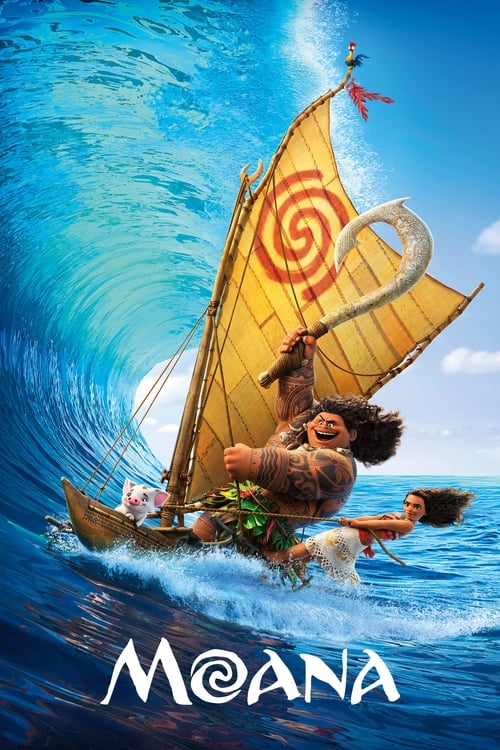
Moana
2016 · John Musker
For a feel-good family night, or any evening you want adventure without darkness — pure comfort viewing that still leaves you a little stirred.
What it's about
In ancient Polynesia, a blight is creeping across the islands, and Moana — a chief's daughter raised to stay inside the reef — answers the ocean's call to sail beyond it. Her mission: find Maui, the vain shape-shifting demigod whose theft of a goddess's heart started the curse, and drag him along to set it right. It's a two-hander quest musical played out on open water.
The experience
Buoyant, big-hearted and gorgeous, with banter-driven comedy riding on top of a sincere coming-of-age story. The songs land, the pace rarely slackens, and the ocean itself — playful, moody, alive — becomes a kind of character.
Performances
Auliʻi Cravalho, cast as a teenager, gives Moana a striking mix of stubbornness and doubt, and Dwayne Johnson's Maui is an ideal use of his comic swagger — including a game turn as a musical number's showman.
The craft
The water animation was the most ambitious Disney had attempted, and it shows: light through waves, hair in wind, whole seascapes that beg for a big bright screen. The songs — written by Lin-Manuel Miranda with Opetaia Foa'i and Mark Mancina — weave Pacific choral textures into showtune architecture, and the film was built with an advisory trust of Pacific scholars, navigators and artists shaping the story.
Why it matters
A modern pillar of the Disney canon whose songs became inescapable, and a landmark for the studio's turn toward consultative, culturally sourced storytelling — with a heroine defined by a voyage, not a romance.
Snapshot
Walt Disney Animation Studios' fifty-sixth feature, co-directed by John Musker and Ron Clements — the partnership that had effectively authored the studio's late-eighties revival — with Don Hall and Chris Williams credited as co-directors. Moana is a seafaring quest musical set in an unspecified pre-contact Polynesia, in which a chief's daughter defies her island's inward-turned caution, recovers a stolen heart-stone, and restores both an ecology and a suppressed voyaging tradition. It is simultaneously the most technically ambitious water picture Disney had attempted and the studio's most sustained experiment in consultative, culturally-sourced storytelling — a film whose production apparatus (research expeditions, an Oceanic Story Trust of Pacific scholars, navigators, linguists and artists) became as much a part of its public identity as its images. It was also, effectively, a valediction: Clements and Musker departed the studio in 2018, closing a directorial line that ran from The Great Mouse Detective through The Little Mermaid, Aladdin, Hercules, Treasure Planet and The Princess and the Frog.
Industry & production
Moana arrives at a specific moment in Disney Animation's institutional history. Under the post-2006 leadership installed after the Pixar acquisition, the studio had rebuilt itself around a story-trust model, a proprietary rendering pipeline, and a return to the musical. Frozen (2013) had made that reconstruction commercially undeniable; Big Hero 6 (2014) and Zootopia (2016) confirmed it was not a fluke. 2016 was an unusual year: Disney Animation released two features, Zootopia in the spring and Moana at Thanksgiving — an output rate the studio had not sustained since the tail of the Renaissance.
Development began around 2011, when Clements pitched a Polynesian-set project and the directors undertook the first of several research trips through Fiji, Samoa and Tahiti (later extended to Aotearoa New Zealand and elsewhere). Those trips produced two consequential outcomes. The first was the film's central historical hook: the archaeological puzzle sometimes called the "long pause," a roughly millennium-long interval in which Pacific long-distance voyaging appears to have halted before resuming and reaching the far corners of the triangle. That gap gave the filmmakers a dramatic engine — a people who stopped sailing — that is grounded in real scholarly debate rather than invented wholesale.
The second outcome was the Oceanic Story Trust, an advisory body of anthropologists, cultural practitioners, linguists, tattoo artists, choreographers and traditional navigators drawn from across the region, convened to review story, design and music. It represented a real methodological shift from the studio's earlier ethnographic tourism, and it demonstrably changed the film: Maui's characterization, the treatment of tapu and genealogy, the design of vessels and sails, and the languages used in the songs all bear its marks. It did not resolve the underlying problem — a Burbank studio monetizing living Pacific cosmologies — and the film's reception in Pacific communities was correspondingly split. The most visible flashpoint came in 2016, when Disney withdrew a promotional Maui costume that rendered a tattooed brown body as a wearable skin-suit; the withdrawal was swift and the criticism widely reported.
Producer Osnat Shurer oversaw the production. Taika Waititi wrote an early draft of the screenplay before the project moved on; the final screenplay is credited to Jared Bush, with story credit shared among the directors, Bush, Pamela Ribon, and Aaron and Jordan Kandell. The film was a substantial commercial success, grossing well over $600 million worldwide, and it traveled under altered titles in several territories — Vaiana across much of Europe because of a trademark conflict, and Oceania in Italy, where the name Moana carried an unrelated association.
Technology
Moana was rendered in Hyperion, Disney Animation's in-house path-tracing renderer, first deployed at scale on Big Hero 6 and by 2016 the studio's default. Path tracing mattered here more than usual: the film's dominant subject is water, and water is a material defined almost entirely by how light behaves inside and across it — refraction, caustics, subsurface scattering, foam, spray, the way a wave goes from translucent green at the crest to opaque white at the break. A brute-force global-illumination renderer makes those phenomena a physics problem rather than a cheating problem.
The harder challenge was that the ocean is not merely an environment but a character with intention. It gestures, sulks, teases, and hands objects to people. This required reconciling two normally incompatible pipelines: fluid simulation, which is governed by solvers and resists direction, and character animation, which demands frame-level control of performance. The studio built dedicated water toolsets to let animators author the ocean's "acting" as a controllable surface while simulation supplied secondary detail, spray and interaction — an art-directable fluid, in effect, layered over physically plausible sea. The result is legible in the film's most distinctive images: a wave that curls into something like a face and a shrug without ever acquiring eyes.
Adjacent R&D covered hair (Moana's dense curls and Maui's mass of it, both of which needed to survive constant wetting), skin under tropical light, and the iridescent, bioluminescent shell of Tamatoa in the Realm of Monsters — an exercise in structural color and blacklight staging that functions as a set-piece demonstration of the renderer's range.
Technique
Cinematography
Disney Animation splits the cinematography credit between layout and lighting units, and Moana uses that division pointedly. The film's compositional grammar alternates between two scales: extreme wide shots that reduce the canoe to a speck against horizon and sky — the visual argument that navigation is a relationship with immensity — and tight, almost handheld-feeling coverage inside the boat, where the two-hander comedy plays. Sunlight is the film's principal expressive instrument; the palette moves from the saturated, high-key greens and blues of Motunui through the desaturated ash-and-ember of Te Kā's approach, and the climactic transformation is staged as a color event as much as a narrative one. Night sequences lean on the star field as an actual instrument of wayfinding rather than décor, which is unusual: the sky is treated as a readable diagram.
Editing
Jeff Draheim, a longtime Clements–Musker collaborator, cuts the film with the compression typical of the modern Disney musical: a fast, dense first act that establishes island, family, prohibition and desire in roughly twenty minutes, then a looser middle governed by episodic encounters (Kakamora, Lalotai, the crossing) and a tightly braided climax. The songs carry much of the structural load — "Where You Are" telescopes years of village life into a single number, a montage function inherited directly from the Renaissance model these directors built.
Mise-en-scène / staging
The production design (Ian Gooding) commits to a stylized rather than documentary Polynesia: a composite island culture, deliberately not identified with any single nation, with vessel design, sail rigging, tapa patterning, carving and adornment vetted for plausibility. The most-discussed staging invention is Mini Maui, the animated tattoo that serves as Maui's conscience and running commentary — hand-drawn in traditional 2D by Eric Goldberg (the Genie in Aladdin) and mapped onto the CG character's moving skin. It is a genuine formal hybrid, and it smuggles the hand-drawn line back into a studio that had abandoned it, giving Maui an interior life the dialogue never states. The Kakamora sequence — armored coconut pirates drawn from Solomon Islands folklore — is staged as a naval chase with a kinetic, vehicular energy that many critics read against contemporaneous action cinema.
Sound
Mark Mancina's score integrates Pacific percussion, log drums and vocal textures with orchestral scoring, and the songs — by Lin-Manuel Miranda, Opetaia Foa'i of Te Vaka, and Mancina — are the film's defining authorial signature. "We Know the Way," largely in Tokelauan and Samoan, is the rare Disney number that declines to translate itself for an English-speaking audience. "How Far I'll Go" is a textbook "I Want" song in the Little Mermaid lineage, self-consciously so. "Shiny" is a glam-rock pastiche. The sound design's quietest achievement is the ocean itself, which performs without a voice: its characterization is carried entirely by movement, water sound and score.
Performance
Auliʻi Cravalho, a Native Hawaiian teenager cast in her first professional role, gives a performance whose unpolished quality is its asset — the vocal reads as a fifteen-year-old rather than as a Broadway instrument. Dwayne Johnson's Maui converts his star persona (bravado as a shield over neediness) into character. Rachel House's Gramma Tala, Temuera Morrison's Chief Tui, Nicole Scherzinger's Sina and Jemaine Clement's Tamatoa give the film a largely Pacific and Aotearoa-sourced cast — a casting practice that was not standard at the studio and became more so afterward.
Narrative & dramatic mode
Structurally, Moana is a two-hander road movie displaced onto water: a mismatched pair, a vehicle, a destination, and a series of encounters that function as tests. Beneath it runs an orthodox monomythic scaffold — refusal of the call, threshold guardian, descent into the underworld (Lalotai), death of the mentor, atonement. What distinguishes it is the resolution. The climax is not a defeat but an act of recognition: the monster Te Kā is identified as the wounded goddess Te Fiti, and the film ends by returning something rather than destroying something. That reframing of antagonism as injury is the film's most interesting dramatic move, and it is executed almost without dialogue.
Moana also carries no romantic plot whatsoever — not deferred, not subordinated, simply absent. Following Brave (2012) and the sororal redirection of Frozen, this completed a decisive break with the studio's foundational courtship structure.
Genre & cycle
The film sits at the intersection of three cycles: the Disney animated musical in its post-Frozen revival; the mythological adventure, which Clements and Musker had already worked in with Hercules; and the studio's mid-2010s turn toward culturally specific settings developed with external consultation. It is also, in a real sense, a sea picture — closer in its pleasures to voyage narratives and Treasure Planet than to the fairy-tale line.
Authorship & method
Clements and Musker's method is legible throughout: broad comic sidekicks, a trickster figure with a self-mythologising number, a mentor's death, and a musical architecture inherited from their own Little Mermaid. The novelty is that they applied it as a hybrid — traditional 2D sensibility staged in a CG pipeline, with hand-drawn animation literally embedded in the frame. The key collaborations are Miranda and Foa'i (whose partnership prevents the score from reading as either pure Broadway or pure exotica), Mancina, Draheim in the cutting room, Gooding in design, Goldberg on Mini Maui, and — structurally novel — the Oceanic Story Trust operating as a distributed, non-credited co-author on matters of cultural representation.
Movement / national cinema
Moana belongs to Hollywood, not to Pacific cinema, and the distinction matters. Barry Barclay's concept of Fourth Cinema — Indigenous filmmaking made from inside the culture, on its own terms — describes work like Whale Rider, Once Were Warriors, or Tusi Tamasese's Samoan-language The Orator. Moana is the outside camera looking in, with unusual care. Its relationship to that tradition is nonetheless direct: Rachel House played Nanny Flowers in Whale Rider, whose plot of a chief's granddaughter inheriting against patrilineal expectation is Moana's clearest live-action antecedent. The film's most substantive gesture toward the region came afterward, in the full dubs produced in te reo Māori, Tahitian, Hawaiian and other Pacific languages — versions that circulated in schools and communities and are, for many viewers, the definitive text.
Era / period
The film is a product of the streaming-era consolidation of Disney: 2016, with Marvel and Lucasfilm integrated, the live-action remake program running, and animation operating as a reliable four-quadrant engine. It also belongs to a moment of intensified public argument about representation and appropriation in mainstream American media — arguments Moana both anticipated procedurally and could not escape.
Themes
Navigation as both craft and identity; the recovery of a suppressed inheritance from within a community that has forgotten it, not from an outside oppressor; ecological restoration figured as returning what was taken; the reframing of monstrousness as unhealed wound; ancestry as active presence rather than memory; and — in Maui — self-worth built on the approval of others, and what remains when that approval is withdrawn. The film's ambivalence about tradition is more interesting than its resolution: Tui's caution is never framed as foolish, only as incomplete.
Reception, canon & influence
Critical reception was strong: broad praise for the animation, the score and Cravalho's performance, with the most common reservations concerning familiar structure and the sidekick comedy. It received Academy Award nominations for Best Animated Feature and for Best Original Song ("How Far I'll Go"), losing the former to Zootopia and the latter to "City of Stars." Response within Pacific communities was genuinely divided — some welcomed unprecedented visibility, careful consultation and the language dubs; others objected to the commodification of atua and to a composite culture assembled for a global market. Te Fiti, it is worth noting plainly, is an invention of the film rather than a traditional deity, while the Maui cycle it draws on is a living tradition with many regional variants.
Backward, the film's influences are traceable: the Renaissance musical grammar Clements and Musker themselves established; the Maui myth cycle; the archaeological literature on the long pause; the Aotearoa screen tradition, with Whale Rider the most direct precursor; and Solomon Islands folklore for the Kakamora.
Forward, its legacy is threefold. Institutionally, the Story Trust model became standard practice, recurring as the Southeast Asia Story Trust on Raya and the Last Dragon and the Colombian cultural trust on Encanto — as did the practice of casting from the depicted region. Musically, it initiated Lin-Manuel Miranda's Disney relationship, which led directly to Encanto. Commercially, it produced a franchise: Moana 2 (2024), converted from a planned streaming series into a theatrical feature and a very large hit, and a live-action version with Dwayne Johnson dated for 2026, with Cravalho stepping back from the lead role into a producing capacity and a new performer cast as Moana. The character's absorption into the Disney Princess apparatus is the ordinary fate of such films; the more durable achievement is that Moana made a Pacific-set, Pacific-voiced, partly Pacific-language musical into a global default text — and set a procedural bar that the studio has since been expected to clear.
Reception
A solid hit with two Oscar nods in 2016, but it lived slightly in Frozen's shadow — then streaming turned it into a monster, topping Nielsen's most-streamed movies in the US year after year, big enough to spawn both a sequel and a live-action remake.
How Moana was received, from release to now →
How to watch Moana: what to notice on a first viewing
- Notice shots swinging between a tiny canoe and close boat-deck banter. Musker and Clements keep pulling back to isolate the canoe against sky and ocean, then pushing in tight for the comic two-hander inside it. The scale contrast makes navigation feel like a relationship with vastness, not just a trip.
- Watch the palette shift from island green to ash gray. The film's color moves from the saturated greens and blues of Motunui toward the desaturated ash and ember of Te Kā's approach. The climax is staged as much through color change as through plot.
- Listen to the ocean: it never speaks, only moves and sounds. The ocean has no lines of dialogue anywhere in the film; every mood it carries comes from motion, splash, and score. Disney gives a nonhuman character full personality without ever giving it a voice.
- Watch the tattoo on Maui's arm move and react on its own. Mini Maui, drawn frame by frame in traditional 2D by Eric Goldberg, comments on and contradicts Maui throughout, independent of the script. The hand-drawn tattoo gives Maui an inner life the dialogue never states.
- Listen for Auliʻi Cravalho's voice sounding like an actual teenager. Cravalho was a first-time actor cast in her first professional role, and her reads keep the rough edges of a real teenage voice. The performance sounds like a real fifteen-year-old, not a trained Broadway belt.
The whole guide to watching Moana, with the keys for a rewatch →
Influences: the films it descends from and the films it influenced
- The Little Mermaid (1989) — Supplies the exact musical architecture Moana reuses — an 'I Want' song staged at a literal shoreline barrier the heroine cannot cross, its reprise placed at the lowest story beat and its melody seeded instrumentally under the opening — the Ashman/Menken template Clements and Musker built and then rebuilt with Miranda.
- Aladdin (1992) — Establishes the directors' trickster set-piece — a shapeshifting boaster's self-mythologising patter number ('Friend Like Me' → 'You're Welcome') animated as rapid-fire metamorphosis gags — alongside the magic carpet, a mute non-human companion given full character performance through silhouette and gesture, the direct staging precedent for the Ocean.
- Hercules (1997) — Inserts animation in a foreign graphic idiom inside the film's own frame — Gerald Scarfe-styled figures and the black-figure vase-painting Muses narrating in flat two-dimensional register — the device Moana escalates into Mini Maui, hand-drawn 2D tattoo animation tracked onto a CG character's deforming musculature.
- Treasure Planet (2002) — The directors' first full commitment to hybrid staging — 2D-drawn principals composited into Deep Canvas CG environments — plus the voyage structure of a young navigator, a duplicitous charismatic mentor and a wordless morphing sidekick that Moana rebuilds with the polarity reversed (CG principals, drawn insert).
- Lilo & Stitch (2002) — Puts untranslated, unsubtitled Hawaiian-language chant ('He Mele No Lilo', Mark Keali'i Ho'omalu's hula-derived vocal) into a Disney feature score without glossing it for the audience — the precedent for Foa'i's Tokelauan and Samoan lyrics in 'We Know the Way' and for casting the vocal from the depicted region.
- Whale Rider (2002) — The most direct precursor: a girl claims a chiefly line closed to her, with the film's authority resting on community consultation, on-location Ngāti Konohi participation and a first-time local teenage lead — the same triangulation of casting, consultation and a wordless summoning of ancestors that Moana restages as 'I Am Moana'.
- Kirikou and the Sorceress (1998) — Builds its antagonist as a wound rather than a will — Karaba's cruelty caused by thorns driven into her spine, so the climax is an extraction and a restoration, not a kill — which is precisely Te Kā/Te Fiti's design, where the villain is a goddess with her heart torn out and the resolution is returning it.
- Ponyo (2008) — Animates the sea itself as a willful character — hand-drawn waves with eyes and intent, tidal surges that carry and reject figures as performance rather than physics — the conceptual model for Moana's Ocean, a fluid simulation art-directed to hold poses, gesture and comic timing against its own solver.
- Dumbo (1941) — 'Pink Elephants on Parade' invents the Disney plot-suspending hallucination number — abstract, saturated, black-ground color staging where the frame abandons its established palette for a single song — the structural slot Moana fills with 'Shiny' and its bioluminescent blacklight Lalotai.
- Brave (2012) — Forced the industry's first production-scale curly-hair solver (Taz), treating hair as a constrained core-curve system rather than straight strands — the R&D lineage Moana inherits and extends into wet-hair behavior, where clumping, mass gain and drying had to be simulated across nearly every shot.
- Big Hero 6 (2014) — First feature rendered in Disney's Hyperion path tracer, whose global-illumination bounce made the San Fransokyo night viable; Moana is the film that stress-tests that renderer on translucent water, subsurface skin under tropical sun and volumetric caustics, none of which the prior scanline pipeline could have costed.
- Finding Nemo (2003) — Pushes the ocean itself into a fully simulated character with photoreal water, the maturation of the caustics-and-fluid rendering lineage Nemo launched at Disney/Pixar.
- Spider-Man: Into the Spider-Verse (2018) — Takes Mini Maui's core trick — hand-drawn 2D marks authored per-frame and locked to CG geometry as it deforms — and makes it the whole film's surface language, with drawn hatching, chromatic offset and comic linework applied over path-traced characters rather than confined to one inset gag.
- Raya and the Last Dragon (2021) — The Story Trust model repeated as the Southeast Asia Story Trust, with casting drawn from the depicted region and the same two-hander road-movie skeleton — reluctant girl plus a boastful shapeshifting mythic being, no romance plot, antagonist revealed as damage to be healed rather than defeated.
- Encanto (2021) — The direct issue of Miranda's Disney relationship that Moana began: his rhythm-forward, internally-rhymed song construction now carrying the whole score, with a Colombian cultural trust standing in for the Oceanic one and untranslated Spanish woven into lyric and dialogue as a matter of course rather than as flourish.
- The Sea Beast (2022) — Moana's co-director takes the ocean-craft with him — art-directable open-water simulation staged for performance, hull-and-wake interaction shot in the extreme-wide-to-tight alternation Moana used for scale, and a wordless sea creature carrying an emotional arc entirely through mass and movement.
- Moana 2 (2024) — Converted from an episodic streaming series back into a feature, it inherits the first film's water, hair and Hyperion pipelines intact but replaces Miranda with Barlow and Bear while retaining Foa'i's Pacific percussion layer — the clearest test of which elements of the hybrid score were structural and which were authorial.
- Coco (2017) — Runs the same procedural bar in parallel at Pixar — an all-Latino principal cast, standing cultural consultants, untranslated Spanish left in dialogue and lyric — and answers 'Shiny' with its own light-show set-piece, the marigold-bridge Land of the Dead built as a saturated emissive palette break from the muted living world.
- Frozen II (2019) — Formalises Moana's consultation practice into a signed agreement with Sámi parliaments (the Verddet group) covering script, design and a Northern Sámi dub — the Oceanic Story Trust converted into contract — while restaging the wordless elemental call as Ahtohallan and its untranslated 'Vuelie' joik-derived choral.
- Finding Dory (2016) — Contemporaneous leap in character-interactive, deformable water simulation, extending the same craft problem — animating a sentient, light-transmitting fluid as a performing element.
- Zootopia 2 (2025) — Bush co-wrote it, and its effects-simulation breakthroughs (character-acted water) run parallel to the fur and crowd simulation, both products of the same mid-2010s Disney FX push.
- Zootopia (2016) — Same-year, same-studio film pairing heavy proprietary in-house simulation (its water pipeline) with mythic worldbuilding — the twin proof of Disney's tech-plus-four-quadrant model.
Similar films
- Treasure Planet (2002) — influence & lineage
- Frozen II (2019) — influence & lineage
- Lilo & Stitch (2002) — influence & lineage
- Coco (2017) — influence & lineage
- Spider-Man: Into the Spider-Verse (2018) — influence & lineage
- Ponyo (2008) — influence & lineage
- Big Hero 6 (2014) — influence & lineage
- Finding Dory (2016) — shared sensibility