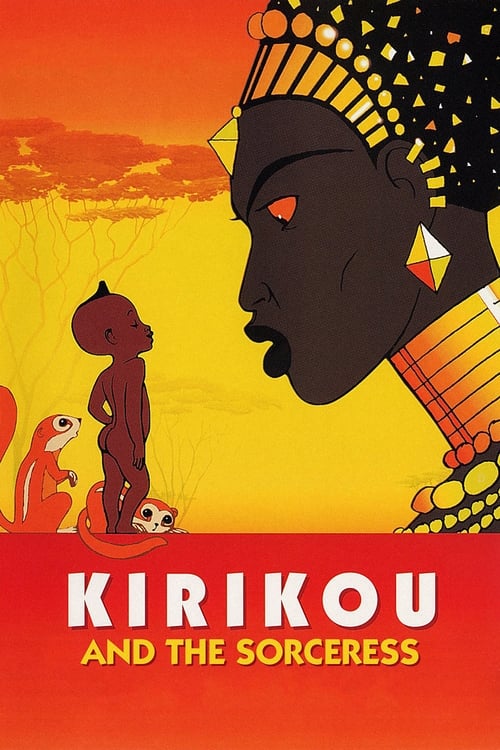
Kirikou and the Sorceress
1998 · Michel Ocelot
For family movie night when you want something genuinely different from studio animation, or for when you want seventy minutes of pure storytelling that leaves everyone a little kinder.
What it's about
In a West African village, a boy named Kirikou speaks from the womb, delivers himself, and starts running the moment he's born. His village lives in fear of Karaba, a sorceress who has dried up the spring and is said to have devoured the men, and tiny, fearless Kirikou — too small to fight, too curious to obey — sets out to learn the one question no one else asks: why is Karaba wicked?
The experience
Bright, brisk, and quietly wise — it has the bounce of a great bedtime story but keeps surprising you with how humane it is. Kids laugh at Kirikou's speed and cheek; adults notice the film gently dismantling the idea of villains.
The craft
Ocelot's hand-drawn images are gorgeously flat and bold — figures in profile against saturated jungle greens and ochre earth, closer to painting and textile than to typical cartoon style. Youssou N'Dour's score, built on West African instruments, gives the whole film its heartbeat.
Why it matters
A surprise phenomenon in France that launched Michel Ocelot's career and opened a lane for European hand-drawn animation rooted in African stories and art.
Snapshot
Kirikou and the Sorceress (Kirikou et la Sorcière) is Michel Ocelot's first feature and the film that established a distinctly European tradition of hand-drawn animation drawn from African material. In roughly seventy minutes it tells the story of Kirikou, a newborn who speaks from the womb and walks the moment he is born, and who sets out to free his village from Karaba, a sorceress who has dried up the spring, devoured the village's men, and terrorized its people through an army of animate fetishes. The film's power lies in the tension between its simple, folk-tale surface and its refusal of the folk-tale's usual moral shorthand: its "witch" turns out to be a wounded woman, and its hero's decisive act is not violence but the removal of a source of pain. Made as a French-led European co-production and scored by the Senegalese musician Youssou N'Dour, it became a landmark of non-Disney feature animation and a founding text for what would grow into a recognizable Ocelot authorship. It also became, unintentionally, a cause célèbre over the depiction of nudity in a children's film.
Industry & production
The film was produced under the aegis of Didier Brunner's Paris company Les Armateurs, the outfit that would go on to back a run of auteur-driven European animated features. Like most animation of its scale and moment, Kirikou was assembled as a multi-country co-production — French, Belgian, and Luxembourgish partners are part of its financing and production record, a structure typical of European animation seeking to pool subsidy, broadcaster money, and tax incentives across borders. The animation labor itself was distributed across more than one European studio rather than being concentrated in a single house; the precise allocation of shots among studios is the sort of granular production fact that is documented unevenly, and I will not overstate it.
What is clear is that Kirikou was made on modest means by the standards of feature animation, and that its economy is visible — and turned to advantage — in its stylization. The film could not compete with the full-animation labor budgets of Hollywood, and Ocelot instead built an aesthetic of flat planes, held poses, and decorative repetition that reads as a deliberate artistic choice rather than a compromise.
The most consequential industrial story around the film is its distribution history in the English-speaking world. Kirikou's villagers are depicted as West Africans of the pre-colonial imagination, which in Ocelot's design means bare-breasted women and naked children. Ocelot refused to add clothing to secure easier distribution, and the film's path into the United States and the United Kingdom was slowed and complicated by that nudity — a striking demonstration of how differently the unclothed body registers in French versus Anglo-American children's markets. The film ultimately reached those territories, but its distribution difficulties there became part of its public identity.
Commercially, Kirikou was a genuine success in France, drawing a large theatrical audience and spawning an unusually broad afterlife of sequels, a stage musical, and merchandising. I am flagging that I do not hold a precise, reliable admissions or gross figure in memory, and will not invent one; the safe, documented claim is that it performed strongly enough at home to make Ocelot a bankable feature director and to justify a franchise.
Technology
Kirikou is a traditionally animated film — drawn artwork rather than 3D CGI — produced at the hinge moment when the animation industry was migrating from photographed cels to digital ink-and-paint. Its clean, flat color fields, hard edges, and absence of the slight texture and registration wobble of photographed cels are consistent with digital compositing of hand-drawn line, and the film belongs to the late-1990s generation for which the computer had become a coloring and assembly tool rather than a modeling one. The technology serves a deliberately anti-illusionist look: there is little of the multiplane depth-faking or airbrushed gradient that Disney used to simulate volume. Backgrounds are built as designed, layered planes, and characters move against them as legible silhouettes. The point of the film's toolset is not spectacle but graphic clarity.
Technique
Cinematography
The category has to be re-read for a hand-drawn film: there is no photographed image and no director of photography in the live-action sense, so "cinematography" here means the film's virtual camera and compositional grammar. Ocelot's framing is emphatically frontal and planimetric. Compositions are staged parallel to the picture plane, with figures presented in profile or full-front like a frieze, and depth rendered through stacked flat bands rather than converging perspective. The palette is saturated and warm — ochres, reds, deep greens, tropical blues — and lighting is largely notional; there is little cast-shadow modeling. The "camera" tends to hold, letting the eye read a tableau, and reserves movement for emphasis. This is a visual language closer to book illustration, Egyptian wall painting, and the flat exoticism of Henri Rousseau than to the roving, volumetric camera of mainstream feature animation.
Editing
Kirikou is cut for legibility and folk-tale cadence rather than kinetic excitement. Its structure is episodic — a series of trials in which Kirikou confronts a threat (the poisoned spring, the fetishes, the beast) and resolves it through curiosity and cleverness — and the editorial rhythm follows that beat-by-beat problem-solving. Scenes are given time to land; the film trusts stillness. I do not have a firmly attributable editor credit to cite and will not invent one, but the editorial sensibility on the screen is patient, chapter-like, and shaped to a young audience's comprehension without condescending to it.
Mise-en-scène / staging
Staging is the film's signature strength. Ocelot arranges figures with the deliberateness of a designer composing a page: symmetrical village gatherings, processional movement, Karaba enthroned amid her fetishes. The world is built from a coherent decorative vocabulary — patterned cloth, stylized flora, geometric architecture — so that every frame reads as an ornamented whole. The staging also carries meaning: Kirikou is tiny, and his smallness within these compositions is a running visual argument about how the powerless outwit the powerful. Karaba, by contrast, is staged for imposing verticality and stillness, a monument of fear whose eventual reduction to a suffering human is prepared by how her posture and framing soften.
Sound
The soundtrack is central to the film's identity. Youssou N'Dour composed and produced the score, drawing on Senegalese and broader West African musical traditions and instrumentation, with vocals in Wolof. The music grounds the film's African setting in actual African sound rather than the orchestral pastiche a Western studio might have defaulted to, and it gives Kirikou an aural authenticity that matches Ocelot's commitment to the material's roots. Voices and effects are handled with the same clarity as the image: dialogue is foregrounded and unhurried, and the sound design leaves space around events rather than saturating them.
Performance
Vocal performance in the original French is pitched for directness. Kirikou's voice must carry the paradox of an infant with an adult's cunning and a child's fearlessness, and the film depends on that voice reading as bright, quick, and unsentimental. Karaba's vocal performance must hold menace long enough that her final vulnerability lands as a reversal rather than a cheat. Because the film has circulated in multiple dubbed versions, the specific cast attributions vary by territory; I will not assert particular performer credits I cannot reliably confirm.
Narrative & dramatic mode
Kirikou operates in the register of oral folk tale rendered as a hero's-journey quest, but it bends the mode in one decisive way. The structure is cumulative and episodic — the child hero passes through a sequence of dangers, each resolved by wit — and it carries the folk tale's characteristic economy and repetition. Yet the film withholds the folk tale's usual final catharsis of the villain destroyed. The dramatic engine is a question the child keeps asking: why is Karaba wicked? The wise grandfather in the mountain supplies the answer — she suffers from a thorn driven into her back by men — and the climax is an act of healing, not conquest. This converts a tale of good versus evil into a parable about the origins of cruelty in unhealed injury, a strikingly humane dramatic turn for a children's film.
Genre & cycle
Nominally the film sits at the crossroads of fantasy, adventure, animation, and family — a mythic quest with a magic-touched hero and a sorcerous antagonist. In practice it belongs to a smaller, more interesting cycle: the auteur-driven European animated feature that defines itself against the Disney model, choosing regional or literary source material, a graphic-design aesthetic over hyper-rendered realism, and a moral scheme more ambivalent than good-versus-evil. Within Ocelot's own work it inaugurates the "Kirikou cycle" of sequels and spin-offs, and within the broader arc of French animation it is an early, prominent entry in a wave that would make France a leading producer of adult-serious animated features.
Authorship & method
Kirikou is unmistakably an Ocelot film, and it announces the concerns that organize his career: African and non-European folk material, a flat and decorative visual style rooted in illustration and the arts of the past, silhouette and pattern as expressive tools, and stories in which children and outsiders undo the cruelties of the powerful. Ocelot spent part of his own childhood in Guinea, and that early exposure to West Africa is generally cited as formative for the film's setting and sympathies — a biographical fact worth stating plainly rather than mythologizing. He came to the feature after years of acclaimed short filmmaking, and Kirikou reads as a short-film sensibility expanded to feature length: economical, designed, unhurried.
Among collaborators, the decisive creative partner is composer Youssou N'Dour, whose score is not decoration but a co-author of the film's identity, binding Ocelot's images to living West African music. For other key craft roles — editor, and the various studio-level animation and background leads spread across the co-production — the publicly consolidated credit record is thinner than for the director and composer, and I will not manufacture attributions to fill it. What can be said is that the film's method was collaborative in the European co-production sense: a strong authorial vision realized by animation labor pooled across several studios and countries under Ocelot's design control.
Movement / national cinema
The film is a cornerstone of the modern renaissance of French animation. France entered the late 1990s and 2000s as an unusually fertile territory for feature-length animation made for a general and even adult audience, supported by a subsidy and broadcaster ecosystem that could underwrite artistically ambitious work. Kirikou, produced through Les Armateurs and its co-production partners, is one of the films that demonstrated this ecosystem could yield an internationally exported success. It also marks a specific strand within that movement: the turn toward non-European, postcolonial, and folkloric subject matter treated with respect and formal seriousness — a French animation that looks outward to Africa, and later, in Ocelot's Azur & Asmar, to the Islamic Mediterranean.
Era / period
Released in 1998, Kirikou arrives at a pivotal moment in animation history. It sits just before and alongside the CGI revolution — Toy Story had appeared three years earlier — and it represents a conscious counter-position: the continued vitality of hand-drawn, design-led animation at the very moment the industry's center of gravity was shifting to 3D. Its late-1990s digital ink-and-paint production situates it in the transition between photochemical and digital animation craft. Culturally, its distribution frictions over nudity also date it precisely to a moment when a European film's frank, non-sexualized depiction of the unclothed body collided with tightening Anglo-American norms around children's media.
Themes
The film's governing theme is the origin of evil in pain. Karaba is not wicked by nature; she is cruel because she is hurt, and the removal of her hidden thorn is a literalized argument that cruelty is a wound that can, in principle, be healed. Around that core the film gathers several related concerns: courage and cunning in the powerless, embodied in a hero who is physically the smallest character in every frame yet the most effective; knowledge over force, since Kirikou defeats threats by asking questions and understanding causes rather than by fighting; and the restoration of community, as the freeing of the men and the returning of the spring reintegrate a fractured village. There is also a persistent theme of the elder as keeper of understanding — Kirikou's grandfather supplies the crucial knowledge — figuring wisdom as something transmitted across generations. Read against Ocelot's background, the film additionally carries a quietly counter-colonial impulse: it presents an African world on its own mythic and aesthetic terms, unclothed and unashamed, dignified rather than exoticized-for-pity.
Reception, canon & influence
Critically, Kirikou was received as a revelation — praised for the beauty and integrity of its design, for the freshness of its African folk source, and for the maturity of its moral scheme. It found strong festival and art-house support and became, over time, a widely taught and widely beloved title, especially in France, where it entered the culture as a children's classic and a point of national pride in animation.
Influences on the film (backward): Ocelot draws visibly on the flat, frontal traditions of illustration and ancient art — the friezelike compositions evoke Egyptian painting, and the lush, stylized foliage recalls the "naïve" jungle canvases of Henri Rousseau. The narrative material comes from West African folk tale, filtered through Ocelot's own childhood memory of Guinea. Musically, the film reaches back to Senegalese and West African performance tradition through N'Dour. It is also, in its whole conception, a reaction against the Disney feature — defining itself by what it refuses: rounded volumetric characters, orchestral scoring, and unambiguous villains.
What it shaped (forward): Kirikou helped prove the commercial and artistic viability of the hand-drawn European auteur feature, and it is frequently cited as a catalyst for the confidence of French feature animation in the 2000s. It launched a franchise of its own — sequels and spin-offs continuing the Kirikou stories, plus a stage adaptation — and it consolidated Ocelot as a major animation author, clearing the path for his later features. More broadly, its success became a reference point in arguments that feature animation need not imitate Hollywood in style, subject, or moral tone, and that a film could treat African material and the unclothed African body with dignity for a young audience. Its distribution battles, meanwhile, remain a standard case study in how national norms shape what children are permitted to see.
A Deleuzian reading
A voice comes from inside a pregnant woman, asking to be born.
The full Deleuzian reading of Kirikou and the Sorceress →
Reception
A modest French release in December 1998 that snowballed into a word-of-mouth family phenomenon — well over a million admissions in France — and is now credited with kickstarting the modern French animated-feature renaissance. Meanwhile it took years to reach English-speaking markets, where distributors balked at its matter-of-fact nudity.
How Kirikou and the Sorceress was received, from release to now →
How to watch Kirikou and the Sorceress: what to notice on a first viewing
- Watch how flat and symmetrical each scene looks. Ocelot stages figures parallel to the picture plane, in profile or full front like a frieze, with depth built from stacked flat bands instead of perspective. Each frame is built to be read like a picture, not looked through like a window onto real depth.
- Watch how small Kirikou is in every single shot. He is staged as the tiniest figure in nearly every composition, dwarfed by villagers, huts, and Karaba herself, in every scene he appears. His size is a running argument that the powerless can still be the most effective person in the room.
- Listen for the music's language and instruments. Youssou N'Dour's score draws on Senegalese and wider West African tradition, with vocals sung in Wolof rather than an orchestral score imitating Africa from outside. The film's Africa is sung in an actual African voice, not approximated by a Western orchestra.
- Watch what Kirikou does right before each danger ends. He investigates instead of fighting, going underwater, following the village women, digging, and each act uncovers one more piece of what is actually happening. He keeps winning by understanding causes, not by defeating anyone with force.
- Notice how warm and saturated the colors stay throughout. The palette runs to ochres, reds, deep greens, and tropical blues, with almost no cast shadow or modeled lighting anywhere in the film. The flat warmth keeps the film feeling like an illustrated storybook rather than a lit, three-dimensional world.
The whole guide to watching Kirikou and the Sorceress, with the keys for a rewatch →
Influences: the films it descends from and the films it influenced
- The Adventures of Prince Achmed (1926) — Establishes the articulated flat silhouette-and-pattern cut-out figure staged frontally against decorative backgrounds — the shadow-theater technique Ocelot inherits for Kirikou's flat frontal design and revives wholesale in his own silhouette work.
- Le Roi et l'oiseau (1980) — Defines the French hand-drawn auteur feature built against Disney — flat graphic architecture, poetic anti-authoritarian morality, unhurried episodic pacing — the native tradition Kirikou consciously extends.
- Fantastic Planet (1973) — Roland Topor's planimetric cut-out graphics and deliberately un-volumetric character design set the European art-house alternative to rounded Disney modeling that Kirikou's decorative flatness continues.
- Yellow Submarine (1968) — Heinz Edelmann's frontally-staged, pattern-driven pop-decorative backgrounds prove a feature can be built from graphic-design flatness rather than illusionistic depth — Kirikou's flat-decorative-palette principle.
- Gerald McBoing-Boing (1950) — UPA's limited-animation flat modernist planimetric staging as a programmatic revolt against Disney naturalism — the economical designed-not-rendered aesthetic Kirikou inherits.
- The Lion King (1994) — The negative model Kirikou answers point-for-point: against Hollywood's Broadway-orchestral, Hamlet-plotted Africa, Ocelot substitutes N'Dour's living West African score, folk-tale cadence, and the unclothed African body treated with dignity.
- Princes et princesses (2000) — Ocelot's immediate follow-up makes explicit the silhouette-and-pattern device latent in Kirikou, reducing the frontal flat figure to pure shadow-theater cut-out.
- Kirikou et les bêtes sauvages (2005) — Direct franchise continuation preserving the episodic folk-tale cadence, planimetric West African staging, and subverted-villain moral scheme of the original.
- Azur & Asmar (2006) — Ocelot pushes the same ornamental, symmetrical frontal staging into Islamic/Maghrebi decorative flatness, using CGI to keep the image flat and pattern-dense rather than volumetric.
- The Triplets of Belleville (2003) — Part of the French hand-drawn renaissance Kirikou catalyzed, extending caricatural flat design and near-wordless vocal-directness as a deliberate rejection of Hollywood polish.
- Persepolis (2007) — A French flat high-contrast graphic feature carrying serious non-European folk-memoir material, proving Ocelot's flat-authorial model could hold weight beyond children's fable.
- The Secret of Kells (2009) — Cartoon Saloon's planimetric layering and ornamental pattern-as-space derive openly from Ocelot; Moore cites Kirikou as proof a folk-illustration flatness could carry a feature.
- Song of the Sea (2014) — Transposes the Ocelot model to Celtic myth — flat decorative palette, ornamental linework, and an episodic folk-tale structure rooted in indigenous source material.
- Wolfwalkers (2020) — Continues the flat frontal ornamental line, building space through pattern and silhouette rather than volumetric rendering in an explicitly counter-Disney feature.
- The Breadwinner (2017) — Uses flat decorative design with stylized silhouette-and-pattern folk-tale interludes, and centers a child undoing the cruelties of the powerful — Kirikou's knowledge-over-force structure.
- Long Way North (2015) — Pushes Kirikou's flat-decorative palette to its logic — outline-free flat color-blocking with no volumetric shading, planimetric staging as pure graphic surface.
- Azur & Asmar: The Princes' Quest (2006) — Ocelot's own breakthrough posing figures in profile against flat folk-art-patterned grounds (African here) is the template Azur transposes onto Maghrebi and Persian ornament.
- Ernest & Celestine (2012) — Shares producer Didier Brunner and the Les Armateurs house style of flat, hand-painted 2D with unmodulated color fields and no digital gloss.
- Aya de Yopougon (2013) — A French-produced flat-graphic feature set in West Africa (Abidjan) treating everyday African life with dignity and locally-rooted music, extending Kirikou's counter-colonial mandate to a contemporary register.
Similar films
- The Secret of Kells (2009) — influence & lineage · same viewing thread
- Song of the Sea (2014) — influence & lineage · same viewing thread
- Princes and Princesses (2000) — influence & lineage
- The King and the Mockingbird (1980) — influence & lineage
- The Breadwinner (2017) — influence & lineage · same viewing thread
- Wolfwalkers (2020) — influence & lineage · same viewing thread
- Azur & Asmar: The Princes' Quest (2006) — same viewing thread
- The Little Prince (2015) — often watched together
All the films related to Kirikou and the Sorceress →
Watch it with: curated runs of related films
- Hand-Drawn Myths and Fairy Tales — Watch these as a run of traditional 2D animation that reaches back into folklore — Celtic selkies, Islamicate djinn, West African sorcery, English rabbit-lore — each rendered in a distinct storybook line.